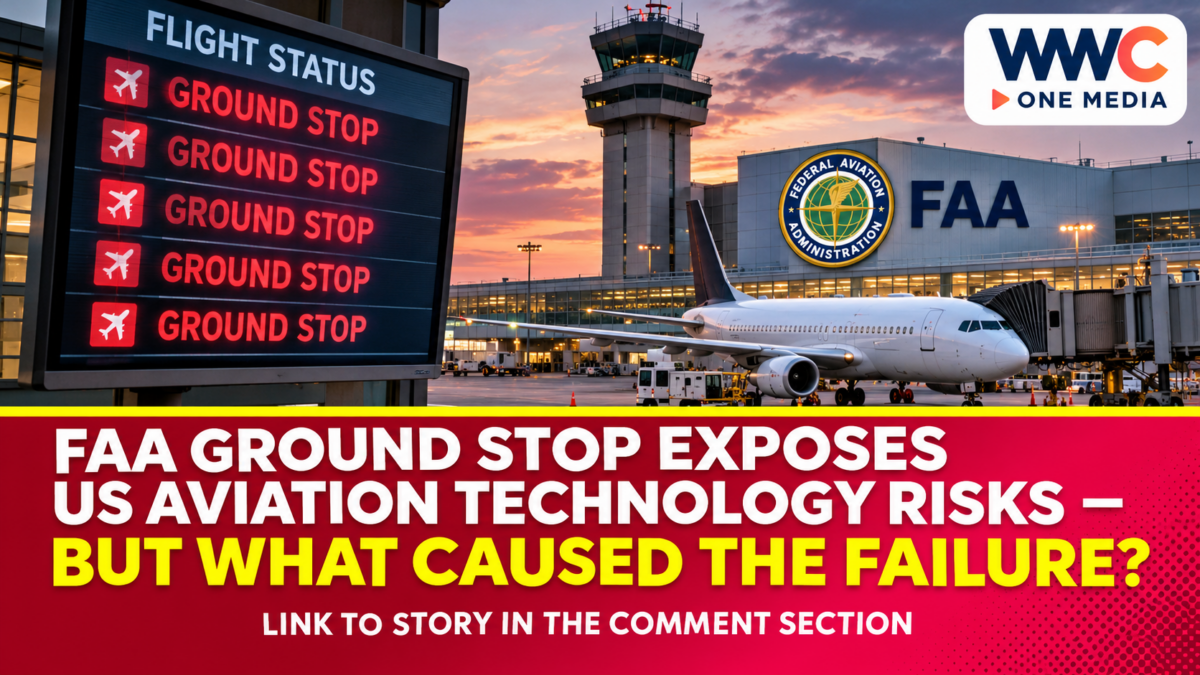
WASHINGTON, United States — Nov. 14, 2026. The Federal Aviation Administration ordered a nationwide ground stop on Friday, Nov. 13, after communications problems affected multiple US air-traffic control centres. The disruption has placed renewed scrutiny on a modernisation programme already facing documented concerns over ageing equipment, delivery schedules and technical risk.
The FAA’s public incident statement confirmed the ground stop and said technicians were investigating. It did not identify a failed software update, malicious attack or particular new technology as the cause, making a distinction between what officials have established and what remains unknown essential for passengers and policymakers.
FAA Ground Stop: What the Official Statement Confirms
In its Nov. 13 statement, the FAA said communication issues were affecting multiple Air Route Traffic Control Centers and that it had issued a nationwide ground stop for US airports. The statement described the information as preliminary and subject to change.
A ground stop restricts departures while aviation authorities manage a safety or operational problem. It does not, by itself, mean aircraft in the air have lost control or that every airport’s communications equipment has stopped functioning.
The agency’s published statement did not supply a detailed technical sequence, identify the defective component or establish how the issue spread. Consequently, claims that an update caused the failure, or that the event was deliberate, go beyond what that particular official record proves.
Why Ageing Air-Traffic Systems Matter
The concerns surrounding American aviation infrastructure predate Friday’s incident. In a report released Sept. 14, 2026, the US Government Accountability Office examined the FAA’s Brand New Air Traffic Control System programme and its accelerated timetable.
The audit recalled an earlier FAA assessment of 138 air-traffic control systems. Of those, 51 had been classed as unsustainable and 54 as potentially unsustainable — a combined 105 systems, or more than three quarters of the inventory reviewed.
The same audit explained that controllers depend on numerous systems for communications, surveillance, weather information and managing traffic. When one important service becomes unavailable, operational restrictions can provide a protective buffer while personnel assess whether normal procedures can continue safely.
What the FAA’s SMART Rollout Does — and Does Not — Prove
Three days before the disruption, the FAA published an update about its Strategic Management of Airspace, Routes and Trajectories system, known as SMART. The agency said the system was expanding to airspace served by all 22 centres after an initial rollout in the National Capital Region in September.
The FAA described SMART as a cloud-based platform bringing together 200 data streams, including weather, flight paths, traffic flow and controller staffing information. Specialists review that information and make scheduling recommendations for consideration through established air-traffic management channels.
This is a planning and decision-support function as described in the official announcement. The statement does not show that SMART replaced air-traffic voice communications, triggered Friday’s disruption or was the subject of any identified failure.
A Previous Nationwide Outage Offers an Important Lesson
A January 2023 disruption to the FAA’s Notice to Air Missions system is an instructive earlier case, although it involved a different service. In an official statement dated Jan. 19, 2023, the FAA said its preliminary review found that contract personnel had unintentionally deleted files while correcting synchronisation between primary and backup databases.
The FAA reported that it had found no evidence of a cyberattack or malicious intent in that earlier incident. It also described repairs and efforts to strengthen system resilience.
That record demonstrates why investigators should separate a service failure from an assumption of hostile interference. It does not establish what happened in November 2026, and no technical link between the two events has been shown in the reviewed records.
Different forms of digital exposure deserve equally careful labels. WWC’s earlier report on cybersecurity incidents involving EVA Air and Evergreen Aviation concerned reported intrusions at aviation businesses, rather than a verified attack on US air-traffic control.
Similarly, Singapore Airlines’ third-party booking data exposure illustrates a separate category of technology risk: information entrusted to an external service provider. Neither incident should be used as evidence that Friday’s ground stop was caused by a cyberattack.
The Modernisation Challenge Is Bigger Than One Incident
The September 2026 audit said the FAA was pursuing a two-phase modernisation programme to upgrade technologies supporting the national airspace. It identified an ambitious schedule alongside shortcomings in cost and schedule planning.
The programme’s first phase aims to upgrade communications, surveillance, weather and other capabilities, with completion targeted for December 2028. The report said Congress had provided $12.5 billion in July 2025 to support the broader effort, with most of that funding directed to the first phase.
The watchdog warned that accelerating delivery without sufficiently reliable estimates and planning could increase the possibility of missed milestones or additional costs. These are programme-wide warnings, not findings that any single modernisation project caused the Nov. 13 failure.
The broader lesson extends beyond aviation. WWC’s coverage of a Singapore healthcare provider’s data breach and its downstream effects examined how dependence on interconnected service arrangements can spread consequences across organisations. The example is an analogy about resilience, not evidence of a shared cause.
What this could mean: More sophisticated infrastructure can improve operations, but modernisation has to be paired with testing, fallback arrangements, careful change control and transparent incident reviews. Faster deployment alone cannot guarantee reliability.
What Happens Next
The immediate unanswered question is technical: which component or dependency failed, and how did the problem affect several air-traffic control centres? A meaningful public explanation would identify the incident timeline, the verified root cause, containment measures and changes intended to prevent a recurrence.
Investigators may need to review change records, network events and backup arrangements, but the public material reviewed here does not establish which specific tests are underway. Nor does it confirm an FBI inquiry into a software update.
Passengers should continue to check flight status directly with their airlines and consult the FAA’s official air-traffic information for operational updates. Any claims about responsibility, cybersecurity or a particular software product should remain provisional until an accountable agency publishes supporting findings.
Frequently Asked Questions
What caused the nationwide FAA ground stop on Nov. 13, 2026?
The FAA confirmed communications problems affecting multiple control centres. Its reviewed public statement did not establish the underlying technical cause.
Did the FBI confirm that a software update caused the outage?
No such confirmation was located in the official FBI or FAA primary records reviewed for this article. A possible cause should not be treated as a finding.
Was the FAA’s SMART system responsible?
The FAA announced SMART’s nationwide expansion on Nov. 10, but the official records reviewed do not establish a causal link to the Nov. 13 incident.
Why are FAA technology systems under scrutiny?
A September 2026 government audit described ageing systems and risks affecting the cost and timetable of an accelerated modernisation programme.
Where can passengers check their flights?
Passengers should contact their airline for booking-specific changes and consult official FAA traffic updates for broader operational conditions.