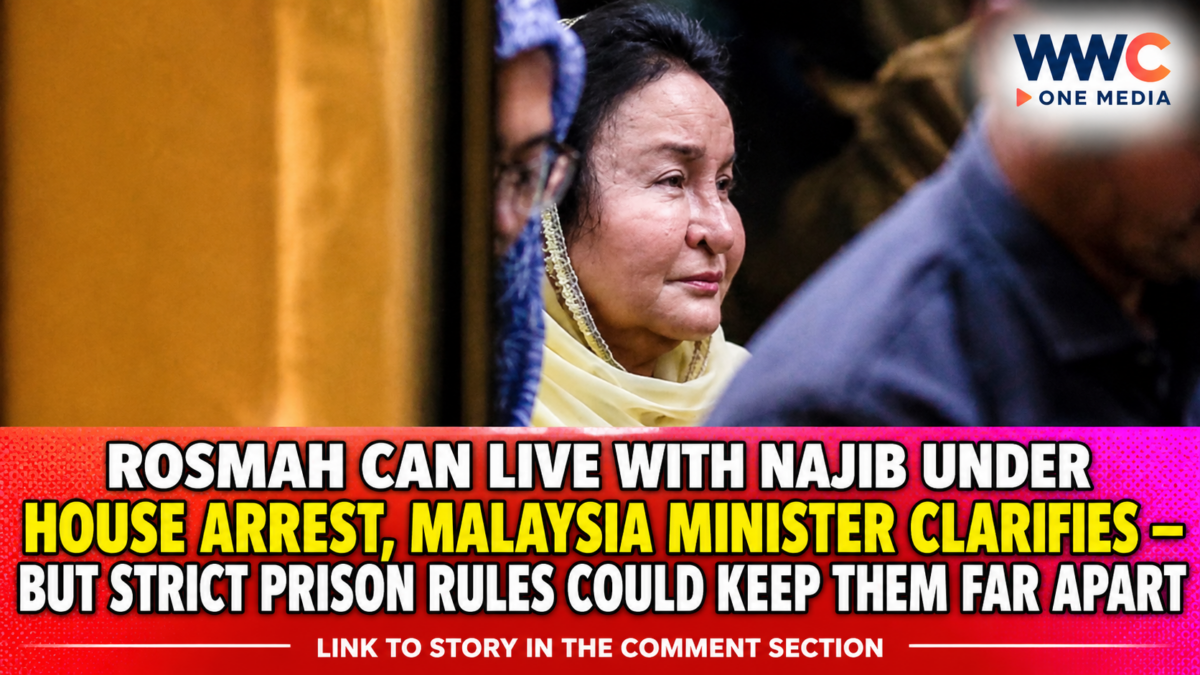
KUALA LUMPUR, November 12, 2026 — Former Malaysian prime minister Najib Razak’s wife, Rosmah Mansor, is allowed to live with him during his house arrest, Malaysia’s Home Minister has clarified, contradicting an earlier claim by an UMNO leader that she would have to remain at a separate residence.
Home Minister Datuk Seri Saifuddin Nasution Ismail provided the clarification in Parliament on Thursday, November 12, explaining that Najib’s conditional pardon permits members of his immediate family — including his wives, children, sons- and daughters-in-law, and grandchildren — to reside with him at his registered home.
The clarification came one day after UMNO Women’s executive council member Nurulhidayah Ahmad Zahid said Rosmah and Najib’s children would not be allowed to live with him because the Taman Duta residence had been gazetted as a prison.
But the minister’s explanation has now established a different position: Rosmah is permitted to stay with Najib, although the former prime minister remains subject to strict restrictions governing visitors, communications, movement and political activities. <Cite refs={[“turn802141search1″,”turn802141search5″,”turn397344news6”]}/>
The distinction is important. Najib may be serving his sentence at home, but he has not been released from prison supervision or granted unrestricted freedom.
And the conditions could make his new living arrangement very different from ordinary family life.
Home Minister Overrules the Confusion: Rosmah Is Allowed to Stay
The controversy began after Nurulhidayah, the daughter of Deputy Prime Minister and UMNO president Ahmad Zahid Hamidi, responded to questions on Threads about Najib’s house-arrest arrangements.
She claimed that Najib’s wife and children would not be allowed to live at the Jalan Langgak Duta residence.
According to her explanation, the property had been gazetted as a prison, meaning ordinary prison rules would apply. She also said family visits would be restricted to designated visiting hours and that prison authorities would determine the food and drinks provided to Najib.
Her comments quickly attracted attention because they appeared to contradict earlier statements by Najib’s lead lawyer, Tan Sri Muhammad Shafee Abdullah, who had indicated that the former prime minister would be allowed to stay with his family.
The issue remained unresolved publicly until Saifuddin addressed Parliament on November 12.
The Home Minister explained that the Pardons Board had specifically identified the family members permitted to reside with Najib.
That group includes:
- His wives.
- His children.
- His sons- and daughters-in-law.
- His grandchildren.
Anyone outside that group must obtain prior written approval before being allowed to reside at the property.
The minister’s statement is the authoritative clarification on the matter currently available. Nurulhidayah’s earlier explanation should therefore not be treated as the final rule governing Najib’s house arrest. <Cite refs={[“turn168470search3″,”turn397344search3″,”turn802141search5”]}/>
Najib Is Home — But He Is Still Under Prison Authority
Najib began serving the remainder of his reduced six-year SRC International sentence under house arrest at his Jalan Langgak Duta residence after the Kuala Lumpur High Court cleared the way for his transfer from Kajang Prison.
The arrangement follows a conditional royal pardon granted in September 2026, subject to payment of a RM50 million fine and compliance with the conditions attached to the order.
The payment was made on November 6, clearing the financial requirement.
The house-arrest arrangement does not mean Najib is free to leave whenever he wants or conduct his personal and political affairs without supervision.
Saifuddin told Parliament that the Pardons Board’s conditions cover four broad areas:
- Residence and association: Najib must remain at his designated residence and may live only with approved immediate family members.
- Movement and visitors: He cannot leave the registered property or receive visitors without the required written authorisation.
- Telephone and communications: He may use only communication devices registered with the Prisons Department for the purposes permitted by the authorities.
- Rehabilitation and intervention: He must participate in the required rehabilitation and intervention programmes.
The Prisons Department is also authorised to impose additional conditions concerning supervision, control and procedures.
These requirements mean that Najib remains under the authority of prison officials despite serving his sentence outside a conventional prison facility. <Cite refs={[“turn397344search2″,”turn397344search1”]}/>
No Unrestricted Visitors, Phone Calls or Social Media
The restrictions extend well beyond who can live with Najib.
According to Saifuddin’s parliamentary explanation, visitors cannot simply arrive at the residence and request access. Prior written permission is required.
Najib is also prohibited from using personal mobile phones or other telecommunications devices that have not been registered with the Prisons Department.
The approved equipment is intended to allow prison authorities to contact him and verify that he remains at his registered address.
The former prime minister is also prohibited from:
- Making statements or comments to the media.
- Appearing in media coverage or on social media platforms.
- Attending public functions without the required permission.
- Participating in political activities.
- Moving to another residence or property without written authorisation.
The restrictions are particularly significant given Najib’s continued political influence within UMNO and the controversy surrounding his conviction.
His house arrest is not a return to public life. It is a way of serving the remaining portion of a specific prison sentence under tightly controlled conditions.
Could Najib Be Sent Back to Kajang Prison?
Yes.
Reuters reported that the Home Minister said a breach of the house-arrest conditions could result in Najib being returned immediately to Kajang Prison or another prison designated by the authorities.
This makes compliance with the conditions central to the arrangement.
A prohibited visit, unauthorised movement or improper use of communications equipment could have serious consequences if it amounts to a breach of the applicable rules.
The Prisons Department is responsible for supervision and enforcement, while the government has said that the conditions are intended to ensure that Najib remains subject to institutional controls.
The arrangement also includes a rehabilitation programme, adding another obligation beyond simply remaining inside the property.
Najib’s legal team and the authorities will therefore have to navigate a detailed set of restrictions throughout the remaining period of the SRC sentence. <Cite refs={[“turn397344search1″,”turn397344search2”]}/>
Najib Cannot Move His House-Arrest Arrangement to Another Property
Another important detail emerged during the Home Minister’s parliamentary explanation.
Najib had submitted a written request seeking permission to use a second residence as an additional location for his house arrest.
Saifuddin said the request could not be approved because the Pardons Board’s arrangement specifies the Jalan Langgak Duta property.
The former prime minister must therefore remain at the registered address unless the necessary written authorisation is granted.
This restriction matters because house arrest is not simply permission to serve a sentence at any property owned by the individual.
The location is part of the conditions governing the arrangement.
Even moving temporarily to another house or building would require the appropriate approval.
The House-Arrest Deal Applies Only to the SRC International Sentence
Najib’s legal position is more complicated than the latest family-residence controversy suggests.
His house arrest applies to the remainder of his reduced six-year sentence in the SRC International case, involving RM42 million transferred from the former 1MDB subsidiary into accounts linked to him.
Najib was originally sentenced to 12 years in prison and fined RM210 million after his conviction was upheld by the Federal Court in August 2022.
In January 2024, the Pardons Board reduced his prison term to six years and his fine to RM50 million.
The September 2026 conditional pardon subsequently allowed him to serve the remaining portion of that sentence under house arrest, subject to payment of the reduced fine and compliance with the conditions.
The sentence is scheduled to end on August 23, 2028.
However, the arrangement does not erase Najib’s separate legal troubles.
In December 2025, he received another 15-year prison sentence in a separate 1MDB-related corruption and money-laundering case. He is appealing that conviction and sentence.
That separate case is not covered by the September conditional pardon.
If the second conviction and sentence ultimately remain in force, Najib could face further imprisonment after the SRC sentence is completed.
WWC ONE MEDIA previously examined the implications of the separate sentence in Najib Razak Returns Home as Malaysia’s Home Ministry Prepares House Arrest — But His Separate 15-Year Prison Sentence Could Change Everything in 2028.
Why Najib’s House Arrest Has Become a Political Flashpoint
The house-arrest arrangement has created significant political tension within Malaysia’s governing coalition.
UMNO remains an important component of Prime Minister Anwar Ibrahim’s government, while other coalition partners have expressed strong reservations about Najib receiving permission to serve the remainder of his sentence at home.
The RM50 million fine payment also generated criticism.
UMNO’s involvement in settling the amount prompted questions about the party’s fundraising and the political consequences of supporting its former president.
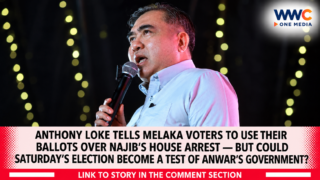
The controversy has also affected Transport Minister Anthony Loke, who announced plans to resign in protest against the decision allowing Najib to serve his sentence under house arrest.
WWC ONE MEDIA previously reported on the political implications in Anthony Loke to Stay as Transport Minister Until Najib Begins House Arrest.
The disagreement illustrates the difficulty of balancing coalition politics, royal clemency and public expectations surrounding corruption convictions.
For Anwar, the challenge is particularly sensitive: UMNO is part of his governing alliance, but the Najib case remains deeply controversial among voters and political opponents.
The Royal Pardon and the Legal Questions Behind It
Najib’s transfer to house arrest followed months of legal and political disputes over the implementation of the royal pardon.
The King, Sultan Ibrahim, granted the conditional pardon in September 2026.
The arrangement initially faced uncertainty over the payment requirement and the legal process needed to transfer Najib from prison to his home.
The RM50 million payment was eventually made by UMNO on November 6.
A subsequent High Court order cleared the way for Najib to serve the remainder of the SRC sentence at his residence.
The transfer became another major political issue after the Attorney-General’s Chambers sought clarification over the legal effect of an earlier court order and the relationship between Najib’s two sentences.
The palace publicly maintained that the royal clemency decision should be respected, while the AGC said judicial clarification was necessary to ensure the order was implemented lawfully.
Najib’s case has therefore become more than a dispute about where a prisoner serves his sentence. It has raised questions about the relationship between royal constitutional powers, court decisions and the executive’s responsibility for implementing prison arrangements.
WWC ONE MEDIA examined the earlier confrontation in Malaysia’s King Rebukes Attorney-General as Najib’s RM50-Million House Arrest Deal Is Blocked — But Could a Second 15-Year Sentence Keep Him Behind Bars?.
Najib’s Family Had Previously Been Waiting for Clear Rules
The uncertainty over whether Rosmah could live with Najib was not the first question raised about the practical implementation of the house-arrest arrangement.
In September, Najib’s daughter Nooryana Najwa said the family was still waiting for formal guidance on how the arrangement would operate.
Questions included security, monitoring, visitation and the procedures that would apply at the Taman Duta property.
WWC ONE MEDIA reported on the family’s concerns in Najib’s Family Still Waiting for House Arrest Rules as Authorities Have Yet to Finalise Process.
The Home Minister’s November 12 statement has now clarified one of the most widely discussed issues: immediate family members, including Rosmah, are allowed to reside with Najib.
But many restrictions remain, and the Prisons Department retains responsibility for supervising his compliance.
What Happens Next?
The immediate issue is no longer whether Rosmah is eligible to live with Najib. The Home Minister has clarified that she is included in the permitted immediate-family category.
The more important question is how the authorities will enforce the restrictions throughout the remainder of Najib’s sentence.
The Prisons Department will oversee the approved communications arrangements, movement restrictions, visitor permissions and rehabilitation requirements.
Any request to leave the registered residence, receive an unauthorised visitor or use an unapproved communication device will have to follow the applicable procedures.
The separate 15-year sentence also remains an important part of Najib’s legal future, with his appeal still to be resolved.
For now, the former prime minister can live at home with his immediate family while serving the remainder of his SRC International sentence — but he remains subject to prison supervision.
The biggest revelation is that Rosmah is not barred from living with Najib after all. But with restrictions on visitors, phones, public appearances and political activity, will this house arrest feel like family life — or simply a prison sentence behind the walls of a private residence?