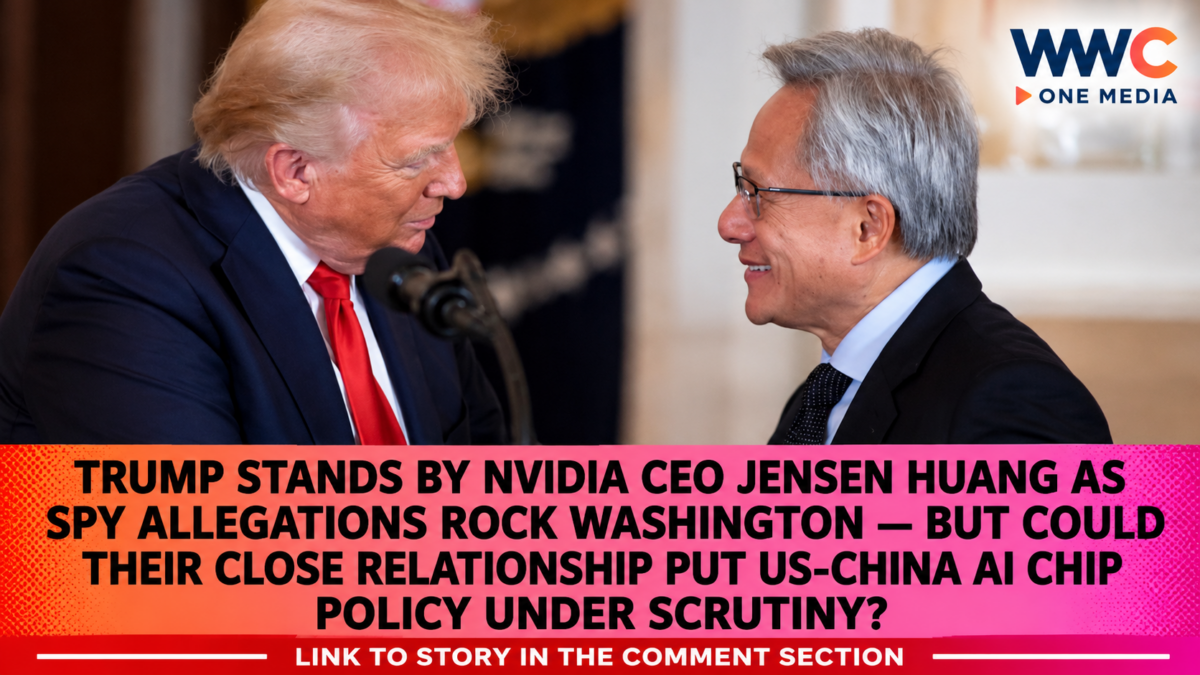
WASHINGTON — US President Donald Trump’s close relationship with Nvidia chief executive Jensen Huang is facing renewed scrutiny as an investigation into alleged Chinese intelligence activity raises difficult questions about national security, corporate governance and Washington’s policy on advanced artificial intelligence chips.
The controversy has placed two powerful figures at the centre of an increasingly sensitive debate: Trump, whose administration controls access to some of the world’s most advanced semiconductor technology, and Huang, whose company supplies the processors powering much of the global artificial intelligence industry.
Trump has publicly defended the Nvidia chief, saying Huang told him he had no knowledge that a Chinese businesswoman linked to him was allegedly working for Beijing.
But the controversy is no longer limited to Huang’s private life.
The FBI is investigating the matter, Nvidia’s board has launched an independent review, and US lawmakers are demanding answers about whether intelligence warnings and semiconductor export restrictions were handled appropriately.
The bigger question now is whether the relationship between the president and one of America’s most influential technology executives could complicate Washington’s efforts to protect its technological advantage over China.
TRUMP AND HUANG: A RELATIONSHIP BUILT AROUND AI, BUSINESS AND CHINA
Huang has become one of the most influential technology executives in Washington since Trump returned to the White House in January 2025.
According to Reuters, the two men have met repeatedly since the beginning of Trump’s second administration, with their relationship becoming increasingly visible as Nvidia pushed for greater access to the Chinese market.
Their interactions have included White House meetings, international trips and public appearances.
In September 2025, Huang joined Trump during a state visit to Britain. He also attended a US-Saudi investment forum in Washington in November that year.
The relationship became particularly significant in May 2026, when Trump invited Huang to join his delegation travelling to China to meet President Xi Jinping.
The Nvidia chief was spotted boarding Air Force One during a refuelling stop in Alaska before the delegation continued to Beijing.
The invitation highlighted Huang’s growing importance to the administration’s technology and economic agenda.
In March 2026, Trump also appointed Huang to the President’s Council of Advisors on Science and Technology, a 13-member body expected to provide advice on artificial intelligence and other technology issues.
In October, Trump presented Huang with the National Medal of Science, the United States’ highest honour for scientists and engineers.
The same day, Trump disclosed that he had purchased up to US$1.6 million and sold up to US$1 million in Nvidia shares during the summer.
The White House said the president’s investment portfolio was independently managed by third-party financial institutions. The disclosure does not, by itself, establish that Trump personally directed Nvidia-related investment decisions or acted improperly.
The company’s relationship with the administration has nevertheless attracted attention because Nvidia’s commercial interests are closely connected to one of Washington’s most sensitive foreign-policy decisions: how much advanced AI technology should be allowed into China.
Reuters has documented the history of the relationship and the policy discussions surrounding it. WWC ONE MEDIA previously examined Huang’s growing influence in Washington in its report, Jensen Huang Becomes Trump’s Biggest AI Ally as Washington Battles Over Safety — And Nvidia Has Billions Riding on What Comes Next.
THE ALLEGATIONS INVOLVING ALICE HUANG
The relationship between Trump and Huang has become more politically sensitive following reports involving Alice Huang, a Chinese businesswoman formerly associated with Singapore-based technology company Megaspeed.
Despite sharing the same surname, she is not related to Nvidia CEO Jensen Huang.
Reports by The New York Times and other outlets described an alleged relationship between the Nvidia executive and the businesswoman, whom US intelligence officials reportedly suspected of passing information to the Chinese government.
Nvidia’s board subsequently announced an independent investigation into whether Huang had been targeted by a foreign intelligence operation.
The allegations have not established that Huang knowingly participated in espionage, assisted Chinese intelligence or deliberately compromised Nvidia’s information.
The distinction is crucial.
Being the alleged target of an intelligence operation is not the same as knowingly cooperating with one. Nor does an alleged personal relationship automatically establish that confidential corporate or government information was transferred.
According to The Associated Press, Nvidia’s board said it had no reason to believe that company secrets or US national-security information had been compromised.
Huang has acknowledged an extramarital affair and apologised to his family and colleagues, according to AP reporting. The company has said he intends to cooperate with the investigation.
China’s Foreign Ministry has rejected the espionage allegations, describing the claims as unsubstantiated.
The investigation must therefore establish what happened, what information may have been accessible and whether any security rules were breached.
TRUMP SAYS HE BELIEVES HUANG — BUT QUESTIONS ABOUT THE WHITE HOUSE REMAIN
Trump’s public response has evolved as the story developed.
On November 8, the president described Huang as an honourable person and said he hoped the allegations would be resolved.
The following day, Trump said he had spoken directly with the Nvidia CEO.
According to Reuters, Huang told the president that he had no idea the woman was allegedly a spy.
Trump said he believed him and expressed confidence that Huang would be in good shape after the FBI investigation.
The president’s support matters because Nvidia is not an ordinary technology supplier. Its advanced processors are central to the US artificial intelligence industry and have become strategically important in the competition with China.
However, the president’s personal confidence in Huang cannot replace an independent investigation or determine whether export-control procedures were followed.
Another question concerns when the administration first received intelligence about the alleged operation.
CNN reported that Secretary of State Marco Rubio briefed Trump about intelligence concerning Huang’s relationship with the businesswoman during their May 2026 trip to China.
Trump later publicly said he did not know about the allegations at the time.
That discrepancy has intensified scrutiny of how intelligence information was communicated within the administration.
The White House has faced questions about what officials knew, when they knew it and whether any action was taken to protect sensitive technology.
NVIDIA’S CHINA CHIP STRATEGY IS NOW UNDER EVEN GREATER SCRUTINY
The scandal is unfolding against a much larger dispute over American semiconductor exports.
Nvidia has repeatedly argued that allowing US companies to sell certain AI processors to Chinese customers can help preserve American technological leadership.
Huang has warned that overly restrictive export policies could encourage Chinese companies to rely more heavily on domestic alternatives, potentially strengthening competitors such as Huawei.
The Trump administration has adopted a more flexible approach toward some Nvidia exports.
In January 2026, Washington began allowing certain exports of Nvidia’s H200 processors to China on a case-by-case basis. The approval did not remove restrictions affecting organisations on US trade-restriction lists.
The H200 is a powerful AI processor, but it is not the most advanced product in Nvidia’s overall lineup.
The policy has generated criticism from lawmakers who argue that allowing powerful American processors into China could undermine national security and weaken Washington’s technological advantage.
The allegations involving Alice Huang have added another layer to that debate.
Reuters reported on November 12 that Democratic senators Elizabeth Warren and Chris Coons had asked the administration to preserve documents related to Nvidia chip exports to China.
The senators also requested a congressional briefing on national-security risks connected to the suspected intelligence operation.
Their concerns include whether export restrictions were adequately enforced and whether officials took appropriate counterintelligence measures.
Separately, Reuters reported that allegations had emerged involving at least US$7.5 billion in Nvidia chip shipments to China. That figure is part of the reporting and allegations now receiving scrutiny; it should not be interpreted as proof that Nvidia knowingly supplied restricted chips illegally.
The broader issue is whether existing controls can prevent advanced processors from reaching unauthorised customers through complicated international supply chains.
WWC ONE MEDIA has also examined the controversy surrounding access to Nvidia processors in its report, US-Blacklisted Chinese University Buys Nvidia’s Powerful H200 AI Chips — But How Did Restricted Technology Reach a Military-Linked Institution?.
The reported procurement raises questions about enforcement, but it does not establish that Huang or Nvidia authorised those particular purchases.
NVIDIA’S BOARD FACES A DIFFICULT DECISION
The investigation has also raised questions about Huang’s future at the company he co-founded.
Huang has led Nvidia for more than three decades and is closely associated with its transformation from a graphics-chip manufacturer into a central supplier for the global AI industry.
The company’s identity, public profile and strategic direction are strongly connected to his leadership.
The Associated Press reported that Nvidia’s board had expressed confidence in Huang while acknowledging the seriousness of the allegations.
Reuters separately reported, citing a person familiar with the matter, that the board was due to meet late on Wednesday, November 11, to consider Huang’s future.
As of November 12, the reports did not establish a publicly confirmed final decision to remove him.
The leadership question is particularly important because Nvidia’s succession arrangements are not widely understood.
AP identified co-founder Chris Malachowsky and chief financial officer Colette Kress among potential figures who could be considered in a future leadership discussion. Neither has been announced as Huang’s replacement.
The company could face a difficult balancing act: protecting its governance standards while avoiding unnecessary disruption to a business that has become central to the global technology sector.
WWC ONE MEDIA explored the potential corporate consequences in Nvidia’s $4 Trillion Empire Faces a Jensen Huang Crisis as Shares Plunge and US Intelligence Investigates — But Could One CEO Shake the Entire AI Boom?.
THE FINANCIAL AND POLITICAL CONSEQUENCES ARE GROWING
Investors have already reacted to the controversy.
The Associated Press reported that Nvidia shares fell more than 4 per cent on November 9 as the allegations became public, with the stock continuing to decline the following morning.
The market reaction reflects more than concern about Huang’s personal conduct.
Nvidia is one of the world’s most valuable companies, and its processors are essential to many of the largest investments in artificial intelligence infrastructure.
Any prolonged leadership uncertainty, regulatory investigation or disruption to its international business could affect investor confidence.
A shareholder lawsuit has also added to the pressure.
AP reported that a shareholder filed a complaint accusing Nvidia and Huang of misleading investors about the relationship and its potential implications for the company’s business and reputation.
Those allegations remain claims in litigation, not findings of wrongdoing. The case must proceed through the legal process.
The controversy also arrives as Washington and Beijing attempt to manage a fragile economic relationship.
Advanced semiconductors have become one of the most important points of friction between the two powers. Any new restrictions could affect technology companies, cloud providers, data-centre investments and the wider AI industry.
WWC ONE MEDIA has examined the diplomatic dimension in Trump–Xi Trade Truce Faces New Crisis as Nvidia Spy Allegations Rock Washington Ahead of China Summit — But Could the $60 Billion Tariff Deal Collapse?.
The allegations do not mean the US-China trade arrangement has collapsed. They do, however, add another sensitive issue to an already complicated relationship.
WHAT HAPPENS NEXT FOR TRUMP, HUANG AND NVIDIA?
Several investigations and political decisions now stand between the current controversy and a clear resolution.
The FBI investigation must establish whether the alleged intelligence operation involved any unlawful activity and whether sensitive information was compromised.
Nvidia’s board must assess whether Huang’s conduct created corporate risks or exposed weaknesses in internal safeguards.
Congressional scrutiny could lead to demands for additional records, briefings and stronger oversight of advanced semiconductor exports.
The Trump administration must also confront a difficult policy question: how can the United States maintain its lead in artificial intelligence while preventing sensitive technology from reaching organisations considered security threats?
For Huang, the immediate challenge is to cooperate with the investigation and preserve confidence in his leadership.
For Trump, the controversy tests the boundaries between his close relationships with technology executives and the administration’s responsibility to enforce national-security policy.
And for Nvidia, the stakes extend far beyond one executive.
The company sits at the centre of the global AI economy, where commercial interests, national security and geopolitical competition increasingly overlap.
There is still no public finding that Huang knowingly assisted Chinese intelligence or that Nvidia’s secrets were compromised.
But the investigation has already raised a question Washington cannot easily avoid:
If America’s most powerful AI companies depend on close relationships with the White House to shape technology policy, who ensures that national security — rather than corporate influence — remains in control?