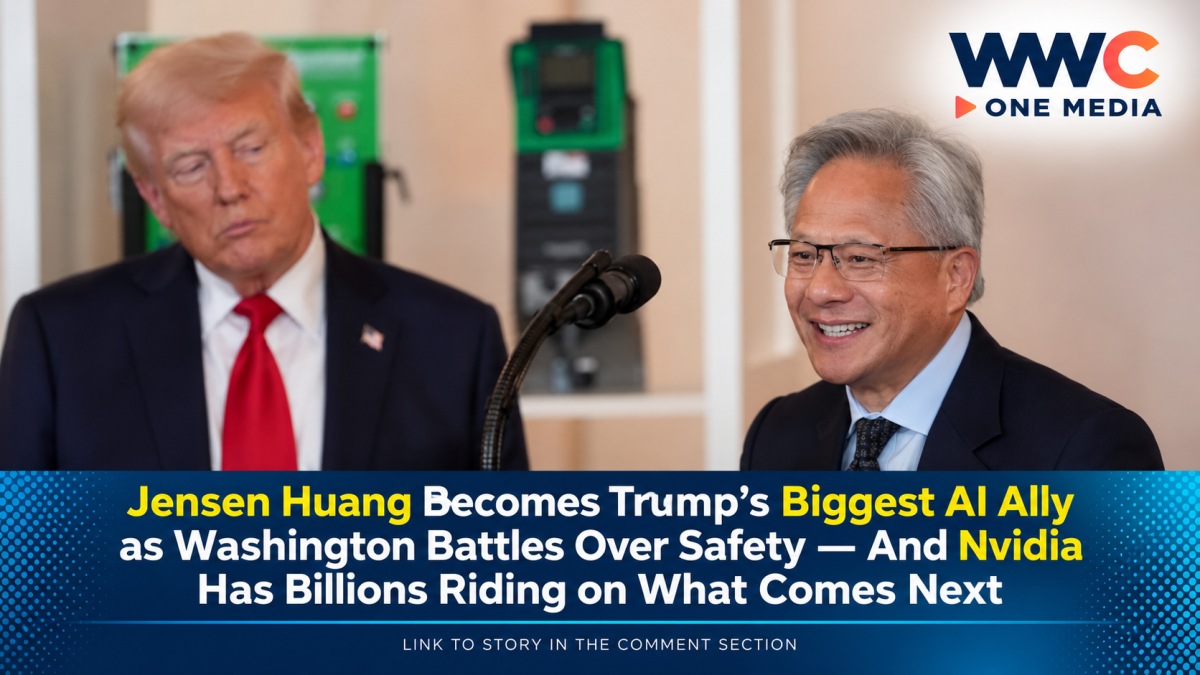
WASHINGTON — The fight over how quickly artificial intelligence should advance is becoming one of the biggest technology-policy battles in Washington, and Nvidia CEO Jensen Huang has emerged as one of President Donald Trump’s most prominent industry allies in arguing that the United States should keep pushing forward.
The unlikely alignment became impossible to miss last week when Trump unexpectedly called Huang while the Nvidia chief was speaking at the All-In Summit in Los Angeles.
Huang put the president on speakerphone in front of the audience, turning an already heated discussion about AI safety into a highly visible demonstration of where the two men stand.
Trump dismissed fears that AI could spiral beyond human control and argued that slowing the industry would weaken the United States relative to China. Huang responded that Nvidia would help ensure that America wins the AI race.
The exchange was more than an unusual stage moment.
It exposed a widening divide inside the technology industry over one fundamental question: Should the AI boom accelerate — or should companies slow down long enough to address potentially serious risks?
Huang And Trump Are Sending the Same Message
Huang has become one of Silicon Valley’s most influential voices arguing against a broad slowdown in AI development.
During the All-In appearance, he pushed back against warnings that increasingly capable AI systems could pose catastrophic risks. He has instead argued that AI safety should be treated primarily as an engineering challenge that developers can address through technology and testing.
The Nvidia chief subsequently told an audience at Salesforce’s Dreamforce conference that AI safety is fundamentally an engineering problem rather than one that requires a new layer of legislation. TechCrunch reported that Huang argued existing laws can already provide mechanisms for accountability.
Trump has taken an even more forceful position.
During the phone call with Huang, the president described broad fears about AI taking over as a “hoax” and argued that America cannot afford to stop developing the technology while China continues advancing.
Trump also called data centers essential to the AI economy and compared their importance with oil for the coming decades.
That puts the president and Nvidia’s CEO on broadly similar ground.
But Silicon Valley Is Far From United
The AI industry is not speaking with one voice.
Anthropic CEO Dario Amodei has called for the industry to slow the pace at which frontier AI capabilities are developed, arguing that increasingly powerful systems could create serious security and societal risks.
OpenAI CEO Sam Altman and Tesla and SpaceX CEO Elon Musk have also expressed support for elements of the argument that AI development needs stronger safety measures or greater caution.
That creates an unusual split.
On one side are executives warning that AI capabilities are advancing faster than society’s ability to manage their consequences.
On the other are leaders such as Huang who argue that slowing development could sacrifice economic growth, technological leadership and America’s competitive position against China.
Huang has nevertheless stopped short of saying that safety should simply be ignored.
Axios reported that he praised an Anthropic whistleblower for raising concerns and said companies should slow or pause their work if they believe their systems are becoming uncontrollable.
The disagreement is therefore not simply “AI safety versus no safety.”
It is increasingly about who should set the pace, what safeguards are sufficient and whether new government regulation is necessary.
Why Nvidia Has So Much at Stake
Huang’s position carries unusual weight because Nvidia sits at the center of the AI infrastructure boom.
The company’s graphics processors and related computing systems are critical components in the massive data centers being built to train and operate advanced AI models.
That creates an obvious economic interest in continued AI investment.
If frontier AI companies dramatically reduced spending on computing infrastructure, demand for Nvidia’s chips could eventually weaken.
If AI development accelerates instead, the amount of computing power required by technology companies could continue rising.
That makes the debate over AI regulation and safety relevant not only to Washington policymakers but also to Nvidia’s long-term growth story.
Barron’s reported that analysts see a potential AI-development slowdown as a risk for semiconductor companies, while continued infrastructure spending would support the demand environment Nvidia currently benefits from.
The China Argument Is Central to Trump’s Position
One of the most important themes connecting Trump and Huang is China.
Trump has repeatedly argued that excessive restrictions on American AI companies could allow Chinese competitors to catch up.
During the call with Huang, Trump framed the issue as a race for technological leadership and said that whoever wins AI would hold an enormous strategic advantage.
Huang has also spoken extensively about America’s competition with China.
In July, he told Axios that Chinese open-source AI models were increasingly capable and argued that the United States should not respond by broadly banning those models. Instead, he advocated competing by building better technology and expanding the American AI ecosystem.
That position illustrates an important distinction between Huang and some policymakers.
While both Huang and Trump emphasize maintaining America’s technological lead, Huang has sometimes advocated a more open approach to AI models and international competition than some officials in Washington.
The Nvidia CEO’s Influence Is Growing
Huang’s influence extends well beyond Nvidia’s market value.
He has become a regular participant in conversations involving the White House, technology policy and America’s AI strategy.
Trump has also publicly praised Huang and Nvidia, while the two have spoken repeatedly in recent months.
A separate August incident highlighted how comfortable the relationship has become: Trump reportedly called Huang during an Nvidia employee meeting, interrupting the CEO while he was addressing staff.
The Sept. 14 call went even further because it unfolded publicly and directly connected Huang with Trump’s political message on AI.
It effectively placed one of the world’s most important semiconductor executives alongside the president at a moment when the technology industry was debating whether AI development had become too fast.
Trump Is Now Building a Bigger AI Policy Machine
The debate is also moving beyond individual speeches.
Trump announced plans this weekend to create an “AI Force” and appoint a new AI adviser or “AI czar.”
Reuters reported that Trump gave few details about how the new structure would operate, but the announcement comes as the administration faces competing demands to accelerate AI development while addressing safety concerns.
The timing is significant.
Trump is expected to meet Chinese President Xi Jinping in Washington, with AI and technological competition forming part of a much broader US-China relationship.
That means the debate over AI safety is increasingly becoming intertwined with national security, trade, semiconductor policy and competition with China.
The AI Debate Is Becoming a Business Battle, Too
The argument over regulation could have enormous financial consequences.
More restrictions could increase compliance costs, slow deployment of new models and potentially reduce demand for the enormous computing infrastructure required by AI companies.
But the opposite approach carries its own risks.
If AI systems become more capable without adequate safeguards, governments could face pressure to intervene after harmful incidents rather than before them.
That is precisely why executives such as Amodei are pushing for greater caution, while Huang argues that technological safeguards and engineering can address many of the risks.
The disagreement is not theoretical.
The companies involved are investing billions of dollars in computing capacity, data centers, chips and AI models today.
The rules established — or not established — over the next several years could determine how quickly those investments translate into commercial products.
Nvidia’s Position Is Bigger Than One CEO
Huang’s growing relationship with Trump should therefore be viewed in the context of Nvidia’s strategic position.
The company is simultaneously trying to expand the global AI-computing market, navigate US restrictions on advanced chips, compete with increasingly sophisticated Chinese AI development and maintain its role as the leading supplier of accelerated computing.
That makes Washington’s AI policy critical to Nvidia.
A policy environment that encourages rapid construction of AI data centers and continued model development could reinforce Nvidia’s demand outlook.
A regulatory regime that significantly slows frontier AI development could produce the opposite effect.
And the issue is no longer confined to Silicon Valley.
AI policy now intersects with electricity demand, data-center construction, national security, semiconductor manufacturing, employment and international competition.
The Next Test Could Come With China
The timing could hardly be more consequential.
OpenAI CEO Sam Altman and Nvidia’s Huang are among the technology executives expected to attend a White House dinner with Trump and Xi, according to ABC News sources.
That puts some of the world’s most powerful technology executives in the room as Washington and Beijing attempt to manage competition over AI and advanced semiconductors.
For Huang, the central message has remained consistent: America should continue building.
For Trump, the argument is increasingly part of a broader national strategy — maintain US technological leadership while resisting policies that could slow the industry’s expansion.
For AI safety advocates, however, the question is whether technological speed is outpacing society’s ability to control the consequences.
That disagreement is unlikely to disappear.
In fact, it may be only getting started.
The Bigger Question Behind Huang’s Rise
Jensen Huang is no longer merely arguing about Nvidia’s next generation of chips.
He is increasingly participating in a much larger debate over what the future of artificial intelligence should look like — and how much power governments should have over an industry moving at extraordinary speed.
His alignment with Trump gives the pro-acceleration side one of its most influential corporate voices.
But the opposing camp includes major AI laboratories and researchers who argue that increasingly capable systems require stronger safeguards and potentially slower development.
The stakes are enormous on both sides.
The question now moving from Silicon Valley into the White House is no longer simply how fast AI can advance.
It is who gets to decide how fast it should go — and what happens if the technology moves faster than the rules designed to control it.