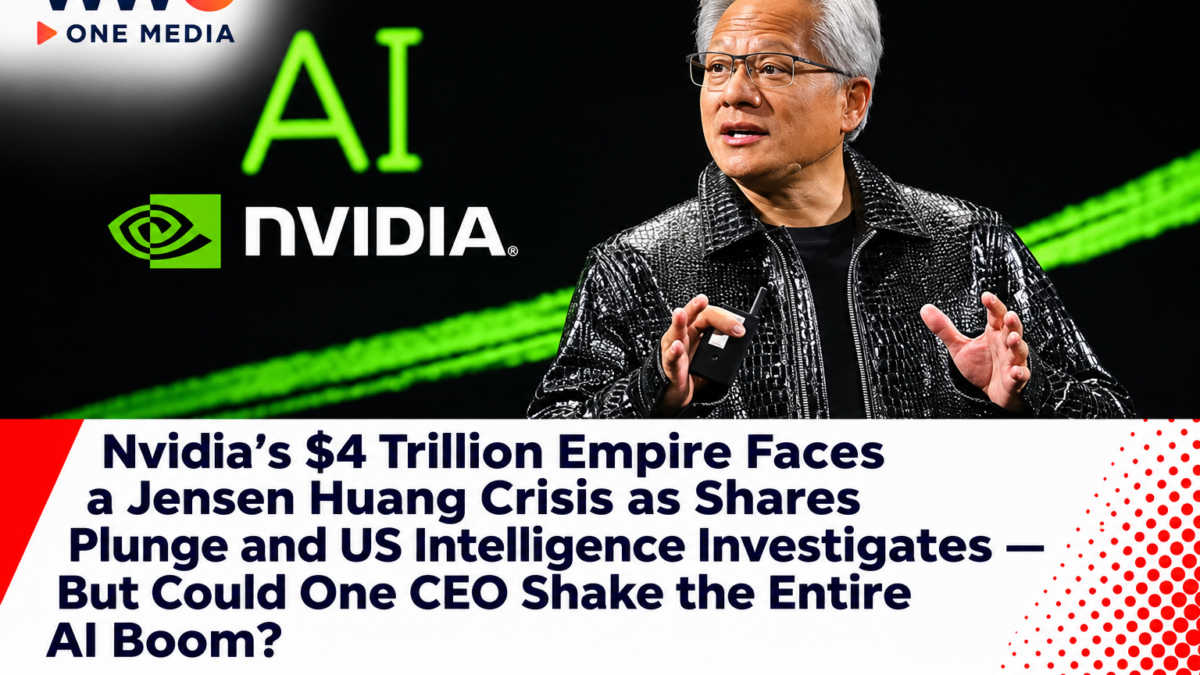
SANTA CLARA, CALIFORNIA / NEW YORK / MANILA — November 11, 2026 — One of the world’s most valuable technology companies is confronting an extraordinary leadership and national-security controversy, raising a question that extends far beyond the fate of a single chief executive: What happens to the global artificial intelligence boom if confidence in Nvidia begins to unravel?
Nvidia, the semiconductor giant whose processors power many of the world’s most advanced AI systems, has suffered a dramatic stock-market selloff following reports about CEO Jensen Huang’s personal relationship with a woman suspected by US intelligence officials of having connections to Chinese intelligence.
Huang acknowledged an extramarital affair, while Nvidia’s board launched an independent investigation into whether its longtime chief executive had been targeted by a foreign intelligence operation.
The Federal Bureau of Investigation is also examining the circumstances, according to reporting by Reuters and the Associated Press.
But the allegations remain under investigation.
Nvidia has said it has no reason to believe that company secrets or US national-security information were compromised.
China has rejected the espionage accusations.
Despite the absence of a final investigative finding, the company’s stock has suffered hundreds of billions of dollars in market-value losses during the controversy.
On November 10, Nvidia shares closed around $168.78, down approximately 5.5%, following a 4.3% decline the previous session.
Microsoft also overtook Nvidia in a closely watched market-capitalization ranking during Tuesday’s trading.
The sudden market reaction demonstrates how much investors have tied their expectations for artificial intelligence to Nvidia’s chips, technology roadmap and the leadership of Jensen Huang.
The question is no longer simply whether Nvidia can maintain its AI dominance. It is whether the company—and the financial markets built around its success—have become too dependent on one executive.
Why Nvidia Matters So Much to Global Financial Markets
Nvidia occupies an unusually influential position in the technology economy.
Its graphics processing units, or GPUs, have become central components in the computing systems used to train and operate advanced artificial intelligence.
Companies developing large AI models require substantial processing capacity.
Cloud providers invest billions of dollars in data centers equipped with specialized accelerators.
Software developers use Nvidia’s tools to build and deploy AI applications.
This demand has transformed Nvidia from a company historically associated with gaming graphics into a major supplier of advanced computing infrastructure.
Its influence extends across many industries.
Cloud computing, software development, medical research, robotics, autonomous vehicles and industrial automation all rely on increasingly sophisticated computing.
Nvidia does not control every part of these markets.
But its products and software are embedded in a substantial share of the infrastructure supporting their growth.
That explains why investors watch Nvidia’s earnings, product announcements and management statements so closely.
A significant change in the company’s outlook could affect not only its shareholders, but also expectations for chipmakers, cloud providers, data-center operators and the broader technology sector.
Nvidia’s Market Value Makes Every Stock Move Enormous
The company’s sheer size amplifies the impact of share-price fluctuations.
At the November 10 closing price, Nvidia had a market capitalization of approximately $4.1 trillion, according to market data.
Market capitalization represents the current share price multiplied by the number of shares outstanding.
It is not money held in the company’s bank accounts.
It is also not the amount of revenue Nvidia earns.
For a company of this size, even a relatively modest percentage decline can erase an enormous amount of market value.
A 5% fall in a $4 trillion company translates into approximately $200 billion in market capitalization.
That is why developments that might normally affect only one corporation can appear to move financial markets on a national economic scale.
However, a decline in market capitalization does not mean an equivalent amount of cash physically leaves the company.
It reflects a change in the market price investors assign to its outstanding shares.
For Nvidia, the scale of those changes has become particularly striking.
Jensen Huang’s Personal Controversy Becomes a Corporate Governance Crisis
The immediate trigger for the selloff involves Huang’s acknowledged extramarital relationship and reports alleging that the woman involved may have been connected to Chinese intelligence.
Reuters and the Associated Press reported that American authorities are investigating whether Huang was targeted by a foreign intelligence effort.
Separate reporting has raised allegations about links between the woman’s business network and restricted Nvidia chip shipments to China.
These allegations are serious because Nvidia supplies advanced computing technology subject to US export controls.
However, the available reporting does not establish that Huang knowingly assisted an intelligence operation or knowingly arranged unlawful chip transfers.
Reuters said it could not independently verify the allegations concerning alleged shipments.
China has dismissed the espionage accusations as groundless.
Nvidia’s board has engaged independent directors and outside legal advisers to examine the matter.
The company has expressed confidence in Huang and says it has no reason to believe sensitive information was compromised.
The investigation is therefore best understood as an unresolved corporate and national-security matter, not a proven finding of espionage.
Nvidia’s Board Faces a Major Leadership Test
The controversy has forced Nvidia’s directors to examine risks involving the company’s highest-ranking executive.
Corporate boards are responsible for overseeing senior management and protecting shareholders’ interests.
When allegations raise potential legal, security or reputational concerns, independent scrutiny can be important.
Nvidia’s board review is intended to establish relevant facts and assess whether company interests were affected.
The investigation may also require directors to evaluate the adequacy of existing governance and security safeguards.
But opening an investigation does not establish that a chief executive has violated the law or company policy.
Huang remains Nvidia’s CEO.
No confirmed board decision has removed him from office.
The outcome will depend on evidence uncovered through the ongoing reviews and any subsequent decisions by the company or relevant authorities.
For shareholders, uncertainty surrounding the investigation can itself create pressure on the stock.
Investors may demand a higher risk premium while they wait for clarity.
Why Jensen Huang Is So Difficult to Replace
Huang co-founded Nvidia in 1993 and has led the company throughout its transformation.
Under his leadership, Nvidia expanded from graphics chips for personal computers into high-performance computing and AI infrastructure.
He has become one of the industry’s most recognizable executives.
His influence extends into product strategy, engineering priorities, partnerships and relationships with major customers.
That concentration of experience creates a challenge.
Replacing a long-serving founder is more complicated than appointing a new executive at a company where responsibilities are already widely distributed.
Potential successors would need to understand Nvidia’s technology, manufacturing relationships and commercial strategy.
They would also need to maintain investor confidence during an intense period of competition.
Nvidia has senior executives with extensive industry experience, including Chief Financial Officer Colette Kress and co-founder Chris Malachowsky.
But neither has been officially announced as Huang’s successor.
Speculation about possible replacements should not be confused with a confirmed succession decision.
As WWC ONE MEDIA examined in its report on Nvidia’s leadership uncertainty and possible succession scenarios, the company’s reliance on its founder has become an important corporate-governance question.
Nvidia’s Stock Loses $190 Billion While Wall Street Rallies
The market’s unusual reaction became particularly visible on November 9.
Nvidia shares fell approximately 4.3%, closing at $178.67.
The decline erased around $190 billion in market capitalization.
Yet the broader US stock market moved sharply higher.
The S&P 500 gained approximately 2.3%, while major technology indexes also advanced.
The divergence was remarkable because Nvidia has historically been a major contributor to market gains associated with AI investment.
This time, investors were buying other stocks while selling Nvidia.
In related reporting, WWC ONE MEDIA examined Nvidia’s $190 billion decline during the broader Wall Street rally.
The episode demonstrates that company-specific risk can outweigh positive market sentiment.
However, it does not prove that the wider artificial intelligence industry has entered a permanent decline.
The November 9 rally suggested that investors were still willing to purchase other technology shares.
The question is whether Nvidia’s difficulties will remain relatively contained or begin affecting confidence in the wider AI investment cycle.
Microsoft Overtakes Nvidia in the Market-Capitalization Race
On November 10, Reuters reported that Microsoft had overtaken Nvidia to become the world’s second-most-valuable company during trading.
The change followed a sharper decline in Nvidia shares.
Microsoft’s stock also weakened, but its smaller decline changed the relative rankings.
The development illustrates how quickly market-capitalization leadership can shift.
Nvidia has benefited enormously from investment in AI computing.
Microsoft has also gained from AI through its cloud infrastructure and enterprise software businesses.
The companies are closely linked commercially.
Microsoft’s Azure cloud platform purchases and operates advanced AI infrastructure, including Nvidia technology.
But their business models differ.
Nvidia sells chips, systems and related technology.
Microsoft sells cloud services, software and other products to businesses and consumers.
A change in their market-capitalization ranking does not establish which company has the stronger long-term business.
It reflects the relative valuations investors assigned at a particular moment.
Nvidia’s Actual Financial Performance Remains Extraordinary
The controversy is occurring against a backdrop of rapid revenue growth.
In its most recent completed earnings report, Nvidia announced $96.2 billion in quarterly revenue, up 106% from a year earlier.
The results covered the second quarter of fiscal 2027, which ended July 26, 2026.
Data-center revenue reached approximately $89 billion, an increase of 117% year over year.
The company also reported nearly $59.7 billion in GAAP net income.
These figures are important because they show that Nvidia’s underlying operations have been exceptionally profitable.
The company is not in the same financial position as an AI startup generating large operating losses while attempting to establish its business model.
Nvidia has already converted strong demand for AI infrastructure into substantial recognized sales and earnings.
But historical growth does not guarantee future returns.
Share prices reflect investors’ expectations about what will happen next.
If investors become concerned about leadership, regulation or future AI spending, Nvidia’s stock can decline even when its latest reported earnings remain strong.
Nvidia’s $108 Billion Revenue Forecast Faces a Major Test
The next earnings announcement will be particularly important.
Nvidia previously projected approximately $108 billion in revenue for its third quarter of fiscal 2027, subject to a variation of 2%.
That was guidance issued on August 26, not revenue already reported.
The company’s next results were scheduled for November 17.
Investors will assess whether demand for AI computing remains strong enough to support the forecast.
They will also examine gross margins, component availability, customer spending and management’s outlook.
The earnings announcement could shift attention back toward the underlying business.
But even a strong result may not immediately resolve questions arising from the investigations.
Financial performance and corporate-governance risk are different dimensions of an investment.
Nvidia must demonstrate strength in both.
Nvidia’s AI Chips Have Become Strategic Technology
The company’s influence also extends into national security.
Powerful AI accelerators can support scientific research, software development and commercial computing.
They may also have potential military or intelligence applications.
That is why Washington has imposed restrictions on exports of certain advanced semiconductors to China.
US policymakers are concerned about the possibility that restricted technology could help strengthen China’s strategic capabilities.
Nvidia, meanwhile, has argued that overly restrictive export policies can reduce American companies’ ability to compete internationally.
The company has warned that denying access to US chips could encourage Chinese customers to adopt domestic alternatives.
This creates a difficult policy debate.
The United States wants to protect sensitive technology.
But American companies also want access to large international markets.
Nvidia sits directly at the center of that tension.
Its ability to operate in China is influenced not only by market demand, but also by export licensing and national-security decisions.
The China Controversy Could Intensify Chip Export Scrutiny
Reports concerning the suspected intelligence operation have revived questions about the movement of advanced AI chips through intermediaries.
Some allegations involve a company called Megaspeed International and suspected diversion of restricted Nvidia hardware to China.
Reuters reported allegations concerning approximately 240,000 chips valued at no less than $7.5 billion.
But those figures refer to alleged transactions, not independently verified illegal shipments.
The company and individuals involved have not been proven responsible for the alleged activities merely because they appear in investigative reporting.
Congressional lawmakers have sought additional information about the situation.
Officials are also examining whether existing export-control safeguards are effective.
The broader issue is whether the United States can reliably track how advanced computing products move through international supply networks.
As WWC ONE MEDIA reported on an earlier short-seller warning about Nvidia’s China-related chip exposure, questions about indirect Chinese demand and possible intermediaries emerged before the latest controversy.
The short seller’s claims were made by an investor betting against Nvidia’s shares.
They should be understood as allegations and analysis, not established regulatory findings.
Why US-China Relations Make Nvidia Unusually Vulnerable
Nvidia operates within a global supply chain that includes important technology and manufacturing partners.
Its chips depend on advanced semiconductor manufacturing, packaging, memory and networking.
Taiwan is particularly important because of the role of Taiwan Semiconductor Manufacturing Company in producing advanced processors.
US export restrictions affect which customers can receive certain products.
China’s own technology policies influence demand for foreign chips.
Political disagreements can therefore affect Nvidia’s commercial outlook.
But the relationship is not limited to restrictions.
Chinese technology companies remain significant participants in the global AI industry.
China is investing in domestic AI processors and alternatives to American systems.
That creates long-term competitive pressure.
In related coverage, WWC ONE MEDIA examined the renewed scrutiny of Donald Trump’s relationship with Jensen Huang and its implications for US-China AI chip policy.
The central issue is that Nvidia’s commercial success has become closely connected to American technology policy.
A regulatory decision can influence expected sales.
An investigation can influence political attitudes.
And a change in US-China relations can alter the business environment.
Nvidia’s Technology Is More Than Hardware
Nvidia’s advantage is not limited to manufacturing or designing powerful GPUs.
It has spent years developing the CUDA software ecosystem, which helps programmers use its processors for complex computing tasks.
Researchers and businesses have built substantial expertise around Nvidia’s tools.
Many AI applications and frameworks are optimized for its hardware.
That creates a practical advantage.
Switching to another chip provider may involve additional development, testing and integration costs.
Nvidia also offers networking, software libraries and complete computing systems.
Customers can purchase infrastructure designed to operate as a coordinated platform.
Competitors such as AMD and specialized AI chip developers are working to challenge that position.
Large technology companies are also developing their own processors.
But Nvidia’s combination of hardware, software and industry relationships remains central to its commercial strength.
The AI Boom Is Creating Winners Across the Semiconductor Industry
The demand for Nvidia’s systems is benefiting other parts of the technology supply chain.
Advanced AI servers require memory chips, networking equipment, cooling infrastructure and power.
That demand has encouraged investment across semiconductors and data centers.
But investors are increasingly questioning how quickly the companies purchasing AI infrastructure will earn returns.
A cloud provider can spend billions of dollars on computing equipment without immediately generating proportional revenue.
If those customers eventually slow spending, suppliers could face weaker demand.
That is why Nvidia’s financial results are watched so closely.
The company is an important indicator of how much capital continues flowing into AI infrastructure.
As WWC ONE MEDIA reported on the broader AI-driven stock-market selloff across Asia, doubts about AI investment returns can quickly affect semiconductor shares well beyond the United States.
The worldwide impact reflects the international nature of the supply chain and investor positioning.
What Happens if Jensen Huang Leaves Nvidia?
A leadership change would introduce uncertainty.
Investors might worry about strategy, customer relationships and the continuity of product development.
But it would not necessarily mean Nvidia’s technology would stop functioning or its products would disappear.
The company employs thousands of engineers, managers and specialists.
Its major customers maintain long-term infrastructure plans.
Its products are supported by manufacturing partners and established software ecosystems.
A well-managed succession process could preserve much of that commercial strength.
However, uncertainty could remain if investors believed the successor lacked Huang’s technical knowledge or industry relationships.
The outcome would depend on who took over, how the transition was managed and whether the company’s strategic priorities remained credible.
At present, Huang continues serving as chief executive.
There is no confirmed decision to replace him.
Could Nvidia’s Crisis Trigger a Wider Stock-Market Selloff?
Because of its enormous valuation, Nvidia can influence major stock indexes directly.
Market-capitalization-weighted indexes assign greater weight to larger companies.
A decline in one of the largest constituents can therefore place downward pressure on the index even if many smaller stocks rise.
Nvidia also influences investor expectations for the AI sector.
If traders become more cautious about its prospects, they may reassess other companies connected to data-center investment.
But a broader selloff is not automatic.
The November 9 trading session demonstrated that the S&P 500 can rally even while Nvidia falls sharply.
That suggests the market can sometimes distinguish between a company-specific controversy and the wider economic outlook.
The greater danger would emerge if the investigation coincided with weakening earnings, reduced AI spending or broader financing stress.
Those developments could reinforce one another.
For now, a market-wide crisis remains a risk scenario rather than a confirmed consequence.
What Nvidia’s Troubles Mean for the Philippines
Nvidia’s financial influence matters to the Philippines primarily through global technology markets and investment flows.
Major US technology stocks are held by international funds.
Changes in their valuations can affect global market sentiment.
The company’s chips also support AI services used by businesses around the world, including enterprises in the Philippines.
However, Nvidia’s stock-market decline does not automatically change the price of AI services or semiconductor products purchased by Philippine companies.
Nor does it directly establish changes in local employment or investment.
Any Philippine effects would depend on developments in the global technology sector, financial markets and the country’s own economic conditions.
The larger lesson for companies considering AI investment is to evaluate the reliability, cost and benefits of the technology rather than relying on enthusiasm about a particular stock.
What Investors Should Watch Next
Several developments will determine how the situation evolves.
First, the independent board investigation. Investors will want to know whether sensitive information was compromised and whether governance changes are necessary.
Second, the federal inquiry. Authorities may clarify whether there is evidence supporting the intelligence-related allegations.
Third, Nvidia’s November 17 earnings announcement. The report will test the company’s earlier $108 billion quarterly revenue forecast.
Fourth, export-control developments. Changes in US restrictions could affect Nvidia’s ability to serve customers connected to China.
Fifth, succession planning. Shareholders will assess whether the board has a credible strategy for maintaining leadership continuity.
Sixth, AI infrastructure spending. Demand from cloud providers and model developers will remain central to Nvidia’s financial outlook.
The company could regain investor confidence if investigations reveal no material compromise and its earnings remain strong.
But extended uncertainty or adverse findings could sustain pressure on the stock.
The Bigger Picture: Nvidia Has Become a Test of the Entire AI Investment Era
The latest controversy reveals how extraordinary Nvidia’s position has become.
The company generated $96.2 billion in revenue in its most recently reported quarter.
Its data-center business alone contributed $89 billion.
Its market value remains measured in trillions of dollars despite the recent selloff.
And its products have become essential to many of the world’s most ambitious AI projects.
But Nvidia’s success has also created vulnerabilities.
Its valuation makes stock-price changes enormous in dollar terms.
Its founder remains central to investor perceptions of the company.
Its products sit at the intersection of commercial technology and national security.
And its future depends partly on whether customers continue spending unprecedented sums on AI infrastructure.
The current investigation does not establish wrongdoing by Jensen Huang or prove that Nvidia knowingly violated export restrictions.
It does, however, demonstrate the financial consequences of uncertainty surrounding a company of Nvidia’s size.
For investors, the next phase will require separating allegations from evidence and market speculation from financial performance.
Nvidia’s extraordinary rise has helped power the global artificial intelligence revolution, transforming Jensen Huang into one of the technology industry’s most influential figures. But as investigations, geopolitical questions and succession fears converge around a company worth approximately $4 trillion, can Nvidia prove that its success is bigger than its founder—or could uncertainty surrounding one CEO become a defining risk for the entire AI market?