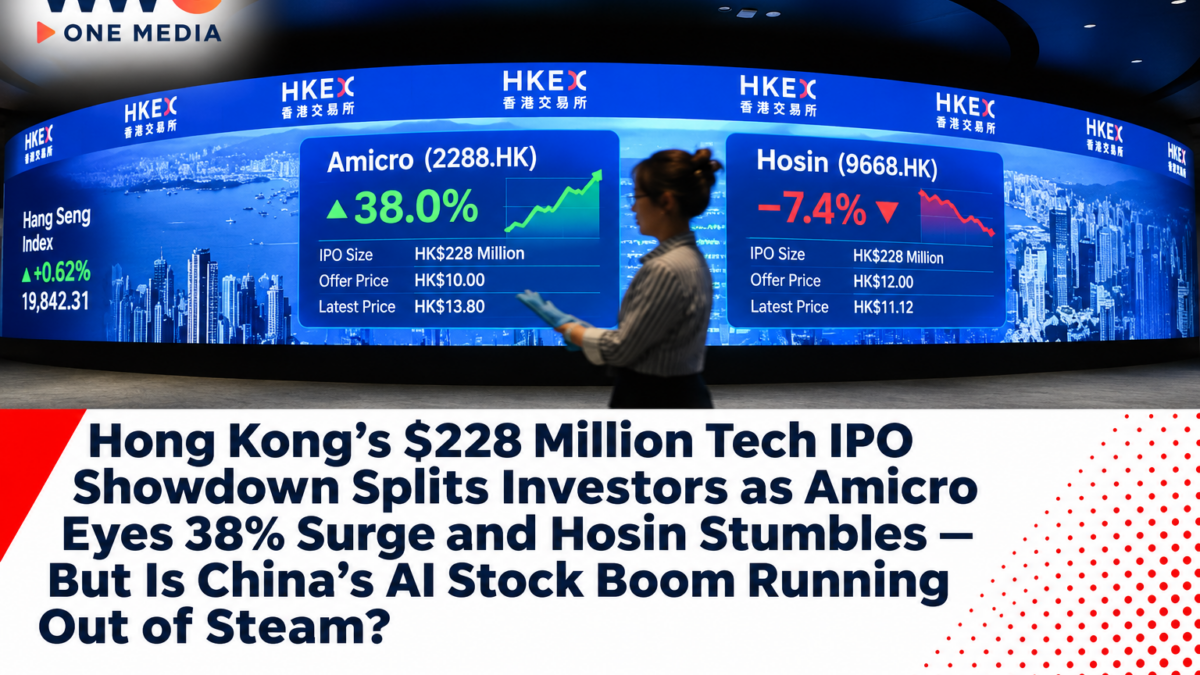
HONG KONG / MANILA, Philippines — November 12, 2026 — Hong Kong’s booming initial public offering market is facing another major test as two Chinese technology companies prepare for sharply different stock-market debuts, highlighting growing investor selectivity toward semiconductor, robotics and artificial intelligence businesses.
Hosin Electronics and Amicro Technology have raised a combined HK$1.78 billion, approximately US$228 million, through their initial public offerings on the Hong Kong Stock Exchange.
But investors appear to be treating the two companies very differently.
Reuters reported early Thursday that Hosin Electronics was indicated to open 0.04% below its IPO price after raising approximately HK$1.07 billion.
Amicro Technology, meanwhile, was indicated to open 37.6% higher following an offering that raised HK$709.7 million.
Both companies are scheduled to begin trading on November 12.
The contrasting expectations come as Hong Kong experiences a surge in fundraising, with official exchange data showing that IPO proceeds jumped 84% during the first 10 months of 2026.
Yet the latest offerings reveal a growing problem for China’s technology industry: Investors are still willing to finance ambitious chip and robotics companies, but they are becoming increasingly selective about which businesses deserve premium valuations.
The question is whether Hong Kong’s fundraising revival can withstand the pressure of falling technology stocks, weaker investor confidence and increased scrutiny of new listings.
Hosin and Amicro Bring Two Different Technology Businesses to Market
Although both companies are part of China’s expanding technology ecosystem, their businesses serve different markets.
Hosin Electronics specializes in semiconductor memory products, controller chips and related storage technology.
Its products are used in smartphones, tablets, wearable devices, computers, automobiles and other electronic systems.
Amicro Technology focuses on intelligent mobile robotics solutions.
Its technology combines software, hardware, navigation systems and specialized computing components used by manufacturers of cleaning robots, service robots and companion robots.
Amicro’s business also includes robot-oriented AI system-on-chip technology, which supports perception, navigation and other functions.
Both companies participate in sectors viewed as strategically important to China’s technological development.
But their customer bases, financial risks and growth opportunities are not identical.
That distinction helps explain why investors may be assigning different valuations to their shares.
Hosin Raises HK$1.07 Billion as Shares Face a Cautious Debut
Hosin Electronics is listing on the Hong Kong Stock Exchange under stock code 02681.
The company sold approximately 14.72 million H shares at HK$72.83 each.
That produced gross offering proceeds of approximately HK$1.07 billion before expenses and any additional shares issued through an over-allotment arrangement.
The final price was close to the bottom of the company’s initial marketing range of HK$72.29 to HK$82.90.
According to its published offering information, the Hong Kong public portion of the transaction was approximately 2.37 times subscribed.
That indicates demand exceeded the shares allocated to the public offering, but it does not demonstrate that investor interest was equally strong across the entire offering.
Before the official trading debut, grey-market quotations suggested limited enthusiasm.
On November 11, Hosin shares finished approximately 0.8% below the IPO price on one pre-listing trading platform.
Reuters subsequently reported an indicated official opening decline of just 0.04%.
The figures are from different trading arrangements and observation times.
They should not be treated as the company’s final first-day return.
Where Hosin Plans to Spend Its IPO Proceeds
Hosin intends to use the money raised to strengthen its semiconductor technology and product development.
Its indicative prospectus allocation assigns:
- 40% of net proceeds to developing and commercializing memory products.
- 35% to controller-chip research, development and improvements.
- 15% to wafer and controller-chip validation and testing.
- 10% to general working capital.
These investments reflect the importance of supporting technologies within China’s semiconductor industry.
Advanced memory systems and storage controllers are essential to modern electronics.
But demand is cyclical.
Consumer-device sales, industrial production, chip prices and competition can affect profitability.
Hosin’s ability to deliver returns will depend on whether its additional investment produces commercially successful products and sustainable earnings growth.
Amicro Raises HK$709.7 Million as Investors Bet on Robotics
Amicro Technology is listing under stock code 02065.
The company priced its offering at HK$9.90 per share and raised approximately HK$709.7 million.
Its offering comprised approximately 71.69 million H shares.
The stock’s pre-listing performance was substantially stronger than Hosin’s.
On November 11, Amicro closed at HK$13.10 on one grey-market platform, approximately 32.3% above its offering price.
Reuters reported that official pre-opening indications on November 12 pointed to a gain of approximately 37.6%.
That early enthusiasm suggests investors are particularly interested in the company’s exposure to intelligent robotics and AI-enabled hardware.
However, a strong opening indication does not guarantee that the share price will maintain those gains.
New listings can experience extreme volatility as early subscribers sell, institutional investors adjust positions and market expectations change.
Amicro Wants to Expand Its Robotics and AI Chip Technology
Amicro provides intelligent mobile robotics solutions to other businesses.
Its products are designed to support different categories of robots, including cleaning machines and service robots.
According to its IPO information, the company ranked third among intelligent mobile robotics solution providers in China by 2025 revenue, with an estimated market share of approximately 4.2%.
The ranking comes from market research referenced in its offering materials.
It is not an indication that Amicro controls 4.2% of the global robotics market.
The company also reported holding 1,363 intellectual property rights as of April 30, 2026, including 1,125 granted patents.
Amicro plans to direct substantial offering proceeds toward robot-specific AI chips, advanced perception systems and technologies associated with embodied intelligence.
Embodied AI refers to artificial intelligence systems that interact with the physical world through machines such as robots.
The technology could become increasingly important as manufacturers and service providers seek to automate more complex tasks.
However, commercialization remains difficult.
Robotics businesses must combine competitive hardware with reliable software, manufacturing scale and sustainable product pricing.
Amicro’s Revenue Is Growing — But Losses Remain a Concern
Amicro’s financial performance illustrates the tension between growth and profitability.
Its 2025 revenue reached approximately RMB406.7 million, up 42.3% from RMB285.8 million in 2024.
But the company also recorded a net loss of approximately RMB155.9 million in 2025.
That loss was larger than the RMB99.3 million reported in 2024.
The figures show that the company is expanding sales but has not yet established sustained profitability.
For prospective shareholders, that creates an important risk.
Revenue growth can reflect rising customer demand and expanding market opportunities.
But continued losses may require a business to raise more money before it can support itself through internally generated profits.
The IPO gives Amicro additional financial resources.
It does not eliminate the need to control costs or eventually demonstrate a sustainable earnings model.
Hong Kong’s IPO Fundraising Surges 84% in 2026
The two listings arrive during one of Hong Kong’s strongest fundraising periods in years.
According to Hong Kong Exchanges and Clearing, IPO fundraising totaled HK$403.9 billion during January through October 2026, up 84% from HK$219 billion in the corresponding period of 2025.
The number of newly listed companies increased to 121, compared with 81 a year earlier.
Total equity fundraising, including IPOs and other share sales, reached HK$753.8 billion, up approximately 47%.
These are separate financial measures.
IPO proceeds cover new public offerings, while total equity fundraising includes additional transactions such as placements and other share sales.
The increase reflects Hong Kong’s continued importance as a gateway for mainland Chinese companies seeking international capital.
Companies developing semiconductors, AI systems and industrial technologies have been among those seeking funds for expansion.
As WWC ONE MEDIA previously reported in its coverage of Hong Kong’s US$765-million IPO rush, Hosin was part of an earlier group of companies marketing share offerings at the end of October.
The latest listing represents the completion of that fundraising process at a final price below the top of its original range.
Chinese Technology Listings Are Producing Very Different Results
The different market expectations for Hosin and Amicro follow another split among Chinese chip-related IPOs.
On November 10, Suzhou Denglin Technology and Jiangsu Xinde Semiconductor Technology began trading in Hong Kong.
Denglin, a developer of graphics processors, opened below its offering price.
Xinde, a semiconductor packaging and testing specialist, opened substantially higher.
As WWC ONE MEDIA reported in its analysis of the two companies’ combined US$301-million fundraising, the contrasting debuts illustrated investors’ willingness to distinguish between different businesses in the same technology sector.
Hosin and Amicro present a similar test.
Investors are not valuing every Chinese technology company equally simply because it is associated with semiconductors or AI.
Business models, financial performance, pricing and growth expectations matter.
That selectivity may become increasingly important as more companies seek listings.
Hong Kong’s IPO Boom Has a Warning Sign: Failed Deals
The strong fundraising totals conceal difficulties elsewhere in the market.
Bloomberg reported earlier in November that approximately one in four Hong Kong IPO transactions had failed to reach completion during 2026, the highest withdrawal or abandonment rate since the 2008 global financial crisis.
The statistic reflects deals that did not complete, not the proportion of companies that suffered share-price declines after listing.
As WWC ONE MEDIA examined in its report on Hong Kong’s IPO withdrawal crisis, the contrast between record fundraising and abandoned transactions highlights a more selective investment environment.
Some companies have been able to raise substantial capital.
Others have struggled to attract demand at acceptable valuations.
The result is a market experiencing both strong activity and significant investor caution.
Regulators Are Watching Complex IPO Investor Arrangements
Hong Kong’s authorities are also paying closer attention to the structure of new offerings.
Bloomberg reported on November 2 that regulators were scrutinizing IPO arrangements involving closely connected investors and complicated cross-investments.
Hosin’s offering attracted attention because some cornerstone investors were reportedly linked to the company’s business relationships or senior executives.
Cornerstone investors typically agree to subscribe for shares before a listing and hold those shares for a specified lock-up period.
Their participation can give an offering greater certainty.
But investors need clear disclosure of relationships that could affect their assessment of demand and independence.
Such arrangements are not automatically improper.
The central concern is whether investors receive sufficient information to understand the structure of the transaction and potential conflicts of interest.
For newly listed companies, transparent disclosures are essential to maintaining confidence.
China’s Semiconductor Ambitions Continue Driving Fundraising
The IPO wave also reflects China’s broader effort to strengthen its domestic technology industry.
Chinese chip manufacturers and component suppliers have been seeking funding to expand research, production capabilities and commercial operations.
International technology restrictions have increased interest in developing domestic alternatives in strategically important fields.
Hosin’s focus on memory technology and controllers fits into that broader industrial objective.
Amicro’s robotics technology also represents an area where China is seeking to strengthen its position.
But strategic importance does not guarantee profitability.
As WWC ONE MEDIA reported in its coverage of Biren Technology’s approximately US$515-million follow-on share sale, access to equity capital can support innovation while also creating dilution and valuation risks.
Investors must assess whether additional funding will produce stronger products, lasting revenue and sustainable returns.
Could the AI Boom Be Creating an IPO Bubble?
The rapid fundraising activity is raising questions about valuations.
Companies associated with artificial intelligence can attract strong investor demand even when profitability remains uncertain.
That creates opportunities for ambitious technology businesses.
It also exposes shareholders to potentially sharp corrections when expectations become unrealistic.
Amicro’s anticipated strong opening demonstrates enthusiasm for robotics and intelligent computing.
But its reported annual losses show why investors should look beyond short-term share-price gains.
Hosin’s more cautious opening outlook illustrates how the market can discount a different technology business even when it successfully raises substantial funds.
Neither outcome alone proves that the market is in a speculative bubble.
A more reliable assessment requires examining earnings, growth rates, customer demand and valuations across multiple companies over time.
What the Listings Mean for Southeast Asia
Hong Kong’s continued ability to attract technology IPOs also matters to the wider Asia-Pacific region.
China is deeply connected to electronics production and technology supply chains across Southeast Asia.
Growth in robotics, memory products and semiconductor design can influence demand for manufacturing equipment, software and industrial components.
For the Philippines, electronics and semiconductor-related manufacturing remains an important part of export-oriented industry.
But a successful Chinese IPO does not automatically translate into new Philippine investment or jobs.
Any benefits would depend on specific commercial relationships and future business decisions.
The broader lesson for regional investors is that new technology listings should be evaluated individually.
A company’s industry may be attractive even when its particular shares are expensive or its earnings outlook uncertain.
What Happens Next for Hosin and Amicro?
The next test will be their actual trading performance on the Hong Kong Stock Exchange.
Hosin begins with cautious pre-opening expectations.
Amicro enters the market with substantially stronger indicated demand.
But those indications are not final market outcomes.
Investors will be watching opening prices, trading volumes and whether early gains or losses persist.
Over the following quarters, attention will shift toward the companies’ financial performance.
Hosin will need to demonstrate progress in memory products and controller technology.
Amicro will need to show that its revenue growth can translate into a more sustainable business model.
Both must also deliver on the research and commercial investments described in their IPO plans.
The Bottom Line: Hong Kong’s IPO Revival Faces a Major Reality Check
Hosin Electronics and Amicro Technology have raised nearly US$228 million through separate Hong Kong offerings.
The transactions reinforce the city’s role as a major source of capital for Chinese technology companies.
But their contrasting trading expectations demonstrate that investors are increasingly selective.
Hong Kong’s IPO fundraising increased 84% during the first 10 months of 2026, while abandoned deals and uncertain technology valuations continue raising concerns.
For companies seeking capital, the market remains open.
For investors, the challenge is determining which businesses can convert ambitious growth plans into sustainable financial performance.
Hosin and Amicro’s debuts may help reveal whether Hong Kong’s technology IPO revival is gaining strength—or whether investors are becoming more cautious about the price of China’s next generation of semiconductor and robotics companies.
As Amicro attracts strong early demand and Hosin faces a quieter opening, could the two listings mark the start of a sustainable new technology investment wave—or is Hong Kong’s IPO boom heading toward a much tougher test?