Six Countries Back Global Rooftop Solar Push to Reach 300 Million Homes by 2030 — But Can the World Afford the Energy Revolution?
By WWC One Media Environment and Energy Desk
November 11, 2026
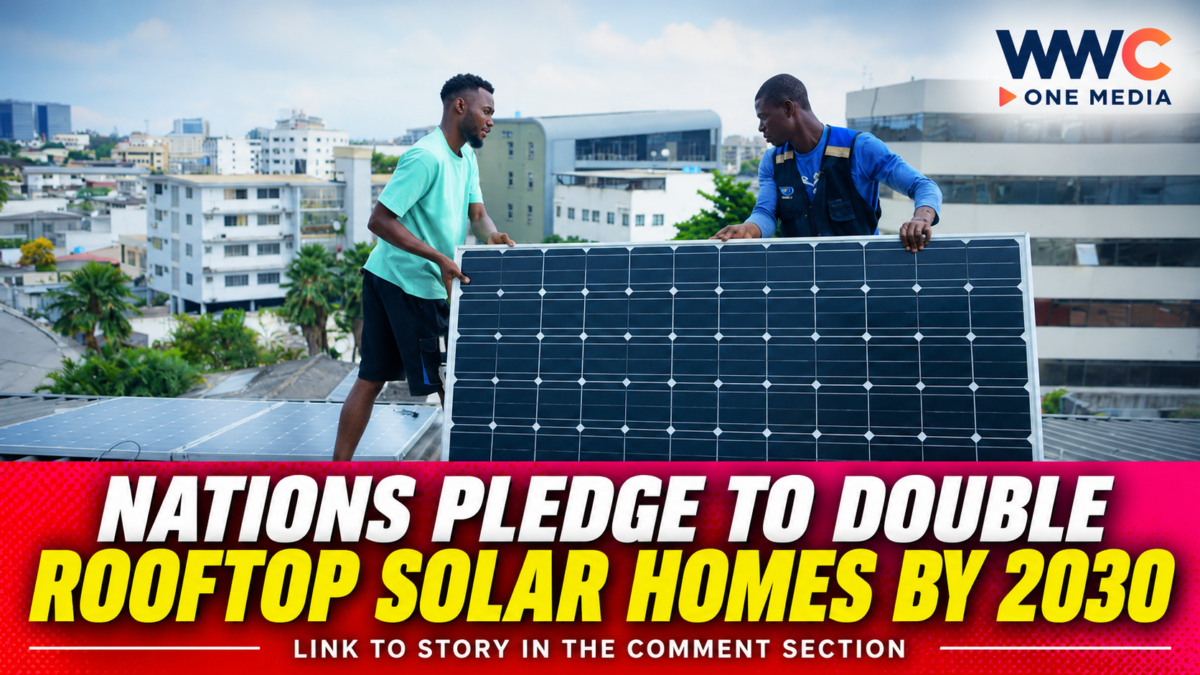
ANTALYA, Türkiye — A major international push to expand rooftop solar is gaining momentum at the COP31 climate summit, with six national governments supporting an initiative that aims to bring solar power to at least 300 million homes worldwide by 2030.
The Global Rooftop Solar Declaration, launched during the United Nations climate negotiations in Antalya, seeks to double the estimated 150 million homes that currently have rooftop solar systems.
Australia was the initiative’s initial government supporter. Bangladesh, Kenya, Nigeria, Palau and Vanuatu subsequently endorsed the declaration, bringing the total to six national governments.
Lawmakers from 21 other countries and Indonesia’s state-owned electricity company, Perusahaan Listrik Negara (PLN), have also backed the initiative.
The announcement puts household solar at the center of a wider debate about energy affordability, electricity access and the transition away from fossil fuels.
For millions of households, rooftop panels could provide an opportunity to generate electricity closer to where it is consumed, potentially reducing dependence on conventional power supplies and helping protect consumers from volatile energy prices.
But the ambition comes with a difficult challenge.
Solar panels alone cannot deliver a reliable energy transition. Governments must also address installation costs, financing, electricity-grid capacity, battery storage and the shortage of qualified workers.
And because the declaration is voluntary and non-binding, its success will depend on whether governments turn the announcement into practical policies and actual installations.
Six Countries Support the Global Rooftop Solar Declaration
The initiative was introduced at COP31 on November 10, 2026, as countries gathered in Antalya to discuss climate action, renewable energy and the future of global electricity systems.
The six government supporters are:
- Australia
- Bangladesh
- Kenya
- Nigeria
- Palau
- Vanuatu
The Global Solar Council, which announced the endorsements, also reported support from 34 individual members of parliament representing 21 countries.
Indonesia’s state-owned electricity company PLN endorsed the declaration as well.
The initiative is intended to encourage governments to make rooftop solar easier to adopt by improving access to financing, simplifying approval procedures, developing skilled installation workforces and strengthening electricity infrastructure.
The target is ambitious: increase the number of solar-powered homes from approximately 150 million to at least 300 million by 2030.
That means enabling roughly 150 million additional homes to gain access to rooftop solar within the next four years.
However, the declaration does not assign every country a legally enforceable installation quota.
It is a voluntary framework designed to encourage national and local governments to accelerate residential solar adoption.
Why Rooftop Solar Is Becoming a Global Priority
The growing interest in rooftop solar reflects a broader change in how households and governments view electricity.
Traditional electricity systems depend heavily on large power stations, transmission networks and distribution infrastructure.
Rooftop solar offers another approach.
Instead of generating all electricity at centralized facilities, homes and buildings can produce some of their own power using panels installed on their roofs.
This can provide several potential benefits.
Lower electricity purchases: Households can use solar-generated electricity during daylight hours, potentially reducing the amount they need to purchase from the grid.
Greater energy independence: Solar systems can help consumers reduce exposure to changes in conventional electricity prices.
Improved electricity access: Distributed solar can provide electricity to communities where extending conventional power infrastructure is difficult or expensive.
Support during emergencies: Solar systems combined with battery storage can help provide electricity during outages, disasters and disruptions to centralized power supplies.
New employment opportunities: Wider deployment creates demand for installers, electricians, engineers, technicians and maintenance workers.
The Global Solar Council says rooftop solar and storage could help households gain access to more affordable and reliable electricity.
But the actual savings depend on installation costs, local electricity prices, system design, sunlight conditions, maintenance and whether batteries are included.
A rooftop system does not automatically eliminate a household’s electricity bill.
Bangladesh Reveals How Much Financing the Solar Expansion Could Require
Bangladesh offers one example of the scale of investment needed to expand household solar.
During the COP31 announcement, Bangladesh’s Power Division Secretary Mirana Mahrukh said the country was targeting approximately 5,500 megawatts of rooftop solar capacity by 2030.
Its indicative implementation plan covers around 870,000 rooftops.
The financing proposal also highlights a major challenge facing developing countries.
Under the country’s proposed 20:80 financing arrangement, approximately 174,000 rooftops would be supported through domestic efforts, while around 696,000 would require international cooperation.
This means the global rooftop solar initiative is not simply about encouraging people to purchase panels.
It also requires governments to find ways to make installations financially accessible.
For lower-income households, the initial cost of panels, inverters, wiring, installation and batteries can remain a major barrier.
Affordable loans, subsidies, financing partnerships and installment arrangements could help more households participate.
Without those mechanisms, rooftop solar adoption could remain concentrated among families and businesses that already have enough money to invest.
Australia Shows What Rooftop Solar Can Achieve
Australia is positioning its own residential solar experience as an example for other countries.
Australian Climate Change and Energy Minister Chris Bowen said approximately one in three Australian homes has rooftop solar panels.
That level of adoption demonstrates how distributed electricity generation can become a significant part of a national energy system.
The Australian government wants to help other countries expand household solar by addressing the barriers that prevent widespread installation.
However, Australia’s experience also shows that rooftop solar growth requires more than favorable sunlight.
Consumers need access to financing, qualified installers, supportive regulations and electricity networks capable of handling changing power flows.
Battery storage is increasingly important because solar panels generate electricity mainly during daylight hours, while household demand often continues into the evening.
A battery can store excess daytime electricity for later use, although it adds to the initial cost of a residential system.
The challenge for countries adopting the Australian model will be making solar and storage affordable across different income levels and housing conditions.
The Biggest Obstacle: Solar Panels Need Stronger Electricity Grids
One of the most important issues facing the global solar expansion is the ability of electricity networks to accommodate more distributed generation.
Rooftop solar systems can send electricity into local distribution networks when households produce more power than they consume.
If too many systems are connected without proper planning, utilities may face difficulties managing voltage, power flows and system reliability.
The problem becomes more complicated when solar generation changes rapidly because of clouds, weather conditions or the time of day.
Battery storage, modern grid-management systems and better coordination between utilities and consumers can help address these challenges.
The International Energy Agency has repeatedly emphasized the importance of electricity-grid investment as renewable generation expands.
A global rooftop solar target therefore requires more than installing panels on additional houses.
Countries must also invest in distribution infrastructure, grid monitoring, flexible electricity resources and storage technologies.
Without those improvements, renewable electricity may not always be delivered or used efficiently.
Why Batteries Could Determine Whether the 300 Million Solar Homes Target Succeeds
Solar panels generate the most electricity when sunlight is available.
But household electricity demand does not stop when the sun goes down.
Families continue using refrigerators, lighting, televisions, air conditioners and other appliances during the evening.
That creates a timing problem.
A household may generate more solar electricity than it needs during the day but still purchase electricity from the grid at night.
Battery storage can help bridge that gap.
A properly designed system can store surplus solar generation and release electricity when panels are no longer producing enough power.
Batteries can also provide backup electricity during certain outages, depending on the system’s configuration and capacity.
However, battery systems add significant costs and require appropriate installation, maintenance and safety measures.
For countries seeking to expand rooftop solar among lower-income households, financing storage will be just as important as financing the panels themselves.
The Global Rooftop Solar Declaration specifically encourages governments to accelerate both rooftop solar and household battery deployment.
The Philippines Could Benefit From the Global Solar Movement
The initiative also has implications for countries such as the Philippines, where households and businesses are increasingly exploring solar power as an alternative source of electricity.
The country’s geography, electricity costs and exposure to extreme weather make distributed renewable energy an important part of the wider energy discussion.
The Department of Energy has already taken steps to simplify access to certain own-use solar installations.
In August 2026, the DOE announced streamlined requirements for eligible Self-Generating Facility Zero-Export Solar Systems and Micro-Solar Systems.
The policy allows qualified households, medical facilities and small businesses to generate electricity for their own use without exporting excess power to the distribution grid.
The government said the changes were intended to reduce unnecessary requirements and make small-scale solar installations more accessible.
For additional context, WWC ONE MEDIA previously examined how rising electricity costs are encouraging more Filipinos to consider solar energy.
The global initiative could reinforce the importance of making rooftop solar easier to finance and install in developing economies.
But the Philippines must also address local issues involving distribution networks, permitting, equipment costs and access to qualified installers.
Philippine Grid Operators Warn That Rooftop Solar Needs Better Monitoring
Rapid rooftop solar adoption can create new challenges for electricity-grid operators.
The National Grid Corporation of the Philippines has called for better tracking of installed rooftop solar systems, warning that incomplete information about privately installed capacity can complicate electricity planning.
This matters because grid operators need accurate information about how much electricity is being generated and where it enters the system.
If more households install solar without adequate coordination and monitoring, utilities may have difficulty forecasting demand and managing changing power flows.
WWC ONE MEDIA previously reported on NGCP’s concerns:
NGCP Wants Rooftop Solar Tracked as Unrecorded Systems Raise Grid Stability Concerns
The issue illustrates why the global solar expansion must be accompanied by stronger electricity infrastructure.
More panels can increase renewable generation, but reliable electricity still requires proper grid planning and coordination.
Philippine Households Are Also Looking Beyond Solar Panels
The next stage of residential solar development may involve combining panels with batteries and intelligent energy-management systems.
Solar panels generate electricity, while batteries help households use that energy beyond daylight hours.
Companies are increasingly promoting integrated systems that combine solar generation, inverters, storage and household energy controls.
WWC ONE MEDIA previously examined TCL’s entry into the Philippine residential energy-storage market and the growing importance of solar-plus-storage systems.
The development reflects a broader shift in the energy market.
The competition is no longer only about who can sell the cheapest solar panels.
It is increasingly about who can provide reliable systems that generate, store and manage electricity efficiently.
For households, the financial decision will depend on the total system cost, expected electricity savings, maintenance requirements and the value of backup power.
Solar Growth Does Not Automatically Mean Fossil Fuels Will Disappear
Despite the momentum behind rooftop solar, the COP31 initiative faces a wider contradiction.
Several countries promoting renewable energy still rely heavily on coal, oil and natural gas.
Turkey, the summit’s host, continues to generate a substantial share of its electricity from coal.
Australia, which is leading the formal negotiations, also remains heavily dependent on fossil fuels for electricity generation and is a major coal exporter.
The two countries’ energy policies have attracted criticism from climate advocates who argue that expanding renewable generation must be accompanied by a clearer transition away from fossil fuels.
The wider COP31 debate also includes Turkey’s proposed target of increasing electricity’s share of global energy consumption to 35% by 2035.
However, critics argue that electrification alone does not guarantee lower emissions.
If additional electricity comes from coal- or gas-fired power stations, some emissions may simply shift from vehicles, buildings and industrial equipment to power plants.
Australia’s ABC News reported that the rooftop solar initiative has received more positive attention while the separate electrification target faces debate over whether the additional electricity must come from clean sources.
The distinction is important.
The climate benefits of electrification depend heavily on how the electricity is generated.
The Real Challenge Is Turning a Voluntary Pledge Into Actual Solar Installations
The Global Rooftop Solar Declaration has created an international target, but its success will be determined by what happens after the announcement.
Governments must simplify installation procedures, develop affordable financing options and ensure that electricity networks can accommodate more distributed generation.
They must also develop the workforce needed to install and maintain millions of systems.
For developing countries, international financial support could be particularly important.
Bangladesh’s proposed financing structure demonstrates how large the funding gap can become when governments attempt to expand rooftop solar beyond wealthier households.
The same challenge could affect other countries across Africa, Asia and the Pacific.
There is also a need to ensure that low-income households, renters and people living in apartment buildings are not excluded from the transition.
Rooftop solar is easier to install for homeowners with suitable roofs and enough money to purchase equipment.
Governments will need additional solutions for households that cannot install panels independently.
These could include shared solar projects, community energy systems and financing arrangements that allow more people to benefit from renewable electricity.
The Bigger Picture: 300 Million Solar Homes Could Change How the World Gets Electricity
The COP31 rooftop solar initiative represents a major international ambition to make household renewable energy more accessible.
Its goal is straightforward: double the number of homes with rooftop solar from approximately 150 million to at least 300 million by 2030.
But reaching that target will require more than political endorsements.
It will require investment, affordable technology, stronger electricity networks, battery storage, trained workers and policies that make participation possible for ordinary households.
For the Philippines, the international push could reinforce domestic efforts to simplify rooftop solar installation and expand access to distributed renewable energy.
For other developing countries, it could create opportunities to improve electricity access without relying exclusively on large centralized power projects.
Still, the declaration remains voluntary.
The real test will be whether governments deliver measurable progress before 2030.
Six countries have backed a global plan to bring rooftop solar to 300 million homes. But unless governments can make installations affordable, strengthen electricity grids and bring batteries within reach of ordinary families, could this ambitious clean-energy promise remain another COP31 declaration that never reaches millions of rooftops?