BERLIN, GERMANY / NEW YORK / MANILA — November 11, 2026 | WWC ONE MEDIA | Global Business, Energy Technology, Artificial Intelligence and Financial Markets
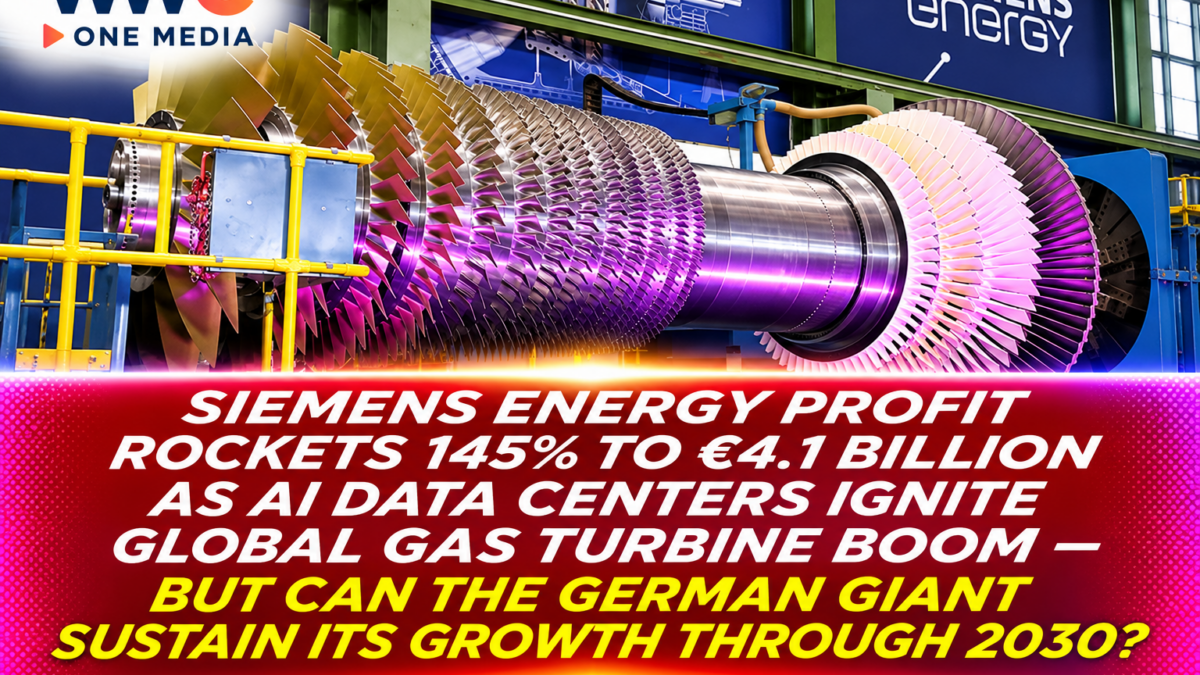
German energy technology giant Siemens Energy has reported a record €4.1 billion in annual net profit, an increase of approximately 145%, as demand for gas turbines and electricity-grid equipment accelerates around the world.
The extraordinary performance comes as artificial intelligence companies, cloud-computing providers and electricity utilities invest heavily in power infrastructure to support the next generation of data centers.
Siemens Energy is positioning itself as one of the biggest beneficiaries of this transformation.
The company generated approximately €44.2 billion in revenue during fiscal 2026, while its order backlog reached a record €164 billion, according to November 11 financial reporting from Germany’s dpa news agency.
Management expects the demand for power generation and transmission equipment to support further revenue growth and stronger profitability through fiscal 2030.
The company is also planning to more than triple its dividend to €2.30 per share and has announced an additional share-repurchase program of up to €9 billion through fiscal 2030.
But behind the spectacular results lies a question that could shape the global energy industry.
Is the artificial intelligence revolution creating a sustainable, multiyear boom in electricity infrastructure—or are companies investing so aggressively that today’s record demand could eventually become tomorrow’s expensive oversupply?
Siemens Energy Reports Record €4.1 Billion Profit
Siemens Energy’s fiscal 2026 performance marks a dramatic improvement from the financial difficulties it faced in previous years.
Its annual net profit increased approximately 145% to €4.1 billion, compared with €1.7 billion in fiscal 2025.
Revenue climbed to €44.2 billion from approximately €39.1 billion.
The company also ended the year with a record order backlog of €164 billion.
These results demonstrate strong demand for Siemens Energy’s products and services across multiple business areas.
Gas turbines are in demand for new electricity-generation facilities.
Grid technology is needed to connect power plants, data centers and industrial consumers.
And Siemens Gamesa, the company’s wind-power subsidiary, achieved a closely watched annual break-even milestone.
However, the company’s strong results should not be interpreted as evidence that every division is operating without financial or execution risks.
The record backlog represents future contracted business awaiting delivery, not cash already received or profit already earned.
The company must manufacture equipment, complete projects and meet contractual obligations before converting much of that backlog into revenue and earnings.
AI Data Centers Are Driving a New Electricity Infrastructure Boom
The global artificial intelligence industry is becoming an increasingly important customer for energy infrastructure suppliers.
AI data centers require enormous computing capacity.
Those facilities need reliable electricity for processors, servers, cooling equipment and networking systems.
As technology companies expand their facilities, electricity demand can increase substantially.
That creates business opportunities for companies supplying gas turbines, power transformers, substations and electrical transmission equipment.
Siemens Energy is particularly well positioned because its portfolio covers several parts of the electricity supply chain.
Its equipment can help generate electricity, move it across power networks and support industrial users.
That estimate illustrates the scale of the potential transformation.
However, it remains a forecast rather than electricity consumption already realized.
The actual amount will depend on data-center construction, computing efficiency, AI adoption and other technological developments.
US Electricity Demand Is Expected to Reach New Records
The strongest source of growth is the United States.
According to a November 10 Reuters report citing the US Energy Information Administration, American electricity consumption is projected to reach new records in both 2026 and 2027.
The EIA expects electricity use to rise from approximately 4,216 billion kilowatt-hours in 2025 to 4,306 billion in 2026.
Consumption is projected to climb further to 4,370 billion kilowatt-hours in 2027.
Data-center growth is one important contributor.
Electrification of homes, businesses and industrial facilities is also increasing demand.
The forecasts reinforce why utilities and infrastructure developers are seeking additional generating capacity.
For Siemens Energy, rising electricity demand could produce opportunities beyond selling gas turbines.
Utilities must also modernize transmission lines, substations and other equipment.
That creates potential demand for the company’s Grid Technologies business.
But electricity-demand growth does not automatically translate into a completed turbine order.
Projects still require permits, financing, equipment deliveries and reliable customers.
Gas Turbine Manufacturers Are Facing a Supply Crunch
Gas turbines are a central part of Siemens Energy’s growth strategy.
These machines convert energy from burning gas into mechanical power that can drive electricity generators.
They are used in power plants that supply electricity to industrial facilities, utilities and other large customers.
Demand has increased as developers seek reliable generation capacity that can complement renewable electricity.
In January, UBS upgraded Siemens Energy from sell to buy, citing a tightening international gas-turbine market.
The bank estimated average annual turbine demand of approximately 88 gigawatts between 2026 and 2035.
It also projected that industry production capacity could reach approximately 90 GW by 2030.
Those figures were UBS estimates, not industry production already delivered.
The bank argued that a constrained supply environment could strengthen turbine manufacturers’ pricing power.
Siemens Energy, GE Vernova and Mitsubishi Heavy Industries are among the major suppliers competing in the market.
Long equipment lead times can make it difficult for customers to expand generation capacity quickly.
But strong order demand can also create manufacturing challenges.
Companies must invest in factories, skilled workers and component suppliers to fulfill contracts.
Siemens Energy’s €164 Billion Backlog Gives It Long-Term Visibility
One of the most striking numbers in Siemens Energy’s latest report is its €164-billion order backlog.
The backlog represents contracted business that has not yet been fully recognized as revenue.
This provides visibility into potential future activity.
But it also creates responsibilities.
Projects may require several years to complete.
Changes in equipment costs, customer requirements or delivery schedules can affect profitability.
Some orders also carry greater commercial risk than others.
Siemens Energy has emphasized the importance of disciplined pricing and execution.
Management previously said newer orders were generally being booked at more attractive margins than older contracts.
That could support profitability as the company works through its backlog.
Nevertheless, an improvement in the price or expected margin of newly signed contracts does not guarantee that every project will achieve its original financial target.
The company must continue controlling costs while expanding production capacity.
Siemens Energy Eyes Stronger Profits Through 2030
Siemens Energy expects the expansion of global electricity infrastructure to support substantial growth through the end of the decade.
The company has outlined a more ambitious long-term profitability outlook alongside its fiscal 2026 results.
Management’s strategy relies heavily on gas turbines, electricity-grid equipment and higher-margin service contracts.
The installed base of turbines can also create recurring revenue opportunities.
Power-generation equipment requires inspections, maintenance, replacement parts and upgrades.
These services can continue for many years after the original equipment is delivered.
That gives Siemens Energy an opportunity to generate income beyond the initial sale.
However, the exact pace of earnings growth will depend on how successfully the company completes projects and manages its operating costs.
Before the November announcement, Bank of America analysts had expected Siemens Energy to target group profit margins of 21% to 23% in fiscal 2030.
Those percentages were analyst expectations, not independently confirmed company guidance.
Investors should use the company’s final published financial presentation when quoting its precise 2030 target.
Siemens Gamesa Finally Reaches a Major Recovery Milestone
The improvement at Siemens Gamesa is another important element of the story.
The wind-power business had previously struggled with costly technical problems and weak profitability.
Equipment-quality concerns, project execution and financial losses created significant pressure on Siemens Energy.
But the situation has improved.
Reuters reported on November 11 that Siemens Gamesa achieved its closely watched annual break-even target.
Germany’s dpa news agency reported that the division’s losses had improved by approximately €1.5 billion and that it had recorded positive earnings in its final two quarters.
The development represents meaningful progress.
However, reaching break-even does not mean the wind business has eliminated every technical, financial or contractual risk.
The company must continue managing quality, manufacturing costs and project commitments.
For Siemens Energy, a more stable wind division could reduce a major source of financial volatility.
That would allow investors to focus more closely on the growth of its gas and grid businesses.
Siemens Energy Plans More Share Buybacks and a Bigger Dividend
The company is also preparing to return more capital to shareholders.
On November 10, Siemens Energy announced plans to repurchase up to an additional €9 billion of its shares through the end of fiscal 2030.
Reuters reported that this would be in addition to an existing buyback program of up to €6 billion.
The company also plans to increase its dividend to €2.30 per share, more than three times the previous €0.70.
The stronger shareholder-return commitments reflect management’s confidence in its financial position.
Buybacks can reduce the number of shares outstanding, potentially increasing earnings per share if other factors remain unchanged.
Dividends provide direct cash distributions to eligible shareholders.
But neither guarantees that the share price will rise.
The actual value created for investors depends on the price paid for repurchased shares, the company’s future earnings and the alternative uses of its capital.
The additional €9-billion repurchase amount is a planned authorization, not a completed purchase.
The AI Boom Is Creating a Political Fight Over Electricity Costs
The surge in data-center electricity demand is also attracting attention from policymakers.
Large computing facilities can require expensive grid connections, new substations and additional generating capacity.
Regulators must determine how those costs should be allocated.
In related reporting, WWC ONE MEDIA examined the US Senate’s November 9 vote advancing debate on an energy infrastructure bill that includes measures affecting the electricity costs borne by large data-center operators.
The proposed legislation could influence how energy infrastructure is financed and approved.
However, advancing debate is not the same as passing a bill into law.
The eventual legal requirements remain dependent on further congressional action.
For Siemens Energy, faster approvals could support demand for its equipment.
But regulatory changes could also alter project economics and affect customer decisions.
Who Will Pay for the Global Grid Expansion?
The AI boom is creating an enormous financial challenge for utilities.
New data centers often need high-capacity electrical connections.
These may require transmission upgrades, transformers and substations.
Some projects also require dedicated or additional power-generation facilities.
The costs can be substantial.
In another report, WWC ONE MEDIA examined the growing controversy over US electricity bills as utilities plan major grid investments to support AI and industrial expansion.
The central question is how much of the cost should be borne by the companies creating additional demand.
Utilities may seek to recover infrastructure spending through rates.
But regulators must consider the effects on households and smaller businesses.
For Siemens Energy, the expansion could create stronger demand for its products.
For electricity consumers, however, greater infrastructure investment does not automatically translate into cheaper power.
The benefits depend on how projects are financed, operated and regulated.
The Philippines Could Also Benefit From Power Infrastructure Investment
The global expansion of energy technology could influence the Philippines.
The country faces ongoing challenges involving electricity reliability, power costs and the need to support economic development.
New power generation and grid equipment can help improve capacity and flexibility.
However, the impact depends on local investment decisions and regulatory requirements.
Schneider Electric and Siemens Energy are separate businesses with different product portfolios.
Both participate in broader markets for energy technologies, but they should not be presented as identical competitors in every product category.
The global growth of electricity infrastructure may create opportunities for equipment suppliers operating in Asian markets.
However, Siemens Energy’s November 11 outlook does not establish a specific new Philippine contract or investment commitment.
Such claims would require a separate company announcement.
Could the AI Energy Boom Become Overheated?
The sharp increase in electricity infrastructure investment also raises concerns about overcapacity and financial risk.
Data-center developers are making long-term commitments based on expected future demand for artificial intelligence computing.
But the returns from some projects remain uncertain.
If companies overestimate future demand, they may delay or cancel construction.
This could affect suppliers that expanded production capacity in anticipation of continuing orders.
In related reporting, WWC ONE MEDIA examined financing pressure surrounding Oracle’s major AI data-center development in New Mexico, including approximately $18 billion in loans linked to the project.
That project is separate from Siemens Energy’s reported order backlog.
It illustrates the financing and execution risks affecting the wider AI infrastructure industry.
The potential danger is that equipment manufacturers expand supply while some customers discover that their computing projects are too expensive or no longer commercially attractive.
However, Siemens Energy’s business is not dependent solely on data centers.
It also supplies utilities, industrial customers and other power infrastructure projects.
That broader customer base may help diversify demand.
Five Major Risks Siemens Energy Investors Should Watch
1. Gas turbine manufacturing capacity
The company must expand production while maintaining equipment quality and controlling costs.
2. AI data-center investment
A slowdown in project development could affect future demand for power equipment.
3. Grid project execution
Large transmission projects involve complex engineering, supply chains and delivery schedules.
4. Siemens Gamesa’s recovery
The wind division must sustain improvements and avoid a return to significant losses.
5. Backlog conversion
The company needs to turn its €164-billion order backlog into actual revenue, earnings and cash flow.
These factors will help determine whether Siemens Energy can achieve its long-term profitability ambitions.
The Bottom Line: Siemens Energy Is Profiting From the AI Power Revolution
Siemens Energy’s fiscal 2026 results reveal how dramatically the global electricity industry is changing.
The company reported €4.1 billion in annual net profit, up approximately 145%.
Revenue reached €44.2 billion.
Its order backlog climbed to a record €164 billion.
And Siemens Gamesa achieved an important annual break-even milestone.
The company is also preparing to increase shareholder distributions through a substantially higher dividend and additional share repurchases.
These developments reflect strong demand for gas turbines, grid equipment and other technologies required to support growing electricity consumption.
But the next stage of growth presents significant challenges.
Siemens Energy must expand manufacturing, deliver increasingly complex projects and manage the possibility that some AI infrastructure investments could be delayed.
Its ambition to achieve substantially stronger profitability by 2030 will depend on sustained demand and successful execution.
Siemens Energy has emerged as one of the biggest industrial beneficiaries of the artificial intelligence boom, delivering record profits as the world races to build power plants and electricity networks. But with a €164-billion backlog, billions of euros in shareholder returns and ambitious targets extending to 2030, can the German giant turn today’s extraordinary demand into lasting profits—or could the global rush for AI electricity eventually become its greatest risk?