ANTALYA, TÜRKIYE / WASHINGTON / MANILA — November 11, 2026 | WWC ONE MEDIA | World Politics, Climate Change, COP31 and Global Economy
The world’s climate crisis has reached another critical political turning point as governments struggle to convince voters that fighting global warming should remain a priority amid soaring living costs, geopolitical conflicts and growing concerns about economic security.
A November 11 Bloomberg Opinion column, titled The Left Needs to Get Everyone Back to Addressing Climate Change, raises a central political question: how can supporters of stronger climate action rebuild broad public engagement with an issue increasingly caught in ideological divisions?
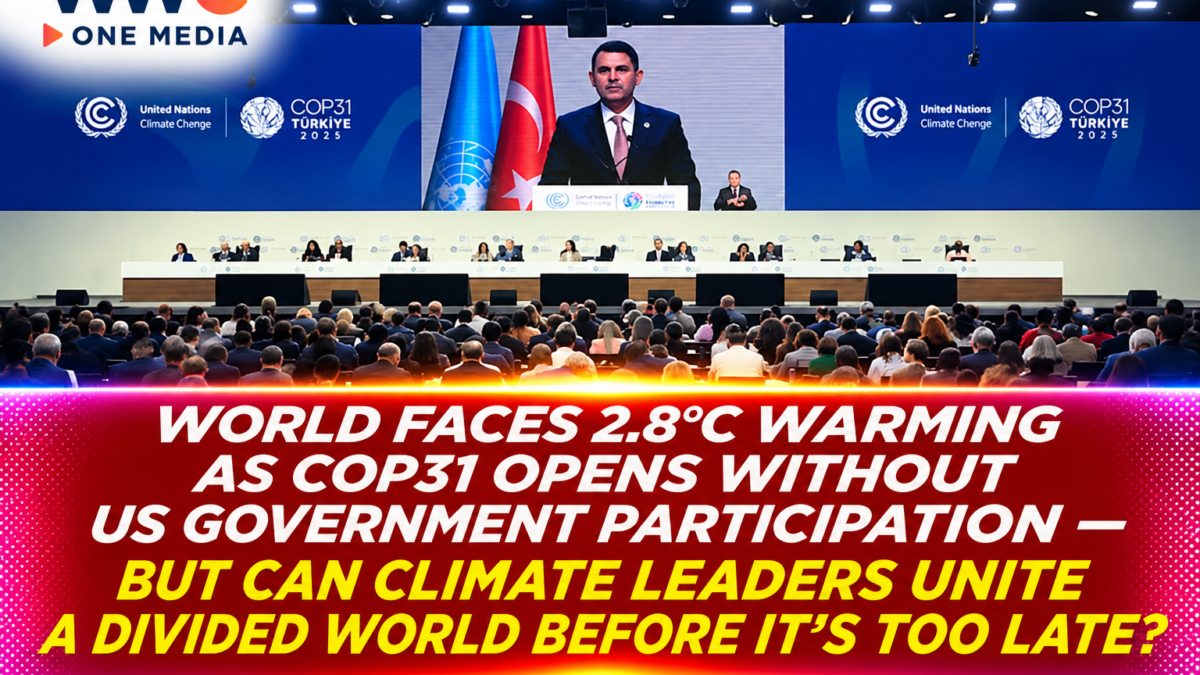
The debate comes as nearly 200 countries gather in Antalya, Türkiye, for the United Nations COP31 climate summit.
The scientific warning is becoming harder to ignore.
According to the United Nations Environment Programme, existing government policies could put the world on a path toward approximately 2.8°C of warming during this century.
Even if countries fully implement their current national climate commitments and sustain comparable efforts, projected warming would remain around 2.6°C.
Meanwhile, the World Meteorological Organization reported that the first nine months of 2026 were approximately 1.47°C warmer than the preindustrial average.
Yet political support for climate policies remains uneven.
In the United States, President Donald Trump’s administration has withdrawn from international climate cooperation and rolled back important environmental regulations.
Other governments are confronting the challenge of meeting climate commitments while maintaining affordable electricity, protecting employment and supporting economic growth.
As the world becomes hotter and climate politics grows more polarized, can leaders persuade voters across party lines that protecting the climate is also about protecting jobs, health, household finances and national security?
Bloomberg Opinion Raises a Bigger Question About Climate Politics
The headline of Bloomberg’s November 11 commentary points to a challenge facing political movements that traditionally champion stronger environmental protections.
Climate policy cannot succeed through scientific evidence alone.
Governments also need public trust, durable legislation, investment and cooperation across institutions.
That becomes difficult when environmental policies are presented primarily as partisan positions.
In democratic societies, governments change.
Policies introduced by one administration may be weakened, reversed or replaced by another.
Businesses planning long-term energy investments can face uncertainty when regulatory requirements shift substantially between elections.
The political question is therefore larger than whether one party supports particular climate targets.
It concerns how governments can build policies that survive changing political leadership.
One approach emphasizes making climate measures relevant to ordinary economic concerns: reliable electricity, lower energy costs, cleaner air, better transportation and employment opportunities.
But there is no single agreed strategy.
Some advocates argue that governments must move more quickly with strong emissions regulations, even when those measures initially create costs.
Others emphasize affordability, innovation, private investment and gradual changes that households and industries can realistically absorb.
These approaches can overlap, but they also create genuine disagreements over how fast the energy transition should proceed and who should bear its costs.
COP31 Opens as the World Falls Behind Its Climate Targets
The latest debate is unfolding at COP31, which began on November 9 and is scheduled to continue through November 20.
Nearly 200 countries are participating in discussions about climate finance, emissions reductions, clean energy, adaptation and implementation of previous commitments.
But expectations for major new agreements are limited.
Negotiators are increasingly focused on making existing promises work rather than announcing another collection of ambitious targets.
In related coverage, WWC ONE MEDIA reported on the opening of COP31 in Türkiye and the warning that global climate action remains far behind what scientists say is necessary.
The central challenge is implementation.
Countries have already made numerous commitments under the Paris Agreement.
Yet emissions remain too high, international financing is inadequate and many governments have struggled to deliver promised policies.
The issue is particularly important for developing countries seeking support to strengthen their energy systems while protecting vulnerable populations from worsening climate impacts.
UN Warns Current Policies Could Lead to 2.8°C Warming
The United Nations Environment Programme’s Emissions Gap Report 2026 provides one of the clearest measures of the challenge.
The report projects that existing policies could result in approximately 2.8°C of warming this century.
Fully implementing current nationally determined contributions could reduce that projection to around 2.6°C.
Neither outcome would meet the Paris Agreement’s objective of holding warming well below 2°C and pursuing efforts to limit it to 1.5°C.
UNEP also examined a scenario in which temperatures temporarily overshoot 1.5°C before returning toward that threshold by 2100.
For that pathway, global greenhouse-gas emissions would need to fall approximately 18% by 2030 and 45% by 2035, compared with 2025 levels.
Those reductions would require major changes in energy production, transportation, industry and land use.
However, the figures represent modeled scenarios based on different policy assumptions.
They are not guaranteed predictions of the precise temperature the world will experience.
The important conclusion is that current policies and commitments remain far from sufficient.
2026 Is Among the Four Hottest Years Recorded
The World Meteorological Organization released its latest climate assessment on November 9.
According to the agency, 2026 is expected to rank among the four hottest years since modern instrumental records began.
The years from 2015 through 2026 are expected to be the 12 warmest in the observational record.
Global temperatures from January through September averaged approximately 1.47°C above the 1850–1900 baseline.
The agency also reported record-high global sea levels and extraordinary ocean heat.
An intensifying El Niño could increase the risk of extreme weather into 2027.
In related reporting, WWC ONE MEDIA examined the WMO’s latest temperature warnings and the growing difficulty of predicting precisely where severe floods, droughts and heatwaves will occur.
One important scientific distinction must be maintained.
A single year with temperatures above 1.5°C does not automatically mean the Paris Agreement’s long-term warming threshold has been permanently exceeded.
Nevertheless, the measurements indicate a continuing rise in global temperatures and growing risks to societies and ecosystems.
Why Climate Change Has Become a Political Dividing Line
Climate change involves science, but climate policy involves political choices.
Governments must decide which technologies to support, how to regulate pollution, where to invest public money and how to distribute costs.
Those decisions affect industries, households and communities differently.
A coal-producing region may worry about the future of mining jobs.
An urban household may be concerned about the cost of electricity or a new electric vehicle.
A farmer may prioritize drought protection and reliable irrigation.
A technology company may want cleaner electricity but oppose regulations that significantly increase operating expenses.
These interests do not always align.
Supporters of aggressive climate action argue that delays will produce greater long-term costs through extreme weather, health damage and economic disruption.
Critics of particular climate policies argue that poorly designed measures can increase household expenses, weaken industrial competitiveness or shift production toward countries with weaker environmental standards.
These are legitimate policy questions that require economic evidence and practical solutions.
They do not change the underlying scientific finding that human greenhouse-gas emissions are warming the planet.
A durable climate strategy must address the economic disagreements without ignoring the physical risks.
US Climate Leadership Faces Another Political Test
The United States remains one of the world’s largest greenhouse-gas emitters.
Its federal policies therefore have substantial international significance.
President Donald Trump’s administration has withdrawn from international climate cooperation and pursued policies favoring expanded fossil-fuel development.
The US government has no official delegation at COP31 for a second consecutive year.
The administration argues that its approach supports energy security, economic competitiveness and domestic production.
Environmental advocates argue that weakening climate regulations increases future emissions and undermines international cooperation.
The November 2026 US midterm elections have introduced another dimension.
Recent Democratic gains in Congress have created expectations that lawmakers may strengthen oversight of federal environmental policy.
However, congressional election results do not automatically reverse executive actions or restore international agreements.
The direction of American climate policy will depend on legislation, court decisions, government agencies and future elections.
The broader question is whether climate measures can attract durable support rather than being repeatedly reversed as political control changes.
Brazil Pushes for a Clearer Path Away From Fossil Fuels
Brazil has emerged as an important voice in the current negotiations.
President Luiz Inácio Lula da Silva is supporting an international roadmap for transitioning away from coal, oil and natural gas.
The proposal seeks to translate commitments made at COP28 in Dubai into more concrete planning.
In related reporting, WWC ONE MEDIA examined Brazil’s new fossil-fuel transition roadmap and the challenge of persuading governments to adopt practical measures.
The plan is politically sensitive.
Countries have different energy resources, development needs and financial capacities.
Some depend heavily on exporting fossil fuels.
Others rely on imported energy and may view renewable electricity as a way to reduce exposure to volatile international prices.
The challenge is agreeing on a transition that recognizes those differences while delivering measurable emissions reductions.
A roadmap can help clarify milestones.
But it does not guarantee that participating governments will adopt or finance the required policies.
Can Cheaper Clean Energy Win Wider Public Support?
One potential route toward broader agreement involves the economic benefits of clean technologies.
Solar panels, wind turbines, battery storage and electric vehicles can reduce reliance on fossil fuels in many applications.
Governments may support these technologies for different reasons.
Some prioritize lower emissions.
Others emphasize energy independence, industrial competitiveness or reduced exposure to fuel-price volatility.
These overlapping interests can create opportunities for cooperation.
At COP31, six national governments have backed an initiative seeking to expand rooftop solar access to at least 300 million homes worldwide by 2030.
In related coverage, WWC ONE MEDIA examined the Global Rooftop Solar Declaration and the challenge of doubling the number of homes using rooftop solar.
The initiative is voluntary.
It does not guarantee that every proposed installation will be completed or that all households can afford the technology.
Financing, local regulations, available roof space and electricity-grid conditions remain important barriers.
Nevertheless, programs that deliver visible financial or reliability benefits may be easier to sustain politically than policies understood only through distant emissions targets.
Energy Affordability Remains a Major Obstacle
The transition toward cleaner energy also must contend with immediate household costs.
Many countries are dealing with elevated fuel prices and uncertainty caused by geopolitical conflicts.
Europe has faced renewed pressure from disruptions affecting international gas shipments.
Such conditions can increase interest in domestically produced renewable electricity.
But governments may also respond by supporting conventional energy production to address immediate supply shortages.
That creates a difficult policy environment.
Renewable electricity can reduce long-term dependence on purchased fossil fuels, but new generating capacity, storage and grid connections require investment.
The cost of that infrastructure may be reflected in electricity tariffs or public spending.
A climate policy that appears economically advantageous over several decades may still create short-term expenses for consumers.
Governments must therefore explain both the benefits and the costs.
Without credible plans to manage household impacts, even technically sound policies can face substantial political resistance.
Climate Action Must Also Protect Workers and Communities
The transition away from high-emission industries creates employment opportunities in some sectors but can threaten jobs in others.
Renewable energy projects require engineers, electricians, construction workers and maintenance specialists.
Power-grid modernization and building-efficiency programs can also create employment.
But workers in coal mining, oil refining and related industries may face uncertainty.
A successful transition requires more than announcing new industries.
Governments may need to support retraining, regional development, infrastructure and assistance for affected communities.
That is one reason COP31 discussions include mechanisms intended to support a just transition.
The goal is to make economic changes more manageable while reducing emissions.
However, the details are contested.
Governments must decide how assistance should be financed, which workers qualify and how outcomes should be measured.
The broader political lesson is that climate policy may become more durable when affected communities see realistic economic opportunities rather than only potential losses.
Why Climate Finance Is Central to Global Cooperation
Developing countries have repeatedly argued that they cannot undertake major energy and adaptation investments without greater international support.
Climate finance can support renewable power, flood defenses, early-warning systems, resilient agriculture and other priorities.
Under a previous international agreement, countries set a goal of mobilizing at least $300 billion annually by 2035, with developed countries taking the lead.
The wider ambition is to increase climate financing to approximately $1.3 trillion annually by 2035 from public and private sources.
But these are financing goals, not amounts already delivered.
Lower-income countries continue raising concerns about the accessibility, adequacy and terms of international funding.
For climate-vulnerable nations, assistance provided mainly through expensive loans may increase fiscal pressure.
Other governments argue that scarce public funds must be combined with private capital and accompanied by credible domestic policies.
That disagreement is one of the central obstacles to stronger international cooperation.
The Philippines Has a Direct Stake in the Debate
For the Philippines, climate change is not merely a distant political argument.
The country faces serious exposure to tropical cyclones, heavy rainfall, flooding, coastal hazards and drought.
Climate-related disasters can damage infrastructure, disrupt livelihoods and increase public spending requirements.
The Philippine government is developing a national framework for climate-related loss and damage through cooperation among the Department of Environment and Natural Resources, the Climate Change Commission and the United Nations Development Programme.
In related coverage, WWC ONE MEDIA examined the proposed Philippine loss-and-damage strategy and whether international climate financing can reach vulnerable communities effectively.
The initiative aims to improve coordination, assess losses and strengthen access to potential financial support.
But developing a framework is different from obtaining and distributing funds.
For Philippine communities, the effectiveness of climate policy will ultimately depend on concrete outcomes.
These include stronger flood protection, reliable water supplies, improved disaster preparedness and greater resilience in agriculture and coastal settlements.
The political label attached to a particular policy matters less to affected families than whether it works.
Can Climate Action Become Less Partisan?
The argument that climate action needs broader political support raises an important strategic question.
Should political leaders emphasize global emissions targets, or should they focus more directly on local economic and community benefits?
The strongest approach may involve both.
Scientific targets provide a measure of whether policies are sufficient to reduce long-term warming.
Practical benefits help households and businesses understand why those policies matter.
That does not require political parties to agree on every proposal.
Different groups may continue favoring different combinations of regulation, carbon pricing, public spending, technological innovation and market incentives.
But policies may have a better chance of lasting when they address shared priorities.
Reliable electricity, affordable transportation, economic opportunity, disaster resilience and public health are concerns that cut across political affiliations.
At the same time, messaging alone cannot substitute for effective policy.
Governments must show that proposed measures deliver measurable benefits and distribute their costs fairly.
Five Questions That Could Determine Climate Politics After COP31
1. Can governments deliver existing climate commitments?
The immediate challenge is closing the gap between promises and actual emissions reductions.
2. Will clean energy become more affordable?
Accessible technologies and reliable electricity systems may increase public support.
3. Can workers benefit from the energy transition?
Employment opportunities, retraining and community investment could reduce resistance.
4. Will developed countries provide adequate climate finance?
Developing economies need resources to adapt and invest without creating unsustainable debt burdens.
5. Can political leaders cooperate despite ideological differences?
Durable climate action requires institutions and policies capable of surviving electoral changes.
The Bottom Line: Climate Change Is a Global Problem That Cannot Depend on One Political Side
The debate surrounding Bloomberg’s November 11 opinion headline arrives at a critical moment for international climate policy.
Scientific evidence continues to show that global warming is advancing.
The World Meteorological Organization expects 2026 to rank among the four hottest years on record.
UNEP warns that existing government policies could put the planet on a path toward approximately 2.8°C of warming this century.
Yet governments remain divided over the economic and political choices involved in reducing emissions.
The left, the right and political movements outside those categories offer competing approaches to regulation, investment, energy production and international cooperation.
No political group can deliver a successful global response on its own.
The challenge is finding policies that reduce emissions while addressing affordability, energy reliability, industrial competitiveness and the needs of vulnerable communities.
For the Philippines and other climate-exposed countries, the consequences of inaction are especially serious.
But the success of future climate policy will depend less on speeches or ideological positioning than on whether governments produce measurable improvements.
As the world heads toward potentially dangerous levels of warming, climate action is struggling to maintain political momentum. But with COP31 exposing deep divisions over energy, money and responsibility, can leaders rebuild a coalition broad enough to deliver meaningful change—or will another decade of political battles leave the planet even further behind?