BRUSSELS / ROME / PARIS / BERLIN / MANILA — November 11, 2026 | WWC ONE MEDIA | World Politics, Donald Trump, European Union and International Relations
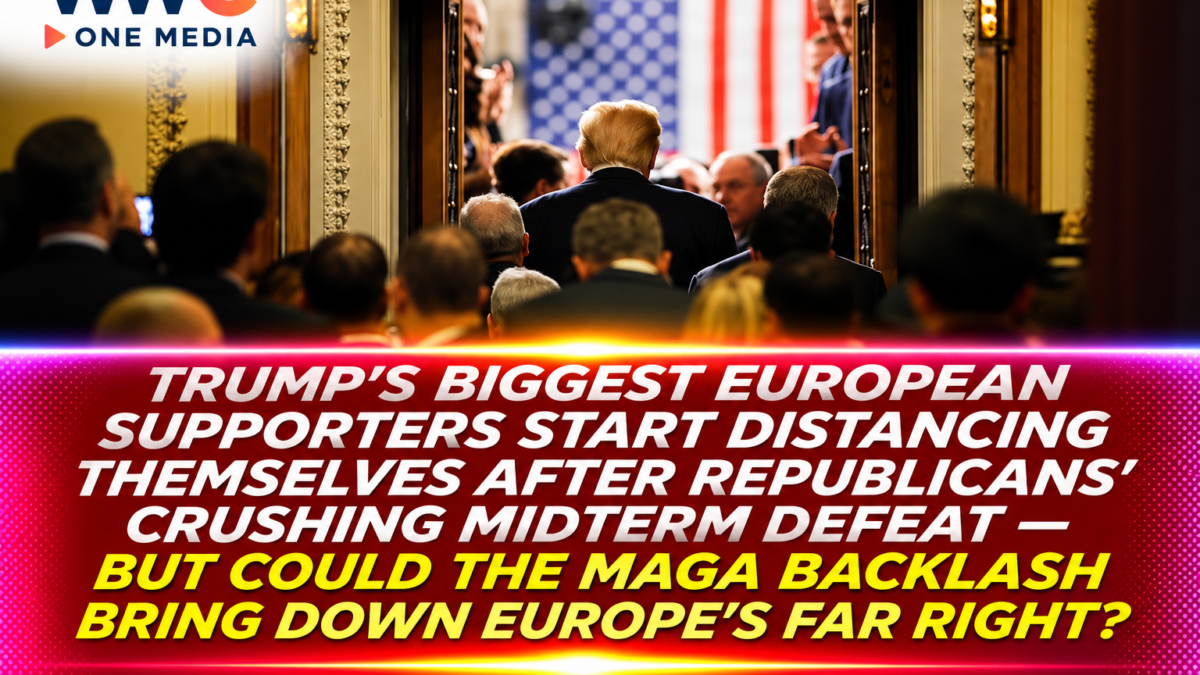
Donald Trump’s political troubles are spreading across the Atlantic as some of Europe’s most prominent nationalist leaders begin distancing themselves from the American president following his Republican Party’s crushing defeat in the November 3 US midterm elections.
The unexpected change is creating a political dilemma for European parties that previously celebrated Trump’s return to the White House.
They still support many of his positions on immigration, national sovereignty and opposition to political establishments. But they increasingly fear that his unpopular foreign-policy decisions, economic disruptions and electoral setbacks could damage their own chances of winning power.
A November 11 Bloomberg Opinion column, Europe’s Biggest Donald Trump Fans Are Suddenly Changing Their Tune, highlights the changing political relationship between the American president and Europe’s nationalist movements.
Independent reporting from Reuters, The Guardian and other international outlets confirms that several European political figures have publicly criticized elements of Trump’s policies.
The shift follows growing dissatisfaction with the Iran war, rising energy costs, disputes over Greenland and uncertainty surrounding American support for Ukraine.
For Europe’s nationalist parties, the political calculation is becoming uncomfortable.
They want to retain the voters attracted to Trump’s message without inheriting the economic and diplomatic problems associated with his administration.
But as the MAGA movement faces an internal reckoning in the United States, could the president’s declining popularity undermine Europe’s nationalist parties—or will they successfully separate their political agenda from Trump’s increasingly controversial leadership?
Trump’s Midterm Defeat Sends Shockwaves Across Europe
The November 3 US midterm elections delivered a major setback to Trump’s Republican Party.
Democrats secured control of both chambers of Congress, changing the balance of power in Washington.
The election results reflected public frustration over issues including living costs, energy prices, the Iran war and perceptions of government performance.
Reuters reported on November 8 that the defeat also triggered disagreements within the MAGA movement itself.
Some conservative activists blamed Trump directly, while others argued that Republican leaders had failed to deliver his original political agenda.
The result has implications beyond American politics.
European nationalist parties have frequently looked to Trump’s political success as evidence that anti-establishment movements can win national elections.
His defeat therefore complicates that narrative.
But the American election does not establish that European nationalist movements are facing an inevitable decline.
Their political fortunes also depend on domestic concerns, including immigration, housing, public services, wages and national economic conditions.
France’s Jordan Bardella Begins Putting Distance Between His Party and Trump
France’s National Rally is among the parties confronting the changing political environment.
Its president, Jordan Bardella, has been associated with a broader European nationalist movement that shares several positions with Trump.
However, Bardella has criticized the economic consequences of American military intervention.
Following the US election, Reuters reported that he highlighted the damaging economic effects of the Iran conflict.
For French voters, international geopolitical disputes can have direct economic consequences.
Higher energy prices increase household expenses and business costs.
Trade disruptions can affect exporters and manufacturers.
The National Rally is seeking to present itself as a credible alternative to France’s established political parties.
That objective creates an incentive to avoid appearing politically dependent on an increasingly unpopular foreign leader.
However, Bardella has not abandoned his party’s positions on immigration, sovereignty or French economic policy.
The change is better understood as distancing from particular Trump decisions rather than a wholesale ideological reversal.
Germany’s Alice Weidel Accuses Trump of Breaking a Major Promise
Germany’s Alternative for Germany party, or AfD, is facing a similar dilemma.
AfD co-leader Alice Weidel has criticized Trump’s interventionist foreign policy.
Reuters reported that she described the Iran war as inconsistent with the American president’s earlier campaign commitments.
Trump had frequently presented himself as a leader capable of avoiding unnecessary foreign conflicts.
For some European nationalists, that message was an important reason for supporting him.
Military escalation therefore creates a contradiction.
Weidel also criticized American actions involving Greenland earlier in 2026.
Germany’s AfD remains a significant political force despite these disagreements.
It achieved a major result in September’s Saxony-Anhalt state election, winning approximately 43.8% of the vote.
That result demonstrates why Trump’s weakening international reputation should not be confused with the disappearance of nationalist politics in Europe.
Parties may continue attracting domestic support even while distancing themselves from Washington.
Italy’s Giorgia Meloni Faces an Increasingly Difficult Balancing Act
Italian Prime Minister Giorgia Meloni has been one of Trump’s most recognizable European political partners.
Their relationship has reflected overlapping conservative positions, particularly on immigration and national security.
But disagreements have become more visible.
Trump’s criticism of Meloni during 2026 created tensions that encouraged other European leaders to defend the Italian prime minister.
Associated Press reporting described how the confrontation strengthened cooperation between Meloni and some European counterparts.
Meloni has also maintained a more supportive position toward Ukraine than several other European nationalist politicians.
On November 5, Reuters reported that she urged European Union governments to agree on a single representative for negotiations over Ukraine.
She warned that competing diplomatic initiatives could weaken Europe’s influence.
Her position reflects a practical concern.
Italy has economic and security interests that do not always align with Washington’s decisions.
But Meloni has not become an opponent of every Trump policy.
She continues seeking cooperation with the United States while defending Italian and European interests.
The situation illustrates the difference between political affinity and unconditional diplomatic support.
The Iran War Has Become a Major Political Liability
The conflict involving Iran has become a central issue behind the growing criticism.
The war has increased international tensions and contributed to energy-market volatility.
For European governments, higher fuel costs can create immediate pressure on households and industries.
Reuters reported that Italian politician Matteo Salvini identified wars, international tensions and living costs as important factors in the American election result.
Fellow Italian nationalist Roberto Vannacci also linked Republican losses to the Iran conflict, Trump’s failure to end the Russia-Ukraine war and higher energy prices.
These statements suggest that some European leaders are increasingly evaluating Trump’s policies through their domestic economic consequences.
The calculation is straightforward.
A politician may agree with Trump’s positions on immigration or national identity while disagreeing with a military conflict that raises petrol prices for voters.
However, international economic conditions are influenced by multiple factors.
It would be inaccurate to attribute every increase in European living costs exclusively to Trump or the Iran war.
Britain’s Nigel Farage Also Faces a Trump Problem
British nationalist politician Nigel Farage has long maintained political connections with Trump and his supporters.
But the relationship has become more complicated.
Reuters reported that Farage attributed part of the Republican election defeat to the Iran war and rising fuel prices.
He also suggested the results could expose disagreements within the American administration, including between Trump and Vice President JD Vance.
Farage’s situation illustrates a problem facing European parties that have built relationships with the American president.
Personal political proximity may provide visibility and access.
But it can also create electoral risks when an overseas leader becomes unpopular.
For British voters, domestic issues such as the cost of living, immigration and public services remain central.
Farage must therefore balance his international political relationships with the priorities of his own electorate.
Greenland Exposed a Fundamental Split Between Trump and European Nationalists
The political disagreements did not begin with the November elections.
Earlier in 2026, Trump’s campaign to increase American control over Greenland created an uncomfortable situation for European nationalist movements.
Many of those parties emphasize national sovereignty and opposition to external interference.
Supporting American pressure on Danish territory would be difficult to reconcile with those principles.
Bardella criticized threats against Danish sovereignty.
Weidel questioned Trump’s willingness to interfere in other countries.
Meloni disagreed with additional tariffs against European governments supporting Greenland.
In related reporting, WWC ONE MEDIA examined the diplomatic backlash after Trump shared a controversial map depicting an expanded United States that included Greenland and Iceland.
The controversy highlighted a fundamental tension between political alignment with Trump and the national interests of European countries.
It also encouraged greater European cooperation over Arctic security.
These developments demonstrate why nationalist parties do not necessarily support every action taken by another nationalist government.
Ukraine Peace Talks Are Creating Another Transatlantic Divide
Russia’s war in Ukraine is another issue exposing differences between Washington and European governments.
The Trump administration is pursuing renewed negotiations with Russia and Ukraine.
But European leaders fear that discussions involving broader security arrangements could affect their countries without adequate representation.
The concern has become particularly important during the latest US-mediated talks in Abu Dhabi.
Some European governments worry that negotiating changes to security arrangements before hostilities end could strengthen Moscow’s position.
In related coverage, WWC ONE MEDIA examined Europe’s demand that Russia end the war in Ukraine before negotiations over a wider European security settlement proceed.
The dispute is not simply ideological.
European countries must consider their own security obligations, defense spending and relationships with Ukraine.
Meloni’s demand for a coordinated European negotiating position reflects those concerns.
Europe Wants a Seat at the Negotiating Table
The latest talks have created fresh disagreements over European participation.
European leaders argue that any agreement involving Ukraine’s borders, Russia’s security demands or NATO’s future must account for the interests of affected countries.
The United States maintains that it is seeking a negotiated settlement capable of ending the war.
Russia has traditionally demanded restrictions on Ukraine’s potential NATO membership and broader changes to European security arrangements.
Ukraine insists that any settlement must provide credible security guarantees and respect its sovereignty.
The competing objectives make negotiations difficult.
The discussions remain ongoing.
No comprehensive peace agreement had been confirmed at the time of the November 11 reporting reviewed.
Trump’s Electoral Defeat Does Not End His Foreign-Policy Powers
Although Republicans lost control of Congress, Trump remains president.
He continues exercising substantial authority over diplomacy, military operations and executive-branch decisions.
Congress can conduct investigations, control appropriations and pass legislation.
But presidential veto powers and the political composition of Congress can complicate efforts to change administration policy.
For European leaders, this creates uncertainty.
A weakened American president may become more willing to negotiate.
Alternatively, he may seek major foreign-policy achievements to strengthen his political legacy.
Neither outcome is guaranteed.
In related reporting, WWC ONE MEDIA examined how Trump’s midterm defeat could affect international relations while leaving him with significant authority over foreign affairs.
The important point is that political weakness at home does not automatically translate into reduced diplomatic influence abroad.
European governments must continue dealing with the sitting US administration while preparing for possible future policy changes.
Is Trumpism Losing Influence—or Simply Changing Form?
The biggest political question is whether European nationalist parties are rejecting Trumpism itself.
The evidence suggests a more complicated development.
Many European movements continue emphasizing immigration restrictions, national sovereignty, cultural identity and criticism of established political institutions.
Those positions existed before Trump’s second presidency and are rooted in domestic political conditions.
What appears to be changing is the willingness of some leaders to associate themselves unconditionally with Trump’s personal political fortunes.
This distinction matters.
A party may oppose Trump’s military actions while still supporting stricter immigration rules.
Another may criticize American tariffs while favoring economic nationalism at home.
Analysts therefore caution against interpreting the US midterm results as evidence that European nationalist movements have lost their political appeal.
Indeed, recent electoral results in parts of Europe indicate continued support for such parties.
The likely political challenge is adaptation rather than disappearance.
Europe’s Mainstream Parties Also Face a Difficult Test
The changing relationship between Trump and Europe’s nationalist movements creates opportunities for mainstream parties.
But those opportunities are not guaranteed.
European voters remain concerned about living costs, housing affordability, immigration and economic growth.
Parties opposing nationalism cannot assume that criticism of Trump will resolve these domestic issues.
The Guardian’s November 5 analysis argued that dissatisfaction with government performance remains a major source of support for populist parties.
That means the same economic pressures hurting Trump could also weaken incumbent European governments.
For voters, the important questions often concern tangible results.
Can their government control living costs?
Can it improve housing availability?
Can it manage immigration effectively?
Can it provide reliable public services?
Political movements that offer credible answers may gain support regardless of their ideological labels.
What the Political Shift Means for NATO and Global Markets
The uncertainty extends beyond electoral politics.
European countries rely heavily on the United States for military capabilities, intelligence sharing and international diplomacy.
Changing relationships with Washington can influence defense investment and diplomatic planning.
The Trump administration has urged European NATO members to assume greater responsibility for their security.
European governments have responded by expanding defense commitments and seeking greater strategic independence.
In another report, WWC ONE MEDIA examined Washington’s renewed effort to persuade NATO allies to finance additional American-made weapons for Ukraine.
Such arrangements illustrate the continuing interdependence of the United States and Europe.
Political disagreements do not automatically end military or economic cooperation.
But uncertainty over policy can affect investment decisions, defense planning and international market sentiment.
For Asian economies, including the Philippines, changes in transatlantic relations may indirectly affect trade, energy prices and global financial conditions.
Those consequences depend on actual policy decisions rather than political rhetoric alone.
Five Questions That Could Shape Europe’s Political Right
1. Will European nationalist parties openly criticize Trump more frequently?
Some leaders have already challenged specific policies, but many continue avoiding direct personal confrontations.
2. Will the Iran war become a bigger electoral issue?
Its political impact will depend on the conflict’s duration and consequences for household energy costs.
3. Can nationalist parties preserve their domestic political appeal?
Their support depends heavily on immigration, living costs, housing and dissatisfaction with established parties.
4. Will European governments become more independent of Washington?
Defense investment and diplomatic coordination may continue increasing regardless of American election results.
5. Could Trump’s weakening position create a new generation of European nationalist leaders?
Some movements may seek to retain the political themes associated with Trump while presenting themselves as less unpredictable and more focused on domestic priorities.
The Bottom Line: Europe’s Nationalists Are Recalculating Their Relationship With Trump
Donald Trump’s influence over European nationalist politics has entered a new and uncertain period.
His Republican Party’s defeat in the November 3 midterm elections has intensified questions about the political costs of association with his administration.
France’s Jordan Bardella, Germany’s Alice Weidel and several Italian nationalist figures have expressed concerns about specific American policies, particularly the Iran war and its economic consequences.
British nationalist Nigel Farage has also linked the Republican setback to foreign-policy and cost-of-living issues.
Meanwhile, Italian Prime Minister Giorgia Meloni is pursuing greater European coordination on Ukraine while maintaining areas of cooperation with Washington.
These developments do not establish a complete ideological break.
European nationalist parties continue attracting support for reasons rooted in their own countries.
But Trump’s personal political appeal is no longer necessarily an advantage for every movement that once embraced him.
Europe’s most prominent nationalist leaders are beginning to question whether their close association with Donald Trump is worth the political cost. But as the American president confronts electoral defeat, rising criticism of the Iran war and growing resistance from European allies, is Trump’s influence over Europe’s political right finally weakening—or are his supporters simply preparing to continue his agenda without carrying his political baggage?