
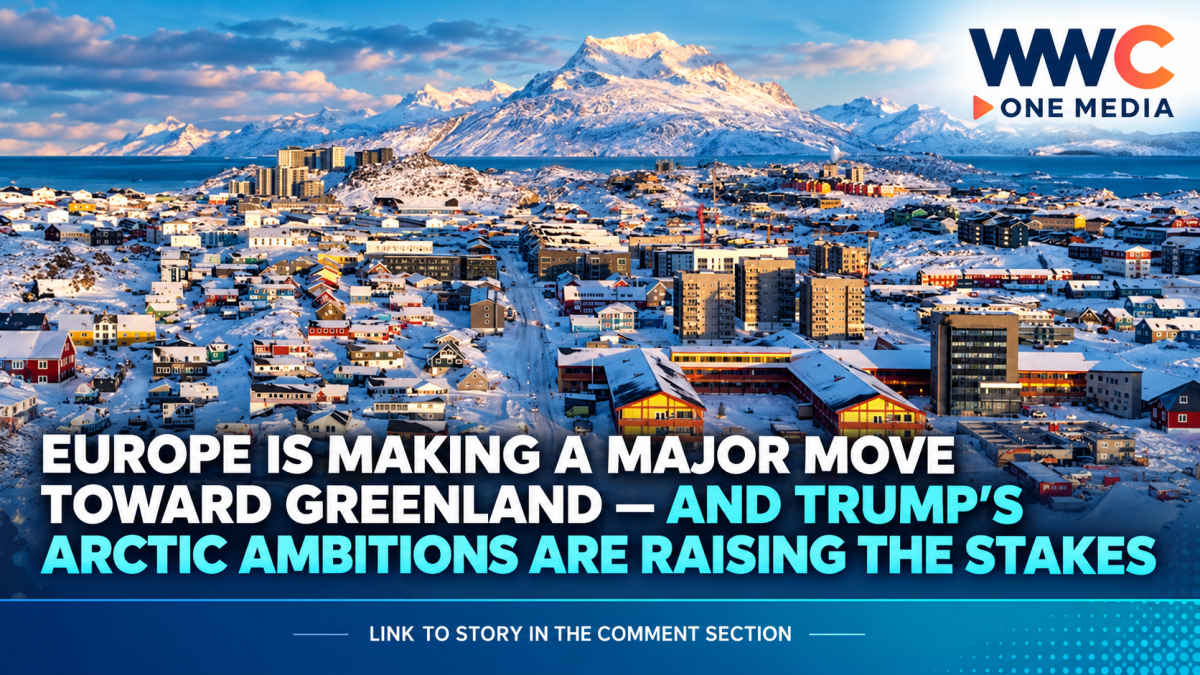
NUUK — The European Union is preparing to deepen its relationship with Greenland as geopolitical competition in the Arctic intensifies and the United States continues to express interest in acquiring the Danish autonomous territory.
European Commission President Ursula von der Leyen is scheduled to visit Greenland on September 6 and 7, accompanied by Danish Prime Minister Mette Frederiksen. Greenlandic Prime Minister Jens-Frederik Nielsen is expected to receive the two leaders in Nuuk, where they are expected to sign a joint declaration aimed at strengthening cooperation between Greenland and the EU.
The visit comes at a particularly sensitive moment for the Arctic.
U.S. President Donald Trump has repeatedly pushed for greater U.S. control over Greenland, citing national-security interests. Denmark and Greenland have rejected the idea, while European governments have emphasized Greenland’s sovereignty and territorial integrity.
EU brings investment to the Arctic table
The European move is not only diplomatic.
According to reporting from CNBC and the Financial Times, von der Leyen is expected to announce a new EU funding package for Greenland that could reach approximately €200 million ($232 million) for 2026 and 2027.
The proposed investment is expected to focus on strategically important areas including:
- Critical raw materials
- Renewable energy
- Undersea cables
- Satellite connectivity
- Data centers
- Public administration and institutional capacity
The funding would come on top of approximately €225 million already allocated to Greenland under the EU’s 2021–2027 budget framework.
The European Commission has also proposed increasing longer-term EU funding for Greenland, with the next seven-year package potentially reaching about €530 million for 2028–2034, subject to negotiations and approval of the bloc’s future budget.
That makes the visit about considerably more than symbolism.
Europe is effectively putting economic resources behind its effort to establish itself as a more significant long-term partner in the Arctic.
Why Greenland matters so much
Greenland is the world’s largest island, covering more than 2.1 million square kilometers, but it has a population of only around 56,600 people.
It is an autonomous territory within the Kingdom of Denmark and is not itself part of the European Union, although Greenland is associated with the EU as an Overseas Country and Territory.
Its location gives it enormous strategic importance.
Greenland sits between North America and Europe and occupies a critical position in the North Atlantic and Arctic regions. Its territory and surrounding waters are increasingly important as governments assess Arctic security, military infrastructure, shipping routes, communications networks and access to natural resources.
Its mineral potential has also attracted international attention, particularly as governments seek alternatives to supply chains dominated by China and other major producers.
That combination — location, resources and strategic infrastructure — helps explain why Greenland has become a major focus of international politics.
Trump’s Greenland push changed the conversation
The European effort comes after months of tension surrounding Trump’s campaign to acquire Greenland.
Denmark and Greenland have repeatedly rejected the idea that Greenland can simply be transferred to another country.
A joint statement issued by Denmark and several European leaders in January stressed that Greenland’s future is a matter for Denmark and Greenland, while also emphasizing the importance of Arctic security and NATO cooperation.
The situation has since moved partly toward diplomacy.
Greenland’s Foreign Minister Mute Egede said this week that discussions with the United States are continuing, although he did not disclose details of those talks.
That means the issue has not disappeared — it has simply entered a more complicated diplomatic phase.
Denmark is also strengthening its Arctic presence
The diplomatic activity is occurring alongside a noticeable increase in Denmark’s attention to Arctic defense.
Reuters reported that Denmark recently deployed conscripts to Greenland for Arctic training as tensions in the region have grown.
The deployment forms part of broader efforts to strengthen Denmark’s military capabilities in the Arctic and comes as NATO increases its focus on the region.
Greenland is already part of the Kingdom of Denmark and therefore part of NATO through Denmark.
European leaders have repeatedly emphasized that Arctic security should be addressed collectively through the alliance rather than through unilateral territorial moves.
The EU wants to be more than a political ally
For Brussels, the Greenland relationship is also about demonstrating that Europe can offer something tangible.
The EU opened a permanent office in Nuuk in 2024, marking a stronger institutional presence on the island. Von der Leyen previously visited Greenland in connection with that development and signed cooperation agreements worth nearly €94 million, according to CNBC.
The latest investment plans would significantly expand that economic relationship.
EU officials have increasingly highlighted infrastructure, critical minerals, renewable energy, digital connectivity and local economic development as areas where European cooperation could provide long-term benefits.
But Greenland’s government has also made clear that investment must serve Greenland’s own interests.
That is particularly important because Greenland has long discussed the possibility of eventually becoming independent from Denmark.
Greenland’s independence ambitions add another layer
Greenland remains financially dependent on Denmark, which provides a substantial annual block grant.
Greater economic development could therefore have implications extending far beyond the current geopolitical dispute.
If Greenland can attract investment, expand its economy and develop its natural resources while strengthening its infrastructure, it could potentially improve its ability to pursue greater political and economic autonomy.
But developing the Arctic economy is difficult.
Extreme weather, enormous distances, limited infrastructure and high construction and transportation costs make major projects considerably more expensive than comparable developments elsewhere.
That means simply announcing billions in potential investment does not guarantee that projects will materialize.
Europe is also looking beyond Greenland
The timing of von der Leyen’s visit is significant for another reason.
Icelandic voters recently rejected a proposal to restart negotiations on joining the European Union, with 52.8% voting against reopening membership talks and 47.2% supporting the proposal, according to the Associated Press.
That result came as Arctic geopolitics was already becoming increasingly important.
For Brussels, strengthening ties with Greenland therefore offers another way to increase Europe’s presence in the wider Arctic and North Atlantic region — even though Greenland itself is not an EU member.
This is not simply an EU-versus-US contest
It would be misleading, however, to portray the situation as a straightforward confrontation between Washington and Brussels over Greenland.
The United States remains an important NATO ally and already has a military presence in Greenland through its longstanding defense relationship with Denmark.
European leaders have repeatedly stressed that Washington remains an essential security partner even while rejecting any attempt to undermine Greenlandic and Danish sovereignty.
The real contest is therefore broader.
It involves security, critical minerals, infrastructure, economic independence, Arctic shipping, Russia, China, NATO and the future political direction of Greenland itself.
And Greenland is increasingly at the center of all of it.
What happens next?
Von der Leyen’s September 6–7 visit could produce a concrete expansion of EU-Greenland cooperation, including new investment and a formal joint declaration.
But the bigger question is whether Europe’s economic engagement can translate into a durable strategic partnership.
Greenland’s leaders have repeatedly emphasized their desire for greater cooperation while maintaining control over their own future.
Meanwhile, Washington continues its dialogue with Greenland and Denmark, while NATO and European governments increase their attention to Arctic security.
The result is an Arctic region entering a new era — one in which Greenland’s resources, location and political future are becoming increasingly important to powers far beyond the island itself.
And with Europe now preparing to put significant money behind its Greenland strategy, the next chapter of the Arctic power struggle may already be taking shape.
WWC ONE MEDIA M.J.E

Leave a Reply