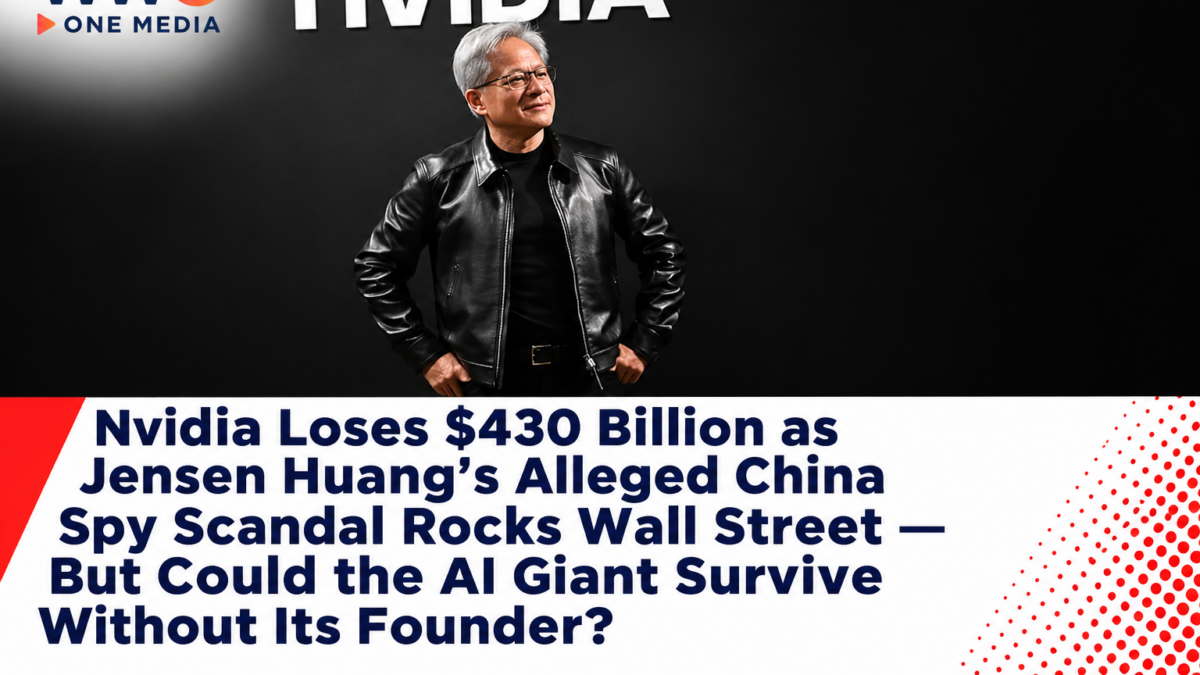
SANTA CLARA, CALIFORNIA / WASHINGTON / MANILA — November 11, 2026 | WWC ONE MEDIA | Global Technology, Artificial Intelligence and Financial Markets
Nvidia, the semiconductor giant powering the global artificial intelligence revolution, is confronting an extraordinary leadership crisis as an investigation involving chief executive Jensen Huang, a woman suspected by US intelligence officials of working for China, and questions surrounding sensitive AI technology sends shockwaves through Wall Street.
The controversy has erased approximately $430 billion in Nvidia’s market value over two trading sessions, according to Reuters, raising concerns that one of the world’s most influential technology companies could face an unexpected leadership transition.
At the center of the scandal is Huang, the 63-year-old billionaire who co-founded Nvidia in 1993 and transformed it into a dominant supplier of advanced processors used by artificial intelligence companies.
Huang acknowledged an extramarital relationship in a November 8 message to employees. Reports subsequently linked the woman involved to allegations of Chinese intelligence gathering.
Nvidia’s independent directors have launched an investigation, while US authorities are examining whether Huang was targeted by a foreign intelligence operation.
The allegations have not been established as fact, and China has strongly rejected accusations of espionage.
Nvidia has emphasized that it has no reason to believe company secrets or sensitive national-security information were compromised.
Nevertheless, the controversy has exposed a question that investors rarely expected to confront:
What would happen to the world’s leading AI chipmaker if Jensen Huang could no longer run it?
According to Bloomberg’s November 10 analysis, the question has become central to Nvidia’s investment outlook as the company’s fortunes remain closely tied to its co-founder.
With Nvidia valued at several trillion dollars and its processors underpinning much of the AI industry’s infrastructure, the consequences could extend far beyond a single company’s share price.
Nvidia Stock Suffers Massive Selloff as China Spy Investigation Intensifies
Nvidia’s shares came under heavy pressure following reports about Huang’s relationship and the subsequent investigation.
On Monday, November 9, shares fell as much as 8.8% during intraday trading before recovering some losses.
The stock closed at $178.67, down 4.3%, wiping approximately $190 billion from Nvidia’s market capitalization during that session.
By November 10, Reuters reported that the company’s cumulative market-value losses over two trading sessions had reached approximately $430 billion.
Its stock had declined about 9.5% since the controversy emerged.
Those figures represent changes in market capitalization, not cash directly lost from the company’s accounts.
The selloff reflected growing concerns about corporate governance, national security and the possibility of an unexpected leadership change.
The controversy also arrived when investors were already questioning whether the extraordinary spending supporting the artificial intelligence industry could continue at its current pace.
In related coverage, WWC ONE MEDIA reported on Nvidia’s initial $190 billion market-value decline and the investigations involving Huang and alleged Chinese intelligence connections.
The latest developments indicate that investors are now assessing risks that extend beyond Nvidia’s quarterly earnings, product roadmap and competition.
They are evaluating whether a company built around one exceptionally influential executive can withstand a prolonged leadership investigation.
Who Is Alice Huang, and Why Is Nvidia Investigating?
The controversy centers on Alice Huang, a former executive associated with Singapore-based Megaspeed International.
According to reporting by The New York Times, Bloomberg, Reuters and The Washington Post, US intelligence officials reportedly suspected that Alice Huang had been recruited to collect information for China.
Reports described concerns that her relationship with Jensen Huang could have created opportunities for foreign intelligence gathering.
Jensen Huang subsequently acknowledged that he had been unfaithful to his wife.
However, that admission does not establish that he knew of any alleged intelligence activity, provided information to a foreign government or violated US export-control laws.
Those are separate questions that investigators must examine.
Nvidia’s board announced on November 8 that independent directors would oversee an inquiry into whether Huang had been targeted by foreign intelligence.
On November 10, the company confirmed that independent directors had retained Joon H. Kim, a partner at Wachtell, Lipton, Rosen & Katz and former acting US attorney for the Southern District of New York.
Kim has been tasked with conducting an independent investigation.
The appointment signals that Nvidia is treating the matter as a serious corporate governance issue.
The company has not announced findings establishing espionage or misconduct involving classified information.
China’s Foreign Ministry has rejected the allegations as unsubstantiated.
For investors, the distinction between allegations and proven misconduct is crucial.
An investigation is not evidence that an individual is guilty of espionage.
The $7.5 Billion Chip Question: Why Megaspeed Matters
The investigation has attracted additional attention because of Megaspeed International’s reported commercial relationship with Nvidia.
Reuters reported allegations that Alice Huang’s relationship with the Nvidia chief executive helped facilitate chip shipments valued at approximately $7.5 billion to China.
Reports also described a network of companies allegedly involved in obtaining roughly 240,000 Nvidia chips, some of which reportedly reached major Chinese technology businesses.
These claims remain subject to investigation and should not be treated as established violations.
The United States restricts exports of certain advanced AI semiconductors to China because of concerns that the technology could contribute to military modernization and other sensitive applications.
Authorities have increasingly scrutinized whether intermediaries or overseas companies are being used to circumvent those restrictions.
The allegations involving Megaspeed have therefore attracted attention from US government agencies responsible for export controls and national security.
A separate Bloomberg investigation examined interactions between Nvidia representatives and US officials during scrutiny of suspected chip diversion involving Megaspeed.
The questions surrounding the case include whether restricted technology was improperly diverted, whether corporate disclosures were sufficient and whether sensitive commercial relationships received appropriate oversight.
But the existence of such allegations does not establish that Nvidia or Jensen Huang knowingly participated in illegal chip transfers.
Investigators must determine what occurred and whether any laws or internal policies were violated.
Why Nvidia’s Entire AI Investment Story Depends on Jensen Huang
The most consequential question for Wall Street may not be the relationship itself.
It is Nvidia’s dependence on its founder.
Jensen Huang has served as Nvidia’s chief executive since establishing the company in 1993.
Over more than three decades, he oversaw its transition from a graphics processor manufacturer into one of the defining companies of the artificial intelligence era.
Nvidia’s GPUs have become essential components of modern AI infrastructure.
Its products support computing systems used by Microsoft, Amazon, Alphabet, Meta, OpenAI and other businesses developing advanced artificial intelligence services.
Huang’s influence extends beyond the company’s technology.
He maintains major customer relationships, oversees product strategy and serves as Nvidia’s most recognizable public representative.
His presentations have become closely watched events throughout the semiconductor and financial industries.
The company’s management structure also reflects his unusually hands-on approach.
Reuters has reported that Huang oversees a large number of executives directly, with approximately 60 employees reporting to him.
The arrangement gives him extensive visibility across the business.
But it also creates potential challenges if an unexpected leadership transition becomes necessary.
For investors, this is known as key-person risk: the danger that a company’s financial performance or strategic direction depends heavily on a particular individual.
Nvidia’s reliance on Huang has become particularly important because of its extraordinary scale.
A sudden change in leadership could raise questions about product development, corporate strategy, employee retention and relationships with major customers.
However, Nvidia also employs thousands of engineers, researchers and executives, and its operating strength cannot be attributed exclusively to one person.
The central uncertainty is whether those capabilities could continue delivering the same results under different leadership.
Could Nvidia’s Board Remove Jensen Huang?
Nvidia has not announced any decision to remove Huang.
The company says he will continue serving as chief executive while the investigation proceeds.
Its board has also expressed confidence in the company’s leadership.
Nevertheless, the controversy has revived questions about the authority of independent directors and the arrangements available if a leadership change becomes necessary.
Under Nvidia’s corporate governance provisions, directors have authority over the appointment and removal of corporate officers, subject to applicable governing rules.
The independent investigation could produce several different outcomes.
Investigators might conclude that no company secrets were compromised and that no action affecting Huang’s leadership is necessary.
They could recommend stronger internal disclosure or security procedures.
Alternatively, findings involving serious governance failures or legal violations could create pressure for more substantial changes.
No such adverse findings have been publicly established.
That dilemma matters because Nvidia has not publicly designated an obvious successor who could immediately assume Huang’s entire role.
The absence of a publicly named replacement does not prove the board lacks an internal succession plan.
However, it increases uncertainty about what an unexpected transition might look like.
Who Could Replace Jensen Huang?
A potential leadership transition would create one of the most closely watched executive searches in the technology industry.
Nvidia’s senior management includes executives with extensive experience in finance, engineering, operations, corporate strategy and customer relationships.
Chief Financial Officer Colette Kress is a prominent member of the leadership team because of her long experience overseeing financial strategy and communicating with investors.
Other senior executives possess specialized expertise in hardware engineering, software platforms and global operations.
But the Nvidia chief executive role involves an unusually wide combination of responsibilities.
Huang has personally shaped the company’s long-term technology direction, business model and relationships with major technology customers.
Replacing those capabilities in a single executive could prove difficult.
The board could theoretically appoint an internal candidate, recruit an external executive or temporarily divide responsibilities during a transition.
Those possibilities remain hypothetical.
No official succession process has been announced.
For now, Huang remains in charge.
China Rejects Spy Allegations as US-China Technology Tensions Escalate
The allegations have added another contentious issue to the already complicated relationship between Washington and Beijing.
China has rejected claims that it conducted an intelligence operation involving Nvidia’s chief executive.
Foreign Ministry spokesperson Guo Jiakun described the allegations as unsubstantiated.
Beijing’s response came amid continuing disputes over semiconductor exports, advanced AI technology and restrictions affecting Chinese access to US computing hardware.
Washington considers certain advanced chips strategically sensitive because they can support military, intelligence and other high-performance computing applications.
China, meanwhile, has repeatedly criticized US technology restrictions.
The Nvidia controversy has introduced a further layer of uncertainty.
If investigators eventually uncover evidence of corporate security weaknesses or illegal technology transfers, Washington could face pressure to strengthen enforcement.
But stronger restrictions are not a predetermined outcome of the current investigation.
The broader geopolitical concern is that Nvidia occupies a critical position in an industry increasingly viewed as strategically important by both governments.
A controversy involving its chief executive can therefore generate consequences well beyond ordinary corporate governance.
Trump Defends Huang as Congress Demands Answers
The investigation has also become a political issue in Washington.
President Donald Trump publicly defended Huang following reports about the alleged foreign intelligence connection.
Trump described the Nvidia chief executive in favorable terms and expressed support for his continued leadership.
However, congressional lawmakers have sought additional information about the allegations.
Republican committee leaders have requested briefings concerning potential national-security risks, while Democratic lawmakers have raised questions about semiconductor export controls and possible information-sharing vulnerabilities.
The political response reflects the unusual position Nvidia occupies in the American economy.
Its chips are commercially important to the world’s largest technology companies, but they also have implications for US national-security policy.
Lawmakers are concerned about whether export-control enforcement and corporate security arrangements are sufficiently robust to protect advanced American technology.
Nvidia’s board investigation and any government inquiry could influence those discussions.
Still, political statements and requests for briefings are not equivalent to findings of wrongdoing.
The government’s next steps will depend on evidence, applicable law and the conclusions reached by investigators.
Shareholder Lawsuit Adds Another Threat
Nvidia’s difficulties have also expanded into the courts.
A shareholder lawsuit reported on November 10 alleges that Nvidia and Huang failed to provide investors with appropriate disclosures concerning the relationship and associated risks.
The litigation raises questions about whether shareholders received materially complete information.
Such lawsuits can create additional costs and reputational damage for major publicly traded companies.
However, allegations in a complaint do not establish that securities laws were violated.
The plaintiffs must support their claims through the legal process, and Nvidia and other defendants have opportunities to challenge the allegations.
The lawsuit adds to the uncertainty investors are evaluating, particularly because the company’s share price has already experienced substantial volatility.
The case could also increase scrutiny of how Nvidia’s board manages potential conflicts, executive disclosures and national-security-related risks.
Why the Nvidia Crisis Matters to the Global AI Industry
Nvidia’s importance extends far beyond semiconductor manufacturing.
Its computing platforms are central to the infrastructure used for training and deploying advanced artificial intelligence models.
Major cloud companies are spending billions of dollars on data centers designed around Nvidia hardware.
Specialized AI infrastructure firms are likewise acquiring GPUs and developing computing facilities to serve customers demanding more AI capacity.
A period of uncertainty surrounding Nvidia’s leadership could affect market confidence even if the company’s underlying operations continue normally.
Investors could question whether a leadership transition would alter product-development schedules, pricing strategies or major customer relationships.
But those outcomes are possibilities, not established consequences of the investigation.
Nvidia has not announced that the inquiry has disrupted production, deliveries or product development.
The distinction is important.
Stock market volatility reflects changing expectations about future risks, not necessarily an immediate deterioration in business operations.
The controversy also coincides with broader concerns about whether the enormous capital spending supporting AI infrastructure will generate sufficient long-term returns.
If investor confidence weakens across the sector, companies dependent on technology financing may face higher borrowing costs or greater scrutiny.
That could affect the wider technology investment cycle.
Could Taiwan, Singapore and the Philippines Feel the Impact?
Nvidia’s leadership crisis has implications for technology companies across Asia because of the semiconductor industry’s international supply chain.
Taiwan plays a central role in producing advanced chips used by Nvidia.
South Korean companies supply important memory technologies.
Singapore is a major regional center for semiconductor-related operations, corporate services and technology infrastructure.
Other Asian economies are seeking investment in AI services, cloud computing and data centers.
For Taiwan, investors will monitor whether Nvidia’s product strategy and manufacturing demand remain stable.
For Singapore, the controversy involving Megaspeed highlights the scrutiny that can arise when technology businesses operate across borders and handle sensitive computing equipment.
For the Philippines, the wider issue concerns the future direction of AI infrastructure investment and the health of international technology markets.
A sustained decline in demand for AI computing could affect parts of the regional technology ecosystem.
Conversely, continued growth in AI demand could support semiconductor suppliers and infrastructure development despite temporary market turbulence.
There is currently no confirmed evidence that Nvidia’s investigation has disrupted Asian chip production or resulted in a major regional supply-chain shutdown.
What Wall Street Will Watch Next
Investors now face several major questions.
First: What will Nvidia’s independent investigation conclude?
The company must determine whether Huang was targeted by a foreign intelligence operation and whether any sensitive information or corporate procedures were compromised.
Second: Will Huang remain chief executive?
Nvidia currently supports his continued leadership, but investors will monitor the investigation’s conclusions and any subsequent board decisions.
Third: Could Washington impose additional restrictions?
The national-security implications could intensify debate over the export of advanced AI chips and oversight of overseas intermediaries.
Fourth: Can Nvidia maintain customer confidence?
The company’s competitive position depends on delivering advanced products and supporting long-term relationships with major technology businesses.
Fifth: Will Nvidia’s financial performance outweigh the controversy?
Strong earnings, customer demand and execution could help restore investor confidence.
But unresolved governance or security concerns could continue weighing on valuation.
The company’s next earnings announcement, scheduled for November 17, is therefore likely to attract exceptional attention.
The Bottom Line: Nvidia’s Greatest Strength May Also Be Its Biggest Vulnerability
Nvidia remains one of the world’s most strategically important technology companies.
Its chips power a substantial portion of the global artificial intelligence industry, and its technology platforms remain deeply embedded in the computing plans of major corporations.
Yet the unfolding controversy has revealed a potentially serious weakness.
Jensen Huang is not simply another chief executive.
He is the company’s founder, principal strategist and most recognizable symbol.
The investigation involving allegations of Chinese intelligence activity has forced investors to consider whether Nvidia’s future depends too heavily on one individual.
The evidence currently available does not establish that Huang knowingly participated in espionage, transferred sensitive information or committed an export-control violation.
China denies the allegations, Nvidia says it has no reason to believe confidential information was compromised, and Huang remains chief executive.
Nevertheless, the uncertainty has already contributed to a major stock market selloff and raised questions about governance, succession and national security.
For Wall Street, the ultimate issue is whether Nvidia’s technological leadership is strong enough to withstand the controversy regardless of the personal outcome for its founder.
Nvidia helped create a global AI investment boom worth trillions of dollars. But as investigators examine allegations involving its most powerful executive, could the company’s extraordinary dependence on Jensen Huang become the one weakness that threatens Wall Street’s biggest artificial intelligence success story?