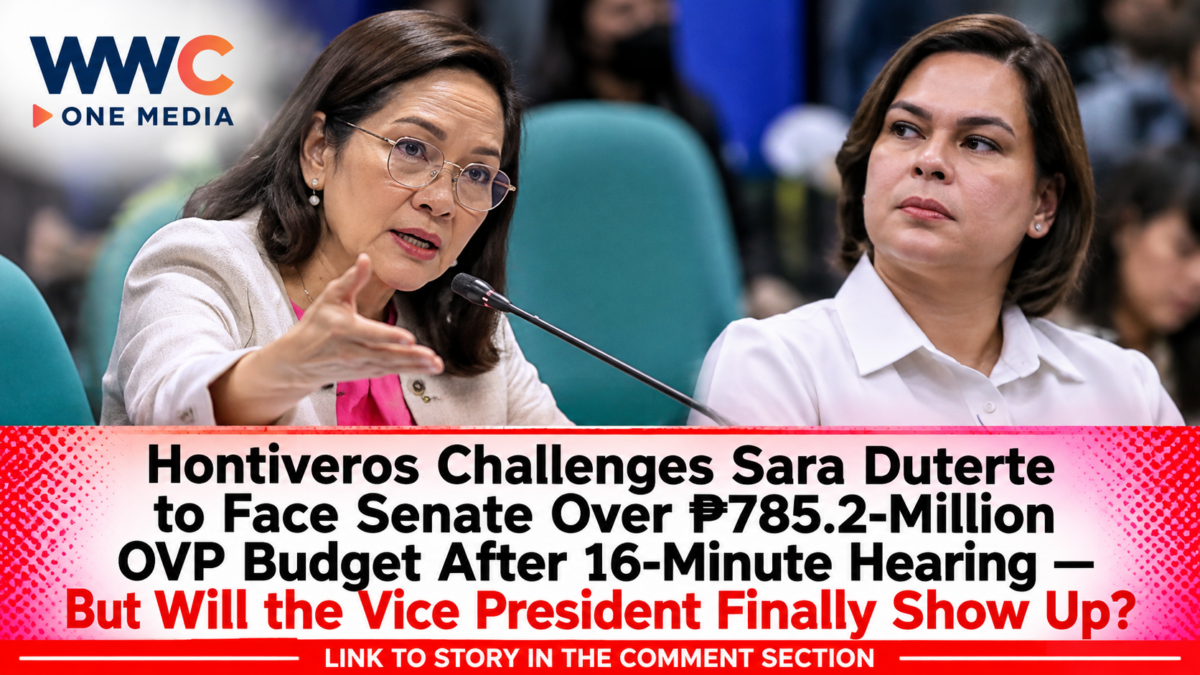
MANILA, PHILIPPINES — November 8, 2026 — Vice President Sara Duterte is facing renewed pressure to personally defend her office’s proposed ₱785.2-million budget for 2027, after Senator Risa Hontiveros declared that the country’s second-highest elected official should appear before the Senate and answer lawmakers’ questions about public spending.
The statement comes after Duterte failed to attend an October 20 Senate finance subcommittee hearing that lasted approximately 16 minutes before lawmakers endorsed the Office of the Vice President’s (OVP) proposed allocation for plenary consideration.
Speaking on Super Radyo dzBB on Sunday, November 8, Hontiveros emphasized that government agency heads are generally expected to participate in budget deliberations, particularly when legislators seek explanations about the programs and expenditures being financed by taxpayers.
The senator said the expectation should apply to every agency head, including the vice president.
She warned that another absence would attract attention because appearing before lawmakers to explain an agency’s budget is part of responsible public administration.
The renewed controversy comes as Congress examines the proposed ₱7.2-trillion national budget for 2027 and the Senate simultaneously handles Duterte’s impeachment trial.
The question now is whether Duterte will personally face senators during the next stage of budget deliberations—or whether another absence will reignite the political confrontation surrounding her office’s use of public funds.
Hontiveros Expects Sara Duterte to Personally Defend OVP Budget
Hontiveros, vice chairperson of the Senate Committee on Finance, made her position clear during a Sunday interview on Super Radyo dzBB.
She said Senate President Sherwin Gatchalian had already emphasized the importance of agency heads personally attending budget proceedings.
The expectation, she explained, applies broadly to government agencies and is not directed solely at Duterte.
Hontiveros said she expects the vice president to appear and warned that another absence would be noticed.
Her comments place renewed attention on the difference between allowing designated agency representatives to answer questions and expecting the agency’s highest official to participate personally.
Government agencies routinely send finance officers, budget officials and senior administrators to congressional hearings.
Those representatives often provide technical explanations of specific expenditures.
However, lawmakers may also want agency heads to explain policy choices, spending priorities and the overall direction of their offices.
For Hontiveros, that responsibility should extend to the Office of the Vice President.
Her statement does not mean that Duterte has been found guilty of misconduct for missing the previous hearing.
Nor does it establish that the Senate has formally ordered the vice president to attend on a particular date.
Instead, it reinforces a political and institutional expectation that senior officials should be available to explain how their offices intend to spend public money.
Senate Endorses ₱785.2-Million OVP Budget After Just 16 Minutes
The controversy follows the October 20 Senate finance subcommittee hearing on the proposed 2027 budget of the Office of the Vice President.
The proceedings ended after approximately 16 minutes.
Duterte was absent.
Her office was represented by Chief of Staff Zuleika Lopez and other officials, who appeared before lawmakers to discuss the proposed spending plan.
Senator JV Ejercito, chairman of the relevant finance subcommittee, ended the proceedings after senators invoked the tradition of institutional courtesy toward the vice presidency.
Senator Imee Marcos moved to terminate the hearing and endorse the proposed allocation for plenary consideration.
Senator Bong Go supported the motion.
Gatchalian questioned Duterte’s absence, pointing out that heads of agencies traditionally appear to defend their proposed budgets.
He expressed hope that the vice president would attend the plenary deliberations.
Ejercito also indicated that it would be preferable for Duterte to appear personally, although he acknowledged that senators might understand the political circumstances surrounding her absence.
The decision to end the committee hearing did not mean that the 2027 OVP budget had already become law.
The proposal must still pass through the remaining stages of the national budget process.
The Senate may examine the allocation further during plenary deliberations, and the final amount remains subject to congressional approval.
Where Was Sara Duterte During the October 20 Hearing?
During the committee proceeding, Gatchalian asked OVP officials about Duterte’s whereabouts.
Lopez explained that the vice president was in Davao City representing her father, former President Rodrigo Duterte, at the interment of a longtime local government official.
The explanation provided context for her absence.
However, it did not resolve the broader debate over whether the vice president should be personally available during budget hearings.
Some lawmakers argue that senior agency officials are capable of answering technical budget questions.
Others believe the agency head has a separate responsibility to explain spending decisions and policy priorities.
The distinction is especially sensitive in Duterte’s case because her office has faced repeated controversy involving confidential funds, financial accountability and legislative oversight.
For the vice president, the decision about whether to attend may also involve considerations connected to the ongoing impeachment proceedings.
However, the existence of an impeachment case does not automatically establish that she is legally prohibited from attending Senate budget deliberations.
Inside the OVP’s Proposed ₱785.204-Million Budget for 2027
According to figures reported by GMA News, the Office of the Vice President’s proposed allocation includes funding for personnel, operations and capital expenditures.
| Budget component | Proposed allocation |
|---|---|
| Personnel Services | ₱220.232 million |
| Maintenance and Other Operating Expenses | ₱561.651 million |
| Capital Outlay | ₱3.321 million |
| Total proposed agency budget | ₱785.204 million |
| Retirement and Life Insurance Premium, automatically appropriated | ₱15.544 million |
The ₱15.544 million for retirement and life insurance premiums is separately identified as an automatic appropriation and should not be confused with the ₱785.204-million proposed agency allocation.
Personnel Services covers salaries and other authorized compensation-related expenses.
Maintenance and Other Operating Expenses supports the office’s day-to-day activities, service delivery and administrative requirements.
Capital Outlay finances eligible equipment and other capital expenditures.
The OVP has said the proposed budget is intended to sustain its nationwide assistance programs and services.
These include activities intended to provide support to qualified beneficiaries through the office’s various outreach initiatives.
However, lawmakers may examine whether those programs duplicate services already offered by agencies such as the Department of Social Welfare and Development, Department of Health and other national institutions.
They may also seek explanations of how beneficiaries are selected and how the effectiveness of assistance programs is assessed.
The purpose of budget scrutiny is not simply to determine whether an agency has money to spend.
It is to establish whether the proposed expenditures are lawful, necessary and justified by public-service objectives.
OVP Budget Proposal Is Lower Than Its Current Allocation
The proposed ₱785.204-million allocation is approximately 11.7% lower than the roughly ₱889-million amount reported for the OVP’s 2026 budget.
That represents a reduction of approximately ₱103.8 million.
The decrease comes after several years of contentious discussions over the office’s spending.
The OVP had previously proposed a substantially larger budget for 2025 before congressional deliberations resulted in a reduced allocation.
The debate has been shaped partly by questions over confidential funds and the role of the vice presidency in distributing public assistance.
The proposed 2027 allocation does not include confidential or intelligence funds, according to earlier reporting on the spending plan.
This is an important distinction because historical allegations involving confidential-fund expenditures should not be conflated with the contents of the current budget request.
As previously reported by WWC ONE MEDIA, questions surrounding public spending and confidential allocations have also triggered calls for stronger accountability across government agencies.
Related WWC ONE MEDIA report: Customs Chief Rejects Secret Funds as ₱29.9-Billion Budget Request Is Slashed to ₱5.9 Billion — But Could Broken X-Ray Machines Open the Door to More Smuggling?
The broader issue is how Congress ensures that public funds are linked to clearly defined government functions and measurable outcomes.
Hontiveros and Duterte Have Clashed Over OVP Spending Before
The latest statement revives memories of an unusually heated Senate budget hearing in August 2024.
During deliberations on the proposed 2025 OVP budget, Hontiveros questioned whether some assistance programs operated by Duterte’s office duplicated services provided by existing government agencies.
She also raised questions about the funding for a children’s book authored by the vice president.
The discussion escalated into a personal confrontation.
Duterte accused Hontiveros of politicizing the budget process.
Hontiveros maintained that lawmakers had a responsibility to ask questions about public expenditures regardless of the official involved.
The exchange attracted national attention and intensified scrutiny of the OVP’s spending.
The controversy illustrated a persistent disagreement over the boundaries of legislative oversight and institutional courtesy.
For Hontiveros, questioning an agency’s budget is part of Congress’s constitutional responsibility.
For Duterte, some of the questions raised during past hearings were politically motivated, according to her statements at the time.
Both perspectives form part of the political history surrounding the current dispute.
But the actual legality and appropriateness of budget expenditures must be evaluated through evidence and applicable rules rather than political accusations alone.
Should Parliamentary Courtesy Override Budget Scrutiny?
A central issue in the current controversy is the practice of parliamentary or institutional courtesy.
Under this tradition, lawmakers sometimes expedite budget discussions involving certain senior government officials or institutions.
The practice is generally presented as a way to recognize the constitutional status of coequal branches and high-ranking offices.
However, parliamentary courtesy is not equivalent to an exemption from all forms of budget accountability.
Congress retains constitutional authority to review appropriations before they become law.
Lawmakers may examine proposed spending and seek supporting information.
The disagreement concerns how that authority should be exercised.
Some legislators believe the OVP should receive the same institutional respect traditionally extended to other high constitutional offices.
Others argue that ending hearings too quickly can prevent important questions from being asked.
The October 20 hearing highlights this tension.
Although the proposed allocation was endorsed after approximately 16 minutes, Gatchalian still questioned Duterte’s absence.
Hontiveros has now reinforced that expectation.
The controversy raises a question extending beyond one official.
Can Congress maintain institutional courtesy while ensuring that every peso of taxpayer money receives meaningful scrutiny?
Sara Duterte’s Impeachment Trial Adds to the Political Stakes
The OVP budget dispute is unfolding while Duterte faces impeachment proceedings before the Senate.
The trial has involved allegations relating to her financial disclosures and the management of public resources.
Duterte denies wrongdoing.
The allegations must be evaluated through the impeachment court’s procedures, and they should not be treated as established findings of guilt.
The Senate is expected to resume impeachment proceedings on November 9, with the defense preparing to present witnesses and challenge prosecution evidence.
The impeachment court’s work is separate from the Senate’s legislative responsibility to examine the 2027 national budget.
However, both proceedings affect the Senate’s schedule and contribute to the political sensitivity surrounding Duterte’s appearances before lawmakers.
As WWC ONE MEDIA reported, the defense has prepared 24 prospective witnesses as the trial enters another important stage.
Related WWC ONE MEDIA report: Sara Duterte’s Impeachment Trial Resumes November 9 as Defense Lines Up 24 Witnesses Against ₱817.87-Million Wealth Allegations — But Can She Save Her Political Future?
The financial allegations being examined in the impeachment proceedings concern a different legal process from the approval of the OVP’s proposed 2027 spending.
A senator’s request for budget explanations does not establish criminal or impeachable wrongdoing.
Likewise, the existence of pending impeachment proceedings does not, by itself, determine whether the office’s legitimate programs should receive funding.
Confidential-Fund Controversy Continues to Shape Public Debate
The Office of the Vice President has faced intense scrutiny over earlier confidential-fund expenditures.
Previous congressional investigations examined how public funds were released, distributed and documented.
The controversy has involved questions about supporting records, disbursement procedures and the identities of individuals identified in some payment documents.
In September, the Philippine Statistics Authority reported that it could not find matching civil-registry records for 1,685 names appearing in certain OVP and Department of Education payee lists.
That finding raised questions requiring further verification.
However, the absence of a matching civil-registry record does not automatically prove that an individual is fictitious or that the funds associated with a listed name were misused.
Further evidence would be needed to establish those conclusions.
As WWC ONE MEDIA reported, the PSA findings formed part of the broader examination of confidential-fund documentation.
Related WWC ONE MEDIA report: PSA Finds No Civil Registry Records for 1,685 Names in OVP and DepEd Payee Lists
These historical issues help explain the heightened attention surrounding the OVP’s current budget hearings.
But they should not be presented as proof that the proposed ₱785.2-million allocation contains improper expenditures.
The present proposal must be assessed on its own merits and supporting documents.
Senate Faces Pressure to Finish the ₱7.2-Trillion National Budget
The OVP hearing forms part of a much larger congressional process.
The proposed national budget for 2027 totals approximately ₱7.2 trillion.
Lawmakers must review spending proposals covering education, healthcare, infrastructure, social protection, defense and other government services.
The Senate Committee on Finance is coordinating the examination of agency budgets before the chamber moves toward plenary deliberations and subsequent legislative stages.
That process is occurring while senators also have impeachment responsibilities.
The competing demands create scheduling pressure.
Senators must ensure that agency proposals receive adequate scrutiny without unnecessarily delaying the national appropriations process.
As previously reported by WWC ONE MEDIA, Senate leaders have also invited civil society organizations to examine the proposed spending plan and identify questionable allocations.
Related WWC ONE MEDIA report: Senate Calls in Budget Watchdogs to Scrutinize ₱7.2-Trillion 2027 Spending Plan Amid ₱55-Million Road Project Controversy — But What Else Could They Uncover?
Those transparency initiatives are particularly relevant to debates over how much scrutiny should be applied to agency budgets.
Even comparatively smaller allocations deserve clear documentation and accountability.
The OVP’s proposed ₱785.2-million budget represents a small fraction of the national spending plan, but its political significance is substantial.
What Happens if Sara Duterte Does Not Attend the Senate Plenary?
Hontiveros has made clear that she expects Duterte to appear personally.
However, there is no confirmed announcement that the Senate will automatically penalize the vice president if she misses the upcoming deliberations.
Lawmakers may question the absence, seek additional explanations from OVP officials or decide how to proceed under Senate rules.
The outcome will depend on the chamber’s procedural decisions.
Duterte’s representatives may still be able to provide technical information regarding the proposed allocation.
But Hontiveros and Gatchalian have emphasized the importance of agency heads being available to explain their offices’ spending priorities.
The next question is whether the vice president will personally participate when the OVP budget reaches the Senate plenary.
As of November 8, her attendance at that stage has not been confirmed in the reporting reviewed.
The specific plenary schedule should also be distinguished from the earlier October 20 committee briefing.
Duterte’s absence from that completed hearing does not prove she will skip all subsequent proceedings.
The Bigger Picture: Is This About ₱785 Million or Government Accountability?
At the center of the dispute is a fundamental question about the responsibilities of public officials.
The Office of the Vice President is requesting ₱785.204 million to maintain its operations and deliver services in 2027.
That funding may support legitimate government activities benefiting Filipinos across the country.
But lawmakers are responsible for examining proposed appropriations before public money is authorized.
Hontiveros argues that agency heads should participate personally in that process.
Gatchalian raised similar concerns when Duterte was absent during the October 20 hearing.
The vice president’s office, meanwhile, sent senior representatives who were available to discuss the proposed allocation.
The disagreement is therefore not simply about whether someone attended a meeting.
It concerns how public institutions balance respect for high-ranking offices with the need for meaningful financial oversight.
The political circumstances surrounding Duterte make the debate more sensitive.
Her previous exchanges with Hontiveros, the historical confidential-fund controversy and the ongoing impeachment proceedings have intensified scrutiny.
But the current budget must still be evaluated according to its proposed programs, documented expenses and expected public benefits.
Hontiveros has now made her expectation clear: Sara Duterte should personally appear before senators and defend her office’s spending priorities.
Whether Duterte agrees remains to be seen.
And as the Senate prepares to examine the OVP’s ₱785.2-million budget, one question could determine whether the controversy escalates further: Will Sara Duterte face lawmakers and answer their questions—or will another absence turn an ordinary budget deliberation into a fresh political showdown?