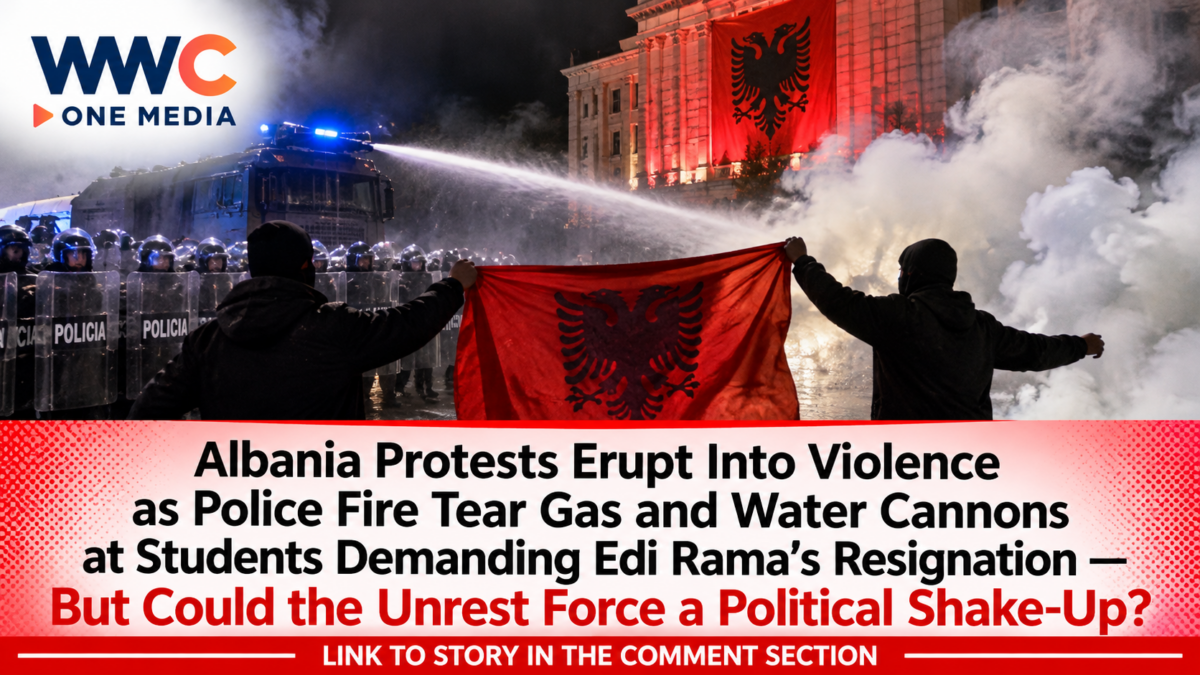
TIRANA, ALBANIA — November 8, 2026 — Albania’s escalating political crisis has erupted into another round of violent street clashes, with police firing tear gas and deploying water cannons against anti-government demonstrators demanding the resignation of Prime Minister Edi Rama.
The latest confrontation unfolded on Saturday, November 7, in the capital Tirana, where student protesters gathered near the Ministry of Education before unrest spread toward the prime minister’s office.
According to Bloomberg and local Albanian media, some demonstrators threw stones, fireworks and Molotov cocktails at police officers, while security forces responded with crowd-control measures.
The violence marks another escalation in weeks of demonstrations driven by frustration over alleged government corruption, limited employment opportunities, education costs and declining public confidence in political institutions.
The unrest also follows months of environmental demonstrations against a multibillion-euro luxury tourism development associated with Jared Kushner, the son-in-law of US President Donald Trump.
What began as opposition to a controversial coastal investment has evolved into a much broader movement challenging Albania’s political leadership.
With students demanding sweeping reforms, opposition parties calling for the government’s resignation and police struggling to contain repeated clashes, could Albania’s latest protests become a defining test of Rama’s political future?
Tirana Erupts as Protesters Clash With Police Near Government Buildings
The November 7 demonstrations began outside Albania’s Ministry of Education.
Students gathered to protest the condition of the country’s education system, rising expenses and limited opportunities after graduation.
A separate rally organized by the opposition Democratic Party also took place in the capital.
According to Albania’s public broadcaster RTSH, Democratic Party supporters later approached the student demonstration, attempting to join the gathering.
Some student organizers resisted their participation, emphasizing that their movement was independent of established political parties.
The confrontation highlighted an important division within Albania’s anti-government movement.
While both groups have expressed dissatisfaction with Rama’s administration, student organizers and opposition politicians do not necessarily share the same political objectives.
As the demonstrations continued, tensions intensified.
Albania’s official ATA news agency reported that some protesters set rubbish bins on fire and pushed them toward police officers.
Masked individuals threw stones and other objects at security personnel.
Police responded with pepper spray, tear gas and water cannons.
Demonstrators subsequently moved toward the prime minister’s office along Dëshmorët e Kombit Boulevard.
There, further clashes erupted as Molotov cocktails, fireworks and stones were thrown toward police.
Security forces deployed additional water cannons to extinguish flames and disperse crowds.
The confrontation disrupted activity around central Tirana and added to concerns over the increasing frequency of violent incidents.
Reports reviewed did not establish a definitive nationwide injury or arrest total for the November 7 demonstrations.
Why Albanian Students Are Demanding Edi Rama’s Resignation
The latest protests are part of a student-led movement that intensified in mid-October.
Demonstrators have raised concerns about the affordability and quality of university education.
Their demands include improved classroom and dormitory conditions, greater financial assistance, better job opportunities and stronger accountability for public officials.
Young Albanians have also expressed frustration over the difficulty of securing stable employment after graduation.
Reuters reported that the movement rapidly expanded beyond university issues as protesters began demanding Rama’s resignation.
Demonstrations subsequently spread from Tirana to other cities.
Albania’s unrest reflects several distinct grievances rather than a single policy disagreement.
Some participants are primarily concerned about education and employment.
Others oppose the government’s handling of corruption allegations.
Environmental campaigners have focused on controversial tourism developments.
And opposition politicians are demanding changes in political leadership.
These groups may share dissatisfaction with the government without necessarily agreeing on what should replace it.
As previously examined by WWC ONE MEDIA, student activism has become increasingly visible across Europe amid concerns over economic insecurity, public services and political representation.
Related WWC ONE MEDIA coverage: Europe’s Young Generation Is Fighting Back—But Will Its Anger Force Leaders to Listen?
The Albanian demonstrations form part of that wider pattern, although their causes and political circumstances are specific to the country.
Jared Kushner’s Luxury Resort Project Helped Ignite the Wider Protest Movement
One of the most controversial issues behind the unrest involves a proposed luxury coastal development associated with Jared Kushner’s investment firm, Affinity Partners.
Earlier demonstrations focused on plans for tourism facilities near Albania’s environmentally sensitive Adriatic coastline.
The development includes proposals associated with Sazan Island and the Vjosa-Narta coastal area.
Environmental campaigners argue that construction could threaten protected habitats used by flamingos, seals, sea turtles and other wildlife.
The protests became known as the Flamingo Revolution, with demonstrators using pink flamingo imagery to symbolize the environmental campaign.
According to Reuters, the broader investment plans have been described as potentially worth as much as €5 billion, although the figures cover multiple proposed development components and should not be confused with the cost of any single resort.
Campaigners have questioned the project’s transparency and its potential effect on protected land.
The development’s backers maintain that the investment could create jobs, strengthen tourism and generate economic benefits.
Rama has defended the proposals as an opportunity to modernize Albania’s tourism industry.
The dispute therefore involves competing considerations about economic development, environmental protection and public consultation.
Importantly, the Kushner-linked resort controversy was an earlier catalyst for demonstrations. It should not be presented as the sole cause of the November student protests.
Albania’s Anti-Government Movement Has Expanded Beyond Tourism
By October, the demonstrations had become increasingly focused on domestic economic and political concerns.
On October 14, thousands of students gathered in Tirana during demonstrations that escalated into attacks on government buildings and commercial properties.
Reuters documented fires at public buildings and banks, along with clashes involving stones, tear gas and water cannons.
The disorder continued over subsequent days.
On October 17, Reuters journalists documented the apparent use of rubber bullets during confrontations between police and demonstrators.
Some protesters and journalists were struck by projectiles.
The incidents heightened concerns about the proportionality of police responses.
By October 29, the unrest had reached Albania’s parliament.
Opposition Democratic Party lawmakers disrupted a parliamentary session, setting off flares and blocking access to the podium.
Opposition leader Sali Berisha criticized the authorities’ treatment of protesters and accused the government of using excessive force.
The incidents demonstrated how street demonstrations were beginning to affect formal political proceedings.
Yet opposition parties have also struggled to establish a unified relationship with student protesters.
Some young demonstrators distrust established political organizations and reject attempts to take control of their movement.
That division remains important in assessing the potential political consequences of the unrest.
Prime Minister Edi Rama Refuses to Resign
Rama, who has governed Albania since 2013, has rejected demands to leave office.
He secured a fourth term following the country’s 2025 parliamentary election.
The prime minister has acknowledged that some public grievances deserve attention while arguing that violence cannot determine political leadership.
In an October 25 address, he stated that those seeking his resignation through violence were mistaken, while recognizing that not every complaint raised by demonstrators was unjustified.
His administration has proposed economic measures intended to address some public concerns.
These include assistance for lower-income households and efforts to reduce financial pressures.
The government has also offered dialogue with students.
However, those initiatives have not ended the protests.
The dispute has become increasingly polarized as demonstrators demand more substantial reforms and authorities seek to restore public order.
Rama has also accused opposition groups of contributing to the violence.
Those allegations remain contested.
Student activists have emphasized that their demonstrations are not simply an extension of the opposition Democratic Party’s political strategy.
The government is therefore facing a difficult challenge: responding to legitimate public concerns while addressing violent incidents without unnecessarily restricting peaceful assembly.
Albania Introduces Heavy Fines to Control Violent Demonstrations
The government’s response has included tougher measures against protest-related violence.
In late October, Albania introduced rules allowing fines of up to 500,000 lek, approximately €5,500, in specified circumstances involving violent demonstrations.
According to Euronews, the measures could apply to individuals who remain in crowds engaged in violence or looting, even if they are not personally responsible for the destructive acts.
That provision has attracted attention because of its potential implications for peaceful participants.
The government argues that stronger penalties are necessary to protect public safety and prevent attacks on businesses, institutions and police officers.
Authorities have also proposed changes relating to masked demonstrators, unlawful road blockages and calls for violence.
However, the measures must be assessed against constitutional protections and Albania’s obligations under European human-rights standards.
The distinction between peaceful protest and criminal violence is essential.
A person participating in a lawful demonstration should not automatically be treated as responsible for violent actions committed by others.
The debate over Albania’s response therefore extends beyond public security.
It also concerns the appropriate limits of state power during politically sensitive demonstrations.
Police Use of Rubber Bullets Raises Human-Rights Questions
The clashes have generated concerns over police tactics.
Reuters reported that rubber bullets were used during earlier October protests.
In one incident, journalists working near demonstrators were struck by projectiles.
Protesters and opposition politicians have accused law enforcement of responding disproportionately.
Authorities maintain that officers have faced dangerous attacks involving stones, fireworks and incendiary devices.
Both issues require separate examination.
Attacks on police officers and destruction of property can constitute criminal offenses.
At the same time, police must use force within applicable legal limits and avoid unnecessary or disproportionate harm.
Investigations into allegations of misconduct are important for establishing accountability.
Rama’s government has said it is committed to protecting peaceful assembly while punishing violence.
Whether the new measures achieve that balance will depend on their implementation and oversight.
The same distinction has been relevant in other recent European demonstrations.
Related WWC ONE MEDIA coverage: Thousands Defy Italy’s Massive Security Crackdown as Police Arrest 9 and Detain 371 — But Is Giorgia Meloni Facing a Bigger National Revolt?
The comparison does not mean Albania and Italy face identical political circumstances, but both cases illustrate tensions between public-order enforcement and the right to demonstrate.
Albania’s European Union Ambitions Face Another Test
The unrest comes at a sensitive moment for Albania’s long-term diplomatic and economic ambitions.
The country is pursuing membership in the European Union.
Rama has identified EU accession as one of his government’s major strategic priorities.
Membership negotiations involve reforms in governance, judicial institutions, public administration and other areas.
Concerns about corruption and the rule of law are therefore relevant to the accession process.
The demonstrations may increase political attention on Albania’s progress toward those standards.
However, street protests do not automatically suspend membership negotiations.
The European Union will assess Albania against its established accession requirements and institutional reform commitments.
A prolonged political confrontation could complicate the reform environment, but the consequences will depend on government decisions, institutional stability and the progress of negotiations.
The prime minister argues that continuing his administration’s reform program is necessary to advance Albania’s European future.
Critics contend that greater transparency and accountability are essential to achieving that objective.
Those competing positions remain central to the country’s political debate.
Protests Could Affect Albania’s Tourism and Investment Image
Albania has attracted international attention as a growing European tourism destination.
Its Adriatic coastline, mountain landscapes and cultural attractions have encouraged investment in hotels, transport and hospitality infrastructure.
The Kushner-linked resort controversy demonstrates the financial interest in large tourism projects.
But the unrest raises questions about development priorities and community consent.
Investors may monitor political stability, planning disputes and regulatory certainty when evaluating potential projects.
Tourists may also reconsider itineraries if demonstrations affect transportation or access to major urban areas.
However, the existence of protests in Tirana does not mean that travel throughout Albania is uniformly unsafe or that the country’s tourism industry has collapsed.
Conditions can differ significantly between locations.
As previously reported by WWC ONE MEDIA, several governments have issued travel warnings relating to demonstrations in parts of Europe, including caution about disruptions and potential violence.
Related WWC ONE MEDIA coverage: Thailand and Malaysia Issue Urgent Europe Travel Warnings as Riots Spread — What Tourists Need to Know Before Departure
Travelers should consult current official advisories and local transport information rather than assuming every European destination faces the same security conditions.
The Student Movement Faces Its Own Political Test
The student movement has become a prominent force in Albania’s demonstrations.
But its growing influence presents organizational challenges.
Some participants insist that the protests must remain independent of established political parties.
Others favor cooperation with opposition politicians who also demand Rama’s resignation.
The November 7 confrontation between students and Democratic Party supporters highlighted those disagreements.
Their competing approaches could affect how future demonstrations are organized.
Independent student groups may prioritize education reform and employment opportunities.
Opposition politicians may place greater emphasis on early elections or changes in government leadership.
The two objectives can overlap, but they are not interchangeable.
Similar tensions between campus activism and broader political movements have emerged elsewhere in Europe.
Related WWC ONE MEDIA coverage: Masked Group Storms Athens University Campus With Axes and Molotov Cocktails, Leaving 3 Injured — Political Student Clashes Raise Fears Over Campus Safety in Greece
That separate incident does not establish a connection to Albania’s unrest. It provides context for the broader challenge of protecting peaceful campus activism while responding to violence.
For Albania’s student organizers, the immediate question is how to maintain a coherent movement while different groups attempt to influence its direction.
What Happens Next as Protests Continue?
The November 7 clashes demonstrate that Albania’s political dispute remains unresolved.
The students’ demands for better education, employment prospects and public accountability have not been fully addressed.
The opposition continues calling for Rama to step down.
The government maintains that it has a mandate to govern and that political change must follow lawful procedures.
Additional demonstrations could bring further confrontation, but their scale and outcome cannot be reliably predicted.
The immediate developments to monitor include any new negotiations with student representatives, the implementation of public-order measures, investigations into alleged police misconduct and the handling of reported corruption cases.
Any verified injuries or arrests from the November 7 clashes should also be reported once authorities or independent news organizations publish reliable figures.
The central challenge is whether Albania’s institutions can respond to public demands while preserving both political stability and fundamental rights.
The Bigger Picture: Could Albania’s Protests Mark a Turning Point?
Albania’s latest violence reflects growing tensions between a government seeking to maintain authority and demonstrators demanding political, economic and institutional changes.
The country has experienced months of protest over environmental concerns surrounding a controversial coastal development.
Those demonstrations have since expanded into wider anger about corruption allegations, education costs, employment opportunities and political accountability.
The November 7 clashes have again placed Tirana at the center of the dispute.
Police used tear gas and water cannons as some protesters threw stones, fireworks and incendiary devices.
Student activists and opposition political groups also demonstrated their differences over how the movement should proceed.
For Rama, the challenge is addressing public concerns while maintaining order and continuing his government’s agenda.
For protesters, it is translating demands into concrete reforms without allowing violence or internal political divisions to overshadow their objectives.
No confirmed resignation, early election or negotiated political settlement has resulted from the latest confrontation.
But the unrest has created a continuing test of Albania’s political institutions, public trust and democratic protections.
And as students return to the streets, opposition parties increase pressure and police confront fresh violence, one question remains: Will Albania’s government and protesters find a path toward meaningful reforms—or could the deepening standoff bring another round of political instability?