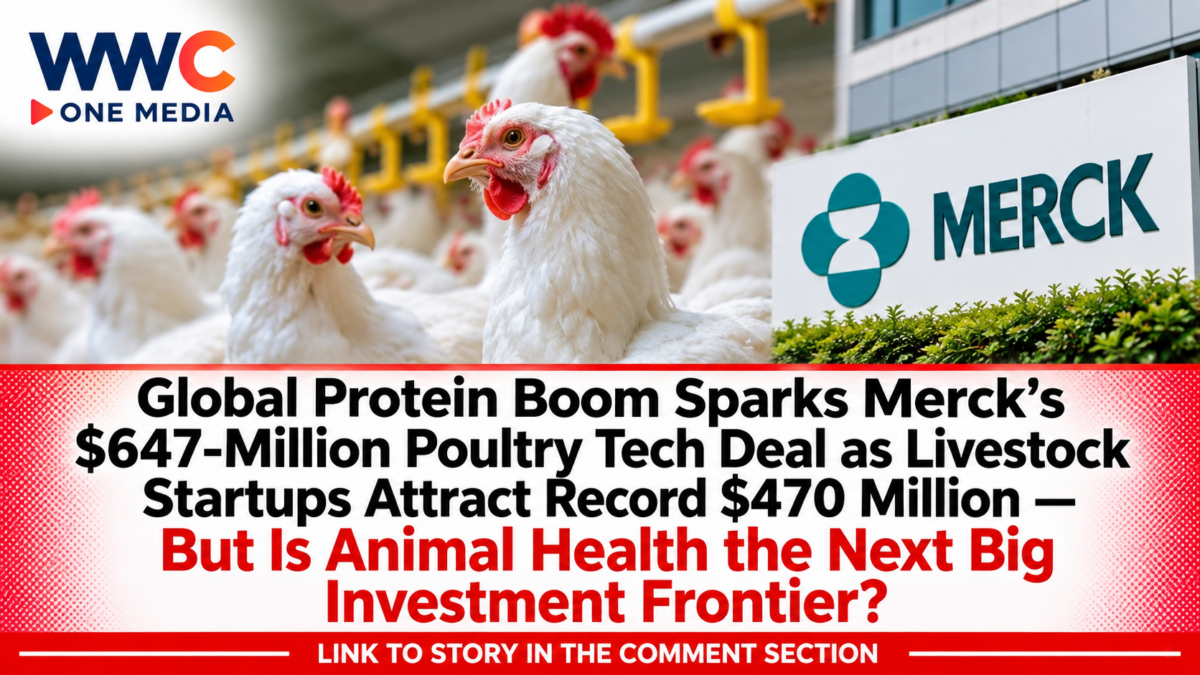
NEW YORK / MANILA — November 8, 2026 — The world’s growing appetite for protein is creating an unexpected investment boom, with pharmaceutical giants and venture-capital firms pouring hundreds of millions of dollars into technologies designed to keep cattle, pigs and poultry healthier.
The new investment race is extending far beyond conventional veterinary medicines.
Companies are acquiring automated poultry systems, livestock genetics businesses, dairy-health specialists and advanced monitoring technologies as farmers face mounting pressure to produce food more efficiently while preventing costly disease outbreaks.
According to Bloomberg’s November 7 report, major animal-health companies including Merck & Co., Zoetis and Elanco Animal Health are expanding their investments in livestock technology as changing diets, population growth and demand for protein-rich foods reshape the agricultural industry.
The numbers are substantial.
Merck completed its acquisition of poultry-technology company TARGAN for US$647 million, according to its latest regulatory filing.
Zoetis agreed to purchase Neogen’s animal genomics business for US$160 million, while venture-capital investment in livestock management reached a reported US$470 million globally through November 3, 2026.
The investment boom is unfolding as farmers confront persistent threats from African swine fever, avian influenza and other animal diseases.
But the industry’s rapid expansion raises a question with consequences far beyond Wall Street.
Could the global race to develop healthier livestock ultimately lower food production costs and strengthen food security—or will the biggest financial gains go to the companies supplying the technology?
Why the World’s Protein Craze Is Driving Livestock Investment
Protein has become one of the most prominent trends in the global food industry.
From high-protein beverages and dairy products to meat, eggs and nutritional supplements, food manufacturers are introducing products designed to appeal to health-conscious consumers.
The trend has gained additional attention from the growing use of GLP-1 weight-loss medications.
Some users of these treatments are seeking protein-rich foods to help maintain muscle mass while losing weight.
But the commercial opportunity extends well beyond consumer food products.
Growing demand for meat, eggs and dairy encourages livestock producers to improve productivity, reduce losses and make better use of resources.
For animal-health companies, those priorities represent opportunities to sell veterinary medicines, vaccines, diagnostics, monitoring equipment and breeding technologies.
A healthier herd or flock can reduce some avoidable production losses.
Early disease detection may also allow farmers to respond before an infection spreads extensively.
However, increasing consumer interest in protein does not necessarily translate into equivalent growth in meat consumption. Protein can come from animal and plant sources, and the strength of demand varies by market.
The investment case is therefore based on broader agricultural needs as well as changing dietary preferences.
Merck Makes a $647-Million Bet on Smart Poultry Farming
Merck has emerged as one of the major participants in the expanding animal-health technology market.
In July 2026, the pharmaceutical company completed its acquisition of TARGAN, a specialist in automated poultry equipment.
Its September-quarter regulatory filing identified the purchase price as US$647 million.
TARGAN’s technologies are designed to help commercial hatcheries manage large numbers of chicks efficiently.
One of its flagship products, WingScan, uses imaging technology and automated analysis to identify and sort chicks by sex.
According to Merck, the system can process up to 160,000 chicks per hour.
The acquisition also provides technology capable of administering certain vaccines to newly hatched chicks.
These systems could help poultry producers improve handling consistency, vaccination processes and operational efficiency.
For Merck, the transaction represents a shift toward combining pharmaceutical products with equipment and data-driven agricultural technologies.
Instead of focusing exclusively on treatments for sick animals, the company is investing in systems intended to improve livestock management throughout the production process.
Merck is also pursuing a separate, approximately US$895-million expansion of animal-health manufacturing operations in Kansas.
The projects highlight the scale of the company’s commitment to its livestock-related business.
Zoetis Moves Into Livestock Genetics With $160-Million Deal
Zoetis is pursuing a different technological opportunity.
In March, the company announced a definitive agreement to acquire Neogen Corporation’s global animal genomics business for US$160 million.
The business provides DNA testing and genetic data tools used in livestock breeding and management.
These technologies can help farmers evaluate breeding characteristics and make more informed decisions about herd productivity.
For cattle producers, genetic information may support decisions involving milk production, breeding performance and other commercially important traits.
Neogen reported that the business generated approximately US$90 million in sales during fiscal 2025.
The acquisition remains subject to the relevant closing requirements and regulatory approvals described in company disclosures.
The importance of the agreement lies in the wider adoption of precision agriculture.
Livestock companies increasingly want to use genetic information alongside veterinary care, nutrition and farm-management data.
Such tools may improve decision-making, but they do not eliminate the need for adequate animal welfare, biosecurity and sound farming practices.
Elanco’s Animal-Health Business Shows Strong Growth
Elanco Animal Health is also expanding its exposure to livestock productivity.
The company acquired AHV International, a Netherlands-based dairy-health business, during 2026.
The transaction increased Elanco’s presence in products and services associated with dairy-cow health.
In its November 6 earnings release, Elanco reported third-quarter revenue of approximately US$1.265 billion, an 11% increase from a year earlier.
The company also reported strong growth in its ruminant business, which primarily serves cattle producers.
According to Bloomberg’s industry coverage, Elanco Chief Executive Jeff Simmons expects livestock-related animal health to remain an important growth area through the remainder of the decade.
Simmons has pointed to the financial importance of small productivity improvements for commercial farms.
Even modest reductions in disease losses or improvements in production efficiency can affect profitability when multiplied across large livestock operations.
Nevertheless, corporate growth forecasts are not guarantees.
Demand for veterinary products can change with animal populations, farm profitability, disease conditions and competition.
Venture Capital Sees a Record Opportunity in Livestock Management
Major pharmaceutical companies are not the only investors entering the sector.
Startups are attracting capital for technologies involving livestock monitoring, automated farm management, precision breeding and veterinary diagnostics.
According to PitchBook data cited in reporting on the industry, global venture-capital investment in livestock management reached approximately US$470 million during 2026 through November 3.
Of that amount, about US$88 million was directed specifically toward animal-health businesses.
The figures cover different but overlapping investment categories.
The US$88 million should not be added to the US$470 million as though it were an entirely separate investment pool.
Developers are working on technologies that can help farmers monitor animal behavior, identify possible health problems and optimize production schedules.
Merck, for example, is developing livestock monitoring technologies for cattle and pigs.
The company expects to introduce a beef-cattle monitoring system for Australian feedlots in 2027 and pursue pilot activities involving pigs.
Such technology could help farmers make more timely management decisions.
But its commercial value will depend on cost, reliability and the improvements it delivers under actual farming conditions.
African Swine Fever Shows Why Animal Health Matters to the Philippines
The investment boom has particular relevance to the Philippines, where livestock diseases continue to threaten farmers and food production.
African swine fever, or ASF, remains a major concern for the country’s hog industry.
The disease can cause severe mortality in infected domestic pigs and lead to extensive movement restrictions and control measures.
In Cebu, authorities have implemented quarantine and livestock-movement restrictions following confirmed infections.
As previously reported by WWC ONE MEDIA, laboratory tests confirmed ASF in pig samples collected in Ginatilan, prompting tighter surveillance and containment activities.
Related WWC ONE MEDIA report: Three Pig Samples Test Positive for ASF in Ginatilan as Cebu Tightens Containment Measures
The situation demonstrates why effective veterinary services and biosecurity are important for domestic food supply.
A disease outbreak can affect not only the number of animals available for sale but also transport arrangements, farm incomes and market access.
For small livestock producers, preventive veterinary care may be especially valuable because even a limited outbreak can cause significant financial losses.
However, advanced monitoring equipment alone cannot prevent ASF.
Farm biosecurity, disease reporting, appropriate testing and enforcement of animal-movement controls remain essential.
Philippines Invests ₱148 Million in Livestock Modernization
The Philippines is also undertaking investments intended to improve the productivity and commercial competitiveness of its livestock industry.
In Magsaysay, Davao del Sur, a ₱148.19-million integrated livestock enterprise project is progressing under the Department of Agriculture’s Philippine Rural Development Project Scale-Up.
The initiative includes facilities for meat processing, milk production and improved market access.
The project is designed to address limitations involving aging slaughterhouse facilities and insufficient dairy-processing capacity.
As WWC ONE MEDIA previously reported, the planned development could benefit livestock farmers, cooperatives and other participants in the local agricultural supply chain.
Related WWC ONE MEDIA report: Magsaysay Moves Ahead With ₱148.19-Million Livestock Project to Transform Local Meat and Dairy Industry
The investment reflects a similar goal to the international animal-health boom: improving efficiency and strengthening the economic value of livestock production.
But the Philippine project focuses primarily on agricultural infrastructure and local processing rather than corporate acquisitions of veterinary technology firms.
Its projected benefits will depend on implementation, effective management and access to reliable markets.
₱237.9-Million Buffalo Genetics Laboratory Highlights Biotechnology’s Potential
Another example of Philippine agricultural modernization is the development of a specialized buffalo-breeding laboratory in Nueva Ecija.
The Department of Agriculture and Philippine Carabao Center inaugurated a ₱237.9-million facility in September 2026 designed to produce sex-sorted buffalo semen.
The technology can help breeding programs increase the likelihood of producing female calves for dairy production.
Female buffaloes are particularly important to expanding herds that produce milk.
The facility represents an effort to improve breeding efficiency and strengthen domestic dairy production over time.
Related WWC ONE MEDIA report: The Philippines Just Unveiled a World-First Buffalo Lab—And It Could Change the Dairy Industry
The project illustrates how animal genetics can support agricultural development outside the world’s largest commercial farming markets.
However, its long-term benefits will also depend on access to feed, veterinary services, breeding support and suitable farm management.
Genetic improvements alone cannot guarantee higher milk production.
Surigao’s ₱6.3-Million Poultry Program Shows Opportunities for Small Farmers
Smaller livestock enterprises are another part of the animal-health investment story.
In Surigao del Norte, the Department of Agriculture supported three farmers’ cooperatives through a combined ₱6.3-million poultry-production program.
Each cooperative received a package valued at approximately ₱2.1 million.
The assistance includes ready-to-lay chickens, housing equipment, feeds, veterinary supplies and other production materials.
Together, the cooperatives received 3,000 ready-to-lay chickens.
As previously covered by WWC ONE MEDIA, the initiative aims to help farmers develop sustainable egg-production businesses and strengthen local food supply.
Related WWC ONE MEDIA report: ₱6.3-Million Livestock Project Lands in Surigao Norte—But What Happens Next Could Change Local Egg Supply
The program demonstrates that animal-health investment is not limited to expensive laboratories or large pharmaceutical transactions.
Basic veterinary supplies, proper housing, nutrition and effective disease prevention can also contribute to livestock productivity.
The challenge is ensuring that farmers can sustain operations after initial assistance ends.
Will the Protein Boom Finally Make Meat, Milk and Eggs Cheaper?
For consumers, the most important question is whether greater livestock productivity will result in lower food prices.
In theory, stronger disease prevention and efficient farm management can reduce production losses.
Healthy animals may require fewer emergency interventions, and improved breeding or monitoring can help farms use resources more effectively.
But food prices depend on much more than veterinary technology.
Feed, transportation, fuel, labor, processing costs, weather conditions and supply-chain competition all affect retail prices.
Advanced equipment can also be expensive to install and maintain.
Farmers may need years to recover those investments.
Consequently, the animal-health investment boom should not be presented as proof that meat, milk and eggs will become cheaper.
Its more immediate potential is to strengthen production reliability and reduce certain risks.
Whether consumers benefit through lower prices will depend on how savings move through the food supply chain.
A Bigger Challenge: Food Security, Sustainability and Animal Welfare
Greater livestock productivity also raises important environmental and ethical questions.
Intensive production systems can increase demand for feed, water and land while generating manure and greenhouse-gas emissions.
Animal-health improvements can potentially make some production systems more efficient.
But the environmental effects depend on production practices, herd sizes, resource management and the specific technologies used.
Animal welfare remains an essential consideration.
The goal of improving production efficiency should not come at the expense of appropriate care, housing or disease prevention.
The Food and Agriculture Organization of the United Nations reported in September 2026 that livestock production systems provide approximately one-third of the world’s protein supply.
That contribution makes livestock an important element of global food security.
It also underscores the importance of balancing agricultural productivity with environmental responsibility and sustainable management.
For developing economies, improvements in livestock health can support livelihoods and food availability.
But appropriate policies need to consider local farming conditions rather than relying solely on technologies developed for large commercial operations.
The Bigger Picture: Could Animal Health Become a Major Global Investment Market?
The latest wave of investments shows how changing consumer preferences can influence industries far beyond supermarket shelves.
Merck is expanding into poultry automation.
Zoetis is pursuing livestock genomics.
Elanco is strengthening its dairy-health portfolio.
Venture-capital firms are funding startups developing technologies for monitoring and managing animals.
Together, these developments reveal increasing interest in the economics of food production.
The opportunity is substantial because livestock producers continually face disease risks, productivity constraints and the need to supply reliable animal-derived food products.
But the industry’s future will depend on more than growing protein demand.
Companies must demonstrate that their technologies work, satisfy regulatory requirements and deliver benefits farmers can afford.
For the Philippines, the trend highlights the importance of disease prevention, genetic improvements, poultry management and stronger agricultural infrastructure.
The global protein boom is creating new opportunities for companies that can help farmers produce food more efficiently and safely.
Yet investment alone cannot guarantee affordable food or sustainable agricultural growth.