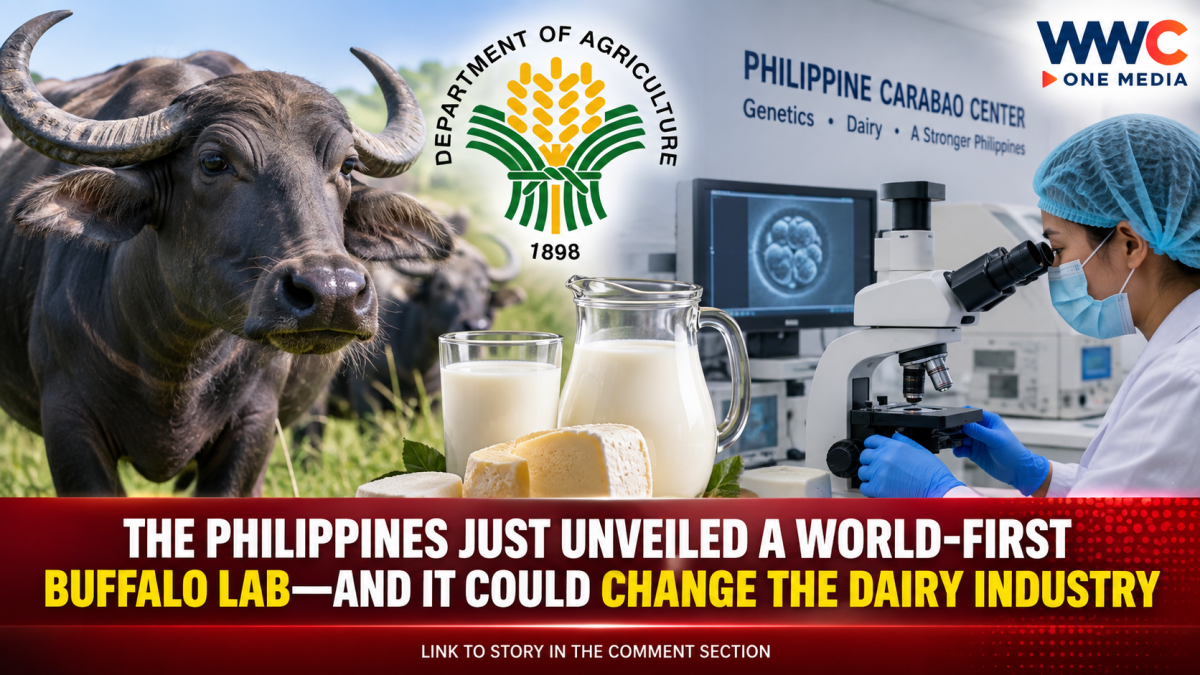
SCIENCE CITY OF MUÑOZ, NUEVA ECIJA — The Philippine government is turning to reproductive biotechnology in a bid to expand the country’s dairy herd, cut dependence on imported dairy products and give Filipino farmers greater control over livestock breeding.
The Department of Agriculture (DA) and the Philippine Carabao Center (PCC) on September 18 inaugurated what the government describes as the world’s first laboratory dedicated exclusively to sex-sorting buffalo semen, a ₱237.9-million facility located at the PCC’s national headquarters and gene pool in Science City of Muñoz.
The technology uses flow cytometry to separate sperm carrying X and Y chromosomes with about 90% accuracy. The resulting semen can then be cryogenically preserved and used in artificial insemination programs.
The objective is straightforward: increase the chances of producing female buffalo calves, which can eventually enter the dairy and breeding herd, while allowing farmers to produce male offspring when meat or draft animals are preferred.
Agriculture Secretary Francisco P. Tiu Laurel Jr. said the facility could help farmers gain more control over breeding while supporting local production of breeding materials and reducing foreign-exchange requirements associated with imports.
Why female buffaloes matter
Female calves are particularly important to dairy expansion because they can eventually become milk-producing animals and replacement breeders.
The PCC plans to produce approximately 170,000 sex-sorted semen straws annually, with female offspring expected to be a major focus of the program. Distribution for field artificial insemination is scheduled to begin in the fourth quarter of 2026, while the first genetically targeted calves are expected in late 2027.
The new facility builds on years of PCC work involving artificial insemination, genetic improvement and reproductive biotechnology. The center has previously identified sex-sorted semen as a potential tool for producing female buffaloes specifically for dairy production.
The timing comes as Philippine dairy production is growing
The laboratory arrives as the domestic dairy sector records significant gains.
DA and National Dairy Authority data show that Philippine local milk production reached 25.38 million liters during January–June 2026, up 21.2% from 20.94 million liters during the same period in 2025.
The country’s dairy herd also increased 6.5%, reaching 165,858 head, while the value of dairy production rose 21.4% to ₱975.73 million at constant 2018 prices.
The Philippine Statistics Authority likewise reported that dairy production during the second quarter of 2026 increased 37.8% year-on-year, reaching 13.58 thousand metric tons.
But the country remains heavily dependent on imported dairy products. The DA says domestic milk production currently accounts for less than 5% of national demand, underscoring the scale of the challenge facing local producers.
Carabao milk is already becoming more valuable
The latest figures also point to rising opportunities for buffalo dairy farmers.
As of March 2026, the farmgate price of carabao milk increased 4.95% to ₱89.55 per liter, according to NDA figures cited by the DA and Philippine News Agency. Cow’s milk, by comparison, was reported at ₱47.05 per liter.
The PCC has also reported 3.9 million liters of buffalo milk traded as part of more than 7.8 million kilograms of buffalo-derived products recorded through June 2026.
The technology is part of a much bigger breeding strategy
The new laboratory is not a standalone intervention.
The PCC has been using artificial insemination and improved buffalo genetics to upgrade Philippine carabaos for milk and meat production. According to the center, crossbreeding Murrah buffalo with Philippine carabaos can substantially increase milk productivity compared with native animals, while maintaining characteristics important to farmers.
As of June 2026, the PCC reported producing 16,918 genetically improved calves through artificial insemination, bull entrustment, private bulls and institutional herds.
Farmer-focused programs are also continuing. In August, the DA-PCC entrusted 21 purebred dairy buffaloes to 16 cooperative members in Nueva Ecija to strengthen the local dairy herd and sustain milk production.
A long-term bet on Philippine dairy
The government’s new sex-sorting facility therefore represents more than a laboratory investment. It is designed to address one of the fundamental bottlenecks in dairy expansion: building a sufficiently large and productive breeding herd.
The facility was funded under the U.S. Public Law 480 program and completed in three months through the DA’s Intensified Community-based Enterprise Development program, according to the agriculture department.
If the planned production and artificial-insemination rollout proceed as scheduled, the technology could gradually increase the number of female dairy buffaloes entering Philippine farms.
But the bigger test will come after the laboratory opens its pipeline to farmers: whether improved genetics translate into more productive animals, higher farmer incomes and, eventually, a larger share of Philippine milk coming from local farms.
For now, the government is betting that the next major step in Philippine dairy development may begin not with more imports—but with better-controlled breeding at home.