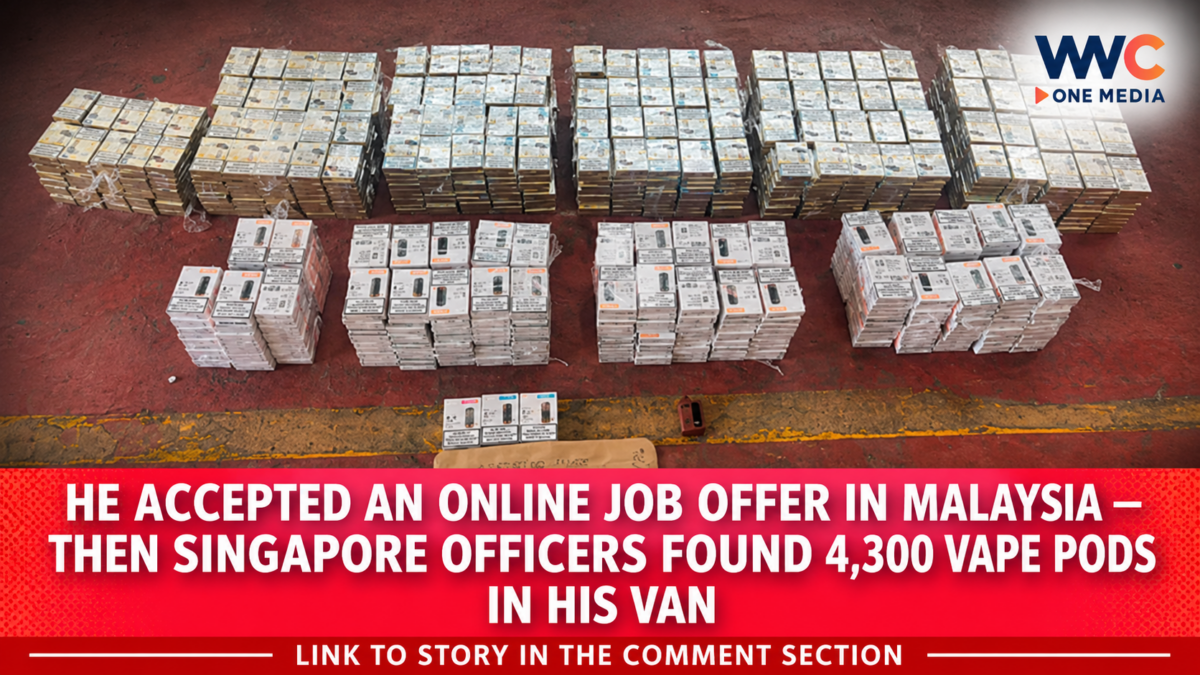
A Malaysian national has been sentenced to 18 months in prison after importing more than 4,300 non-etomidate vaporiser pods into Singapore through Woodlands Checkpoint, marking the highest sentence imposed to date for this specific importation offence under Singapore’s Tobacco and Vaporisers Control Act.
The case has drawn attention not only because of the quantity of prohibited products seized, but also because investigators traced the arrangement to an online job offer and an unidentified individual whom the accused referred to as “Boss”.
Syed Mohd Ridzuan Syed Yahya, 31, was sentenced on November 5, 2026, after Immigration and Checkpoints Authority (ICA) officers discovered the products in his Malaysia-registered van on July 10.
The Health Sciences Authority (HSA) said the seized pods were worth an estimated S$22,000. The vehicle was also seized and is liable to forfeiture under the law.
The prosecution sends a strong warning to people recruited to transport prohibited vaporiser products into Singapore: accepting an assignment does not remove criminal responsibility for importing the goods.
The Woodlands Checkpoint Discovery That Led to an 18-Month Jail Sentence
The incident happened on the morning of July 10, 2026, when ICA officers directed Ridzuan’s vehicle for enhanced checks at Woodlands Checkpoint.
During the inspection, officers uncovered more than 4,300 vaporiser pods concealed within the vehicle.
The case was subsequently referred to HSA for investigation. The authority seized both the products and the van.
According to HSA, another charge involving possession of one vaporiser was also taken into consideration during sentencing.
The November 5 sentence is particularly significant because HSA described it as the highest sentence imposed to date for importing non-etomidate vaporiser pods under the Tobacco and Vaporisers Control Act.
The case is separate from prosecutions involving etomidate-containing vaporisers, which carry a different and more severe penalty framework.
An Online Job Offer Led to the Importation Arrangement
HSA’s investigation uncovered how Ridzuan became involved in the transportation arrangement.
In early June 2026, he applied for jobs through a Facebook page. An unidentified man using a Malaysian phone number subsequently contacted him and offered him work.
Ridzuan travelled from Malacca to Johor Bahru to meet the individual, whom he referred to as “Boss”.
HSA said the unidentified man arranged for a vehicle to be registered in Ridzuan’s name and organised accommodation for him in a rented house in Johor Bahru.
The individual also procured a Malaysian SIM card for communications relating to the deliveries.
Ridzuan was then assigned to transport vaporiser pods into Singapore. The vehicle was loaded with the products the night before the July 10 journey.
The available HSA announcement does not identify the person referred to as “Boss” or state that the individual has been arrested or charged.
That distinction is important. While the investigation revealed an arrangement involving another person, the published information does not establish the identity or legal status of the alleged organiser.
More Than S$22,000 Worth of Prohibited Products Seized
The scale of the seizure adds to the significance of the case.
HSA confirmed that more than 4,300 vaporiser pods were recovered, with an estimated value of S$22,000.
The authority also seized the Malaysia-registered van used in the importation.
Under the Tobacco and Vaporisers Control Act, vehicles used in relevant offences can be seized and are liable to forfeiture. If forfeiture takes place, the offender loses all claims to the vehicle.
This means the consequences can extend beyond imprisonment and financial penalties.
The case also highlights the risks associated with allowing a vehicle to be registered in one’s name for an arrangement involving prohibited products.
Why This Is the Highest Sentence for This Specific Vape Importation Offence
Singapore has maintained strict restrictions on vaporisers for years, but its enforcement framework was strengthened through the Tobacco and Vaporisers Control Act, which took effect on May 1, 2026.
Under the framework, importers of prohibited vaporisers face mandatory imprisonment of up to nine years and fines of up to S$300,000.
Suppliers face mandatory imprisonment of up to six years and fines of up to S$200,000.
HSA’s description of Ridzuan’s 18-month sentence as the highest to date applies specifically to the importation of non-etomidate vaporiser pods under the Act.
It should not be interpreted as the highest sentence for every type of vaping-related offence.
The distinction matters because Singapore separately regulates vaporisers containing specified psychoactive substances, including etomidate.
For offences involving these substances, importers face three to 20 years’ imprisonment and five to 15 strokes of the cane. Suppliers face two to 10 years’ imprisonment and two to five strokes of the cane.
These are separate legal categories, and the more severe penalties should not be attributed to Ridzuan’s case.
Singapore’s Vape Enforcement Campaign Is Expanding Beyond Checkpoints
The Woodlands prosecution forms part of a much wider enforcement campaign targeting the importation, supply and possession of prohibited vaporisers.
Figures released by HSA and the Ministry of Health in August 2026 showed that authorities caught and penalised 2,428 people for possession and use of vaporisers between April 1 and June 30.
During the same period:
- More than 3,900 vaporisers and related components were seized at Singapore’s checkpoints.
- Authorities detected 19 people importing regular vaporisers.
- Nine people were charged over the alleged import or supply of etomidate vaporiser products.
- More than S$880,000 worth of etomidate vaporiser pods were seized in cases involving six individuals allegedly connected to a transnational syndicate.
- More than 600 online listings involving vaporisers and related components were removed.
The figures show that enforcement is not confined to people physically transporting prohibited products across the border.
Authorities are also targeting online advertisements, sellers, suppliers and larger distribution arrangements.
Around 230,000 Vaporisers and Related Products Seized in 2025
Singapore’s crackdown also has an international dimension.
In a parliamentary response published on February 3, 2026, the Ministry of Health said joint operations involving HSA and ICA detected 59 large-scale vape-smuggling cases in 2025, with approximately 230,000 vaporisers and related products seized.
The authorities also reported that more than 10,000 online advertisements involving vaporisers were removed during 2024 and 2025.
The Ministry said ICA, the Central Narcotics Bureau and Singapore Police Force share intelligence with foreign counterparts to disrupt cross-border supply chains.
This wider enforcement approach is relevant to Ridzuan’s case because the recruitment and transportation arrangement involved individuals and preparations in Malaysia before the products entered Singapore.
However, the available information does not establish that Ridzuan was part of the same transnational syndicates identified in other investigations.
The Wider Network Behind Singapore’s Illegal Vape Trade
The scale of Singapore’s enforcement challenge is also reflected in previous prosecutions involving local distribution operations.
In September 2026, six people admitted their roles in a syndicate that stored nearly 58,000 vape-related products in two Singapore properties.
The case involved a distribution operation that reportedly handled as many as 210 orders a day.
Related WWC ONE MEDIA coverage:
Six Admit Roles in Syndicate That Stored Nearly 58,000 Vape Items in Singapore Warehouses
The case illustrates how prohibited products can move beyond individual imports and become part of larger storage and distribution operations.
Another investigation highlighted the overseas connections authorities have been examining as they seek to disrupt illegal supply chains.
The report provides additional context on Singapore’s efforts to address cross-border networks, including overseas suppliers and suspected distribution links.
These are separate cases from Ridzuan’s prosecution, but together they demonstrate why authorities are focusing on the wider movement of prohibited vaporiser products rather than only individual possession offences.
What the Case Means for Malaysian Travellers and Cross-Border Workers
The 18-month sentence is a reminder that people entering Singapore remain subject to its import restrictions, regardless of where prohibited products originate.
A job offer, transport assignment or payment arrangement does not make the importation of prohibited goods lawful.
The case also highlights the potential consequences of becoming involved in an arrangement where another person provides the vehicle, accommodation or communication arrangements but the recruited individual carries out the journey.
HSA has made clear that importation and supply offences are treated seriously, with imprisonment, substantial fines and vehicle forfeiture among the possible consequences.
For travellers, the practical message is straightforward: prohibited vaporisers and their components must not be brought into Singapore.
A Checkpoint Seizure That Raises a Bigger Question
Ridzuan’s 18-month sentence closes one part of the case, but the identity of the individual he referred to as “Boss” remains undisclosed in HSA’s public announcement.
The case began with an online job application, developed into a transportation arrangement in Johor Bahru and ended with the seizure of thousands of prohibited products at one of Singapore’s busiest land checkpoints.
It also arrives as Singapore continues to pursue larger supply networks operating across borders and through online channels.
The sentence sends a clear message to anyone considering similar work: importing prohibited vaporiser products can carry serious criminal consequences, even when the transportation assignment originates from an online recruitment approach.
The bigger question now is whether investigators will be able to identify the wider network behind the arrangement — and how many other supply operations remain under scrutiny.