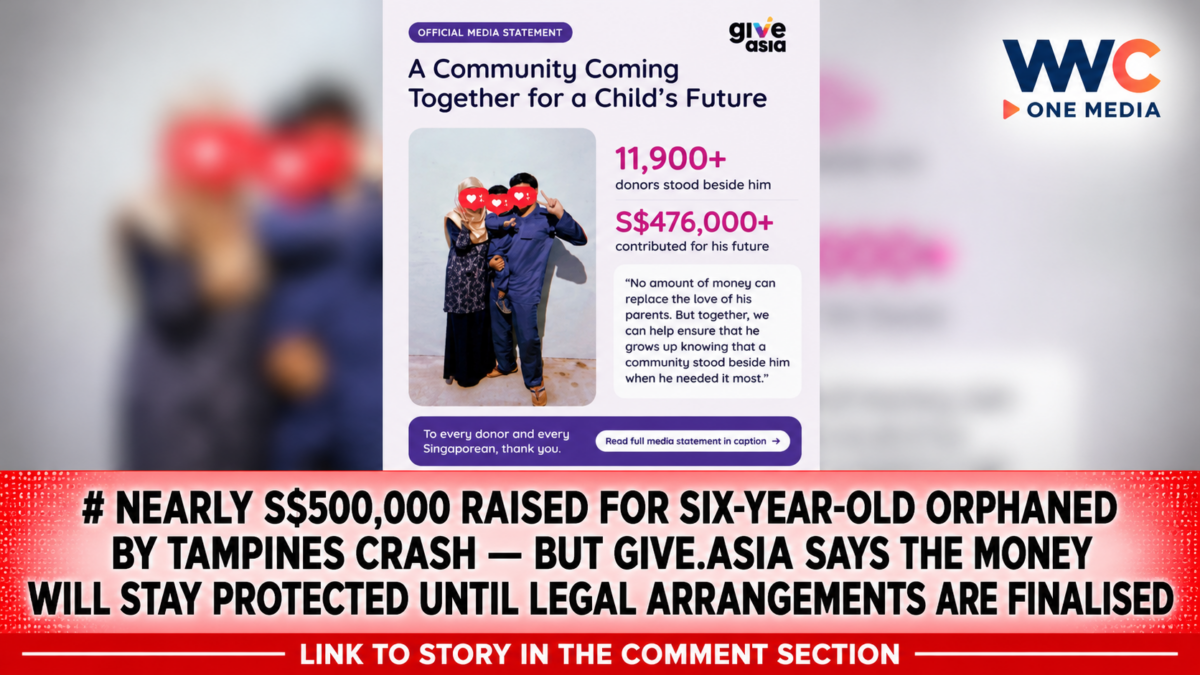
SINGAPORE — November 6, 2026 — An extraordinary wave of public generosity has raised almost S$500,000 for the six-year-old son of a young couple killed in the fatal Tampines Avenue 12 accident. But as donations continue to arrive, the focus has shifted from how much money has been collected to a more important question: how can the funds be protected for the child as he grows up?
The fundraising campaign was launched after the couple, both aged 24, died in a multi-vehicle collision on October 29. Their son was left without either parent, while the boy’s mother was reportedly pregnant with their second child.
The response from the public was swift. Thousands of people contributed, turning a family tragedy into a major community fundraising effort.
However, questions emerged after an initial appeal circulated through a personal PayNow QR code. The organiser subsequently moved the campaign to Give.Asia, where the platform reviewed documentation before approving the fundraiser.
Give.Asia has since confirmed that donations collected through its platform will remain safeguarded while the necessary legal guardianship and financial arrangements are being worked out.
The central issue is no longer simply the amount raised. It is ensuring that the money genuinely serves the child’s needs, education, healthcare and long-term security.
Donations Surge as Singaporeans Rally Behind the Orphaned Child
The campaign, titled “Help An Orphan: A Community Coming Together for His Future,” attracted an overwhelming response from the public.
According to Give.Asia’s campaign page, the fundraiser had collected S$487,439.37 from 12,085 donors when checked on November 6, 2026. The campaign was scheduled to close on November 12.
Earlier reports show how quickly the total increased. AsiaOne reported on November 2 that donations had exceeded S$428,000, while The Straits Times reported approximately S$480,000 from nearly 12,000 donors on November 4.
The figures reflect different reporting times rather than conflicting final totals.
The campaign was initiated by a relative of the deceased boy’s father, who described the appeal as a personal effort to help a child whose life had been changed by the sudden loss of both parents.
The organiser explained that the family had received numerous messages from people asking how they could contribute. The Give.Asia campaign was established to provide a centralised fundraising channel for those who wanted to help.
The intended support includes the boy’s upbringing, education, healthcare and future financial needs.
Why the Original PayNow Appeal Raised Questions
Before the Give.Asia campaign was established, a PayNow QR code linked to the organiser’s personal bank account circulated on social media.
The appeal attracted attention as members of the public sought ways to support the child. But questions soon emerged online about the identity of the organiser and whether the contributions would reach the intended beneficiary.
Some social media users urged others to stop sharing the personal QR code until they could establish who was collecting the money.
The organiser subsequently explained that the original QR code had been shared after relatives, friends and followers asked how they could contribute. She said the contributions received through PayNow had been recorded to maintain transparency.
She also said that the QR code had expired after the fundraising effort moved to Give.Asia.
Importantly, the public concerns should not be treated as proof that the organiser committed wrongdoing. The available reporting describes questions raised online and the organiser’s response, not a finding that the original appeal was fraudulent.
The distinction between the original personal PayNow contributions and the Give.Asia campaign is also important.
Give.Asia’s verification and safeguarding arrangements apply to donations collected through its official platform. The amount collected through the earlier personal PayNow appeal has not been publicly disclosed in the reports reviewed.
Give.Asia Confirms Verification and Safeguarding Measures
In a November 4 statement reported by The Straits Times, Give.Asia said it had reviewed the organiser’s identification documents and the deceased couple’s death certificates before approving the campaign.
The platform also addressed concerns about what would happen to the substantial amount collected.
Give.Asia said it was working with the family to establish an appropriate arrangement to ensure that the donations would benefit the child.
One proposal is to establish a dedicated bank account in the boy’s name. The platform also said it was prepared to explore suitable account structures, trusteeship arrangements or other safeguards, depending on the family’s wishes and applicable legal requirements.
The most important point is that the money collected through Give.Asia has not simply been handed over for immediate use.
The platform said the funds would remain safeguarded while the legal guardianship process and necessary banking arrangements were being completed. Disbursement would take place only after the relevant legal authority and arrangements had been verified and approved.
There is currently no confirmed date for the release of the funds.
This means the campaign’s large fundraising total should not be confused with money already transferred into a bank account controlled by the child or his family.
The safeguards are intended to ensure that the public’s contributions are managed responsibly and remain available for the child’s welfare.
Family Plans to Seek Legal Advice on a Trust or Dedicated Fund
The organiser has also provided an update through the Give.Asia campaign page.
The family said it intends to engage a lawyer for independent legal advice on establishing an appropriate trust or fund arrangement.
It is also working with both sides of the family and relevant government authorities on the child’s care and legal guardianship.
These arrangements are especially important because the beneficiary is only six years old and cannot independently manage a substantial amount of money.
A properly established financial arrangement could help ensure that the donations are used for the purposes intended by contributors, while providing a framework for managing the funds over the longer term.
The family has asked donors and members of the public to be patient as these matters are worked through.
The campaign page also states that November 12 was chosen as the closing date because it would have been the late father’s 25th birthday.
The family described the date as one of special significance, while acknowledging that the circumstances surrounding it have changed.
The Tragedy Behind the Fundraiser: A Young Couple Killed in Tampines
The fundraising campaign followed a fatal collision along Tampines Avenue 12 at approximately 10.35pm on October 29.
The accident involved a blue Audi, a motorcycle and another car.
The 24-year-old motorcyclist and his 24-year-old wife, who was riding pillion, were taken to hospital unconscious. Both subsequently died.
The couple reportedly had a six-year-old son, and the woman was about one month pregnant at the time.
A 25-year-old woman driving the other car was also taken to hospital, conscious.
According to police information reported by Channel NewsAsia, the driver of the blue Audi and his passenger allegedly left the scene before police arrived. The pair were later arrested.
The driver, 30-year-old Muhammad Zulfiqar Abdul Aziz, was charged with nine offences on October 31.
The charges include dangerous driving causing death, dangerous driving causing hurt, driving while under disqualification, failing to stop after an accident and failing to render assistance.
Other charges concern the alleged use of a vehicle without insurance coverage, a deregistered vehicle, driving without a valid licence and displaying a false licence plate.
The accused was remanded for investigations and is scheduled to return to court on November 27.
These remain allegations before the court. The accused has not been convicted of the offences.
A gag order has also been imposed to protect the identities of the deceased couple and their child.
The Case Has Also Raised Questions About Road Safety
Beyond the fundraising effort, the fatal collision has renewed attention on the consequences of dangerous driving and the vulnerability of motorcyclists.
A separate WWC ONE MEDIA report examined the case of the accused driver, who was reportedly under a six-year driving disqualification that ran from March 2026 to March 2032.
The latest tragedy has also affected the driver of the other car involved in the collision. Although she did not suffer serious physical injuries, she is seeking psychiatric treatment following the incident. Her father’s vehicle was so badly damaged that it had to be scrapped.
The wider road-safety picture is also concerning. Singapore police statistics show that motorcyclists and pillion riders remain a particularly vulnerable group on the roads.
Read more: Foreign-Registered Motorcycles Linked to 1,372 Injury and Fatal Accidents in Singapore in 2025
Another collision involving a motorcycle and two lorries along Neo Tiew Road in Lim Chu Kang left three people injured in October. The incident further highlighted the risks faced by motorcyclists on Singapore roads, although police investigations were ongoing.
Read more: Lim Chu Kang Crash: Lorry Allegedly Crossed Double-White Lines While Overtaking, Hitting Motorcycle
These incidents are separate and should not be treated as evidence of a single cause or pattern of responsibility. Together, however, they underline the potentially far-reaching consequences of road accidents for victims, families and other road users.
What Happens to the Donations Next?
For donors, the next stage is likely to be more important than the speed at which the campaign reached its fundraising target.
The family and Give.Asia must complete the necessary legal and administrative steps before the money can be released under an approved arrangement.
The key developments to watch include:
- Legal guardianship: The relevant arrangements must establish who has the legal authority to make decisions for the child.
- Financial protection: The family intends to seek legal advice on a suitable trust or dedicated fund.
- Dedicated banking arrangements: Give.Asia has said a separate account in the child’s name is being considered.
- Controlled disbursement: Funds collected through the platform will remain safeguarded until the required legal authority and banking arrangements are verified.
- Future updates: Donors will need clear information about how the funds are managed and how they will support the child.
The amount raised is significant, but the long-term management of the money will determine how effectively it can help the boy.
The family has also made clear that both sides are still grieving while trying to make decisions about the child’s future.
A Community’s Generosity Must Translate Into Long-Term Support
The response to the Tampines crash fundraiser demonstrates how quickly people can come together when a child is left facing an uncertain future.
More than 12,000 donors have contributed through Give.Asia, and the campaign total has approached half a million Singapore dollars.
But financial support cannot replace the parents the boy has lost. Nor can a fundraising total, by itself, guarantee that his needs will be met throughout childhood.
That is why the legal and financial safeguards matter.
The priority now is to ensure that the donations are protected, properly managed and used for the child’s benefit as he grows older.
The campaign has already shown the scale of public compassion. The next challenge is turning that generosity into lasting security.
For the six-year-old boy, the most meaningful outcome will not simply be how much money was raised — but whether the support remains there for him in the years ahead.