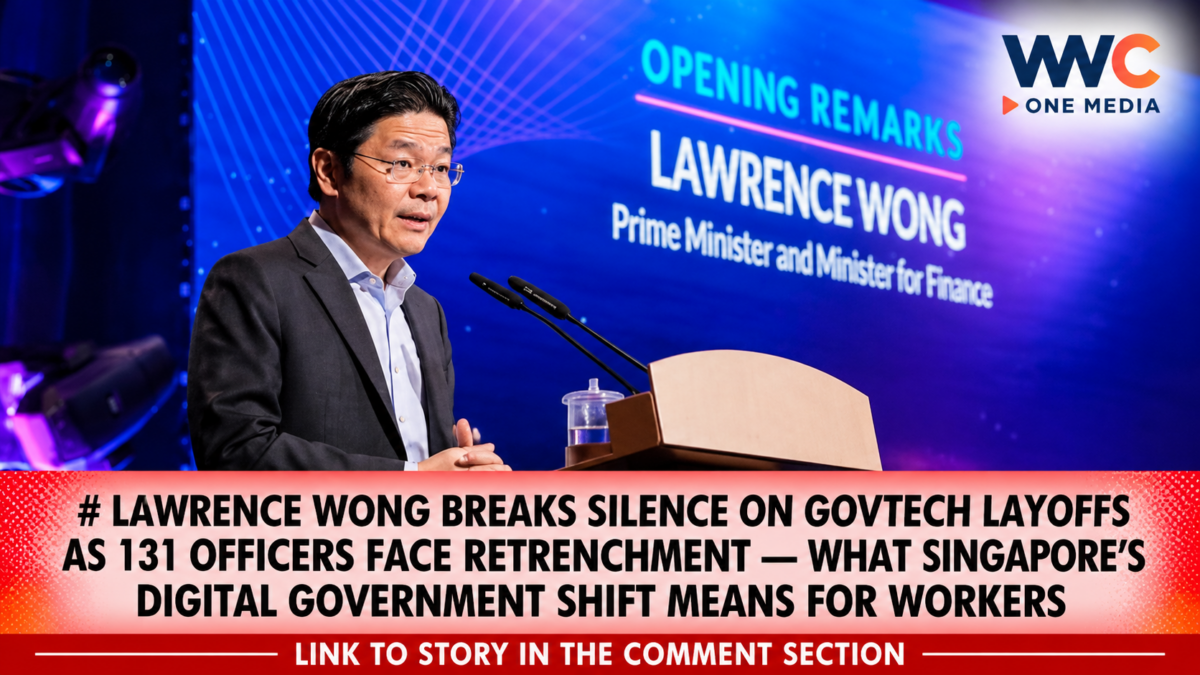
SINGAPORE — November 6, 2026 — Singapore Prime Minister Lawrence Wong has acknowledged the difficult period faced by employees affected by the Government Technology Agency’s (GovTech) restructuring, promising continued support as the agency changes how it builds and manages the digital services used across the public sector.
Speaking at GovTech’s 10th anniversary dinner on November 5, Wong said affected officers would continue to receive assistance as they acquire new skills and prepare for opportunities, whether within GovTech or elsewhere.
His remarks come as GovTech pursues a workforce transformation expected to reduce its headcount by between 7 and 9 per cent over two years. The agency is moving away from a model heavily focused on delivering technology projects towards taking greater ownership of the digital products and platforms it builds, operates and improves.
Two of the three planned restructuring phases have now been implemented. A total of 555 officers have been affected by the workforce review, including 131 who have been retrenched.
The figures do not mean that all 555 officers have lost their jobs. Some have remained in their existing roles, while others have been considered for retraining, conversion or apprenticeship pathways.
The third phase is expected in mid-2027.
The restructuring has attracted attention because retrenchments in Singapore’s public sector are relatively uncommon. It has also raised questions about how government agencies can modernise their technology while ensuring that experienced employees are treated fairly and supported through a difficult transition.
Wong’s message was that GovTech must continue to renew its capabilities—but that the transformation must also account for the people who helped build the systems Singaporeans depend on.
PM Wong Says Affected GovTech Officers Will Continue to Receive Support
At the November 5 anniversary dinner, Wong acknowledged that the restructuring had been difficult for some employees.
He said the Government would continue supporting affected officers as they developed new skills and prepared for their next opportunities.
The commitment is significant because the transformation involves more than eliminating particular positions. It reflects a change in the types of skills GovTech needs and how the agency expects its teams to work.
The Government wants technology officers to take greater responsibility for digital products throughout their life cycles—from design and development to maintenance, security and ongoing improvements.
Under the older project-delivery approach, teams could be focused on completing a system according to requirements established at the start of a project. Under the product-ownership model, teams are expected to continue improving the product after launch as user needs and technology evolve.
That shift changes the work required inside GovTech, including the balance between traditional project and vendor management roles and specialist capabilities such as software engineering, product management, cybersecurity, data and platform engineering.
Wong said the agency must remain a place where people with deep expertise and a strong sense of public purpose can develop their craft and work on important problems.
He also stressed that technology skills cannot be concentrated in GovTech alone. Other public agencies will need stronger technological capabilities of their own, even as GovTech remains a centre of excellence for complex challenges.
Why Is GovTech Restructuring Its Workforce?
GovTech, which operates under Singapore’s Ministry of Digital Development and Information, supports the technology needs of government agencies and develops digital services used by the public.
The restructuring announced in July 2026 is part of a shift towards building and managing more digital products in-house.
GovTech has said the exercise is not driven by artificial intelligence and is not intended simply as a cost-cutting or downsizing exercise.
Instead, the agency says it needs a workforce better suited to its future operating model.
As it assumes more direct responsibility for digital products, it expects to need more software engineers, product managers, designers, data specialists, cybersecurity experts and platform engineers. At the same time, the proportion of roles associated with traditional project delivery and vendor management is expected to decline.
The distinction matters. The agency is not saying that technology work is becoming less important. It is changing how that work is organised and which capabilities it needs to maintain within its own teams.
However, even when a restructuring is designed around future skills rather than cost savings, the transition can still create serious uncertainty for employees whose existing roles no longer fit the new model.
That is the challenge GovTech and the public service must manage alongside the technical transformation.
What Has Happened in the First Two Restructuring Phases?
GovTech’s workforce transformation is being carried out in three phases over approximately two years.
The first phase was announced in July. At that point, 305 officers from GovTech headquarters and teams deployed to other government agencies were affected by the review.
Of those, 93 officers were retrenched, 102 remained in their existing roles, and another 110 were offered apprenticeship pathways intended to help them transition into new capabilities.
The second phase was announced in October. GovTech said 38 officers would leave the agency, while 106 would remain in their current roles and another 106 would be eligible for conversion and apprenticeship pathways.
Across the two phases, the number of officers retrenched reached 131.
The distinction between officers affected and officers retrenched is important. Workforce transformation can include several outcomes: retaining existing employees, retraining them for new responsibilities, redeploying them where suitable opportunities exist, or supporting them as they leave the organisation.
The third phase is expected to take place in mid-2027. The final number of employees affected by that phase has not been confirmed in the reports reviewed.
The agency’s overall target is to reduce its headcount by 7 to 9 per cent over two years, equivalent to approximately 300 employees based on the workforce size cited in earlier reports.
The Support Package: Retraining, Job Matching and Career Assistance
GovTech has said it is working with the Public Service Division, the Skills and Workforce Development Agency and the Amalgamated Union of Statutory Board Employees to assist affected employees.
Support includes career coaching, job matching and placement assistance to help officers explore opportunities within the public service and private sector.
The union has also said it negotiated an enhanced support package for employees leaving GovTech, covering all three restructuring phases.
According to reporting by Channel NewsAsia, the package includes compensation linked to years of service, an additional payment to support the transition, a pro-rated performance bonus and continued union membership for eligible members.
The union and employment-support organisations have also been helping affected officers identify suitable vacancies and consider skills-upgrading options.
These measures are intended to make the transition more manageable, but they cannot guarantee that every affected employee will secure a suitable new position.
Matching an employee to another role involves more than identifying a vacancy. The job must fit the person’s experience and capabilities, and the employee must still meet the hiring agency’s recruitment requirements.
For some workers, retraining may create a pathway into a different technical role. For others, moving into a new organisation or industry may be the more realistic option.
The effectiveness of the support will therefore depend not only on the assistance offered, but also on whether suitable jobs are available and whether employees can make the transition successfully.
Why the Restructuring Has Drawn Public Attention
Retrenchments in Singapore’s public sector are relatively rare, making GovTech’s restructuring particularly notable.
The agency also supports technology systems and services that government agencies rely on. Its workforce changes therefore raise questions beyond the immediate impact on individual employees.
The Government has argued that the public service must adapt as technology evolves, or risk falling behind in the quality, security and responsiveness of its digital services.
That is a long-term concern. Public-facing digital systems must be maintained, updated and protected as users’ needs change and cybersecurity threats evolve.
At the same time, public institutions are expected to handle workforce transitions responsibly. Employees may have spent years developing knowledge of government systems and operational processes, and that experience can be difficult to replace quickly.
The policy challenge is to modernise the organisation without losing valuable expertise or leaving affected employees without realistic pathways to future work.
GovTech’s restructuring will therefore be judged not only by whether it develops the desired technical capabilities, but also by how effectively it supports the people whose roles are changing.
Is Artificial Intelligence Responsible for the GovTech Layoffs?
The restructuring has prompted questions about whether artificial intelligence is replacing technology workers.
However, GovTech has explicitly said that its workforce transformation is not an AI-driven downsizing exercise.
The agency’s stated reason is a change in its operating model: it wants to build, operate and improve more digital products itself, which changes the balance of skills and roles it requires.
That does not mean AI is irrelevant to the broader future of work. Artificial intelligence is changing how organisations approach software development, administrative tasks, data analysis and other activities.
But the available reporting does not establish that AI caused GovTech’s retrenchments.
It is important to distinguish between a workforce restructuring driven by an organisation’s operating model and job losses directly attributed to automation. They may occur in the same period, but they are not automatically the same thing.
For context, read WWC ONE MEDIA’s report: 89% of Singapore Professionals Are Already Using AI at Work — But Only 67% Think It Will Help Their Careers.
The report examines the contrast between growing AI adoption and workers’ uncertainty about how the technology may affect their careers.
Singapore’s Wider Employment Picture Adds to the Concern
GovTech’s restructuring is taking place as Singapore’s labour market faces wider adjustment pressures.
According to advance figures from the Ministry of Manpower reported in October, retrenchments reached 4,800 in the third quarter of 2026, the highest quarterly total since the fourth quarter of 2020.
The figures show that workforce restructuring is not limited to one organisation. Businesses and institutions continue to adjust their operations as economic conditions, technology and skills requirements change.
However, GovTech’s situation has its own context. Its leadership has described the restructuring as part of a planned shift in how digital services are developed and managed, rather than a direct response to AI replacing workers.
The wider labour-market figures provide useful context, but they should not be taken as proof that GovTech’s restructuring caused or was caused by the national increase in retrenchments.
Singapore Is Also Expanding AI and Digital Skills Training
Alongside the workforce changes, Singapore is investing in efforts to prepare public officers and other workers for a more technology-intensive economy.
The Ministry of Digital Development and Information announced in September that the new Institute of Digital Government would lead a government-wide effort to equip more than 150,000 public officers with practical digital, data and AI capabilities by the end of 2028.
The initiative is intended to help officers apply digital tools to their work, test new approaches and improve public services.
This broader training push reflects the Government’s view that digital transformation requires more than new software. Employees also need the skills and organisational support to use technology effectively.
For GovTech officers affected by restructuring, however, general digital-skills initiatives are not necessarily a substitute for the specific retraining, career coaching and job-placement assistance required to move into a new role.
Read more: Singapore Launches 200+ AI Courses and New Career Centre as Workforce Agency Targets Future-Ready Jobs.
The challenge is to connect training with actual employment opportunities, so that workers can translate new skills into realistic career pathways.
Wong Wants Technology to Become Part of Policymaking From the Start
At the anniversary dinner, Wong also outlined a broader change in how the Government wants technology and policy to work together.
For years, many government technology projects followed a sequence in which policymakers first decided what needed to be done, after which technology teams were asked to build systems to implement those decisions.
Wong said this approach has limitations, particularly when policies accumulate complicated rules, exceptions and special cases that become difficult to translate into software.
He argued that policymakers and technologists should work together earlier, while decisions are still being developed.
Policymakers need to understand what technology can and cannot do. Technologists, in turn, should understand the policy objectives and operational realities behind a request, and be willing to suggest simpler or more effective approaches.
Wong also highlighted a move away from treating software as a one-off project that is completed at launch.
Instead, digital products should be continuously improved, with teams retaining responsibility for their performance, security and usefulness after release.
This approach is intended to make government digital services more responsive to changing needs.
Why Cybersecurity and Legacy Systems Matter
The restructuring also sits within a wider effort to modernise ageing government technology systems.
Some long-running systems have accumulated layers of code and interconnected functions over many years. As they become more complex, introducing new features, maintaining security and implementing policy changes can become more difficult.
Wong said the Government is reviewing and modernising legacy systems across the public service.
He also emphasised that cybersecurity must be built into systems from the beginning and continually strengthened as threats evolve.
These priorities help explain why GovTech wants stronger in-house product and engineering capabilities. Building a digital service is only one part of the work; maintaining its reliability, security and performance over time is equally important.
The Government’s stated goal is to create a public service in which technological expertise is more widely embedded across agencies, while GovTech remains a centre of excellence for complex technical challenges.
Whether the restructuring delivers those improvements will depend on how effectively the new operating model works in practice.
What Happens Next for GovTech and Its Affected Employees?
The third restructuring phase is expected in mid-2027, meaning the workforce transformation is not yet complete.
The next phase will be important for employees awaiting clarity about their future roles, as well as for the agency’s ability to retain the expertise it needs.
Several questions remain:
- How many officers will be affected in the final phase?
- How many will be retrained or redeployed into other roles?
- How many will ultimately leave the agency?
- Will career support and job matching help affected officers secure suitable employment?
- Will the new operating model improve the quality, reliability and security of government digital services?
The answers will help determine whether the restructuring achieves its intended goals while managing its impact on employees.
For now, the Government has committed to supporting affected officers as they prepare for new opportunities. But the full results of the transformation will become clearer only as the remaining phase is completed and GovTech demonstrates how its new workforce structure performs.
A Digital Government Transformation With Human Consequences
GovTech’s restructuring highlights a difficult reality of technological change: organisations may need new skills and different ways of working, but those changes affect people whose experience and contributions helped build the systems already in place.
Wong has made clear that Singapore intends to keep renewing its technological capabilities. The Government wants technology to shape policy from the beginning, digital products to be improved continuously, and cybersecurity to remain a priority.
At the same time, affected employees need more than reassurance. They need practical support, realistic opportunities to retrain and a fair chance to move into suitable roles.
The next stage of GovTech’s transformation will test whether those two objectives can be pursued together.
The central question is no longer just how GovTech will build Singapore’s digital future—but how it will help its people navigate the changes required to deliver it.