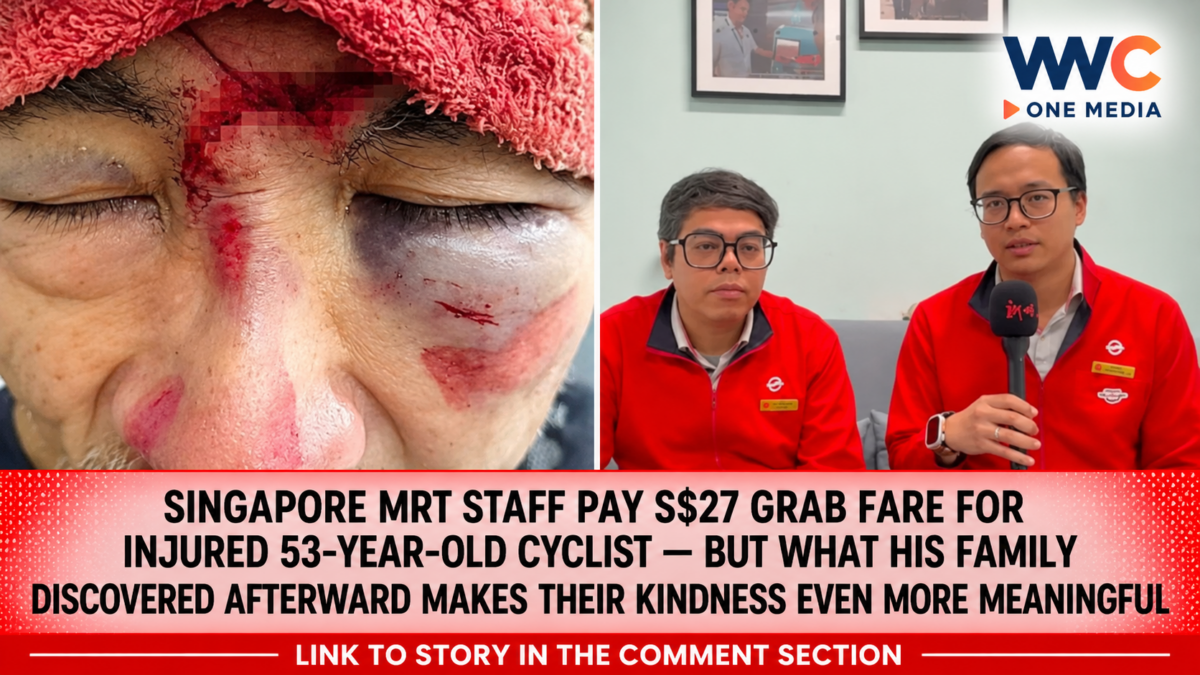
SINGAPORE — Two SMRT employees at Labrador Park MRT station have earned praise for their compassion after stepping in to help an injured 53-year-old cyclist, administering first aid and paying S$27 out of their own pockets for his ride home when he refused an ambulance.
What initially appeared to be a simple act of assistance turned out to involve a much more serious accident.
The cyclist, identified as Michael Oh, had fallen while cycling to work on October 5, 2026. He suffered a deep forehead wound and facial injuries but did not initially realise how serious his condition was.
When two station employees discovered his injuries, they immediately provided first aid, attempted to persuade him to seek medical attention and eventually arranged a private-hire vehicle to take him home.
Their generosity did not end there.
When Michael’s older brother returned the following day to reimburse them for the journey, the employees refused to accept the money.
And according to a follow-up report by Mothership published on November 5, Michael’s injuries were considerably more serious than initially understood. He had suffered multiple facial fractures, undergone two operations and spent almost 10 days in hospital.
The incident has since become another example of how ordinary acts of kindness by public transport employees can make a meaningful difference during an emergency.
53-Year-Old Cyclist Falls While Travelling to Work
Michael Oh reportedly cycles approximately 30 kilometres daily between Yishun and Pasir Panjang Wholesale Centre as part of his regular journey to work.
On October 5, however, his routine journey took an unexpected turn when he fell from his bicycle outside Labrador Park MRT station.
According to his brother’s account to Mothership, Michael could not remember exactly how the accident happened. He suspected that he might have ridden over something before losing his balance and falling face-first onto the pavement.
After the incident, he managed to make his way into the nearby MRT station to clean himself up.
However, the bleeding from his forehead continued.
A passer-by noticed his condition and alerted station personnel, setting off a response that would eventually bring two SMRT employees into the story.
AsiaOne’s November 6 report, which cited Shin Min Daily News, also described how a woman approached the passenger service counter to report an injured man near the station’s escalator.
The cyclist had sustained a wound measuring approximately five centimetres on his forehead.
Two SMRT Employees Immediately Provide First Aid
The two employees who responded were assistant station manager Muhammad Taufik bin Mohamed Rais, 32, and station manager Luqmannul Hakim bin Yahya, 37.
After learning about the injured cyclist, Taufik alerted Hakim, who brought a first-aid kit to assist.
The pair assessed Michael’s condition and bandaged his forehead to help control the bleeding.
According to Mothership, Hakim noticed that Michael was repeatedly touching his forehead and mumbling while responding to questions.
The employees were concerned about the severity of his injuries and recognised that he needed further medical attention.
They therefore offered to call an ambulance.
However, Michael repeatedly declined the offer.
He reportedly wanted to return home first to put away his bicycle and did not fully appreciate how serious his injuries were at that point.
Rather than simply leaving him to make his own arrangements, the two employees continued looking after him.
Their response demonstrated the importance of recognising when someone may need assistance, even when that person does not initially understand the seriousness of the situation.
They Personally Paid S$27 for His Grab Ride Home
After Michael declined an ambulance, Hakim decided to arrange a Grab ride to take him home.
The two employees escorted him to the ground-floor pick-up area and remained with him while waiting for the vehicle.
They also continued speaking to him to ensure that he remained alert.
The private-hire journey cost approximately S$27, which Hakim paid using his own money.
It was a gesture that went beyond simply providing the assistance expected of station personnel.
The employees were not looking for recognition or repayment. Their immediate concern was making sure that the injured cyclist could get home safely.
Speaking to Mothership, the staff members explained that helping people in need was part of their responsibility as frontline employees.
Their actions would later become the subject of widespread appreciation after Michael’s family learned what had happened.
His Brother Returns the Next Day — But the Staff Refuse the Money
On October 6, Michael’s older brother visited Labrador Park MRT station to thank the two employees personally.
He had learned that they had paid for his brother’s Grab journey and wanted to reimburse them for the S$27 expense.
However, the employees declined to accept the repayment.
Instead, Michael’s brother brought snacks for the station staff as a small gesture of appreciation.
He also took a photograph with the employees to remember their kindness.
The family’s gratitude was particularly meaningful because the two workers had helped Michael at a moment when he was struggling to understand the extent of his injuries.
Their decision to refuse reimbursement also reinforced the message behind the incident: helping someone in difficulty should not always come with an expectation of something in return.
The employees reportedly regarded their actions as part of their everyday responsibility.
For Michael’s family, however, the assistance was something they would not easily forget.
Follow-Up Reveals Cyclist Suffered Multiple Facial Fractures
The November 5 Mothership report provided a much more detailed picture of Michael’s injuries.
After reaching home, Michael’s other brother, Sean, quickly drove him to the emergency department at Khoo Teck Puat Hospital.
Medical examinations reportedly revealed multiple facial bone fractures and fluid in his head.
He had also sustained a deep forehead wound, accompanied by significant swelling and bruising around his left eye.
Michael subsequently underwent two operations.
He remained hospitalised for almost 10 days, from October 5 until October 14, before being discharged.
According to his family, he was in stable condition following his discharge.
In an update shared on November 4, his brother said Michael was recovering well, although the fractured bones would require several more months to heal.
The medical developments underline why the station employees’ initial concerns about his condition were important.
Although Michael had declined an ambulance, his injuries ultimately required hospital assessment, surgery and an extended period of recovery.
His experience also highlights why serious head and facial injuries should not be underestimated, even when an injured person appears conscious and able to move around.
SMRT Employees Say Helping Passengers Is Part of Their Responsibility
The two employees’ response was not presented as an extraordinary act from their perspective.
According to Mothership’s interview, both workers said they considered helping people in need part of their responsibilities.
Hakim, who has worked with SMRT Trains for 13 years, explained that his duties include overseeing station operations and responding to emergencies, including medical incidents.
Taufik, who has been with the company for six years, also described passenger safety as a priority.
The employees said they were more accustomed to responding to incidents involving passengers fainting or experiencing seizures.
This was their first encounter with an injured cyclist in such circumstances.
Although they were initially shocked by the condition of Michael’s injuries, they were pleased that they could provide assistance.
They also explained that SMRT employees receive first-aid training and attend refresher courses every two years.
Their training helped them respond to the situation, while their willingness to personally arrange transportation demonstrated an additional level of consideration.
Another Example of SMRT Employees Helping Passengers in Need
The Labrador Park incident comes shortly after another heartwarming story involving SMRT employees helping an elderly commuter at Bayfront MRT station.
In that October 15 incident, four SMRT employees assisted a man believed to be in his late 60s who was experiencing difficulties while using a motorised wheelchair.
The employees helped him move to a safer area, provided food and coordinated with his helper to arrange a safe journey home.
One employee also contacted staff at Buona Vista MRT station to ensure that assistance would be available when the commuter arrived.
The story was covered by WWC ONE MEDIA:
SMRT Staff Praised for Helping Elderly Commuter With Parkinson’s at Bayfront MRT Station
Both incidents demonstrate how station personnel can play an important role beyond their regular operational responsibilities.
For passengers experiencing unexpected difficulties, having someone willing to listen, respond and coordinate assistance can make a significant difference.
Singapore’s Everyday Acts of Kindness Extend Beyond MRT Stations
The story also reflects a broader pattern of ordinary Singaporeans stepping forward to help strangers in difficult situations.
In another recent incident, a Singaporean woman motorcyclist earned praise after helping an elderly rider whose motorcycle had stalled at a traffic junction in Kallang Bahru.
Rather than simply continuing her journey, she stopped and helped move the motorcycle away from moving traffic.
Read the related WWC ONE MEDIA report:
Another incident involved a motorist who spotted an elderly man walking dangerously close to traffic along Singapore’s Ayer Rajah Expressway.
Concerned about the man’s safety, the driver intervened and later contacted the police to report the situation.
Read more:
There was also a recent story involving a migrant worker who helped two stranded Singaporeans find transportation after midnight.
The worker offered them a lift despite having his own work commitments, leaving the pair deeply appreciative of his generosity.
Read the full WWC ONE MEDIA report:
Together, these stories illustrate how compassion can come from people in different professions, backgrounds and circumstances.
They also show why seemingly small gestures often resonate so strongly with the public.
Why First Aid and Early Medical Attention Matter After a Fall
Michael’s experience also highlights an important safety issue for cyclists and other road users.
A person who falls and sustains a head injury may not immediately recognise the seriousness of the situation.
Being conscious, speaking or walking does not necessarily mean that an injury is minor.
Head injuries can require urgent medical assessment, particularly when accompanied by significant bleeding, confusion or facial injuries.
In Michael’s case, the initial forehead wound was followed by the discovery of multiple facial fractures and other complications requiring hospital treatment.
The incident serves as a reminder that people who experience significant head injuries should seek appropriate medical attention rather than assume they can safely continue their journey.
The station employees’ decision to offer an ambulance was therefore an important part of their response, even though Michael initially declined.
Their assistance also demonstrates the value of having trained personnel and accessible first-aid resources in public transport facilities.
A S$27 Gesture That Became Much More Than a Ride Home
For the two SMRT employees, the incident may have started as another situation requiring frontline assistance.
But for Michael and his family, it became an experience that demonstrated the importance of compassion during an unexpected emergency.
The employees provided first aid, stayed with an injured stranger, arranged transportation and personally paid the fare.
When his brother returned to reimburse them, they refused to accept the money.
Michael is now recovering at home, although his family expects the healing process to take several more months.
His brother has also expressed gratitude to everyone who helped him during the incident.
The story is a reminder that public transport employees are often among the first people passengers encounter when something goes wrong.
Their training, attentiveness and willingness to assist can make a meaningful difference.
Sometimes, the most memorable acts of kindness are not measured by how much money is spent, but by the decision to help someone who needs it.
And while the two SMRT employees may have considered the S$27 Grab fare a small personal expense, their actions gave one injured cyclist and his family something far more valuable: reassurance that strangers were willing to care when it mattered most.