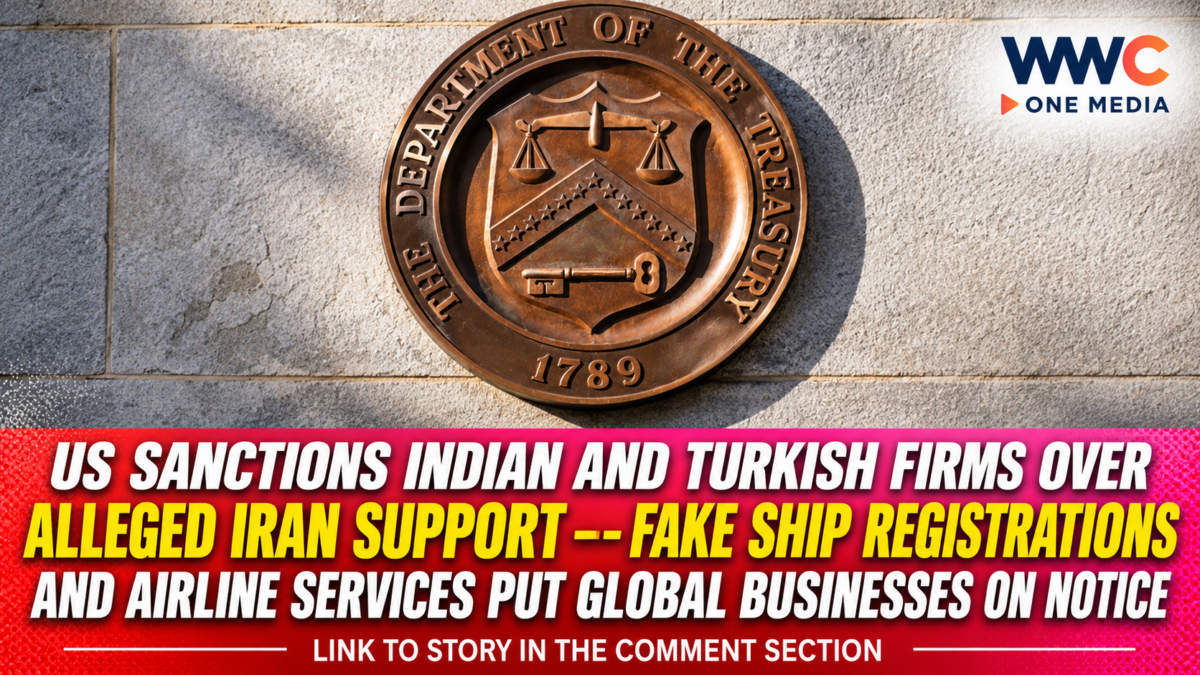
WASHINGTON — November 5, 2026 — The United States has expanded its economic pressure campaign against Iran, imposing fresh sanctions on individuals and companies in India and Turkey accused of helping Tehran maintain access to oil revenues and international aviation services.
The latest action by the US Treasury Department targets an alleged maritime-fraud network operated by Indian businessman Suniel Kumar Sharma and his wife, Jaspreet Preeti Shahid, alongside other individuals and nine associated entities. Washington accuses the network of creating fraudulent ship-registration systems and issuing false maritime certifications that allowed vessels carrying Iranian petroleum to operate under misleading identities.
A separate Turkish company, Fugo Ground Services Inc, has also been sanctioned over allegations that it continued providing ground-handling and other services to US-sanctioned Iranian airlines.
Announced on November 4, the measures form part of President Donald Trump’s Operation Economic Outcast, a campaign designed to restrict Iran’s ability to generate revenue from petroleum exports and other economic activities.
The latest sanctions send a broader warning to international businesses: companies operating outside the United States may still face serious consequences if Washington determines that they are helping sanctioned Iranian networks evade restrictions.
However, the action should not be mistaken for sanctions against India or Turkey as countries. The designations apply to specifically identified individuals and businesses.
Indian Couple Accused of Building a Network of Fake Ship Registries
At the centre of the latest US action are Suniel Kumar Sharma and his wife, Jaspreet Preeti Shahid, who are based in Chandigarh, India.
According to the US Treasury, the couple allegedly operated a network that created fraudulent maritime registration authorities and classification organisations, claiming to represent countries that had not authorised them to provide such services.
These services included ship registration, seafarer training and certification, and vessel classification.
The Treasury said the network used websites and online domains to make its operations appear legitimate, including websites claiming to provide maritime services on behalf of countries such as Guyana, Eswatini and Laos.
The alleged scheme enabled sanctioned vessels transporting Iranian petroleum to operate using false or unauthorised flags and documentation.
A ship’s flag identifies the country whose laws and maritime regulations govern the vessel. Legitimate registration is important because it establishes regulatory oversight and helps authorities monitor a ship’s safety, ownership and compliance with international requirements.
If a vessel falsely claims to be registered under a particular country’s flag, it can make monitoring and enforcement more difficult.
The Treasury said Sharma’s network had been involved in these activities for years, with operations dating back to 2014.
One example cited by Washington involved a company established in Singapore in 2023 under the name Eswatini Maritime Affairs and International Ship Registry PTE. Ltd.
The Treasury said Eswatini authorities had publicly disavowed the organisation, but it continued providing registration services to vessels transporting Iranian petroleum.
The US also identified several sanctioned vessels allegedly connected to the network, including LATTAFA, BINARY STAR and VERA.
These allegations form the basis of the latest US sanctions. They should be understood as findings and claims made by the US government, rather than independently established criminal convictions.
Nine India-Linked Entities Also Targeted
The sanctions extend beyond the two principal individuals.
The Treasury identified nine associated entities in its action, including:
- Eswatini Maritime Affairs and International Ship Registry PTE. Ltd.
- Oceaniek Technologies India
- Aryavart Ship Management Private Limited
- Precept Trends Private Limited
- Polynesia Maritime Private Limited
- Alexarya Finserv Private Limited
- Alexarya Media and Entertainment Private Limited
- Viharaboating Private Limited
- Aryavart Maritime and Educational Trust
The department also named two other Indian nationals, Ashwani Kumar Dhiman and Ishwinder Singh, over their alleged roles in businesses connected to the network.
According to the Treasury, Sharma was linked to Oceaniek Technologies India, while Shahid was linked to several other businesses within the network.
The US government said some of these entities were used to establish or operate fraudulent maritime registries.
The case illustrates how sanctions enforcement can extend beyond oil traders and tanker owners to the service providers, registration businesses and intermediaries that allegedly help sanctioned cargoes move through international shipping networks.
Why Fake Ship Flags Matter to the Global Shipping Industry
The use of false ship registrations is more than a technical regulatory issue.
Vessels operating under fraudulent flags can make it harder for maritime authorities, insurers and shipping companies to establish who is responsible for a ship and whether it meets recognised safety standards.
The Treasury warned that vessels carrying false registrations may lack valid protection and indemnity insurance.
Such insurance is important because it helps cover liabilities involving maritime accidents, environmental damage and other incidents.
If an uninsured or improperly registered tanker causes a major oil spill or damages port infrastructure, the financial consequences could be substantial.
The issue also creates risks for legitimate shipping companies that may unknowingly conduct business with vessels using fraudulent documentation.
The US Office of Foreign Assets Control, or OFAC, issued a new industry alert alongside the sanctions, warning maritime stakeholders to screen vessels carefully and watch for potentially false flags.
The alert reinforces earlier US guidance about deceptive shipping practices used in the transportation of Iranian petroleum.
For additional background, WWC One Media previously examined the maritime confrontation involving Iranian oil tankers in Iran Says It Struck a U.S. Drone Boat in Hormuz — But Washington’s Attack on Three Oil Tankers Raises the Stakes Far Higher.
The wider issue is that the movement of Iranian oil has become a major focus of the conflict, with shipping routes, tanker identities and maritime services increasingly caught up in geopolitical pressure.
Turkey-Based Fugo Ground Services Also Hit With Sanctions
The latest Treasury announcement also targets a separate business operating in Turkey.
Fugo Ground Services Inc was sanctioned over allegations that it continued providing ground-handling and related services to several Iranian airlines already designated by the United States.
According to the Treasury, the company had direct service agreements with six US-sanctioned Iranian carriers:
- Iran Air Tour
- Saha Airlines
- Sepehran Airlines
- Varesh Airlines
- Taban Airlines
- Ata Airlines Company
The department said Fugo continued providing services to several of these airlines after their designation by Washington on September 8, 2026.
Ground-handling services are essential to airline operations. They can include aircraft handling, passenger and baggage services, ramp operations and other support provided while an aircraft is on the ground.
By targeting a service provider rather than only the airlines themselves, Washington is attempting to make it more difficult for sanctioned carriers to maintain international operations.
The move also signals that companies providing logistical or operational support to designated Iranian airlines could face scrutiny even if they are not based in Iran.
What the US Sanctions Actually Mean for the Companies
The sanctions were imposed under Executive Order 13902, which targets important sectors of Iran’s economy, including petroleum and aviation.
For designated individuals and entities, the consequences can be substantial.
Property and financial interests belonging to those designated that are within the United States or under the possession or control of US persons are generally blocked. US persons are also generally prohibited from conducting transactions with designated parties unless an applicable authorisation or licence allows them to do so.
The restrictions can extend to companies owned 50 per cent or more, directly or indirectly, by blocked persons under OFAC’s ownership rules.
Foreign companies are not automatically subject to every US restriction simply because they operate outside American territory. However, non-US businesses can face sanctions exposure for certain dealings involving designated parties, sanctions evasion or transactions that cause US persons to violate US rules.
This is particularly significant for international banks, insurers, shipping operators, aircraft-service providers and businesses that rely on access to US financial markets.
For companies with international operations, the risk is not limited to direct dealings with Iran. Working through intermediaries or accepting questionable maritime documents can also create serious compliance problems.
Operation Economic Outcast Expands Washington’s Pressure on Tehran
The latest designations are part of the Trump administration’s broader Operation Economic Outcast, announced by Treasury Secretary Scott Bessent on August 24, 2026.
The campaign seeks to restrict the financial channels and commercial networks Washington says allow Iran to continue earning money despite US sanctions.
The strategy focuses on several areas, including petroleum exports, shipping networks, financial intermediaries and aviation services.
The US government has argued that limiting these economic channels will reduce the resources available to the Iranian government and its military-linked organisations.
Treasury has also warned that it intends to pursue individuals and companies that facilitate sanctions evasion, regardless of where they are based.
The latest action follows earlier measures against businesses and financial institutions accused of helping Iran move money internationally.
WWC One Media previously reported on the growing pressure in Iran’s Economy Is Buckling Under War and Sanctions — But the Strait of Hormuz Could Be the Next Global Shock.
That report examined how sanctions, falling trade and the disruption of shipping routes have intensified economic pressure on Tehran.
The latest measures demonstrate that Washington is not limiting its campaign to Iranian companies. It is also targeting foreign intermediaries that it believes help Iran maintain access to international markets.
Iran’s Oil Trade and the Strait of Hormuz Remain at the Centre of the Conflict
The sanctions are also connected to the wider confrontation over Iran’s petroleum exports and the strategically important Strait of Hormuz.
The strait connects the Persian Gulf with the Gulf of Oman and is one of the world’s most important energy-shipping routes.
Before the conflict, roughly one-fifth of global oil consumption passed through the waterway.
Any disruption can affect oil shipments, shipping insurance, transport costs and energy prices around the world.
Iran’s ability to export petroleum has therefore become a major economic and strategic issue in the conflict.
Washington has used sanctions and maritime restrictions to pressure Tehran, while Iran has sought to maintain its economic and strategic leverage.
The growing importance of tanker registration and shipping services shows how the economic confrontation has expanded beyond the battlefield.
WWC One Media has also examined the financial consequences of the conflict in Trump’s Iran War Costs US Taxpayers US$47.1 Billion as Hormuz Crisis Drags On — But Could the Next Strike Send the Bill Even Higher?.
The report highlights the growing costs of the war and the importance of the Strait of Hormuz to global energy markets.
India and Turkey Could Face a Difficult Business Compliance Challenge
The latest US action could create additional pressure for companies in India, Turkey and other countries that maintain commercial links with Iran.
Both countries have businesses involved in international shipping, logistics, aviation and trade. Companies operating in these sectors may now face greater scrutiny over their customers, documentation and business partners.
For India-based businesses, the allegations involving fraudulent ship registries could prompt closer examination of maritime service providers and registration claims.
For Turkish aviation-service companies, the sanctions against Fugo Ground Services provide a warning about the risks of continuing to serve Iranian carriers already designated by Washington.
The measures do not mean that all Indian or Turkish companies doing business with Iran are automatically sanctioned.
However, the US Treasury has made clear that it intends to pursue specific foreign entities it believes are helping sanctioned networks operate.
The distinction matters because legitimate trade, prohibited transactions and sanctions-evasion activity are not the same thing.
Businesses will need to assess their exposure carefully rather than assume that operating outside the United States places them beyond the reach of American sanctions.
What Happens Next?
The latest sanctions raise several important questions for international businesses and the wider Iran conflict.
First, will more foreign companies be targeted?
Treasury has warned that its campaign will continue to pursue networks supporting Iran’s petroleum and aviation sectors. Additional designations remain possible.
Second, will shipping companies become more cautious about Iranian-linked cargoes?
The new OFAC alert could encourage insurers, shipowners, maritime registries and financial institutions to increase checks on vessel identities and documentation.
Third, could the sanctions affect Iran’s ability to export oil?
The measures are designed to make it harder for Iranian petroleum to move through international shipping networks. Their actual impact will depend on enforcement, alternative service providers and the ability of Iran-linked networks to adapt.
Finally, could the expanding pressure complicate diplomatic efforts?
The sanctions come amid an unresolved conflict and continuing disagreements between Washington and Tehran. Economic pressure may strengthen Washington’s negotiating position, but it could also deepen tensions if Iran views the measures as another obstacle to a settlement.
The Bottom Line: Washington Is Targeting the Networks Behind Iran’s Oil and Aviation Trade
The latest US sanctions mark another expansion of Washington’s campaign to restrict Iran’s access to international business networks.
The action targets an alleged Indian maritime-fraud network accused of providing false ship registrations and certifications to vessels carrying Iranian petroleum. It also targets a Turkish ground-handling company accused of supporting six Iranian airlines already under US sanctions.
The message from Washington is clear: companies that allegedly help sanctioned Iranian networks operate — whether through shipping documentation, logistics or aviation services — could face serious financial and legal consequences.
But the wider effects may reach beyond the businesses named in the Treasury announcement.
Shipping companies, insurers, banks and aviation providers across the world may now face greater pressure to verify their customers and business partners.
As the US continues to tighten its economic campaign against Tehran, the next question is whether these measures will significantly restrict Iran’s ability to trade — or push the networks involved to find new ways around the restrictions.