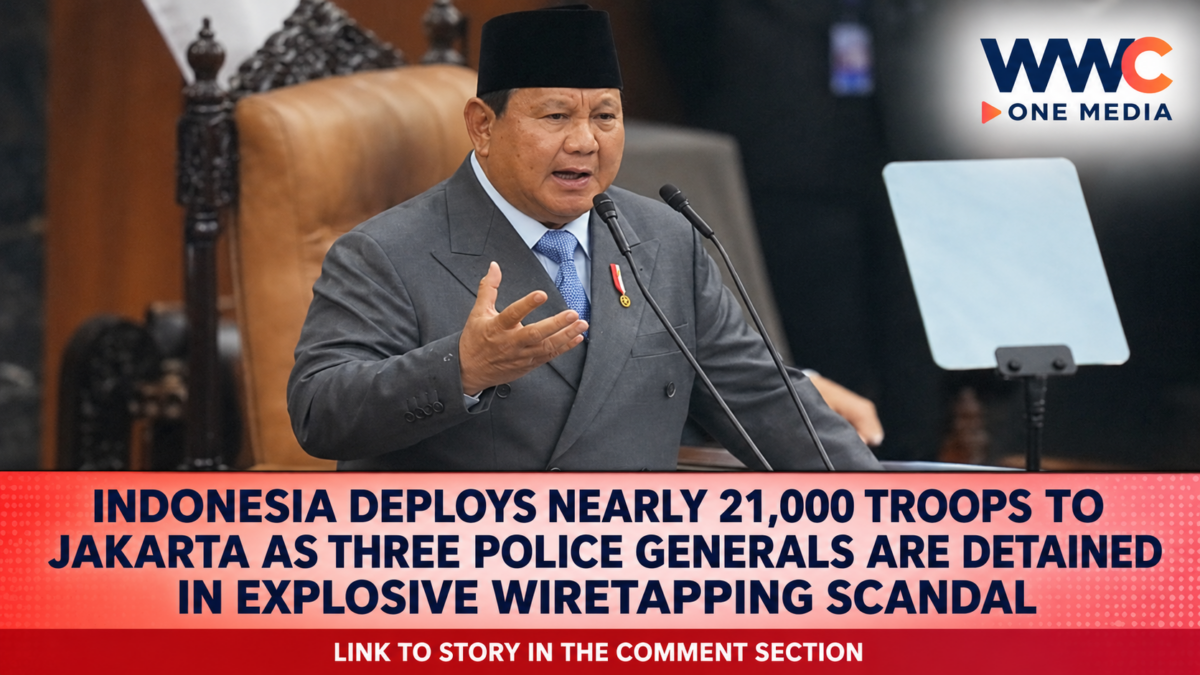
Indonesia is mobilising nearly 21,000 military personnel in Jakarta as the country faces an extraordinary security and political controversy involving the alleged illegal surveillance of President Prabowo Subianto and other prominent figures.
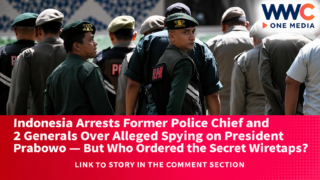
The deployment comes as three senior police officers, including former national police chief and recently appointed presidential chief of staff General Listyo Sigit Prabowo, have been detained as suspects in an investigation into alleged illegal wiretapping.
The scandal has become increasingly sensitive after the presidential palace suggested that the alleged surveillance could amount to conduct leading towards treason and threaten national security.
President Prabowo subsequently dismissed Listyo from his position as presidential chief of staff on November 4, a day after police publicly announced the arrests.
But the military deployment has raised another important question: Is Jakarta preparing for a wider security challenge, or is the movement part of routine military operations?
Officials have not confirmed that the troop deployment is directly connected to the wiretapping investigation.
According to the Associated Press (AP), the Indonesian military plans to involve 20,980 personnel in the capital, with another 13,140 on standby if additional forces are needed.
The developments have placed Indonesia’s security institutions under intense scrutiny, with investigators still working to establish who authorised the alleged surveillance, why it was carried out and whether additional individuals were involved.
Nearly 21,000 Military Personnel Mobilised in Jakarta
The Indonesian military is moving thousands of personnel into Jakarta as part of a security deployment involving units from different parts of the country.
Vice Admiral Yayan Sofiyan, the navy’s operations assistant, said the total number of personnel involved would reach 20,980.
The first phase began on Monday, November 2, involving approximately 2,100 personnel from units already stationed in Jakarta.
Additional forces from outside the capital were scheduled to arrive beginning Wednesday, November 4.
The deployment includes personnel from marine and navy units, training centres and naval bases in Java and Lampung province.
Another 13,140 personnel are being kept on standby and could be deployed if necessary.
The figures indicate a substantial mobilisation, although the 13,140 personnel on standby should not be counted as already deployed in Jakarta.
Indonesian Armed Forces spokesperson Major General Muhammad Nas said troop movements were a normal part of maintaining national security and territorial integrity.
He stressed that the military must remain prepared to protect the country.
Navy spokesperson Tunggul also said the deployment was intended to safeguard security and stability. Reuters separately reported that some of the movement was connected to upcoming military training in areas surrounding the capital.
Most importantly, authorities have not officially linked the mobilisation to the arrests of the three police generals.
The timing has attracted attention, but it would be inaccurate to claim that the military was deployed specifically to respond to a coup threat or an imminent confrontation.
Three Senior Police Generals Detained Over Alleged Secret Surveillance
The arrests are at the centre of the growing political controversy.
Indonesian police identified three senior officers as suspects in an investigation into alleged illegal interception of communications.
They are:
- General Listyo Sigit Prabowo — former national police chief and recently appointed presidential chief of staff.
- Inspector General Ahrie Sonta Nasution — head of the Indonesian National Police’s legal division.
- General Eko Hadi Santoso — a senior police officer associated with the National Police Education and Training Institute.
Police announced the detentions publicly on November 3, saying the investigation involved alleged unlawful interception, unauthorised access to electronic systems and the deletion of electronic information.
According to investigators, the suspected surveillance took place between 2025 and 2026, during the period when Listyo was serving as national police chief.
The alleged targets reportedly included President Prabowo, Cabinet officials, politicians, journalists, civil society representatives and business executives.
The identities of all the alleged targets have not been publicly disclosed.
Investigators are also examining allegations that electronic records containing intercepted communications were deleted in October, supposedly to conceal evidence of the operation.
The suspects have not publicly responded to the allegations, and the case has not resulted in convictions.
President Prabowo Dismisses His Newly Appointed Chief of Staff
One of the most significant developments came on November 4, when Prabowo removed Listyo from the presidential chief of staff position.
The dismissal came just weeks after Listyo had been transferred from his position as national police chief.
He had led the Indonesian National Police since 2021, having been appointed under former president Joko Widodo.
On October 1, 2026, Prabowo replaced him as police chief and appointed him to lead the Executive Office of the President.
That made his subsequent detention particularly significant.
The man who had recently occupied one of the country’s most powerful law-enforcement positions was now facing allegations involving the possible misuse of surveillance capabilities.
The presidential office described the alleged conduct as extremely serious.
Presidential spokesperson Prasetyo Hadi said unauthorised access to a head of state’s communications could expose sensitive information and endanger national interests.
He suggested that the alleged activity could fall within conduct leading towards treason.
However, the government has not established a final finding about the motive behind the surveillance.
The distinction matters: an allegation of serious national-security wrongdoing is not the same as a court finding that treason occurred.
Why Was Indonesia’s President Allegedly Being Monitored?
The biggest unanswered question is why anyone would allegedly target the communications of the country’s own president.
The suspected operation reportedly extended beyond Prabowo.
Police have identified possible targets across government, politics, journalism, civil society and business.
Such a broad range of alleged targets raises questions about whether surveillance tools intended for lawful investigations were used for unauthorised purposes.
However, authorities have not established exactly what information was obtained, how it was used or who ultimately benefited.
Indonesia’s senior legal affairs minister, Yusril Ihza Mahendra, said the motive remained under investigation.
The Associated Press reported that Mahendra also described preliminary indications suggesting the alleged operation may have gone beyond illegal interception and could have been intended to undermine or paralyse government operations.
He stressed that the investigation was continuing and that the assessment was not final.
That is an important development, but it does not mean investigators have conclusively established a coup attempt.
The authorities still need to determine who authorised the alleged activity, what objectives were involved and whether other people participated.
Investigators Suspect Electronic Records Were Deleted
The allegations became more serious after investigators raised concerns about attempts to remove electronic records.
Police allege that the suspects ordered files containing intercepted communications to be deleted in October.
If established, the alleged deletion could become a significant part of the investigation because electronic records may help establish how the surveillance was conducted.
Investigators have also been examining electronic devices and questioning witnesses.
According to reporting by WWC One Media on the arrests, police questioned 10 witnesses and three expert witnesses and seized 11 mobile phones, one tablet and four USB flash drives.
Those materials may help investigators reconstruct communications, instructions and access to the relevant systems.
However, the seizure of devices does not itself prove that the suspects committed the alleged offences.
Digital forensic analysis and evidence presented through proper legal proceedings will be necessary to establish responsibility.
Could the Alleged Wiretapping Be Considered Treason?
The word “treason” has become one of the most prominent parts of the controversy.
The presidential palace suggested that allegedly monitoring the president without legal authority could endanger the state and the country’s leadership.
The legal affairs minister also indicated that preliminary investigative findings raised questions about whether the suspected operation had a broader objective.
But the investigation is still developing.
There is a difference between officials describing conduct as potentially treasonous and a court establishing that a specific treason-related offence has been committed.
The authorities must prove the relevant legal elements and the involvement of each suspect.
The investigation also needs to establish whether the alleged surveillance was limited to unlawful interception or formed part of a wider effort involving other individuals.
For now, the motive and full scope remain unresolved.
Why the Military Deployment Is Raising Questions
The timing of the troop mobilisation has naturally attracted attention.
The military’s announcement came as the police investigation was expanding and the presidential office was publicly describing the alleged surveillance as a threat to national security.
However, both AP and Reuters reported that authorities had not confirmed a direct connection between the arrests and the military deployment.
The armed forces have described troop movements as routine security operations, while the navy has also cited upcoming training activities near Jakarta.
Reuters quoted an Australian National University researcher who said the deployment could reflect concerns about possible tensions between military and police personnel loyal to Listyo.
The researcher also warned that tensions could escalate unintentionally.
That is an analyst’s assessment, not an official confirmation that a confrontation is expected.
Indonesia has a history of deploying soldiers in Jakarta during periods of heightened political tension, including ahead of anti-government demonstrations.
The current mobilisation therefore deserves attention, but it should not automatically be interpreted as evidence that the capital is preparing for a military takeover or armed conflict.
Indonesia’s Political Climate Adds to the Pressure on Prabowo
The wiretapping scandal is unfolding during a politically sensitive period for Prabowo’s administration.
Reuters reported that the president has faced growing public dissatisfaction over food prices, government spending and major programmes, including his free-meals initiative and village cooperatives.
The administration has also faced questions from investors about policy predictability and economic management.
Prabowo’s relationship with former president Joko Widodo has also attracted attention, with Reuters reporting signs of a political rift between the two leaders.
Listyo was widely regarded as close to Widodo, having been appointed police chief during the former president’s administration.
That background has made his arrest particularly sensitive.
Nevertheless, there is no established evidence that the alleged surveillance was ordered by Widodo or carried out on behalf of any political faction.
Investigators must establish the facts rather than allow speculation about political loyalties to replace evidence.
For more background, readers can follow WWC One Media’s report on Prabowo’s October government reshuffle and the appointment of a new foreign minister.
Why the Case Matters Beyond Indonesia
Indonesia is Southeast Asia’s largest economy and one of the region’s most influential political and security powers.
A major investigation involving its police leadership, presidential security and military deployment therefore has implications beyond Jakarta.
The alleged targeting of journalists and civil society representatives also raises concerns about privacy, freedom of expression and the protection of confidential communications.
Amnesty International Indonesia has called for transparency about the alleged targets, warning that unchecked surveillance could create the conditions for a secret police apparatus used against political opposition.
A credible investigation will need to answer several questions:
- Who authorised the alleged surveillance?
- Which individuals were actually monitored?
- What information was collected?
- Were electronic records deliberately deleted?
- Did anyone outside the three detained officers direct or benefit from the operation?
- What safeguards will prevent future misuse of surveillance systems?
The answers could influence public confidence in Indonesia’s police, military and broader government institutions.
Other Challenges Facing the Prabowo Administration
The political controversy is not the only major challenge confronting Indonesia.
The government has also faced criticism over environmental emergencies, economic policy and public spending.
In October, forest fires and toxic haze triggered demonstrations and intensified criticism of the administration’s environmental response.
WWC One Media covered the unrest in Indonesia Erupts in Protests as Toxic Haze Sickens Thousands and 1.9 Million Hectares Burn.
The administration has also been dealing with major economic decisions and changes in its Cabinet.
For additional context, see:
- Indonesia Just Got Its Third Finance Minister Under Prabowo — But Suahasil Must Chase 6% Growth.
- Prabowo Taps Billionaires and Political Heavyweights for New Advisory Council.
These developments are separate from the wiretapping case, but together they illustrate the range of political and economic pressures facing the administration.
What Happens Next in the Jakarta Security Crisis?
The next phase will depend on the evidence collected by investigators and the government’s handling of the military mobilisation.
Three issues will be particularly important.
First, the wiretapping investigation.
Authorities must determine who ordered the alleged interceptions, who was monitored and whether the suspects acted alone or with others.
Second, the military deployment.
Officials will need to clarify the purpose, duration and operational scope of the deployment, particularly if additional personnel are moved into Jakarta.
Third, institutional accountability.
Indonesia will face pressure to demonstrate that surveillance powers are subject to meaningful legal controls and that security agencies cannot use sensitive systems without proper authorisation.
The investigation could lead to further arrests or additional charges if investigators uncover evidence involving other individuals.
But until that happens, the case should remain focused on the three named suspects and the allegations that authorities have publicly disclosed.
The Bigger Picture: Nearly 21,000 Personnel, Three Detained Police Generals and a President Facing Difficult Questions
Indonesia is facing an extraordinary combination of developments.
Nearly 21,000 military personnel are being mobilised in Jakarta, three senior police officers have been detained over alleged illegal wiretapping, and President Prabowo has dismissed his recently appointed chief of staff.
The alleged surveillance reportedly involved the president and a wide range of prominent figures, while investigators are also examining claims that electronic records were deleted.
Yet one crucial fact remains unresolved: the authorities have not established the motive behind the alleged operation or confirmed that the troop deployment was ordered because of the arrests.
For now, the military says it is protecting national security and carrying out its operational responsibilities, while police continue investigating the suspected misuse of surveillance systems.
The outcome could become one of the most consequential tests of accountability for Indonesia’s security institutions under Prabowo.
With thousands of troops in Jakarta and a former police chief among the detained suspects, the question now is whether this investigation will remain a case involving three senior officers — or uncover a much wider security scandal inside Indonesia’s government.