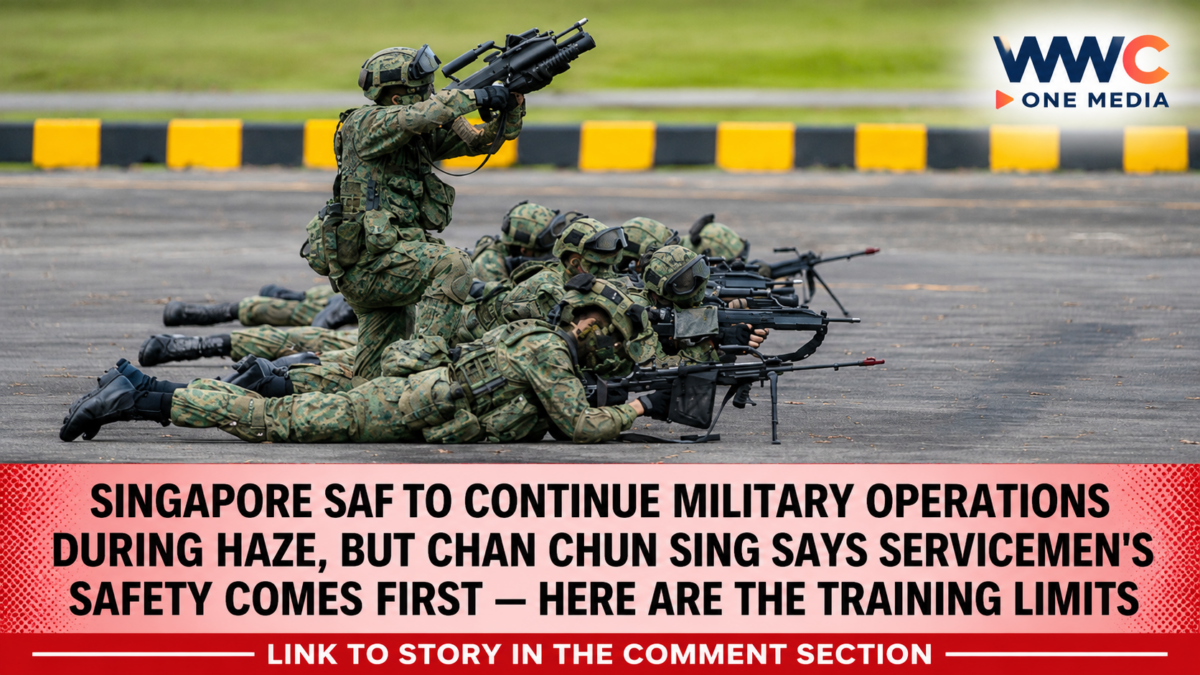
The Singapore Armed Forces (SAF) will continue carrying out essential military operations even when haze affects the country, but outdoor training will be adjusted according to air-quality conditions and medical advice, Defence Minister Chan Chun Sing has told Parliament.
Chan’s November 4 statement has brought renewed attention to the health and safety of Singapore’s national servicemen as the country deals with one of its more prolonged haze episodes in recent years.
The minister said the SAF must remain operationally ready to protect Singapore’s defence and security, regardless of haze conditions. At the same time, he stressed that the health and well-being of servicemen and women remain a priority.
The clarification followed a parliamentary question from Workers’ Party MP Kenneth Tiong of Aljunied GRC, who asked what restrictions apply when the 24-hour Pollutant Standards Index (PSI) reaches the unhealthy range of 101 to 200.
Tiong also raised questions about whether servicemen with pre-existing lung or heart conditions would be exempted from outdoor physical activities and whether the SAF’s haze-related training guidelines could be made public.
The discussion is significant for Singapore’s national service community, particularly full-time national servicemen and operationally ready national servicemen who may be required to participate in physical training and outdoor duties.
The central message from the Defence Ministry is clear: military readiness must continue, but training intensity and outdoor exposure must be adjusted as air quality deteriorates.
Chan Chun Sing: SAF cannot stop essential defence operations because of haze
Responding to the parliamentary question, Chan said the SAF must continue its operations because they are critical to Singapore’s defence and security.
He emphasised that servicemen’s health and well-being remain important even while the military maintains its operational responsibilities.
Personnel conducting operational duties are issued protective equipment, including N95 masks, where necessary.
However, the minister distinguished between essential operations and routine training activities.
While essential defence operations must continue, prolonged or strenuous outdoor training is moderated when air quality enters the unhealthy or very unhealthy ranges.
If the PSI reaches the hazardous range, all non-essential outdoor activities will be cancelled.
This distinction matters because maintaining operational readiness does not mean every physical training session, outdoor exercise or military activity must proceed at its usual intensity.
The SAF can adjust the nature, duration and intensity of activities while continuing to carry out duties necessary for national defence.
What happens when Singapore’s PSI reaches 101 to 200?
One of the main concerns raised in Parliament was the unhealthy PSI range.
Singapore classifies a 24-hour PSI reading of 101 to 200 as unhealthy.
When pollution reaches this level, the SAF’s training and activity guidelines call for adjustments to physical and outdoor training.
The Ministry of Defence’s published guidance explains that when PSI is 100 or below, training generally continues as normal. Once it exceeds 100, physical and outdoor training is reduced accordingly.
This means that the unhealthy range does not automatically trigger a complete suspension of all SAF training.
Instead, the military considers the level of pollution, the duration and intensity of the activity, and the medical fitness of the personnel involved.
For example, prolonged outdoor runs and strenuous physical exercises may be moderated, while activities that can be conducted indoors may be adjusted or moved to more suitable environments.
The approach is consistent with the broader principle that exposure to fine particles should be reduced when pollution becomes unhealthy.
It also explains why the SAF does not simply apply one universal restriction to every military activity.
An essential operational duty and a routine outdoor fitness session do not carry the same operational requirements.
The exact haze thresholds that trigger stronger SAF precautions
The Ministry of Defence published more detailed SAF haze measures on October 9, 2026.
These guidelines use both the 24-hour PSI and one-hour PM2.5 concentration readings to determine when additional precautions are needed.
| Air-quality threshold | SAF response |
|---|---|
| PSI 100 or below | Training generally continues as normal, subject to routine safety requirements |
| PSI above 100 | Physical and outdoor training is reduced or moderated |
| PSI above 200 or one-hour PM2.5 above 150 μg/m³ | Prolonged or strenuous outdoor physical activity is avoided; outdoor fitness tests are postponed or moved indoors where applicable |
| PSI forecast above 300 or one-hour PM2.5 above 250 μg/m³ | All non-essential outdoor activities are cancelled; N95 masks are worn for essential outdoor duties |
The thresholds are important because they show that the SAF’s response becomes progressively stricter as air pollution worsens.
At the very unhealthy level, additional safeguards apply to servicemen performing outdoor duties, participating in physical training or living with existing medical conditions that could be aggravated by haze.
At the hazardous level, non-essential outdoor activities are cancelled.
These measures are designed to limit exposure without compromising essential defence responsibilities.
The published guidelines also show why it is inaccurate to interpret Chan’s statement as meaning that all SAF outdoor activities will continue regardless of pollution levels.
Will servicemen with asthma or heart conditions be exempted?
Another important issue raised by Tiong concerns servicemen with pre-existing medical conditions.
Haze exposure can be particularly concerning for people with chronic respiratory or cardiovascular conditions.
Fine particulate matter, especially PM2.5, can penetrate deep into the lungs and aggravate existing health problems.
For this reason, the SAF’s October 9 guidance specifically identifies personnel with existing medical conditions that could be worsened by haze as requiring additional measures.
These include the provision of N95 masks when they perform essential outdoor duties.
However, the publicly available guidance does not establish a blanket rule stating that every serviceman with a heart or lung condition is automatically exempted from all outdoor activities.
The measures are based on medical fitness, the nature of the activity and the level of pollution.
This distinction is important.
A serviceman’s medical condition may require an individual assessment and adjustments to his duties or training. The existence of a medical condition should not be interpreted as an automatic exemption from every military responsibility.
The SAF’s stated approach is to reduce exposure and take additional precautions for personnel who may be more vulnerable.
Why Kenneth Tiong brought up the 1997 haze restrictions
Tiong also referred to the restrictions introduced during Singapore’s 1997 haze episode.
At the time, outdoor physical activities were subject to limits, including runs of up to five kilometres and marches of up to eight kilometres.
His question sought clarification on whether similar distance-based restrictions would apply under current haze conditions.
The issue is relevant because military training has changed significantly since the late 1990s, while the understanding of air pollution and health risks has also developed.
The SAF’s present framework is based on air-quality readings, medical fitness and the nature and intensity of activities.
This is different from relying solely on fixed distance limits.
A five-kilometre run, for example, may involve different levels of exertion depending on the pace, temperature, terrain and fitness of the individual.
A distance-based rule alone may therefore not provide sufficient protection in every circumstance.
The current approach allows the SAF to adjust training according to the actual conditions rather than applying one fixed limit to every activity.
Singapore’s haze episode has raised concerns beyond the military
The SAF is not the only institution adjusting its activities because of the haze.
The National Environment Agency (NEA) has been monitoring air quality and issuing advisories as smoke from fires in Indonesia affects Singapore.
On October 9, the NEA reported 24-hour PSI readings between 136 and 192 across Singapore’s five regions, placing the island in the unhealthy range.
At that time, the agency warned that readings could rise above 200 if unfavourable weather conditions and regional smoke continued.
The Government’s Haze Task Force was also activated to coordinate responses across 28 government agencies.
The task force’s measures included preparing healthcare institutions, supporting vulnerable residents and coordinating precautions for workplaces and outdoor activities.
WWC One Media previously reported on the deterioration in air quality in its coverage, Singapore Haze Deepens as PSI Remains Unhealthy Across Much of the Island.
The episode demonstrated how transboundary haze can affect not only people’s health but also workplaces, schools, sporting events and essential services.
Outdoor workers also face stricter precautions during unhealthy haze
The questions surrounding SAF personnel come amid a wider national discussion about protecting people who must work outdoors.
The Ministry of Manpower has advised employers to reduce prolonged or strenuous outdoor work when the 24-hour PSI reaches 101 to 200.
When PSI rises to 201 to 300, prolonged or strenuous outdoor work should be avoided. If it cannot be avoided, employers should provide appropriate respiratory protection, such as N95 masks.
When PSI exceeds 300, employers should minimise outdoor work. Employees who must continue working outside should wear N95 masks, with more stringent protection required at even higher readings.
Employers are also encouraged to rotate workers, provide indoor rest breaks, ensure adequate hydration and defer non-essential work.
These requirements reflect the wider principle that people should not be exposed unnecessarily to unhealthy air conditions simply because their jobs involve outdoor duties.
The SAF’s operational requirements are different from ordinary workplace arrangements, but the underlying health concern is similar.
WWC One Media examined the wider issue in its report, Singapore Haze Returns as Central Region PSI Enters Unhealthy Range.
The report explained how readings above PSI 100 can affect decisions about prolonged outdoor physical activity.
Why PM2.5 readings matter alongside the PSI
One of the most important parts of Singapore’s haze response is the use of two different air-quality measurements.
The 24-hour PSI provides a broader indication of pollution levels and is used for planning activities and issuing health advisories.
The one-hour PM2.5 reading measures the concentration of fine particulate matter over a shorter period.
PM2.5 particles are particularly concerning because they are small enough to penetrate deep into the respiratory system.
This is why the SAF’s guidelines use both measurements.
Even if the 24-hour PSI has not yet crossed a particular threshold, a high one-hour PM2.5 reading can trigger additional precautions.
For residents, this distinction is also important when deciding whether to exercise outdoors.
The NEA recommends checking one-hour PM2.5 readings for immediate activity decisions, while the 24-hour PSI forecast is useful when planning ahead.
WWC One Media previously explained the difference in its report, Singapore Sees Brief Improvement in PM2.5 Levels, but Haze Keeps Air Quality Unhealthy.
The two indicators should not be treated as interchangeable because they measure pollution over different time periods and serve different purposes.
Singapore’s defence readiness and servicemen’s health must go together
The debate highlights a difficult responsibility for the SAF.
Military personnel must remain prepared to respond to threats and carry out essential duties, even when environmental conditions are challenging.
At the same time, haze can affect physical performance and aggravate existing medical conditions.
The SAF’s approach is therefore based on maintaining essential operational readiness while reducing unnecessary exposure.
That can involve protective equipment, indoor alternatives, postponed physical fitness tests, reduced outdoor training intensity and additional safeguards for medically vulnerable personnel.
The Ministry of Defence’s October guidance also shows that the SAF is not relying solely on broad public health recommendations.
It has specific PSI-Activity and PM2.5-Activity guidelines under its Operations Directive and Training Safety Regulations.
The challenge will be ensuring that these measures are consistently applied across different units and activities as conditions change.
The Bottom Line
Chan Chun Sing’s parliamentary response makes one point clear: the Singapore Armed Forces will not suspend essential defence operations simply because haze affects the country.
But that does not mean servicemen will be required to carry out every outdoor activity under normal conditions.
The SAF’s published guidelines provide for reduced training when PSI exceeds 100, avoidance of prolonged or strenuous outdoor activity when PSI exceeds 200 or one-hour PM2.5 rises above 150 μg/m³, and cancellation of non-essential outdoor activities when PSI exceeds 300 or PM2.5 exceeds 250 μg/m³.
Additional measures also apply to servicemen with existing medical conditions that could be aggravated by haze.
The discussion is particularly important for national servicemen and their families, who want to know how military readiness is balanced against personal health.
Singapore’s defence responsibilities remain essential, but protecting the people who carry them out is just as important.
As haze conditions worsen, should the SAF publish more detailed training restrictions so servicemen and their families know exactly what activities are allowed at each PSI level?