MANILA, Philippines — November 5, 2026 | WWC ONE MEDIA | Philippine Business, Marketing & Consumer Brands
After more than a century of selling beverages in the Philippines, Coca-Cola is putting a different face on its brand: the Filipino workers, neighborhood entrepreneurs, artists and communities who have helped make its products part of everyday life.
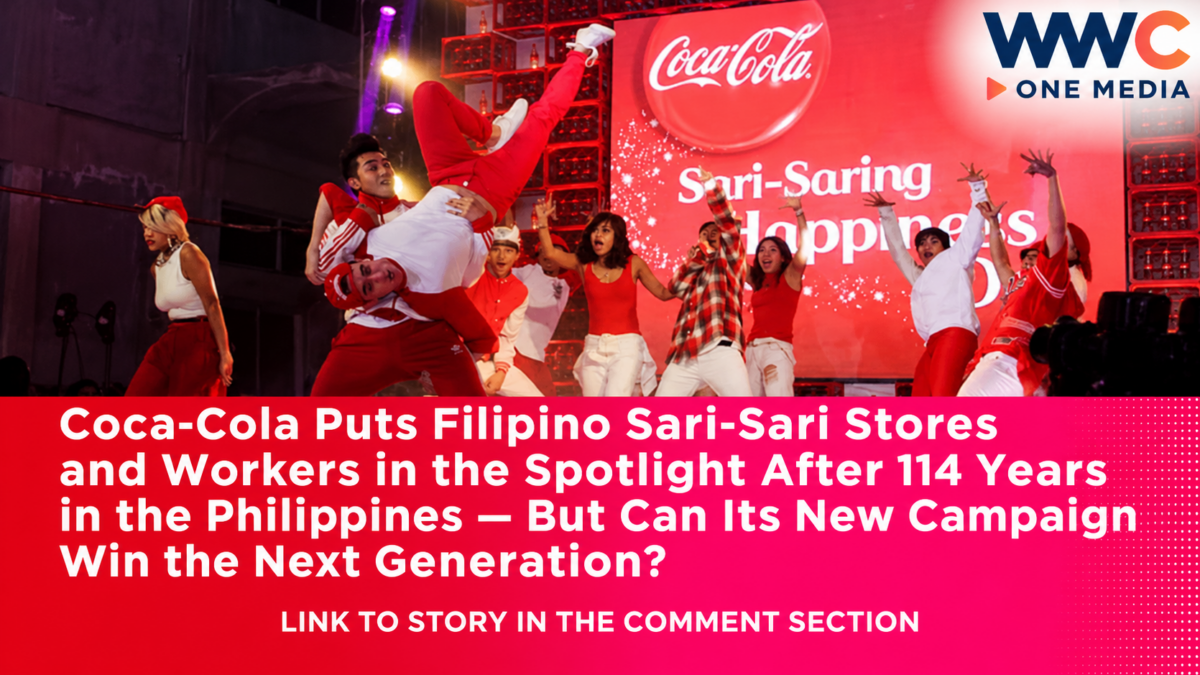
Coca-Cola Philippines has unveiled “Coke Natin ’To,” a storytelling campaign that celebrates the people behind its nationwide operations, from factory and distribution workers to sari-sari store owners and carinderia operators.
The campaign marks a renewed effort to strengthen consumer relationships by connecting the company’s products with familiar Filipino experiences.
Instead of focusing exclusively on beverage advertising, Coca-Cola is highlighting the people involved in making, moving and selling its products.
Its centerpiece is a film featuring employees across the company’s production and distribution network, alongside small business owners who serve customers in local communities.
The initiative also draws attention to Coca-Cola’s support for Filipino music, community livelihood programs, water-access efforts and plastic bottle recycling.
According to InsiderPH’s November 4 report, Coca-Cola is using these stories to reinforce connections developed across generations of Filipino consumers.
The strategy comes as beverage companies compete for customer loyalty in an increasingly crowded market shaped by changing preferences, digital commerce and growing expectations about corporate responsibility.
But can emotional storytelling turn Coca-Cola’s 114-year Philippine history into stronger long-term consumer loyalty—or will the company need to prove that its community initiatives deliver measurable benefits beyond advertising?
Coca-Cola’s New Campaign Celebrates the People Behind Every Bottle
The “Coke Natin ’To” campaign emphasizes the workers and businesses that form Coca-Cola’s Philippine value chain.
The company’s production employees manufacture and package beverages.
Distribution teams move products through an extensive logistics network.
Sari-sari stores, carinderias and other retailers make the beverages available to consumers.
The film connects these activities with familiar settings, including family meals, neighborhood gatherings and community celebrations.
Chris Pesigan, president and CEO of Coca-Cola Europacific Aboitiz Philippines (CCEAP), said the campaign recognizes the contribution of people working throughout the company’s operations.
CCEAP is the bottling and distribution partner for Coca-Cola products in the Philippines.
Coca-Cola Philippines president Banu Karakullukcu Cetin likewise emphasized the shared experiences that have helped establish the brand’s presence across generations.
Their statements underline the campaign’s central message: Coca-Cola wants consumers to associate the brand not only with the drinks they purchase, but also with the people and communities connected to those products.
Why Sari-Sari Stores Are Central to the Campaign
Neighborhood stores play an important role in Philippine retail.
They bring consumer products closer to households and provide everyday access to affordable goods in small quantities.
For beverage manufacturers, this network can be particularly valuable.
Consumers do not always purchase drinks from supermarkets or large restaurants.
Many buy beverages from local stores, roadside food businesses and neighborhood eateries.
These outlets help companies reach communities that may not be served as conveniently by modern retail chains.
The new Coca-Cola campaign places these small entrepreneurs at the center of its message.
That decision also reflects their commercial importance.
Local retailers help sustain product availability and customer familiarity.
For Coca-Cola, maintaining strong relationships with these businesses can support its distribution network.
For store owners, brand partnerships may create opportunities for sales, customer engagement and participation in additional programs.
However, the launch announcement does not disclose how much additional income individual retailers will earn because of the new campaign.
A 114-Year Relationship With Filipino Consumers
Coca-Cola traces its Philippine history to 1912.
That makes its presence in the country more than a century old.
Over time, its beverages became familiar products in restaurants, neighborhood shops and celebrations.
The new campaign uses that history to highlight the brand’s continuing place in Filipino culture.
The approach is significant because established consumer companies face a difficult challenge.
Brand familiarity does not automatically translate into future loyalty.
Younger consumers have more beverage choices, different purchasing habits and access to a wider range of competing products.
Companies must continually find ways to remain relevant.
Coca-Cola’s strategy is to connect its historical presence with contemporary stories about community, entrepreneurship and shared experiences.
But whether the campaign attracts new consumers or strengthens repeat purchases will require evidence beyond its launch.
Coca-Cola Combines Filipino Culture With Modern Marketing
The latest initiative follows Coca-Cola’s growing investment in digital and personalized marketing.
In October, the company received Brand of the Year recognition and eight campaign awards at the SMARTIES Philippines 2026 Awards.
The recognition included work involving artificial intelligence-supported advertising and a collaboration with Grab.
WWC ONE MEDIA previously examined those initiatives in Coca-Cola Philippines Wins Brand of the Year and Eight Marketing Awards With AI-Powered Campaigns.
That earlier report covered how Coca-Cola used consumer insights, digital platforms and personalized experiences to connect advertising with purchasing opportunities.
The new “Coke Natin ’To” initiative takes a different creative approach.
Rather than making technology the centerpiece, it emphasizes human stories.
Together, the initiatives illustrate two sides of contemporary brand building: using technology to reach consumers more effectively while developing messages that connect with their culture and experiences.
However, the awards do not establish that the newly launched storytelling campaign has already increased sales.
Original Pilipino Music Remains Part of the Strategy
Music is another important part of Coca-Cola’s Philippine brand identity.
Through Coke Studio, the company has provided Filipino musicians with a platform to perform and reach audiences.
The broader campaign also highlights the company’s participation in local festivals and celebrations.
These activities connect Coca-Cola with cultural experiences that extend beyond traditional product advertising.
Music and community events can create opportunities for brands to engage consumers in less transactional settings.
For Filipino artists, participation in such platforms may also provide additional exposure.
But those benefits depend on the terms of individual projects and their actual reach.
The “Coke Natin ’To” campaign does not disclose new artist payments, a new Coke Studio season or a quantified audience target.
Its confirmed focus is the broader role of Filipino cultural experiences in Coca-Cola’s brand story.
Sprite’s Filipino Food Campaign Shows the Same Strategy
Coca-Cola’s approach to local culture is also visible in its other beverage brands.
Earlier in 2026, Sprite collaborated with Makati restaurant Your Local on a food campaign built around spicy dishes and refreshing beverages.
WWC ONE MEDIA covered the collaboration in Filipinos Love Their Food Spicy—Now Sprite Is Turning Up the Heat With a Surprising New Pairing.
That campaign linked Sprite to familiar Filipino flavors and dining habits.
The new Coca-Cola initiative similarly draws on experiences consumers already recognize.
The difference is its emphasis on workers, retailers and communities rather than a specific food pairing.
Both campaigns demonstrate how international beverage brands are adapting their marketing to local preferences.
Plastic Recycling Becomes Part of Coca-Cola’s Community Story
Beyond cultural activities, “Coke Natin ’To” highlights Coca-Cola’s environmental programs.
One of the most significant is Tapon to Ipon, the company’s PET bottle collection initiative.
Launched in 2021, the program encourages consumers to bring used clear PET bottles to participating collection points.
It accepts qualifying bottles from different beverage brands, not only Coca-Cola products.
The collection network involves local governments, community organizations, retailers and other partners.
Some participating sari-sari stores serve as collection hubs where consumers can return bottles and receive program-specific incentives.
The model links everyday retail activity with recycling efforts.
However, collecting a plastic bottle does not automatically mean it has been successfully recycled.
The effectiveness of the program depends on sorting, collection, transportation and processing.
More Than 6,000 Collection Hubs Show the Scale of the Recycling Push
Coca-Cola’s 2026 corporate disclosures describe a nationwide collection network exceeding 6,000 hubs.
The company has also expanded the program through partnerships with local governments and community retailers.
In October, the initiative reached additional neighborhoods in Biñan City, Laguna.
WWC ONE MEDIA reported on the development in Coca-Cola Expands PET Bottle Recycling Push to Biñan as Neighborhood Stores Become Collection Hubs.
The Biñan rollout initially involved 50 participating store owners across 10 barangays.
The model uses neighborhood shops as convenient collection locations, allowing residents to bring recyclable materials to places they already visit.
The program’s scale is significant.
But the number of collection points is not equivalent to the number of bottles actually recycled.
A fuller assessment requires reliable figures on the quantity collected, how much material reaches recycling facilities and how much is successfully processed.
The Philippines’ Plastic Recovery Targets Raise the Stakes
Coca-Cola’s recycling activities are taking place within a changing regulatory environment.
Under the Philippines’ Extended Producer Responsibility Act of 2022, covered companies face increasing plastic-packaging recovery obligations.
The statutory target is 60% in 2026, rising to 70% in 2027 and 80% from 2028 onward.
These requirements make effective collection systems important for beverage manufacturers and other businesses that introduce plastic packaging into the market.
Coca-Cola’s Tapon to Ipon program can support the company’s packaging-recovery efforts.
However, compliance must be evaluated using the applicable rules and audited recovery or offset data.
The announcement of a campaign or the existence of collection hubs alone does not establish complete compliance with every regulatory obligation.
For consumers, the important issue is whether such programs produce verifiable reductions in unmanaged plastic waste.
Coca-Cola Is Also Exploring Stronger Ties With Filipino Farmers
The company’s relationships with Philippine communities extend into agricultural supply chains.
In October, industry discussions emerged about allowing beverage manufacturers to purchase sugar more directly from local farmers.
WWC ONE MEDIA reported on the proposal in Beverage Makers Explore Buying Sugar Directly From Farmers.
The report identified Coca-Cola among major beverage manufacturers interested in exploring such arrangements.
Any direct-purchasing model would need to address the difference between raw sugar produced by farmers and the refined sugar generally required for beverage manufacturing.
The proposal is separate from “Coke Natin ’To” and should not be presented as a completed supply agreement.
Nevertheless, it demonstrates why major consumer brands have relationships with many sectors beyond retail advertising.
Manufacturing and distribution can depend on farmers, suppliers, transport businesses and local enterprises.
Those relationships are relevant to Coca-Cola’s effort to tell a broader story about its Philippine presence.
Competitive Pressure Makes Consumer Loyalty More Important
Coca-Cola competes in a Philippine beverage market that includes carbonated soft drinks, ready-to-drink teas, juices, coffee, bottled water and other products.
Local food and beverage manufacturers continue investing in distribution and brand-building.
WWC ONE MEDIA previously examined the competitive consumer market in Piattos Reaches 73% of Filipino Households as Great Taste Records 317 Million Consumer Choices.
The report covered Universal Robina Corporation’s performance across several major consumer brands, including C2 tea.
The figures relate to URC, not Coca-Cola.
They nevertheless illustrate how widely distributed consumer brands compete for household attention and repeat purchases.
For Coca-Cola, strengthening relationships with retailers and consumers is one way to reinforce its position.
But emotional attachment alone cannot determine commercial success.
Price, availability, product preferences and consumer purchasing power also matter.
Can the New Campaign Produce Measurable Business Results?
The “Coke Natin ’To” announcement does not include a new sales target, campaign budget or measured increase in customer loyalty.
It also does not disclose how many viewers have watched the campaign film or how much additional revenue is expected.
That limits what can be concluded about its commercial impact.
An effective marketing assessment might examine brand awareness, consumer sentiment, audience engagement and changes in purchasing behavior.
For community programs, relevant measurements could include retailer participation, livelihood support, water access and verified plastic recovery.
Those outcomes should be assessed separately.
A successful storytelling campaign may strengthen consumer perceptions without immediately producing a measurable increase in sales.
Likewise, a sustainability initiative may provide community benefits that cannot be evaluated using advertising metrics alone.
The important issue is matching each claim to appropriate evidence.
What Other Sources Confirm
InsiderPH reported on November 4 that Coca-Cola Philippines had introduced “Coke Natin ’To,” highlighting employees, distributors, small retailers and community programs.
Coca-Cola’s official Philippine website independently confirms the campaign and the company’s historical presence since 1912.
Separate coverage published by Vic-Vic Bautista and Dot Daily Dose describes the same campaign film, company executives and community initiatives.
However, those reports closely reflect the company’s promotional announcement and should not be treated as independent evaluations of campaign effectiveness.
Coca-Cola Europacific Aboitiz Philippines’ own publications provide additional details about Tapon to Ipon, including its collection model and partnerships.
Marketing-industry reporting has also documented Coca-Cola’s earlier digital campaigns and recognition at the SMARTIES Philippines awards.
Together, the sources establish the campaign’s launch, creative concept and the existence of the related programs.
They do not establish that “Coke Natin ’To” has already produced a measurable increase in sales, loyalty or recycling volumes.
The Bottom Line: Coca-Cola Is Selling a Story Bigger Than a Beverage
Coca-Cola Philippines is using “Coke Natin ’To” to celebrate the people who help make its products part of everyday Filipino life.
The initiative places employees, delivery workers, sari-sari store owners, carinderia operators and communities at the center of its message.
It also connects cultural activities with the company’s livelihood, water-access and recycling programs.
The campaign builds on a Philippine history that began in 1912, while addressing the modern challenge of maintaining relevance among consumers with expanding choices.
For Coca-Cola, the strategy could reinforce emotional connections that extend beyond an individual purchase.
But the real test will be whether those connections generate sustained loyalty and whether the community programs highlighted in the campaign deliver measurable results.
Coca-Cola has spent 114 years becoming a familiar part of Filipino celebrations. Its latest campaign asks consumers to look at the people behind that history.
As the beverage giant turns everyday Filipino stories into its newest brand strategy, will “Coke Natin ’To” strengthen loyalty for another generation—or will customers increasingly demand proof that the company’s promises to communities and the environment go beyond advertising?