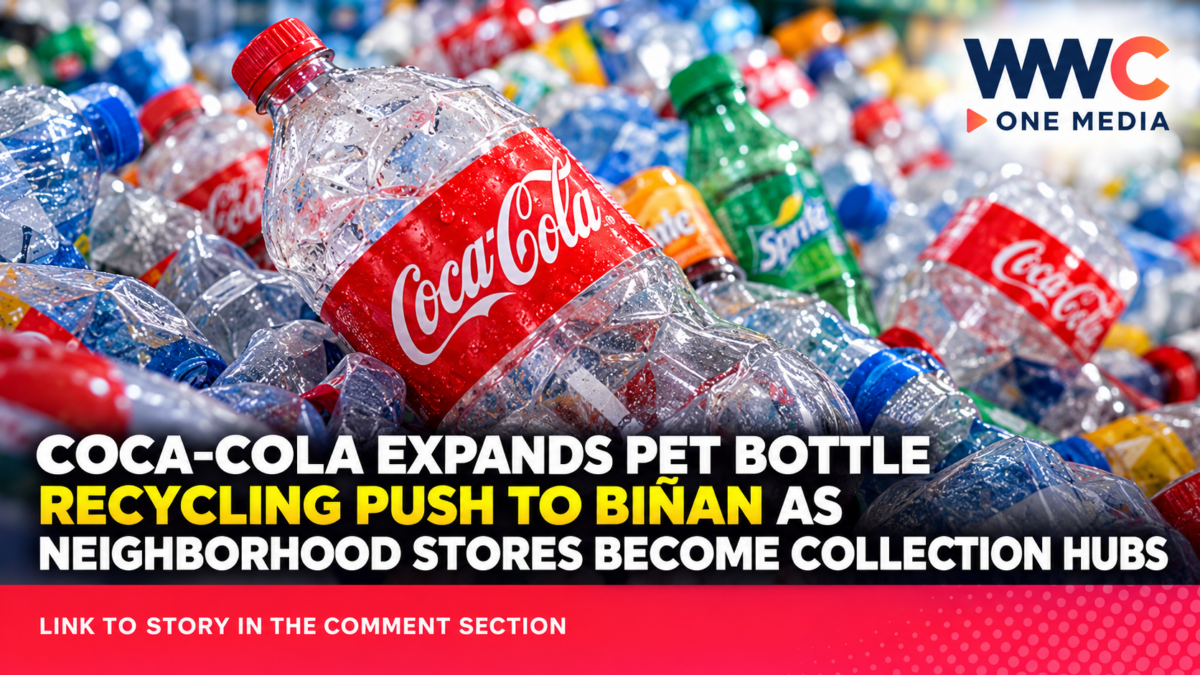
BIÑAN CITY, Laguna — Coca-Cola Philippines is taking its plastic-bottle recycling campaign deeper into Filipino neighborhoods, turning sari-sari stores and other community retailers into PET collection hubs as companies face increasingly tougher plastic-recovery requirements nationwide.
The beverage company has expanded its Tapon to Ipon program to Biñan City, Laguna, starting with 50 participating store owners across 10 barangays, or five retailers in each community.
The rollout is being implemented with the Biñan City Government, Department of the Interior and Local Government-Laguna, Basic Environmental Systems and Technologies Inc. (BEST), and retailer partners.
RECYCLING MOVES CLOSER TO FILIPINO HOMES
Instead of requiring residents to travel to major recycling centers, the program places collection points inside businesses they already visit regularly.
Residents can bring used clear PET bottles from any brand to participating stores. Retailers then consolidate the recovered bottles while earning points that may be exchanged for products, food items, online-shopping vouchers and utility-bill credits.
The approach gives sari-sari stores a bigger role in the recycling chain while addressing one of the persistent challenges in waste recovery: making collection points accessible enough for households to use consistently.
Coca-Cola Philippines said its broader Tapon to Ipon network has already reached more than 170 cities and municipalities since the initiative began in 2021.
FROM SARI-SARI STORES TO A BOTTLE-TO-BOTTLE RECYCLING FACILITY
The ultimate goal is not merely to collect the bottles but to return usable PET material into the packaging supply chain.
Recovered bottles are intended to be brought into recycling pathways that include PETValue Philippines in General Trias, Cavite, a joint venture between Coca-Cola Europacific Aboitiz Philippines and Indorama Ventures.
PETValue processes used PET bottles into food-grade recycled PET, or rPET, which can then be used in producing new beverage bottles. Coca-Cola describes the facility as the country’s pioneering food-grade bottle-to-bottle PET recycling operation.
That distinction matters because bottle-to-bottle recycling keeps PET material in a higher-value closed loop rather than immediately downcycling it into products that may not be recyclable again.
OVER 6,000 COLLECTION POINTS NATIONWIDE
The Biñan expansion forms part of a much larger collection network.
Coca-Cola Philippines said its expanded Tapon to Ipon system now includes more than 6,000 bottle-recycling drop-off locations across the country, including sari-sari stores, retailers, community locations and collection activations at major festivals.
The company consolidated several collection programs under Tapon to Ipon, including the Tindahan Extra Mile initiative, which works with micro-retailers to collect PET bottles and other recyclables while offering incentives based on the volume recovered.
Collections have also been supported through local-government partnerships involving baling machines, collection bins and material-recovery infrastructure.
In Metro Manila, Coca-Cola Europacific Aboitiz Philippines has partnered with local governments including Manila, Pasig, Valenzuela, Quezon City and Caloocan to improve PET recovery and transport efficiency.
COMMUNITY COLLECTION IS BECOMING A BIGGER PART OF THE STRATEGY
The neighborhood model has increasingly become central to Coca-Cola’s Philippine recycling strategy.
Its Tapon to Ipon program already works with sari-sari stores, barangays and LGUs across areas including Baguio, Dumaguete, Palawan, Quezon City, Cagayan de Oro, General Santos, Northern Samar and Siargao.
At festivals including Sinulog, Dinagyang, Panagbenga, Kadayawan and MassKara, Coca-Cola has also operated collection booths where consumers can exchange eligible clear PET bottles for products or prizes.
The strategy reflects a simple reality: a recycling plant can only process bottles that actually make it into a formal collection system.
WHY THE TIMING MATTERS: PHILIPPINES’ EPR TARGET HITS 60% IN 2026
The expansion also comes during an important year for the Philippine plastics industry.
Under Republic Act No. 11898, or the Extended Producer Responsibility Act of 2022, covered large companies must recover or offset an increasing percentage of the plastic packaging they place into the market.
The statutory recovery targets rose from:
20% in 2023
40% in 2024
50% in 2025
60% in 2026
70% in 2027
80% from 2028 onward.
That means collection networks are becoming more important not only for corporate sustainability programs but also for meeting legally mandated recovery obligations.
Government figures cited in August showed that audited 2024 recovery rates reached 59.98% for rigid plastics and 56.33% for flexible plastics, both above that year’s statutory target of 40%. Authorities nevertheless said monitoring would continue, with the DENR issuing show-cause letters to 155 potential obligated enterprises over possible compliance issues.
BIÑAN PUTS THE FOCUS ON THE LAST MILE
Under the Biñan partnership, the city government will help mobilize local communities and officials, while Coca-Cola will provide collection tools and kits.
BEST will support collection operations, the Philippine Association of Stores and Carinderia Owners will help mobilize retailers, and the DILG will help monitor the program’s outcomes.
Biñan Mayor Angelo Alonte emphasized that community participation would determine whether the program succeeds.
Coca-Cola Philippines Senior Director for Public Affairs, Communications and Sustainability Ma. Christine Ponce-Garcia likewise said effective recycling systems require cooperation among companies, communities and local partners rather than action from a single organization.
THE BIGGER TEST: CAN RECYCLING BECOME AN EVERYDAY HABIT?
The Biñan rollout illustrates a broader shift in recycling strategy: instead of relying mainly on large facilities or occasional cleanup campaigns, companies and local governments are increasingly trying to build collection directly into people’s daily routines.
For Coca-Cola, putting PET recovery inside neighborhood stores creates a potentially powerful last-mile network.
But the long-term test will be whether those hubs consistently collect enough bottles, whether recovered material reliably reaches recycling facilities and whether participation continues after the novelty of the program fades.
With the Philippines’ mandatory plastic-recovery target now at 60% in 2026 and headed toward 80% by 2028, the success of community-level collection could become one of the most important links in the country’s effort to keep plastic packaging out of dumpsites, waterways and the environment.