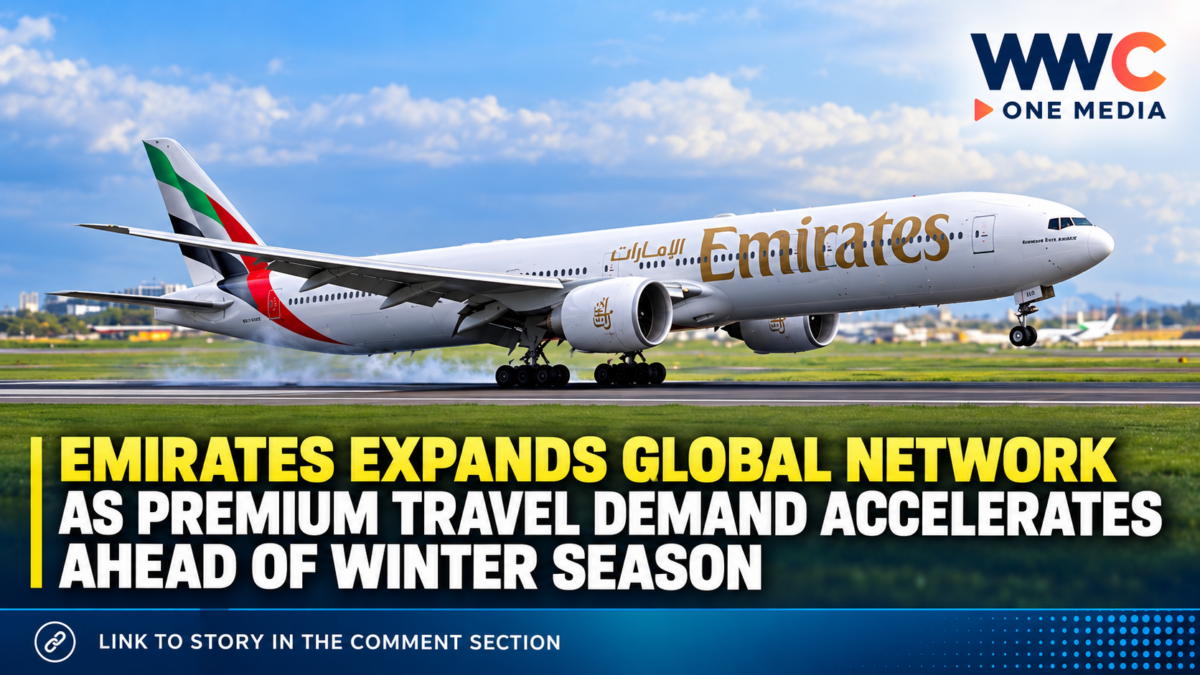
DUBAI — Emirates is accelerating its global expansion as premium travel demand strengthens, adding flights, upgrading aircraft and widening the reach of its Premium Economy cabin as millions of passengers return to international travel ahead of the winter season.
The Dubai-based airline carried more than 8.6 million passengers in July and August 2026, while operating at around 93% of its pre-disruption capacity, according to Emirates.
Bookings for the upcoming winter travel period are also tracking positively, even as passengers increasingly make travel decisions closer to their departure dates.
The rebound is giving Emirates room to pursue a strategy built around more than simply adding seats.
The carrier is expanding its route network while investing heavily in Premium Economy, upgraded cabins, Airbus A350 aircraft and retrofitted Boeing 777s and Airbus A380s—a push aimed at travelers willing to pay more for additional comfort without moving all the way up to Business Class.
PREMIUM TRAVEL BECOMES A BIGGER GROWTH ENGINE
Demand has been particularly strong for Emirates’ Premium Economy product.
The airline said Premium Economy bookings have been rising across its international network, with the Americas among the strongest-performing markets.
The shift mirrors a broader airline-industry trend in which carriers are adding more premium seating as leisure and corporate travelers increasingly seek extra space, privacy and service.
Emirates has made that segment a centerpiece of its fleet investment.
By September, the airline had completed retrofits on 104 aircraft, including 53 Boeing 777s and 51 Airbus A380s.
Its Premium Economy and latest cabin products were available on 137 aircraft, with Emirates targeting 155 aircraft by the end of December 2026.
Earlier this year, the carrier said Premium Economy would reach 99 destinations by the end of 2026, reflecting how quickly the cabin is being deployed across its global system.
EMIRATES ADDS MORE AIRCRAFT
The airline is also receiving new planes at a faster pace.
Since January, Emirates said it had taken delivery of 18 aircraft—11 Airbus A350 passenger jets and seven Boeing 777 freighters.
Another six A350s were scheduled to arrive before the end of 2026.
The A350 is becoming an important part of Emirates’ growth strategy because it allows the airline to serve destinations that may not require the massive capacity of its flagship Airbus A380.
It also provides Emirates with a newer aircraft platform equipped with its latest cabin products.
HELSINKI JOINS THE NETWORK
One of the most visible additions is Helsinki, which joined Emirates’ network on October 1, 2026, using the Airbus A350.
At the same time, Emirates is increasing frequencies across Asia and Africa.
Additional services include second daily flights to destinations such as:
Accra
Tokyo Narita
Ho Chi Minh City
Hanoi
The airline is also moving one of its daily Delhi services to its flagship Airbus A380.
India is an especially important market.
Emirates announced earlier in 2026 that Premium Economy would be available across six Indian cities—Delhi, Mumbai, Ahmedabad, Bengaluru, Kolkata and Kochi—by the end of October.
Delhi will also become the airline’s third Indian destination served by the A380, alongside Mumbai and Bengaluru.
DEMAND IS RISING ACROSS SEVERAL MARKETS
Emirates said passenger demand is running ahead of year-earlier levels in several countries, including:
South Africa
Brazil
India
Portugal
Egypt
Ghana
Colombia
Saudi Arabia
Pakistan
Nepal is also showing stronger demand through Emirates’ partnership with flydubai.
Reuters separately reported that Emirates saw seat load factors above 75% across major regions including Europe, West Asia, Africa, the Americas and the Middle East during its summer recovery.
That performance is important because airlines generally become more profitable when they can fill a larger share of available seats while simultaneously selling more premium cabin inventory.
DUBAI REMAINS AT THE CENTER OF THE STRATEGY
Dubai itself continues to generate substantial passenger traffic.
More than 500,000 Emirates passengers arrived in Dubai during the second half of August, around 7% higher than during the comparable period in 2025, according to the airline.
That reinforces Emirates’ traditional business model: use Dubai as a global connection point linking Asia, Europe, Africa, the Middle East and the Americas.
The airline now works with 168 codeshare, interline and intermodal partners, giving passengers access to approximately 1,750 additional cities beyond Emirates’ own network.
PHILIPPINES GETS MORE EMIRATES CAPACITY
For Filipino travelers, Emirates’ expansion has a direct impact.
The airline has operated in the Philippines since 1990, giving it a 36-year presence in the country in 2026.
Earlier this year, Emirates increased its Philippine capacity from 28 to 32 weekly flights, serving Manila, Cebu and Clark and linking passengers to Dubai and onward destinations throughout its global network.
The expansion included four additional weekly flights between Manila and Dubai beginning April 2, operated with Boeing 777-300ER aircraft.
Emirates said the added services were designed partly to meet demand from Filipino travelers, corporate passengers, maritime workers and the large Filipino diaspora.
The airline also has a partnership with Philippine Airlines, enabling passengers arriving through Manila, Cebu and Clark to connect onward to additional domestic destinations with baggage checked through to their final stop.
PREMIUM ECONOMY IS BECOMING MORE IMPORTANT
One of the most significant parts of Emirates’ expansion is the space between Economy and Business Class.
Premium Economy has increasingly become attractive to passengers who want larger seats, better dining and more personal space but do not want to pay Business Class prices.
Emirates is pushing that concept even further.
In September, the airline introduced a new electrically powered Premium Economy seat for upcoming A350 aircraft featuring adjustable privacy dividers, wireless charging and upgraded entertainment technology.
The product illustrates how airlines increasingly see premium economy not simply as upgraded economy seating but as a distinct revenue category.
BUT HIGHER FUEL COSTS REMAIN A RISK
The expansion is taking place against a more difficult cost environment.
Reuters reported in September that Emirates was working to contain the impact of higher jet-fuel prices on ticket prices amid continued Middle East disruptions.
Emirates Deputy President and Chief Commercial Officer Adnan Kazim said the airline had hedged around half of its fuel requirements, helping shield the carrier from some price volatility.
Fuel remains one of the airline industry’s biggest operating expenses, meaning prolonged high energy prices could eventually place pressure on fares, margins or capacity decisions.
THE BIGGER STORY: EMIRATES IS BETTING ON PASSENGERS TRADING UP
Emirates’ latest expansion suggests the airline sees more opportunity not simply in carrying more travelers, but in convincing more passengers to buy higher-value seats.
Its strategy combines new destinations, additional frequencies, A350 deliveries, A380 deployments and an increasingly large Premium Economy network.
For Filipino travelers, that means more connections through Dubai and potentially more cabin choices as upgraded aircraft spread throughout the network.
But the larger aviation battle is only beginning.
With global airlines increasingly competing for passengers willing to pay for more comfort, Emirates is betting billions on premium travel continuing to grow—even as fuel costs, geopolitical disruptions and economic uncertainty remain major risks.
The question now is whether passengers will continue trading up fast enough to justify the industry’s premium-cabin expansion.