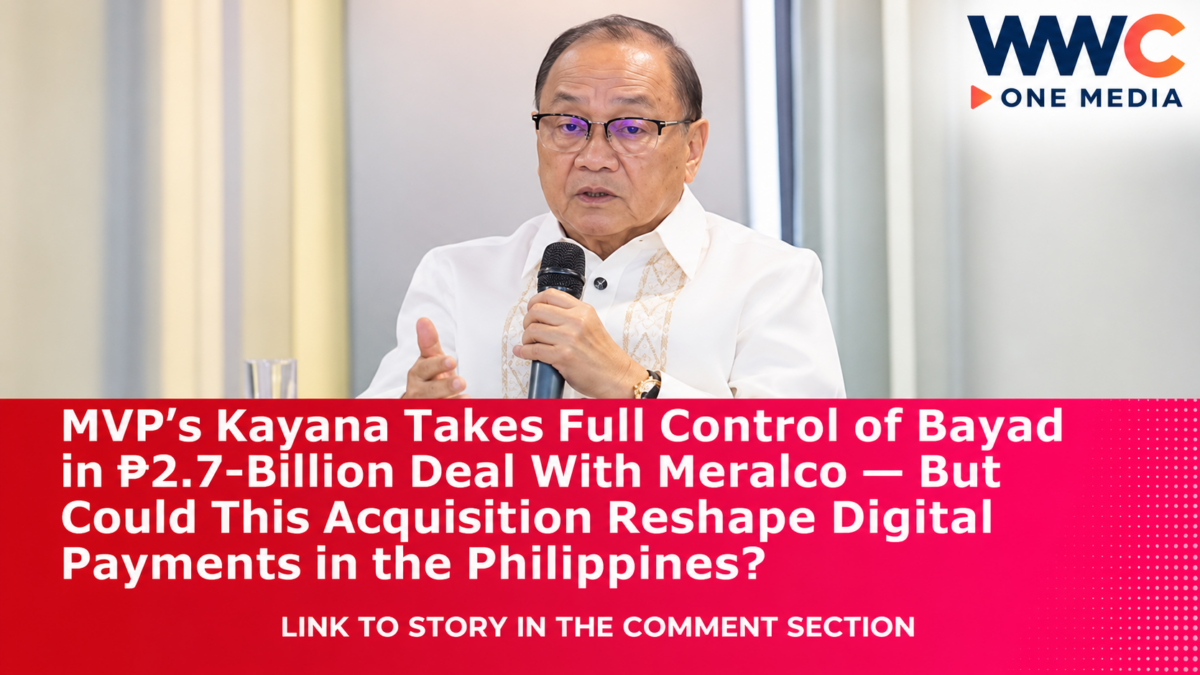
MANILA, PHILIPPINES — Business tycoon Manuel V. Pangilinan’s digital technology ambitions have taken another major step forward after PLDT-backed Kayana Solutions Inc. completed its ₱2.7-billion acquisition of CIS Bayad Center Inc., bringing one of the country’s established bills-payment platforms entirely under the ownership of the MVP Group’s digital venture.
The transaction, completed on November 3 and reported by Bilyonaryo on November 4, gives Kayana full ownership of Bayad after acquiring the remaining 90% interest previously held by Manila Electric Company (Meralco) and its wholly owned subsidiary, Corporate Information Solutions Inc. (CIS).
The deal represents a significant consolidation of digital-payment operations within a corporate group whose businesses already span telecommunications, electricity distribution, infrastructure, data services and financial technology.
For millions of Filipinos who rely on bills-payment outlets, online collection services and digital wallets, the acquisition could eventually influence how everyday transactions are processed.
But the immediate significance is strategic rather than a confirmed change to customer services.
Kayana is positioning itself to combine Bayad’s established payment infrastructure with the wider group’s technology, data and customer relationships.
The bigger question is whether the ₱2.7-billion acquisition will turn Bayad into a more powerful digital-payments platform—or whether competition from established fintech giants will make the next phase of expansion far more difficult.
Kayana Completes ₱2.7-Billion Bayad Acquisition
According to the November 3 transaction disclosure, Kayana acquired 504,948 common shares of CIS Bayad Center from Meralco and CIS.
The shares represent the remaining 90% of Bayad that Kayana did not already own.
Before the transaction, Bayad’s ownership was divided among three entities:
- Corporate Information Solutions Inc., with 85%.
- Kayana Solutions Inc., with 10%.
- Manila Electric Company, with 5%.
Under the completed agreement, CIS transferred 476,895 common shares, while Meralco sold its directly held 28,053 shares.
The agreed acquisition price was ₱2.7 billion, or approximately ₱5,347.08 per share.
With the transaction completed, Kayana now owns 100% of Bayad.
The acquisition was initially outlined earlier in 2026 and subsequently disclosed through the Philippine Stock Exchange.
The transaction’s completion marks an important development because Kayana can now exercise full ownership over Bayad rather than operating solely as a minority shareholder.
However, full ownership does not mean the company has automatically launched new services or completed all planned technology integrations.
Those operational developments will depend on management decisions and implementation.
Was the Entire ₱2.7 Billion Already Paid?
One important detail deserves clarification.
Although the acquisition was completed on November 3, previous regulatory disclosures established a payment arrangement extending into 2027.
Meralco’s board approved revised payment terms on October 6.
Under the original arrangement, Kayana would have paid the entire ₱2.7-billion purchase price at closing.
The revised terms instead provide for an initial payment on the closing date, with the remaining balance payable in April 2027.
The disclosed agreement did not specify the exact initial payment or outstanding balance.
Therefore, it would be inaccurate to conclude that Kayana has already settled every peso of the acquisition price solely because the transaction has closed.
The distinction matters for investors evaluating the companies’ cash flows and financial obligations.
The acquisition is completed in ownership terms, but the previously disclosed payment schedule may still involve an outstanding financial commitment.
Any subsequent announcement confirming full settlement would need to be evaluated separately.
Who Owns Kayana? PLDT, Meralco and MPIC Join Forces
Kayana is a digital technology venture backed by three major companies associated with Pangilinan’s business network.
Its ownership structure is:
PLDT Inc. — 45%
The telecommunications giant is Kayana’s largest shareholder.
Its involvement provides access to an established technology and telecommunications business with nationwide customer relationships and infrastructure.
Manila Electric Company — 27.5%
Meralco, the country’s largest electricity distributor, retains an indirect economic interest in Bayad through its shareholding in Kayana.
Metro Pacific Investments Corporation — 27.5%
MPIC contributes the broader group’s infrastructure and investment experience.
Together, these companies give Kayana access to business relationships across several major sectors.
The acquisition also changes Meralco’s relationship with Bayad.
Instead of holding its previous direct and subsidiary interests, Meralco now retains an indirect 27.5% interest through Kayana.
This is not an outright exit by Meralco from the payment platform’s economic ownership.
Rather, it represents a restructuring that places Bayad under a jointly owned digital-services company.
Why Pangilinan Wants Bayad Under Kayana
The acquisition is part of a wider strategy to expand digital services across the MVP Group.
Bayad has traditionally provided bill-payment and collection services through both physical locations and digital channels.
Its business model connects customers, payment institutions, billers and service providers.
For Kayana, acquiring full ownership provides an opportunity to integrate these functions with technology and data capabilities.
The company has described its strategy as using data-driven solutions to improve customer experiences and expand digital transactions.
Potential areas of development include more streamlined bill-payment processing, improved transaction management and stronger integration among group businesses.
However, these remain strategic opportunities rather than confirmed new consumer features.
The group’s broader objectives may include increasing transaction volume, improving operating efficiency and expanding partnerships with additional billers and merchants.
The challenge will be converting those possibilities into measurable financial results.
Bayad’s Payment Network Provides a Valuable Starting Point
Bayad is not a new entrant attempting to establish a payment business from scratch.
The platform already operates within an established ecosystem of bills-payment outlets, collection partners and digital transaction channels.
Earlier industry reporting described a network involving more than 800 outlets and over 104,000 payment touchpoints across the country.
These figures provide historical context and should not be interpreted as a newly verified November 2026 network count.
Bayad’s physical presence is important because a substantial number of Filipino consumers continue to use cash-based payment methods.
Some customers prefer paying bills at authorized physical outlets instead of using digital wallets or online banking.
Others may have limited internet access or prefer obtaining payment assistance in person.
A successful digital transformation therefore does not necessarily require eliminating physical outlets.
Instead, Bayad could benefit from offering customers convenient options across physical and electronic channels.
Why the Philippines Is an Attractive Digital-Payments Market
The acquisition comes during a period of rapid growth in digital financial transactions.
According to Bangko Sentral ng Pilipinas data, digital payments accounted for 64.7% of retail-payment transactions by volume in 2025, up from 57.4% in 2024.
The figures illustrate how electronic payments are becoming central to everyday commerce.
WWC ONE MEDIA previously examined a related trend in Philippines Remains Southeast Asia’s Biggest Cash-on-Delivery Holdout — But a 198% Digital Payment Surge Signals a Major Shopping Shift.
That report highlighted how many Filipino consumers continue relying on cash-on-delivery even as QR-code payments and instant bank transfers expand rapidly.
The contrast illustrates the opportunity facing payment-service providers.
Millions of customers are moving toward electronic transactions, but cash remains important in certain segments.
For Kayana, Bayad’s combination of physical and digital services could provide a competitive advantage in reaching consumers with different payment preferences.
Can Bayad Compete With GCash and Maya?
The acquisition arrives amid intense competition in the Philippine financial technology industry.
GCash has expanded into a broad ecosystem offering money transfers, digital payments, financial products and merchant services.
Maya, another major player linked to Pangilinan’s business network, combines digital wallet services with digital banking and merchant-payment solutions.
Bayad operates within the same broader digital financial ecosystem, but its core focus includes payment collection and biller connectivity.
That difference is important.
The acquisition does not automatically make Bayad a direct replacement for GCash or Maya.
Instead, Bayad may compete with some services while also partnering with other financial platforms to process bill payments.
WWC ONE MEDIA previously covered the significance of GCash’s market expansion in GCash’s Record ₱60.9-Billion IPO Draws BlackRock, Citadel and Global Investors — But the Real Test for Philippine Tech Begins Now.
The company’s landmark public offering demonstrated substantial investor interest in Philippine digital financial services.
But its success also highlights the level of competition Kayana will face as it seeks to expand Bayad’s digital capabilities.
Pangilinan’s Fintech Strategy Extends Beyond Bayad
Bayad is only one element of the broader financial technology ambitions associated with Manuel V. Pangilinan.
Maya remains another important business within the wider investment network.
In October, Pangilinan discussed the possibility of pursuing Maya’s initial public offering in 2027.
WWC ONE MEDIA examined those plans in After GCash’s ₱60.9-Billion IPO, Pangilinan Eyes Maya Listing in 2027 — But Will Wall Street or Filipino Investors Get the Bigger Opportunity?.
The report highlighted the growing importance of digital finance in Pangilinan’s long-term investment strategy.
However, Maya and Kayana should not be treated as identical businesses.
Their operating structures, ownership arrangements and strategic roles differ.
Maya’s potential public listing is also a separate transaction from Kayana’s completed Bayad acquisition.
There has been no verified announcement establishing that Bayad will be merged into Maya or that Kayana will undertake its own IPO.
Such developments would require additional corporate disclosures.
Artificial Intelligence Could Play a Bigger Role
Kayana’s strategy involves using data and technology to improve customer engagement.
That raises the possibility of applying artificial intelligence to payment-related operations.
Potential uses include automated customer support, fraud monitoring, transaction analysis and more personalized services.
AI could help a platform identify unusual transaction patterns, improve operational efficiency or assist customers completing routine payments.
However, the practical benefits depend on the technology deployed, the accuracy of its outputs and the quality of underlying data.
PLDT has already been expanding its own use of artificial intelligence.
WWC ONE MEDIA previously examined those developments in PLDT’s AI Agents Are Saving Tens of Thousands of Work Hours — But the Bigger Question Is What Happens to the Human Workforce.
The report described how PLDT has introduced intelligent systems to improve enterprise workflows and customer interactions.
These developments provide strategic context for the wider group’s technology ambitions.
But they do not establish that Bayad has already deployed the same AI systems or achieved equivalent productivity gains.
Kayana will need to demonstrate the specific operational benefits of integrating digital capabilities into Bayad.
Cybersecurity and Fraud Protection Will Be Critical
Expanding digital transactions also creates greater responsibility for protecting customers.
Payment platforms must maintain reliable systems for transaction processing, personal-data protection and detecting suspicious activities.
As customer networks grow, cybercriminals may attempt to exploit account vulnerabilities, social engineering and weaknesses in payment infrastructure.
WWC ONE MEDIA previously examined this challenge in Philippine Digital Finance Market Emerges as Key Growth Opportunity for Global Fraud-Prevention Firm.
That report highlighted growing demand for identity verification, fraud detection and anti-money-laundering technology.
For Kayana and Bayad, security will be essential to building long-term consumer confidence.
An effective payment platform must offer more than convenient transactions.
Customers also need assurance that their information is protected and that payments can be traced and verified.
The acquisition itself does not prove any deficiency in Bayad’s existing cybersecurity systems.
Rather, increased scale and digital integration make strong safeguards an important strategic priority.
How Meralco Benefits From the Restructuring
Meralco’s involvement makes the transaction particularly interesting.
The power distributor previously held Bayad through a combination of its wholly owned subsidiary CIS and direct ownership.
After the acquisition, Meralco retains a 27.5% indirect interest through Kayana.
This arrangement allows the utility to remain economically connected to Bayad while participating in a wider digital technology venture.
Meralco may also benefit from improvements in customer payment experiences and collection infrastructure.
However, the transaction should not be presented as an automatic increase in Meralco’s earnings.
The accounting impact of the disposal, any recognized gain and the future contribution from Kayana will depend on the company’s financial disclosures.
Meralco has separately been pursuing significant investment across its core electricity and power-generation operations.
WWC ONE MEDIA examined those developments in Meralco Targets Record ₱56.6-Billion Profit as Power Generation Earnings Jump 24% — But Will Filipino Consumers Benefit?.
The report highlighted management’s full-year core-earnings target and investment strategy.
Bayad’s transfer to Kayana is a separate corporate transaction and should not be assumed to account for the utility’s expected earnings growth.
Will Customers See Lower Fees or Faster Transactions?
One of the most important questions is whether the acquisition will produce direct benefits for consumers.
Kayana’s strategy includes improving Bayad’s payment and collection capabilities.
That could eventually support faster transactions, additional payment options or a more integrated customer experience.
But no specific nationwide reduction in transaction fees has been confirmed as a direct result of the acquisition.
Neither has the transaction itself established that existing Bayad branches will close or that customers must immediately move to a different application.
Customers should continue relying on official Bayad communications for any changes to payment channels, service terms or transaction procedures.
The potential benefits remain meaningful, but they must be assessed through actual service improvements rather than corporate announcements alone.
What Happens Next? Three Major Questions
First, how quickly will Kayana integrate Bayad into its digital-services ecosystem?
The company must determine how to combine its technology and data capabilities with Bayad’s established payment operations.
Second, will the acquisition produce measurable business growth?
Investors will look for evidence of higher transaction volumes, expanded partnerships, improved efficiency and sustainable profitability.
Third, how will the remaining purchase-price obligations and financial effects be disclosed?
Earlier transaction documents provided for the balance of the acquisition price to be paid in April 2027.
Future financial reports may clarify the final cash payments, accounting treatment and earnings impact.
These developments will help determine whether the transaction delivers value to Kayana’s shareholders and customers.
The Bigger Picture: Is MVP Building a Stronger Philippine Digital-Payments Ecosystem?
The completion of Kayana’s ₱2.7-billion acquisition of Bayad represents more than a change in corporate ownership.
It gives a digital venture backed by PLDT, Meralco and Metro Pacific full ownership of an established Philippine payment-collection platform.
The transaction combines Bayad’s experience in bill payments with the broader group’s technology ambitions and nationwide business relationships.
It also comes at a time when digital payments are becoming increasingly important to Filipino consumers and companies.
Yet the strategic opportunity is accompanied by challenges.
GCash and Maya have established strong positions in consumer financial services.
Banks, payment gateways and emerging fintech companies are also expanding their digital capabilities.
Customers expect convenience, affordability, security and reliability.
For Kayana, owning Bayad is only the beginning.
The real challenge will be proving that corporate consolidation produces better services and stronger financial performance.
As Manuel V. Pangilinan’s Kayana completes its ₱2.7-billion takeover of Bayad, could the combination of telecommunications, electricity, infrastructure and digital-payment capabilities create a powerful new fintech ecosystem—or will fierce competition from established financial technology platforms limit the group’s ambitions?