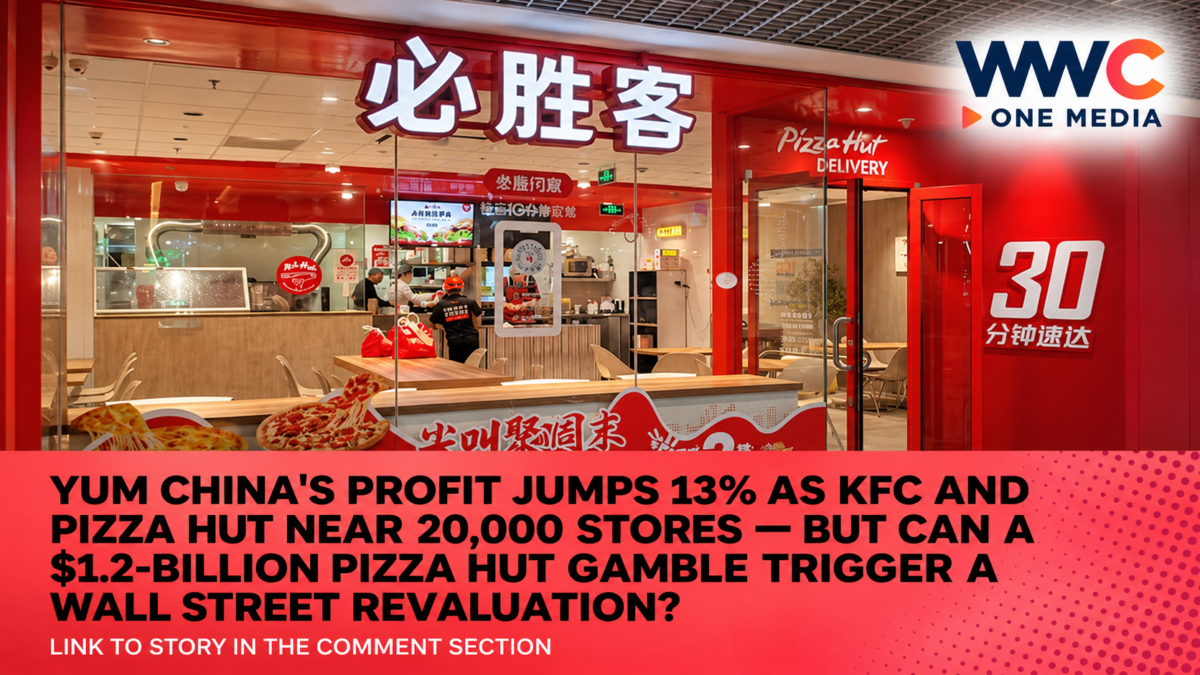
SHANGHAI, China / MANILA, Philippines — November 4, 2026 | WWC ONE MEDIA | Global Business, Consumer Markets & Investments
China’s restaurant industry is becoming one of the fiercest battlegrounds in global consumer business, and Yum China Holdings is attempting to convince investors that its expanding fast-food empire deserves a higher stock market valuation.
The operator of KFC and Pizza Hut restaurants across mainland China has reported stronger third-quarter earnings, improving operating margins and record restaurant openings, even as cautious Chinese consumers continue demanding cheaper meals.
In financial results released November 3, Yum China reported an 8% increase in quarterly revenue to approximately $3.48 billion and a 13% rise in operating profit to $451 million.
Diluted earnings per share climbed 20% to $0.91.
The company also expanded its restaurant network to 19,989 locations, putting it within striking distance of the psychologically significant 20,000-store milestone.
But the numbers reveal a more complicated picture.
While Yum China opened hundreds of additional restaurants, sales at comparable existing locations fell 3% from a year earlier.
That contradiction lies at the center of the company’s investment story.
Yum China is becoming bigger and more profitable, but its existing restaurants are still facing pressure from customers increasingly focused on value.
With a $1.2-billion acquisition of the Pizza Hut brand in mainland China, aggressive franchising plans and a $1.5-billion annual shareholder-return program, the company is trying to demonstrate that its business deserves a fresh valuation.
The question is whether investors will reward that transformation—or whether weak consumer demand will continue limiting the stock’s upside.
Yum China’s $3.48-Billion Quarter Shows Stronger Profitability
Yum China delivered several important improvements during the three months ended September 30, 2026.
Revenue reached approximately $3.48 billion, compared with $3.21 billion during the equivalent period in 2025.
Operating profit increased to $451 million from $400 million.
Net income attributable to the company climbed to $311 million from $282 million, representing growth of approximately 10%.
Meanwhile, diluted earnings per share increased to $0.91 from $0.76.
Management attributed the improvement to restaurant expansion, operational efficiency, favorable commodity costs and the growing contribution of newer business formats.
The company’s operating margin increased to 13%, compared with 12.5% a year earlier.
Restaurant margin improved to 17.8%, an increase of 50 basis points.
These improvements matter because restaurant operators frequently operate with narrow margins and face fluctuating costs for ingredients, labor, delivery and property leases.
Even modest improvements in cost efficiency can contribute meaningfully to overall profitability.
However, headline revenue growth requires context.
Excluding foreign currency translation effects, Yum China’s revenue increased by approximately 2%, substantially less than the reported 8%.
Core operating profit rose 6% after currency and other comparability adjustments.
The company’s results therefore show genuine operational progress, but some headline figures benefited from currency translation.
Wall Street Is Not Completely Convinced
Despite the improvement in earnings, Yum China’s latest financial performance did not satisfy every investor expectation.
According to Investing.com, the company reported adjusted earnings per share of $0.91, exceeding an analyst consensus estimate of $0.88.
But revenue of approximately $3.48 billion was slightly below the expected $3.5 billion.
The earnings release was followed by a reported 4.42% decline in premarket trading on November 3.
That initial market reaction illustrates why stronger profits do not always lead to higher stock prices.
Investors compare company results not only with the previous year but also with expectations already reflected in the share price.
A business can become more profitable while still disappointing investors who anticipated stronger sales.
Yum China’s valuation debate therefore involves two separate questions.
First, can management continue expanding earnings?
Second, are those future earnings already adequately reflected in the stock’s market price?
A stock market rerating occurs when investors become willing to pay a higher valuation multiple for a company’s earnings or cash flow.
Such a change may follow sustained improvements in profitability, growth prospects or perceived business risk.
But a rerating is not guaranteed simply because quarterly earnings improve.
Nearly 20,000 Restaurants Across China
Yum China’s restaurant network reached 19,989 locations at the end of September.
The company opened a record 692 net new restaurants during the third quarter.
Approximately 44% of those additions were opened by franchisees.
The expanding network includes 14,307 KFC restaurants and 4,740 Pizza Hut restaurants.
Other Yum China businesses include Lavazza, Huang Ji Huang, Little Sheep and Taco Bell.
The company has raised its target for 2026 to more than 2,400 net new restaurant openings.
It expects to end the year with over 20,500 locations.
These figures demonstrate the scale of its expansion strategy.
But opening more stores does not automatically produce higher returns.
Each new restaurant must attract enough customers to cover food, labor, property and operating expenses.
Expansion can also create the risk of existing restaurants competing against newer locations serving overlapping customer areas.
For investors, the important question is whether new openings contribute profitable sales rather than simply increasing the company’s physical footprint.
Franchise Expansion Could Change Yum China’s Economics
One of Yum China’s most important strategic changes involves greater reliance on franchised restaurants.
Instead of financing and operating every new location directly, the company is increasingly allowing qualified franchise partners to invest in restaurant operations.
Franchising can potentially reduce the amount of capital required for expansion.
The company may earn franchise-related income while using partners to support new store development.
For the third quarter, franchisees accounted for 44% of Yum China’s net new restaurants.
Management expects franchisees to account for 40% to 50% of new KFC and Pizza Hut openings during 2026.
The model could improve capital efficiency if Yum China can maintain its brand standards and franchise economics.
However, franchising introduces different risks.
Restaurant operators must monitor product quality, service standards, operational compliance and the financial stability of franchise partners.
Rapid expansion could weaken consumer trust if restaurant experiences become inconsistent.
Therefore, the investment case depends not only on how many stores open but also on the profitability and quality of the network.
The $1.2-Billion Pizza Hut Acquisition Changes Everything
One of the most significant developments for Yum China occurred on August 7, 2026.
The company completed its acquisition of ownership rights to the Pizza Hut brand in mainland China from Yum! Brands for approximately $1.2 billion.
The transaction represents a major change in Yum China’s business structure.
Previously, Yum China operated Pizza Hut restaurants in mainland China under a licensing arrangement that required payments to Yum! Brands.
Following the acquisition, those previous license fees are no longer payable under the former structure.
The financial benefits are already visible.
During the third quarter, Pizza Hut’s operating profit climbed 29% to $73 million.
Its operating margin increased from 8.9% to 11%.
Management attributed part of the margin improvement to savings from the licensing fees previously paid to Yum! Brands.
This is important because removing recurring licensing expenses can improve profitability without requiring an equivalent increase in customer spending.
The deal also gives Yum China greater direct control over the Pizza Hut brand in mainland China.
However, the $1.2-billion purchase price creates another financial consideration.
Investors must assess whether the long-term profit improvements justify the acquisition cost.
The fact that operating profit rose after the acquisition does not, by itself, establish the full return on that investment.
Pizza Hut Profit Rises Even as Comparable Sales Decline
Pizza Hut’s results show why investors are paying attention to the company’s strategy.
The chain generated $665 million in quarterly revenue, up 5% from a year earlier.
Its operating profit rose 29%, substantially outpacing revenue growth.
However, same-store sales declined 3%.
Customer transactions increased 5%, but the average amount spent per transaction moved lower.
This suggests that Pizza Hut attracted additional orders while customers increasingly purchased lower-priced items or smaller meals.
Management has been introducing more affordable offerings designed to appeal to solo diners and consumers seeking value.
The company is also expanding new formats, including Pizza Hut Burger Bar.
By the third quarter, the Burger Bar concept had exceeded 300 locations.
The strategy could create additional opportunities to serve consumers who may not want a traditional sit-down pizza meal.
But the risk remains that lower average spending could eventually offset improvements in customer traffic.
The business must balance affordability with profitability.
KFC Remains Yum China’s Biggest Earnings Engine
KFC continues to dominate Yum China’s operations.
The fried chicken chain generated approximately $2.6 billion in quarterly revenue and $425 million in operating profit.
Its operating profit increased 10% from a year earlier.
The chain opened 518 net new restaurants during the quarter.
KFC’s total network reached 14,307 locations.
The brand is also expanding beyond conventional fried chicken meals.
KCOFFEE cafés surpassed 4,000 locations, while KPRO exceeded 700 locations.
These formats are intended to create additional dining occasions and reach customers with different preferences.
Coffee, breakfast, snacks and smaller meals can potentially increase the frequency with which consumers visit a restaurant.
However, KFC’s same-store sales also fell 3%.
Customer transactions increased, but the average ticket declined 5%.
The result suggests that Yum China is successfully attracting additional orders while facing pressure on how much consumers spend.
For investors, the central question is whether higher transaction volumes can continue offsetting weaker average spending.
China’s Fast-Food War Is Becoming More Competitive
Yum China’s rapid expansion is taking place during a broader transformation of the restaurant industry.
American restaurant brands continue expanding in mainland China, while Chinese food and beverage companies are aggressively entering overseas markets.
WWC ONE MEDIA previously examined this trend in US and Chinese Fast-Food Chains Are Crossing Into Each Other’s Markets — And the Food Fight Is Getting Bigger.
That report highlighted the expansion of international brands in China alongside the overseas ambitions of companies such as Mixue, Luckin Coffee and Wallace.
It also demonstrated how localization has become an essential competitive strategy.
KFC’s Chinese menu includes products specifically adapted to local preferences, including rice dishes, congee and other regional offerings.
These products help the chain appeal to customers whose preferences differ from those in the United States.
But local competition remains intense.
Chinese restaurant operators frequently compete through lower prices, delivery platforms and rapid menu innovation.
For Yum China, the challenge is maintaining brand recognition while remaining affordable enough to attract increasingly selective consumers.
Starbucks and Luckin Show How Dangerous China’s Price War Can Become
China’s restaurant competition is especially visible in the coffee industry.
Starbucks faces aggressive competition from Chinese operators including Luckin Coffee and Cotti Coffee.
These companies have expanded through app-based ordering, smaller stores, frequent promotions and value-focused pricing.
WWC ONE MEDIA explored that competition in Starbucks and Luckin Push Deeper Into Xinjiang as China’s Coffee War Expands — But Forced-Labor Scrutiny Could Follow Them Abroad.
The report discussed restaurant expansion, aggressive competition and the additional political risks associated with operating in sensitive markets.
Although the Starbucks-Luckin battle involves a different business segment, its pricing dynamics are relevant to Yum China.
Consumers can compare products more easily than ever through digital platforms.
Promotional offers can attract customers, but they also pressure margins.
Yum China’s growing KCOFFEE network places it closer to this competitive environment.
The company must therefore distinguish its products while maintaining disciplined costs.
China’s Weak Consumer Spending Remains the Biggest Threat
Yum China’s expansion comes at a difficult moment for the wider Chinese economy.
Manufacturing and exports have supported growth, but domestic consumption remains uneven.
Households have faced uncertainty about employment, income growth and property values.
The prolonged real estate downturn has also weakened consumer confidence.
WWC ONE MEDIA previously examined these challenges in China’s Factory Boom Masks Growing Strain as Consumer Spending Slows.
The report highlighted the imbalance between industrial expansion and weaker household spending.
That distinction is especially important for restaurant operators.
Unlike exporters that sell products to overseas customers, Yum China depends heavily on consumer spending within mainland China.
Its ability to grow therefore depends on people continuing to visit restaurants and purchase meals.
Consumers may still eat out frequently while becoming more cautious about prices.
Yum China’s higher transaction counts and lower average tickets are consistent with that possibility.
However, the company’s financial results alone cannot establish the spending behavior of every Chinese household.
China Needs a Broader Consumer Recovery
The challenges facing Yum China reflect wider economic questions.
China’s manufacturing sector has benefited from technology exports and government industrial policies.
But retail spending has grown more slowly.
WWC ONE MEDIA examined the issue in China’s Q3 Economic Growth Set to Rebound as Export Boom Drives Manufacturing, but Weak Consumer Spending Raises Concerns.
That October report discussed expectations for third-quarter economic growth and the continued weakness in domestic demand.
For Yum China, a stronger consumer recovery could improve opportunities to increase average spending per customer.
It could also strengthen demand for premium menu products.
But the company cannot rely entirely on broader economic conditions.
Management must continue improving product offerings and restaurant operations even if household spending remains cautious.
Sports and Entertainment Could Create New Restaurant Demand
Chinese policymakers are seeking additional ways to encourage domestic consumption.
One initiative involves expanding sports, tourism and entertainment activities.
WWC ONE MEDIA previously examined the policy in China Bets on a US$1 Trillion Sports Boom to Revive Consumer Spending and Create Jobs.
The initiative aims to increase China’s sports-industry output to more than 7 trillion yuan by 2030.
Large sporting events can generate spending on transportation, accommodation, shopping and restaurants.
For companies like Yum China, increased activity around public events could potentially create additional customer traffic.
However, the proposed expansion of China’s sports economy does not represent guaranteed revenue for Yum China.
Any commercial benefit would depend on restaurant locations, consumer behavior and the company’s ability to attract customers.
The broader importance is that China’s policymakers are actively seeking new sources of domestic demand.
Delivery Is Becoming Central to Yum China’s Business Model
Digital ordering and delivery have become increasingly important for the company.
Yum China’s delivery sales increased 7% in the third quarter.
Delivery accounted for approximately 54% of company sales, compared with 51% a year earlier.
That represents a significant change in how customers interact with the company’s restaurants.
Digital ordering can improve convenience and allow restaurant operators to reach consumers who prefer eating at home or at work.
Yum China also reported more than 278 million active KFC and Pizza Hut members, up 6% from the previous year.
These customers represent a substantial base for loyalty programs and personalized promotions.
However, delivery comes with additional costs.
The company identified higher rider expenses as one factor affecting restaurant margins.
Delivery-platform subsidies and promotional competition can also distort comparisons between reporting periods.
The challenge is ensuring that growing delivery volumes produce sustainable profits.
Yum China Plans to Return $1.5 Billion to Shareholders
The company’s investment appeal extends beyond restaurant expansion.
Yum China has maintained an ambitious capital-return strategy involving share repurchases and dividends.
During the third quarter, it returned $362 million to shareholders.
That included $263 million in share buybacks and $99 million in cash dividends.
For the first nine months of 2026, shareholder returns reached approximately $1.08 billion.
Management expects to return $1.5 billion during the full year.
The amount was equivalent to roughly 10% of the company’s market capitalization as of October 30, according to its earnings announcement.
Yum China’s board also increased its share repurchase authorization by $1 billion in November.
The company has indicated that it plans to return approximately 100% of annual free cash flow, after specified subsidiary-level distributions, beginning in 2027.
This policy could appeal to investors seeking businesses that generate cash and distribute capital.
However, buybacks and dividends are not guaranteed future returns.
The company must continue generating sufficient cash while funding restaurant expansion and maintaining financial flexibility.
The Investment Argument: Why a Rerating Could Happen
The argument for a higher Yum China valuation rests on several developments.
The company is expanding its restaurant network.
Its operating profit is increasing.
Restaurant margins have improved.
Franchising could reduce capital requirements for expansion.
Pizza Hut’s newly acquired mainland China brand rights eliminate previous licensing costs.
Meanwhile, substantial share repurchases may support earnings per share by reducing the number of shares outstanding.
Together, these factors could encourage investors to view Yum China as a business capable of generating stronger cash flow and more efficient growth.
That is the central investment question raised by Bloomberg Opinion’s November 4 column.
However, a successful corporate strategy does not automatically justify a higher share price.
Investors must compare the company’s growth prospects with its existing valuation, financing requirements, competitive environment and business risks.
Without that analysis, claims that the stock is undervalued would remain speculative.
The Bear Case: Falling Same-Store Sales Cannot Be Ignored
Despite the encouraging operating results, Yum China faces an important challenge.
Its same-store sales declined 3% during the quarter.
The decline affected both KFC and Pizza Hut.
This means that comparable existing restaurants generated less revenue than they did a year earlier.
Although more customers placed orders, average transaction values were lower.
The company is using value-focused promotions, menu innovation and operational improvements to respond.
That strategy may preserve customer traffic and improve long-term loyalty.
However, sustained discounting can become difficult if commodity, labor or delivery costs rise.
Investors must also consider the risk that new restaurants reduce sales at nearby existing locations.
The strongest evidence for a successful long-term transformation would be improving restaurant profitability alongside stable or recovering comparable sales.
Until then, the company’s results present a mixed picture.
What Other Financial Outlets Confirm
Yum China’s November 3 earnings release provides the primary figures for revenue, operating profit, restaurant openings, transaction growth and shareholder returns.
Investing.com independently reported that earnings exceeded analyst expectations while revenue fell slightly short, contributing to a negative initial market reaction.
Yahoo Finance carried additional financial analysis identifying the 3% decline in same-store sales and the company’s substantial expansion over recent years.
Meanwhile, Reuters Breakingviews previously examined the Pizza Hut transaction, framing the sale as part of a broader restructuring of international restaurant ownership.
Yum! Brands separately confirmed that the mainland China Pizza Hut acquisition was completed on August 7 for $1.2 billion.
These sources support the central financial and corporate developments.
They do not independently establish that Yum China’s stock is undervalued or that a rerating will occur.
That remains a judgment about future financial performance and investor expectations.
The Bottom Line: Bigger Profits, More Restaurants, But Tougher Customers
Yum China is approaching a major milestone as its restaurant network nears 20,000 locations.
Its latest quarterly earnings demonstrate improving profitability and operational efficiency.
The $1.2-billion Pizza Hut acquisition has already contributed to margin improvements, while management is using franchising to support expansion.
Shareholders are also receiving substantial capital returns through dividends and buybacks.
But the company’s biggest challenge may be beyond management’s direct control.
China’s consumers remain cautious, and restaurant operators continue facing intense price competition.
Falling same-store sales demonstrate that growth in restaurant numbers does not necessarily translate into stronger spending at existing locations.
Yum China has assembled several ingredients that could support a higher stock market valuation: earnings growth, better margins, expanding franchises and shareholder payouts.
But with existing restaurants reporting lower sales and China’s consumer recovery still uncertain, will investors reward its transformation with a higher valuation—or could its aggressive expansion become the very reason Wall Street refuses to pay more?