
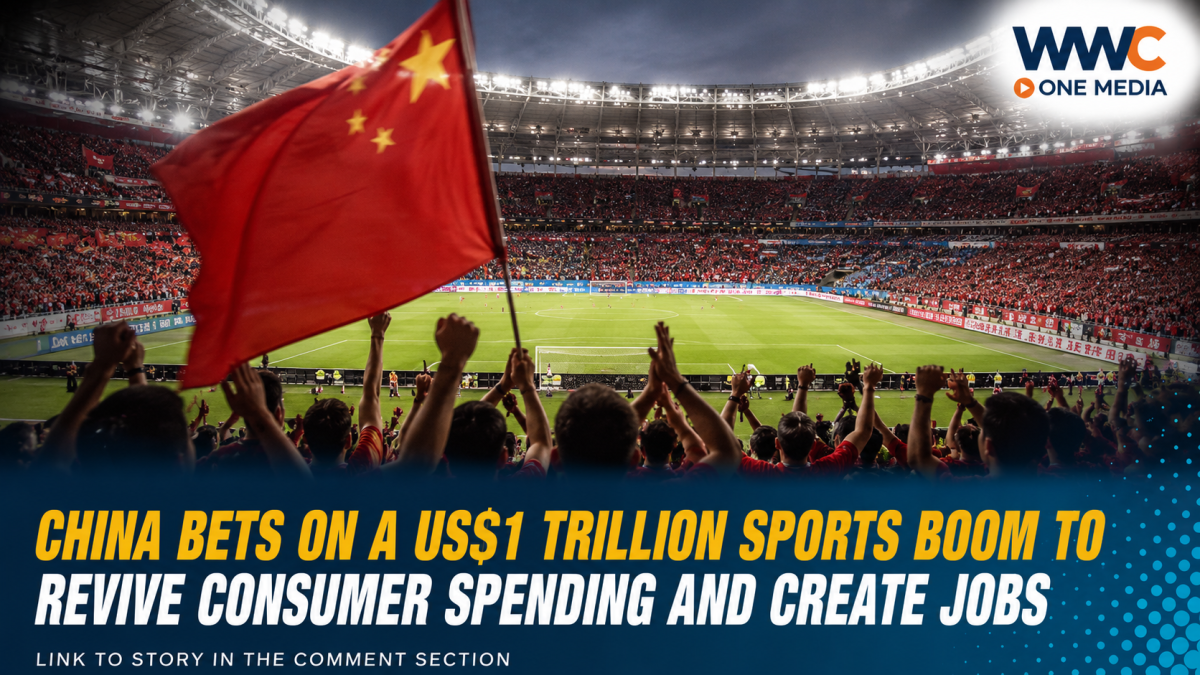
China is turning to an unexpected economic engine to help boost domestic consumption: sports.
Beijing has unveiled an ambitious five-year plan aimed at expanding the country’s sports industry to more than 7 trillion yuan — roughly US$1.04 trillion — by 2030, nearly doubling the industry’s 2024 output. Officials hope sporting events, fitness, outdoor recreation and sports-related tourism can generate new spending while supporting local businesses and employment.
The strategy comes at a crucial moment for China’s economy, where weak household demand and the prolonged property downturn continue to weigh on growth. Reuters reported in August that China’s retail sales increased only 0.6% year-on-year in July, while the property sector remained under pressure.
From football matches to a trillion-dollar industry
China’s plan goes far beyond professional sports.
Authorities want to create more opportunities for people to participate in fitness, outdoor activities and grassroots competitions while using major sporting events to drive spending in surrounding industries.
That means a football match is no longer viewed simply as a sporting event.
A successful competition can bring spectators into restaurants, hotels, shopping centres, transport services, tourist attractions and entertainment venues.
Chinese officials describe this as using sports to stimulate a much wider economic chain.
One example is the Jiangsu Football City League, which attracted more than 2.43 million spectators during its 2025 inaugural season. The league became a model for how relatively inexpensive local sporting events can generate spending beyond the stadium.
China Daily reported that during the 2025 season, every yuan spent on tickets for the Su Super League generated an estimated 7.3 yuan in peripheral consumption, while six matches in Changzhou generated more than 2 million visitor trips and stimulated over 1.5 billion yuan in consumption.
The numbers show why Beijing is interested
China’s sports industry is already enormous.
Official data show that the sector’s total output reached 3.8421 trillion yuan in 2024, with value added of 1.6033 trillion yuan, equivalent to 1.19% of China’s GDP.
The new target of more than 7 trillion yuan by 2030 would therefore represent a dramatic expansion from the current base.
But it is important to understand what the figure means.
The 7 trillion yuan target refers to the total scale/output of China’s sports industry, not a government promise to spend US$1 trillion or a single new stimulus package. The industry includes sporting goods manufacturing, fitness services, sports venues, training, competitions, tourism-related activity and other services.
Beijing wants more people to exercise — and spend
The government is simultaneously expanding China’s national fitness programme.
By 2030, authorities want about 40% of residents to exercise regularly, up from 38.52% in 2025.
China also plans to increase sports venue space to about four square metres per person and build or upgrade more than 5,000 smaller fitness facilities, including community sports parks and multipurpose courts.
Artificial intelligence is also being incorporated into the strategy.
Officials say AI and big data will be used for smart fitness services, sports facilities and virtual sporting activities, while technology will help personalise exercise and improve participation.
Sports could become China’s next consumption machine
The appeal for policymakers is straightforward.
Unlike a one-time purchase of a subsidised consumer product, sports can encourage repeated spending.
People may purchase equipment, pay for training, attend competitions, travel to events, eat at restaurants and stay in hotels.
That makes sports potentially useful as a recurring consumption ecosystem rather than simply another retail category.
China’s authorities are therefore pushing for greater integration between sports, tourism, culture, healthcare and commerce.
The government is also planning 100 high-quality outdoor sports destinations and wants to develop more home-grown sporting events with wider national and international influence.
The timing is not accidental
The sports push comes while Beijing is searching for additional ways to strengthen domestic demand.
China’s economy grew 4.3% in the second quarter of 2026, according to Reuters, its weakest quarterly growth rate in more than three years. July retail sales also slowed sharply, highlighting continued weakness in consumer demand.
That means policymakers are looking for sectors capable of generating activity without relying exclusively on property investment or exports.
Sports offers one possible answer because it combines services, manufacturing, tourism, entertainment and consumer spending.
And unlike building another large industrial facility, grassroots sporting events can potentially spread economic activity across smaller cities and communities.
China is also building a sports-manufacturing ecosystem
The opportunity extends beyond stadiums.
China is already one of the world’s major producers of sporting goods, and cities such as Yiwu have become important hubs for sports-related manufacturing and exports.
Xinhua reported that Yiwu’s sporting-goods and equipment exports exceeded 11.6 billion yuan in 2025, up 20.3% from the previous year, with growth continuing into 2026.
Emerging sports are also being targeted.
Pickleball, for example, is developing into a new business opportunity involving equipment manufacturing, training and event organisation.
This is exactly the type of broader commercial ecosystem Beijing wants to cultivate.
But there is no guarantee the US$1 trillion target will revive consumption
The biggest question is whether expanding the sports industry can meaningfully change China’s broader consumption picture.
A larger sports sector does not automatically mean households will spend more across the entire economy.
China continues to face weak consumer confidence, a troubled property market and slower retail growth. Reuters has reported that policymakers are under pressure to stimulate domestic demand as investment and household spending remain challenging areas.
Sports can create new economic activity, but it is unlikely to solve China’s consumption problem by itself.
Instead, Beijing appears to be betting that millions of smaller spending decisions — tickets, meals, hotel stays, equipment, fitness classes and travel — can collectively become a significant economic force.
The bigger picture
China’s US$1 trillion sports ambition is therefore about much more than producing Olympic champions.
Beijing wants to transform sports into a mass-market consumption industry, create new business opportunities, encourage healthier lifestyles and generate economic activity in cities outside China’s largest metropolitan centres.
The strategy is particularly significant because China is attempting to move toward a growth model in which domestic demand and services play a larger role.
If successful, a local football match could become more than entertainment — it could become an economic catalyst for an entire city.
And with Beijing targeting more than 7 trillion yuan in sports-industry output by 2030, China is betting that its next big consumption boom could begin not in a shopping mall, but on the playing field.
WCC ONE MEDIA J.M.D

Leave a Reply