
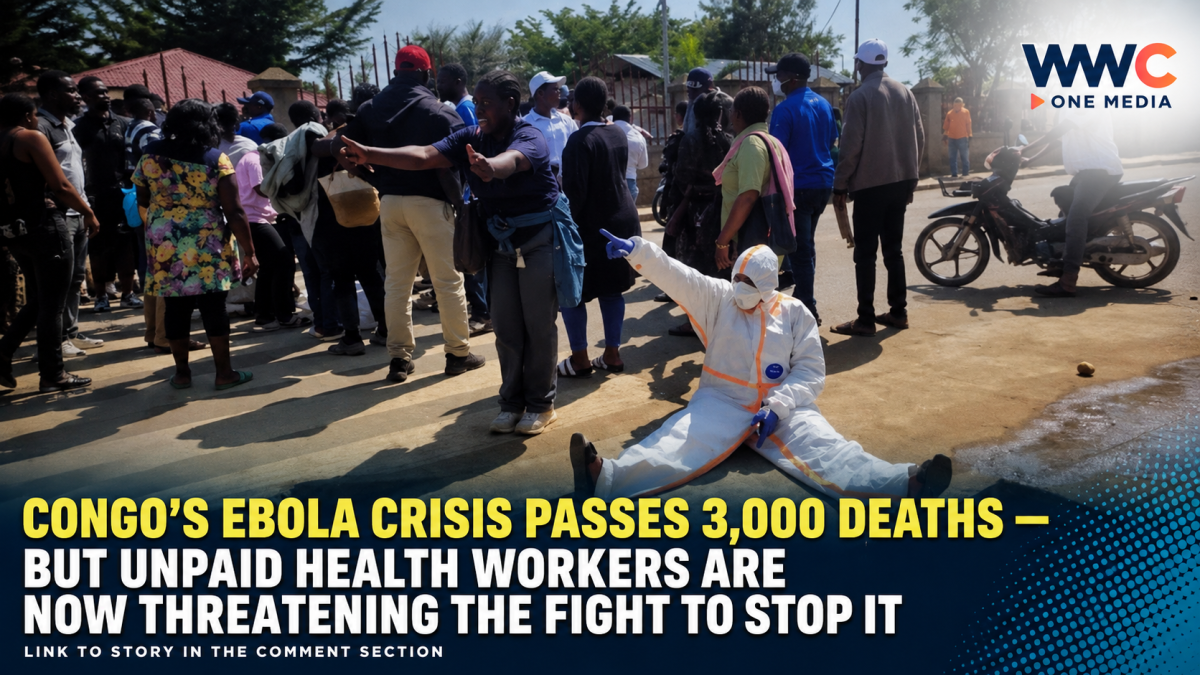
The Democratic Republic of Congo’s Ebola crisis has crossed another devastating milestone, with more than 3,000 people now reported dead as the outbreak continues to expand — while payment disputes are disrupting some of the very health workers needed to contain it.
The World Health Organization said September 2 that the epidemic had surpassed 6,000 reported cases and 3,000 deaths. The outbreak is now affecting 60 health zones across six provinces, making it the largest Ebola outbreak ever recorded in the Democratic Republic of Congo and the second-largest on record globally.
At the center of the growing crisis is Ituri province, which accounts for about 85% of reported cases and 88% of deaths, according to WHO Director-General Tedros Adhanom Ghebreyesus. Even more worrying, many deaths are occurring inside communities rather than treatment centers, while numerous victims were not previously identified as contacts of known cases. That means health officials are still missing transmission chains.
The people fighting Ebola are fighting another battle
The outbreak is being complicated by a deeply rooted problem inside Congo’s health system: workers on the front lines have struggled to receive the money they were promised.
The Japan Times, citing reporting from Bloomberg, reported that six Ebola checkpoints in northeastern Congo stopped reporting last month after their staff had not been paid. At one Ebola treatment center, officials reportedly found that only 40 people were actually working even though 240 names appeared on the payroll list.
Congo’s government has been attempting to remove so-called “ghost workers” — people listed as employees who may not actually exist or work at the facilities where they are registered.
Public Health Minister Roger Kamba has estimated that roughly 15% to 20% of people submitted for some Ebola-response payments were fictitious. Authorities have responded by introducing biometric registration and centralized payment systems.
But the effort to clean up the payroll system has created another problem: genuine health workers have also experienced delays in receiving their wages.
That has triggered protests and strikes among Ebola response workers, disrupting activities including screening, treatment and infection-control operations. Reuters previously reported that workers at Ebola treatment centers staged protests over unpaid compensation, while AP reported that a strike at a treatment center disrupted patient care.
A broken payment system is becoming a public-health problem
The problem goes far beyond the current Ebola outbreak.
Reporting from Bloomberg and Le Monde points to longstanding weaknesses in Congo’s health administration, including incomplete personnel records, fragmented payment systems and workers who are employed without properly funded positions.
A World Bank assessment cited in the reporting found that among nearly 256,000 health workers listed in Congo, fewer than 20% received a base salary in 2022, while 41% received an occupational-risk allowance and 56% received neither.
The logistical challenges are particularly severe in remote areas.
UN officials have said the response has been hampered by weak banking infrastructure, poor connectivity, insecurity and difficulties moving cash. Tens of thousands of people are involved in the Ebola response, making reliable and timely payment a critical operational issue.
In other words, the payroll crisis is no longer simply an administrative problem. Every delay can potentially translate into fewer people screening travelers, tracing contacts, disinfecting facilities, supporting patients or conducting safe burials.
The outbreak is spreading faster than the response
WHO has described the epidemic as the fastest-moving Ebola outbreak it has ever seen.
As of August 30, WHO data showed approximately 6,100 confirmed cases and 2,950 confirmed deaths, representing a case-fatality ratio of about 48%. By September 2, WHO said the death toll had reached 3,000.
The virus has spread across six provinces: Ituri, North Kivu, South Kivu, Haut-Uélé, Bas-Uélé and Tshopo.
WHO has warned that the geographic expansion, continuing transmission and difficulties identifying infection chains leave Congo at very high risk. Neighboring countries including Uganda, South Sudan and the Central African Republic face heightened risks because of cross-border movement, trade, mining activity, displacement and limited health-system capacity.
The outbreak is caused by the Bundibugyo virus, a less common Ebola species. Unlike the Zaire ebolavirus responsible for many previous Ebola outbreaks, there is currently no approved vaccine specifically established for Bundibugyo virus and no approved specific treatment for the disease. Clinical trials of potential treatments and vaccines are underway.
WHO says the window to contain the outbreak is narrowing
Despite the alarming numbers, international health agencies say the epidemic can still be brought under control — but only if the response expands quickly.
WHO says it has shipped more than 330 tonnes of emergency supplies and deployed more than 300 experts. Laboratory capacity has expanded to 24 laboratories, with testing capacity reaching about 3,000 tests a day. Treatment and isolation capacity has also expanded to more than 1,300 beds across 49 facilities, with plans to reach 3,000 beds within three months.
But money remains a major concern.
WHO estimates that the government-led six-month response plan requires approximately $1.3 billion. UN officials have separately warned that emergency funds supporting expanded operations could run out within weeks.
The UN has also reported more than 260 attacks against health workers in Congo over a six-month period, with eight health workers killed. Violence, mistrust, misinformation and decades of conflict are making it harder to reach communities and maintain the response.
The bigger danger may be what happens next
The immediate concern is not simply the number of people already infected.
It is the number of transmission chains that health officials still cannot see.
WHO says many victims are dying outside treatment centers, while some were never identified as contacts of confirmed patients. Unsafe burials can further accelerate transmission, and movement between communities can carry the virus into areas where surveillance and healthcare capacity are weaker.
The situation therefore presents Congo with a dangerous race against time: identify hidden infections, protect health workers, pay the people carrying out the response, expand treatment capacity and rebuild community trust — before the virus moves even farther beyond the reach of the response.
For Congo, the Ebola emergency is no longer only a battle against a virus.
It is also a test of whether a fragile health system can keep its frontline workers supported long enough to win that battle.
WWC ONE MEDIA MJE




Leave a Reply