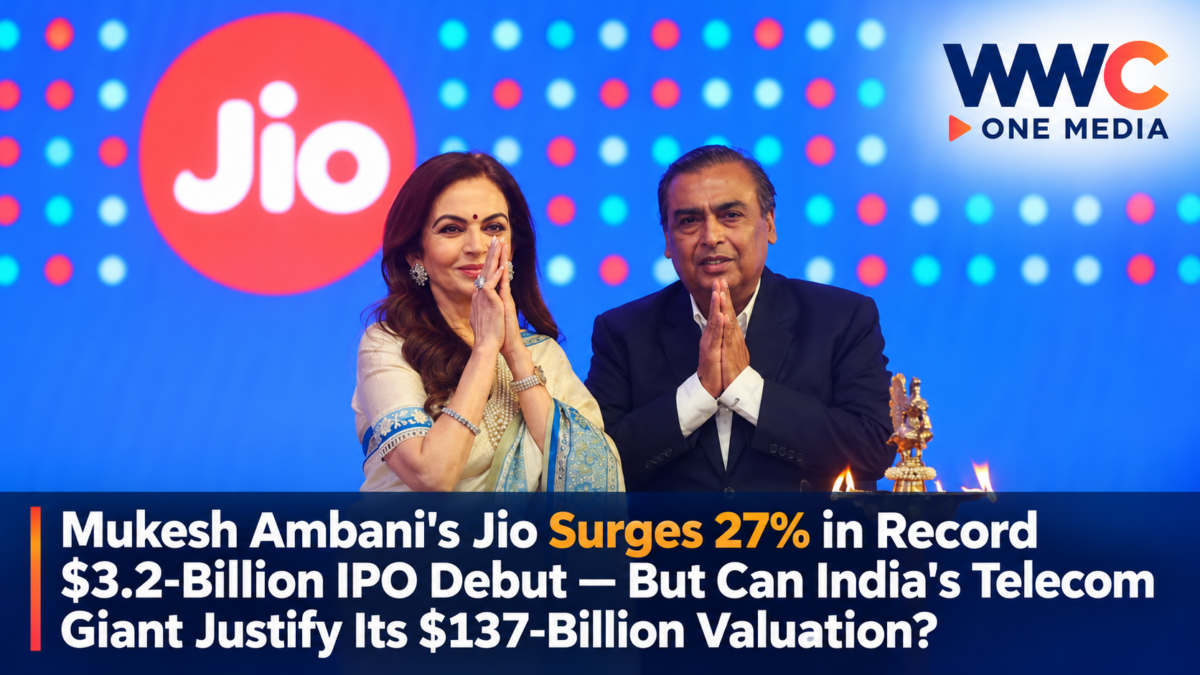
MUMBAI, India — October 30, 2026. Billionaire Mukesh Ambani’s Jio Platforms has delivered one of the biggest stock market debuts in Indian history, with shares surging approximately 27% on their first trading day following a record-breaking $3.2-billion initial public offering.
The October 28 listing propelled the telecommunications and digital technology company to a market capitalization of approximately $137 billion, making it India’s second-most valuable listed company, behind its parent, Reliance Industries.
Jio’s strong debut capped a heavily subscribed offering that attracted global investment institutions and renewed attention on the future of India’s digital economy.
But the spectacular first-day rally has also created a bigger challenge for investors.
Can a business built primarily on affordable mobile connectivity generate enough new profits from artificial intelligence, cloud computing and broadband to justify one of the world’s most closely watched telecommunications valuations?
Jio makes history with India’s largest IPO
Jio Platforms raised approximately ₹30,213 crore, or $3.2 billion, through its initial public offering, surpassing previous Indian IPO records.
The share sale was priced at ₹1,119 per share, the top of the announced price range of ₹1,065 to ₹1,119.
Shares began trading on October 28 at ₹1,358 on the National Stock Exchange, approximately 21.4% above the offer price.
The stock extended its gains during the session, rising by roughly 27% compared with the IPO price.
That rally lifted the company’s market valuation to approximately $137 billion.
The performance attracted widespread attention because Reliance Industries had not brought a major subsidiary to the stock market since 2006.
For Mukesh Ambani, the listing marks another important milestone in a decades-long effort to expand the Reliance empire beyond oil refining and petrochemicals into consumer services and digital technology.
However, the market’s enthusiastic opening response does not establish that shares will continue to rise.
Investors buying after the IPO face a higher starting valuation than those who received shares at the offering price.
Why the 21% and 27% listing gains both matter
Different reports on Jio’s market debut describe gains of approximately 21% and 27%.
Both can be accurate because they refer to different points in the trading session.
The 21% figure describes the premium at which Jio shares initially opened.
The larger gain reflects the stock’s subsequent rise during its debut.
That distinction is important for reporting market performance.
A strong opening price shows how much investors were willing to pay immediately when trading began.
The later advance demonstrates how market demand evolved during the session.
Neither figure should be confused with a guaranteed investment return.
The outcome for any individual investor depends on the price at which shares were acquired or sold, trading expenses and subsequent market movements.
More than $25 billion in investor demand preceded the listing
The successful debut followed extraordinary investor interest in the offering.
Jio’s public share sale was subscribed approximately 22 times, with institutional buyers accounting for particularly strong demand.
Major global investment institutions, including BlackRock, Fidelity and Abu Dhabi Investment Authority, participated in the fundraising process.
Earlier reports documented billions of dollars in demand for available shares.
WWC ONE MEDIA previously examined that demand in Jio IPO Sparks $25 Billion Investor Frenzy as BlackRock and Global Giants Rush In.
It also followed the public subscription process in Mukesh Ambani’s $3.2 Billion Jio IPO Triggers $16 Billion Investor Frenzy.
Those articles documented investor interest before Jio began trading publicly.
The October 28 debut provided the next test: whether market participants would continue paying a premium once shares became available on the stock exchange.
Importantly, investor bids are not equivalent to money raised.
Although subscriptions greatly exceeded the available shares, the actual IPO raised approximately $3.2 billion.
Jio overtakes Bharti Airtel to become India’s second-most valuable listed company
Jio’s share-price surge quickly changed the rankings of India’s largest listed businesses.
The company overtook rival telecommunications operator Bharti Airtel and financial services giant HDFC Bank by market capitalization.
Only parent company Reliance Industries remained ahead of Jio at the time.
The development demonstrates the enormous value investors are assigning to mobile connectivity and digital infrastructure in India.
It also highlights the extraordinary scale of the Reliance business empire.
But comparisons involving parent and subsidiary market capitalizations require care.
Reliance Industries continues to own a controlling stake in Jio, so simply adding the two companies’ market values can involve overlapping economic interests.
Such figures should not be interpreted as a consolidated value of the entire conglomerate or as Mukesh Ambani’s personal wealth.
Jio’s 530 million customers provide its biggest competitive advantage
The foundation of Jio’s investment story is its enormous telecommunications business.
Reliance Jio Infocomm, the group’s principal telecom operation, serves more than 530 million customers.
The company transformed India’s mobile communications market after its 2016 launch by offering aggressively priced data and voice services.
Its network now handles a substantial proportion of India’s mobile data traffic.
This vast customer base gives Jio a potential distribution platform for additional digital products.
Services involving home broadband, business connectivity, cloud computing and digital applications could eventually generate new revenue from existing subscribers.
However, reaching customers does not automatically mean they will purchase additional services.
Jio must demonstrate that it can increase revenue per customer while controlling network costs and maintaining competitiveness.
India remains a highly price-sensitive market, making aggressive increases in telecom charges potentially difficult.
Jio earned more than $3 billion in annual profit before the IPO
According to financial figures reported by Reuters, Jio Platforms generated approximately ₹1.47 trillion in revenue during the financial year ended March 2026.
Revenue increased 14.6% from the preceding year.
Profit rose 15.1% to approximately ₹300.49 billion, equivalent to around $3.16 billion at the reported exchange rate.
Telecommunications accounted for about 90% of revenue and profit.
That concentration is significant.
Although Jio is increasingly promoted as an artificial intelligence and digital technology business, most of its financial performance continues to come from telecommunications.
The company must therefore show that its newer ventures can become material sources of earnings.
Until then, investors are largely paying for an established telecommunications franchise alongside the possibility of future technology growth.
Google, Meta and major investment funds remain part of Jio’s story
Jio attracted international capital long before its public market debut.
In 2020, the company raised more than $20 billion from strategic and financial investors.
Meta and Alphabet’s Google became major shareholders, along with global investment firms including KKR.
The investment round helped strengthen Jio’s financial position and supported its expansion ambitions.
Google and Meta’s involvement also demonstrated international interest in India’s large digital consumer market.
But strategic backing does not guarantee future profitability or stock market gains.
Jio must still compete for customers, invest in infrastructure and develop commercial technology products that can deliver adequate returns.
Investors should also monitor the potential sale of shares by existing financial investors after applicable lock-up restrictions expire.
A significant increase in available shares could affect trading dynamics even if the underlying business continues growing.
Akash Ambani takes the spotlight as the next generation steps forward
The stock exchange ceremony also highlighted the growing public role of Mukesh Ambani’s children.
Akash Ambani, Jio Platforms’ managing director, described the listing as a beginning rather than the conclusion of the company’s growth journey.
He emphasized plans to make technologies such as artificial intelligence, cloud computing and connected devices more widely accessible.
Isha Ambani and Anant Ambani also have leadership roles within the broader Reliance group.
The younger generation’s prominence reflects an ongoing transition in the management of one of India’s largest corporate empires.
However, investors will judge the company’s leadership through financial performance, capital allocation and governance rather than family succession alone.
As a publicly traded company, Jio now faces greater scrutiny of its strategy, operating results and decisions affecting minority shareholders.
AI and cloud computing could determine Jio’s future valuation
Jio’s most ambitious opportunity lies beyond conventional telecom subscriptions.
Its management wants to expand into artificial intelligence, enterprise technology, digital platforms and cloud services.
India’s large population and growing digital economy could provide substantial demand for these offerings.
The company also has established relationships with major international technology businesses, including Nvidia.
Yet the economics of AI infrastructure remain challenging.
High-performance computing requires expensive equipment, data centers, electricity, cooling systems and specialized expertise.
The costs of developing these capabilities may emerge before substantial recurring revenues materialize.
Jio’s challenge is to prove that it can transform its network scale into a profitable technology platform.
Investors should distinguish announced partnerships and long-term ambitions from actual earnings generated by these newer businesses.
Starlink adds uncertainty to Jio’s broadband ambitions
Competition could also increase as India expands access to satellite communications.
Elon Musk’s Starlink has been seeking authorization to offer services in the Indian market.
Satellite internet could become particularly relevant in areas where installing conventional mobile or fiber infrastructure is difficult.
The regulatory debate has created friction involving satellite spectrum, market access and competition.
WWC ONE MEDIA explored the issue in Elon Musk Accuses Indian ‘Oligarchs’ of Blocking Starlink — But Jio and Airtel Are Also Supposed to Help Sell It.
Jio and Airtel have explored commercial relationships with Starlink even as questions about licensing and competition remain.
This illustrates how satellite connectivity could become both a business opportunity and a competitive threat.
For Jio shareholders, the important issue is whether new broadband technologies can complement the company’s existing operations or pressure its pricing and growth.
Most of the IPO proceeds are intended for debt repayment
Despite the excitement surrounding artificial intelligence and digital services, Jio’s immediate financial priorities are more conventional.
The company has indicated that a substantial majority of net IPO proceeds will be used to repay or prepay borrowings associated with its telecommunications business.
Debt reduction could improve its financial flexibility and reduce future interest costs.
However, this means investors should not assume that the entire $3.2-billion offering will be used to construct new AI data centers or finance technology expansion.
Those future investments will still require careful capital allocation.
Investors will be watching whether Jio can generate sufficient cash from its operations to support both debt reduction and new business development.
What Jio’s record IPO means for Asian technology listings
The strong debut may encourage other Asian technology and financial services companies considering public offerings.
It shows that investors remain willing to commit substantial capital to businesses with large customer bases and recognizable brands.
The Philippines recently experienced its own major digital finance listing through GCash operator Mynt.
WWC ONE MEDIA covered the transaction in GCash’s Record ₱60.9-Billion IPO Draws BlackRock, Citadel and Global Investors.
There is also discussion of a potential 2027 public listing for Maya, as examined in After GCash’s ₱60.9-Billion IPO, Pangilinan Eyes Maya Listing in 2027.
These companies operate in different markets and business segments, so their valuations and operating results are not directly interchangeable.
Nevertheless, their IPO activity illustrates increasing attention to large Asian consumer technology platforms.
The lesson for investors is that a successful public offering and a successful long-term investment are two different things.
Can Jio sustain its spectacular debut?
The October 28 listing delivered a major financial milestone for Mukesh Ambani and Reliance Industries.
Jio raised approximately $3.2 billion, attracted enormous institutional demand and quickly became one of India’s largest listed companies.
Its telecommunications business has scale, established profitability and a customer base exceeding half a billion people.
Those strengths provide a substantial foundation.
But the stock market is also valuing future opportunities in artificial intelligence, cloud computing, enterprise technology and digital services.
The company’s ability to justify its market capitalization will depend on delivering those ambitions without undermining its financial position.
Investors will need to monitor subscriber spending, broadband expansion, operating margins, capital expenditure, debt reduction and the commercialization of new services.
Jio’s record IPO has given the Ambani empire a spectacular new beginning. But the most important question is no longer whether investors want to own India’s digital giant — it is whether Jio can produce enough sustained earnings growth to justify the price they are now paying.