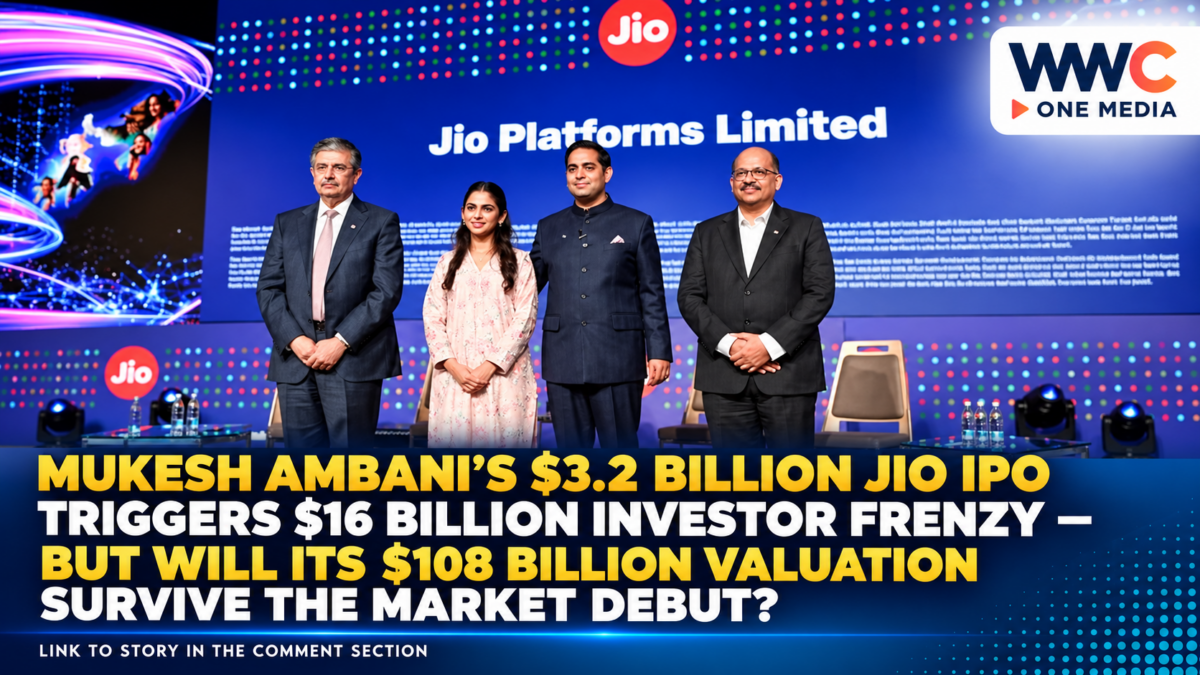
New Delhi, India | October 23, 2026 — Indian billionaire Mukesh Ambani has unleashed one of the biggest stock market events in the country’s history, as Jio Platforms’ $3.2 billion initial public offering (IPO) attracts more than $16 billion in estimated investor demand, underscoring global confidence in India’s rapidly expanding digital economy.
The landmark IPO, the largest in India’s history, has become a major test of investor appetite for technology and telecommunications companies at a time when concerns about artificial intelligence valuations are reshaping global investment decisions.
By Friday, October 23, subscriptions had exceeded seven times the shares offered, with strong participation from institutional investors, retail buyers, employees and existing Reliance Industries shareholders.
The surge in demand highlights investors’ willingness to back one of India’s most influential digital businesses, even as questions remain about whether its blockbuster valuation can translate into strong returns after listing.
A $108 Billion Digital Powerhouse Heads to the Stock Market
Jio Platforms, part of Ambani’s Reliance Industries conglomerate, is seeking a valuation of as much as $108.3 billion, which could immediately position it among India’s most valuable publicly traded companies.
The offering opened for public subscription on October 21 and closes on October 23, with shares expected to begin trading on October 28.
Jio set its IPO price band at 1,065 to 1,119 Indian rupees per share and offered approximately 270 million new shares.
Investor enthusiasm was evident from the beginning.
The IPO was fully subscribed in less than two hours on its opening day, an unusually rapid response for an Indian public offering of this scale.
By the final subscription day, estimated public bidding demand exceeded $16 billion, assuming bids were largely placed at the top of the price range.
However, the demand figure represents the value of share applications, not money already raised by the company. Actual fundraising remains tied to the IPO’s final allocation and pricing.
BlackRock, Fidelity and Sovereign Wealth Funds Join the Rush
Some of the world’s most prominent investment institutions have emerged as major participants in the Jio offering.
Anchor investors, including Abu Dhabi Investment Authority, BlackRock and Fidelity, competed for an approximately $854 million reserved allocation.
That portion reportedly attracted more than $25 billion in demand, demonstrating the intensity of institutional interest ahead of public bidding.
Indian Express separately reported participation from major international investment groups and sovereign wealth funds, including Singapore’s GIC and Norway’s sovereign wealth fund.
By Friday, the retail investor portion had attracted applications for approximately twice the shares reserved for individual buyers, while the employee allocation was subscribed around 2.5 times.
The category reserved for existing Reliance shareholders attracted demand equivalent to approximately 5.7 times the shares allocated.
The figures signal extraordinary competition for shares but do not guarantee that Jio’s stock will rise once it begins trading.
From Free Mobile Data to More Than 500 Million Users
Jio’s rise has been one of the most dramatic corporate transformations in modern Indian business.
Launched in 2016, Reliance Jio disrupted India’s telecommunications market by introducing aggressively priced services and promotional offers, helping make mobile internet access more affordable for millions of consumers.
The strategy challenged established competitors, including Bharti Airtel and Vodafone Idea, and accelerated India’s transition into a mobile-first digital economy.
A decade later, Jio’s telecom network serves more than 500 million customers, placing it second only to China Mobile among telecom operators measured by subscribers in a single national market.
Its influence extends beyond mobile connectivity into digital services, cloud technology and artificial intelligence initiatives.
More than 90% of Jio Platforms’ revenue, however, still comes from telecommunications, making network profitability, customer spending and competitive pressure central to its investment outlook.
Meta and Google Back Ambani’s Digital Ambitions
Global technology giants Meta Platforms and Alphabet’s Google are among Jio Platforms’ high-profile investors.
Their involvement reflects the strategic importance of India’s vast internet market, where hundreds of millions of consumers increasingly rely on smartphones for communication, entertainment, shopping and financial services.
Jio’s listing represents another step in Reliance Industries’ long-term transformation from an oil and petrochemicals-focused conglomerate into a diversified consumer, telecommunications and technology powerhouse.
The IPO also marks the first public offering from the Reliance group in approximately two decades.
The company’s leadership is closely linked to the Ambani family’s next generation, with Akash Ambani occupying a prominent role in the Jio business.
Why India’s Biggest IPO Matters to Global Investors
Jio’s stock market debut comes at a critical moment for global equities.
Investors have become increasingly selective about richly valued technology businesses, particularly those connected to the artificial intelligence investment boom.
Against that backdrop, Jio offers exposure to India’s large telecommunications market and its rapidly developing digital infrastructure.
Its record-setting IPO also surpasses previous landmark Indian share offerings, including Hyundai Motor India’s approximately $2.9 billion listing in 2024.
The enthusiasm surrounding Jio could influence sentiment toward other major Indian companies considering public offerings, although the broader market effect will depend on Jio’s post-listing performance.
For investors in other Asian markets, including the Philippines, the listing provides another indication of how international capital is being directed toward large-scale telecommunications and digital infrastructure businesses.
The Ambani Legacy Adds to Investor Expectations
The Reliance story stretches back decades to founder Dhirubhai Ambani, who helped popularize share ownership among Indian households.
Reliance Industries has remained a powerful force in India’s financial markets.
According to LSEG figures cited by Reuters, Reliance shares have delivered returns of approximately 900% since 2006, compared with about 685% for India’s benchmark Nifty index over the same period.
That historical performance has strengthened the company’s reputation among long-term investors, although past returns do not predict future investment outcomes.
Jio now faces the challenge of building on that legacy while justifying a valuation exceeding $100 billion.
What Happens Next?
All eyes are now on October 28, when Jio Platforms is expected to make its stock market debut.
Investors will be watching whether the extraordinary subscription demand translates into a strong opening share price, and whether the business can sustain growth as it expands its digital and AI-related activities.
Despite the overwhelming interest, risks remain. Telecommunications infrastructure requires significant capital spending, competition can pressure profitability, and high initial valuations can limit future returns if earnings disappoint.
The real test may begin only after the IPO excitement fades.
For Mukesh Ambani, Jio’s record-breaking offering is more than another corporate fundraising milestone. It is a defining moment in his effort to build one of the world’s most valuable digital businesses. But with billions of dollars chasing a limited supply of shares, the biggest question remains: Can Jio reward investors after the initial frenzy, or has the market already priced in much of its future success?