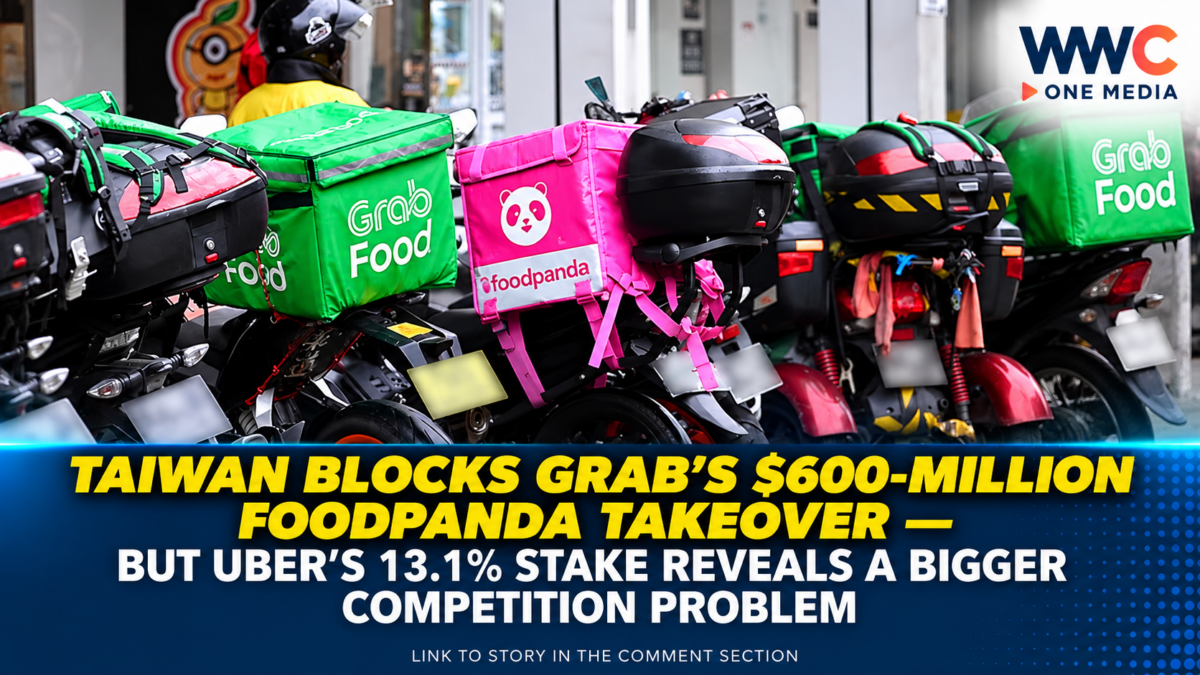
TAIPEI, TAIWAN — Singapore-based technology giant Grab Holdings has suffered a major setback in its international expansion plans after Taiwan’s competition regulator blocked its proposed US$600-million acquisition of Foodpanda’s Taiwanese delivery business, citing concerns that the transaction could weaken competition in an already highly concentrated market.
The decision, announced Wednesday, October 21, 2026, by Taiwan’s Fair Trade Commission (FTC), effectively derails Grab’s proposed entry into Taiwan through the takeover of the local Foodpanda operation owned by German delivery company Delivery Hero.
But the regulator’s objections reveal a more complicated issue than a conventional corporate acquisition.
At the heart of the decision is an existing ownership connection between Grab and Uber — the parent company of Foodpanda’s biggest rival, Uber Eats.
Taiwanese regulators warned that this financial relationship could discourage the two delivery platforms from competing aggressively, potentially affecting delivery fees, promotional discounts and the bargaining position of restaurants.
The development was confirmed by Reuters, Channel NewsAsia, Taiwan’s Central News Agency and the country’s competition regulator.
Taiwan Rejects Grab’s Biggest Food Delivery Expansion Plan
Grab announced in March 2026 that it had reached an agreement to acquire Foodpanda’s Taiwan business for US$600 million in cash.
The transaction was designed to give the Singapore-headquartered company a significant presence outside Southeast Asia for the first time.
Grab currently provides services including ride-hailing, food delivery and digital financial products across eight Southeast Asian countries.
Its expansion into Taiwan would have given the company access to an established delivery platform rather than requiring it to develop a new operation from the ground up.
However, after months of regulatory scrutiny, Taiwan’s Fair Trade Commission concluded that the proposed acquisition presented unacceptable competition risks.
The regulator determined that the potential harm to competition outweighed the overall economic benefits of the transaction.
It also found that the corrective measures proposed by the companies were insufficient to address those risks.
The acquisition was consequently prohibited under Taiwan’s Fair Trade Act.
The Uber Connection That Changed Everything
One of the most striking revelations behind the rejected deal concerns Uber’s ownership stake in Grab.
According to Taiwan’s FTC, Uber holds approximately 13.1% of Grab’s shares, creating a financial connection between two companies that would otherwise be expected to compete directly in Taiwan.
Uber is also the parent company of Uber Eats, one of the two dominant players in Taiwan’s food delivery sector.
If Grab had acquired Foodpanda, it would have become Uber Eats’ principal competitor in that market.
But regulators feared that Uber’s investment in Grab could create incentives that weaken genuine competition between the two platforms.
For example, if Uber Eats aggressively reduced delivery fees or offered more discounts to win customers away from Grab, it could also hurt Grab’s profitability — and consequently the value of Uber’s investment.
The FTC also considered the companies’ previous commercial relationships and governance links, including the fact that Uber’s chief executive had previously served on Grab’s board.
The concern was not that Grab and Uber had been proven to operate an illegal cartel. Rather, regulators concluded that their existing relationships created a significant risk of weakened competition.
Four Reasons Taiwan Blocked the Deal
Taiwan’s Central News Agency reported that the competition authority identified four principal concerns.
- Reduced incentive for Uber Eats to compete: Uber’s shareholding in Grab could discourage aggressive competition that might harm Grab’s earnings.
- Reduced incentive for Grab to compete: Grab’s business relationships and ownership links with Uber could similarly weaken its incentive to challenge Uber Eats.
- Greater risk of coordinated behavior: The companies’ history of interaction and cooperation raised concerns about potential coordination.
- Limited competitive pressure from other platforms: Taiwan’s highly concentrated delivery market might lack a sufficiently strong third player to disrupt such behavior.
The FTC emphasized that Taiwan’s food delivery industry is already dominated by Foodpanda and Uber Eats.
Replacing Foodpanda with Grab would not necessarily solve these structural competition problems, particularly given Grab’s relationship with Uber.
Taiwan’s regulators had also considered possible remedies, including changes to shareholdings, restrictions on overlapping directorships and limits on exchanging competitively sensitive information.
Ultimately, the commission decided that the proposed measures could not reliably eliminate the risks.
Grab Expresses Disappointment, Signals Continued Southeast Asian Focus
Grab expressed disappointment over the decision, saying it had hoped to introduce its services, innovations and economic opportunities to Taiwan’s consumers, delivery partners and merchants.
The company nevertheless emphasized that its core operations across Southeast Asia remain strong.
Grab said it would continue directing capital and resources toward its existing regional growth strategy and supporting communities in the markets where it operates.
The statement suggests that the rejected acquisition will not prevent Grab from pursuing opportunities across its established Southeast Asian footprint.
However, the company’s immediate plans for entering Taiwan through a different route remain unclear.
No replacement acquisition or alternative market-entry agreement was confirmed in the reports reviewed.
Delivery Hero Faces a New Challenge
The rejection also creates uncertainty for Delivery Hero, Foodpanda’s German parent company.
The proposed sale would have transferred its Taiwanese operations to Grab in exchange for US$600 million.
Following the decision, Delivery Hero said the transaction agreement contained contractual protections, including a break-fee arrangement that could apply under certain conditions.
A break fee is a payment that may become payable if a transaction fails under circumstances specified in the acquisition contract.
However, the existence of the arrangement does not automatically mean Grab must pay a penalty.
The precise financial consequences will depend on the contractual terms and whether the relevant conditions are satisfied.
Delivery Hero has not confirmed in the reviewed reports that it has secured another buyer for the Taiwanese operation.
Taiwan Has Blocked Another Major Foodpanda Takeover Before
This is not the first time Taiwanese regulators have rejected an acquisition involving Foodpanda.
In 2024, Uber Eats also pursued a takeover of Foodpanda’s Taiwanese business.
That transaction was rejected because of serious competition concerns.
Taiwanese public broadcaster PTS reported that the earlier combination would have resulted in a market share exceeding 90%, threatening to leave consumers and restaurants with extremely limited alternatives.
The 2026 Grab transaction raised a different problem.
Unlike the earlier Uber-Foodpanda proposal, Grab did not already operate as a direct competitor in Taiwan’s delivery market.
Instead, regulators focused on the indirect competitive effects created by Grab’s existing relationship with Uber.
The two decisions illustrate Taiwan’s determination to examine not only traditional mergers between direct competitors but also ownership relationships that could reduce competitive pressure.
What This Means for Food Delivery Customers and Restaurants
The rejected transaction could have important implications for consumers, restaurants and delivery workers.
For customers, effective competition between platforms can influence delivery charges, subscription benefits, restaurant selection and promotional discounts.
For restaurant operators, competition can affect commissions, commercial conditions and their ability to negotiate with platform providers.
For delivery workers, the availability of multiple platforms may influence access to work opportunities and the conditions offered by competing services.
Taiwanese delivery worker organizations welcomed the regulator’s decision, according to PTS, expressing support for stronger oversight of mergers affecting workers, merchants and consumers.
Nevertheless, the ruling does not guarantee that delivery fees will decrease or that working conditions will improve.
Those outcomes depend on how the market develops and how the remaining companies respond.
Why the Decision Matters for Southeast Asia and the Philippines
Grab’s failed acquisition could also attract attention across Southeast Asia, including the Philippines, where app-based delivery and ride-hailing services form an important part of the digital economy.
The Taiwanese ruling highlights how competition regulators assess the relationships between platforms, investors and potential acquisition targets.
For companies seeking to expand through mergers, ownership stakes in competitors can become as important to regulatory reviews as market share.
For consumers and merchants in the Philippines, the development offers a broader lesson: rapid consolidation in digital delivery markets can create both efficiencies and competition concerns.
However, Taiwan’s decision applies to the proposed acquisition of Foodpanda’s Taiwanese operations. It does not represent a ban on Grab, Foodpanda or their services in the Philippines.
There is also no verified indication in the reviewed reports that Philippine regulators are taking an equivalent action in response to this particular deal.
What Happens Next for Grab and Foodpanda?
The immediate future remains uncertain.
Grab could examine other opportunities for international expansion, but any renewed acquisition involving the Taiwanese business would have to address the regulator’s concerns.
Delivery Hero must also evaluate its options for Foodpanda Taiwan, whether that means continuing to operate the business or pursuing another transaction.
The FTC has not established that either company will leave the Taiwanese market as a result of the ruling.
For now, Taiwan’s decision sends a clear regulatory message: maintaining two major delivery platforms is not necessarily enough if their corporate relationships threaten to undermine meaningful competition.
The bottom line: Taiwan has blocked Grab’s US$600-million Foodpanda acquisition because regulators believe Uber’s substantial stake in Grab could weaken competition between the island’s leading food delivery services. The ruling leaves Grab’s expansion plans and Delivery Hero’s next steps unresolved.