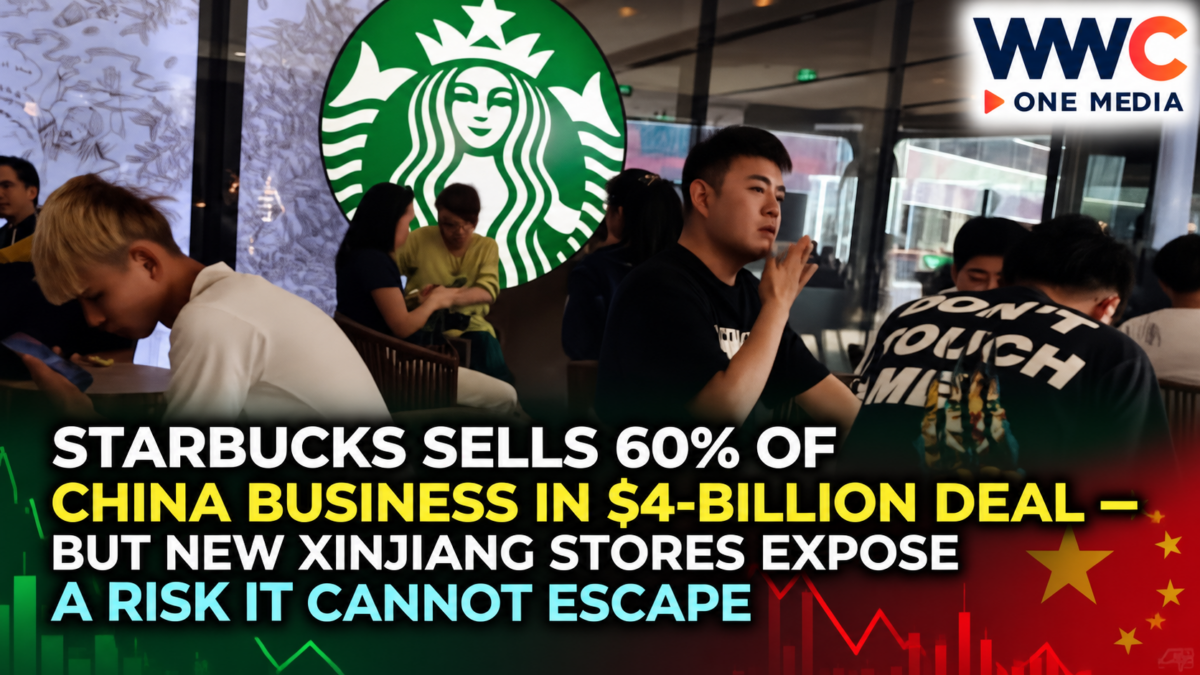
SHANGHAI, China — October 14, 2026 — Starbucks may have found a way to reduce its direct exposure to China’s fiercely competitive coffee market, but the American giant is discovering that surrendering control of a business does not necessarily protect its global reputation.
Months after transferring majority ownership of its Chinese retail operations to private equity firm Boyu Capital, Starbucks is facing political criticism in the United States over the opening of two coffee shops in Xinjiang, a region that has been at the center of international allegations of serious human rights abuses.
The latest controversy highlights a difficult challenge for multinational companies: how to expand in one of the world’s largest consumer markets without becoming entangled in geopolitical disputes.
In an October 12 Bloomberg Opinion column titled Starbucks Can Sell China, Not the China Risk, columnist Juliana Liu argued that the company’s decision to give a Chinese partner majority ownership makes commercial sense but cannot completely shield Starbucks from political and reputational pressure.
The financial restructuring was significant.
Boyu Capital acquired 60% of Starbucks’ China retail operations under a transaction valued at approximately $4 billion. Starbucks retained 40%, together with ownership and licensing rights over the Starbucks brand and intellectual property.
The move was intended to strengthen the chain’s competitiveness against lower-priced domestic rivals such as Luckin Coffee and Cotti Coffee.
But the opening of two Starbucks-branded stores in Urumqi, Xinjiang’s regional capital, has demonstrated how local operating decisions can still create international controversy.
Starbucks has transferred control of its China operations to a local partner — but the bigger question is whether it can protect its global brand when the decisions creating political risk are increasingly made thousands of miles from its Seattle headquarters.
Starbucks Gives Up Majority Control of Its China Business
The restructuring represents one of the most significant changes to Starbucks’ international business model.
In November 2025, the company announced an agreement with Boyu Capital to create a joint venture for its Chinese retail operations.
The transaction closed on March 30, 2026, and Starbucks formally announced its completion on April 2.
Under the arrangement:
- Boyu Capital-controlled funds hold 60% of the China retail business.
- Starbucks retains a 40% ownership stake.
- Starbucks continues to own and license its brand and intellectual property.
- The joint venture assumes responsibility for operating and expanding Starbucks stores in China.
- Both partners aim to strengthen the brand’s local competitiveness.
Starbucks disclosed that the transaction was based on an agreed enterprise value of approximately $4 billion.
Its financial filings reported total consideration of around $3.1 billion, including financing-related proceeds from the joint venture.
The company also reported a retained equity investment valued at approximately $1.2 billion.
The transaction was not a complete withdrawal from China.
Instead, Starbucks exchanged majority operational control for a minority investment, licensing revenues and a partnership with an investor experienced in the Chinese market.
Two New Xinjiang Stores Trigger Political Backlash
The latest controversy began when Starbucks-branded stores opened in Urumqi on September 29.
One outlet opened at the Grand Bazaar, a popular tourist location.
The second opened at Urumqi Tianshan International Airport.
Both locations were positioned to serve residents and travelers in a region experiencing significant tourism promotion and development.
However, the openings attracted immediate criticism in Washington.
Republican Representative John Moolenaar, chairman of the US House Select Committee on the Chinese Communist Party, urged Starbucks to close the locations.
Moolenaar argued that an American company should not expand its presence in a region associated with serious human rights allegations.
His criticism intensified attention on the company’s decision to continue operating under the Starbucks brand even after majority ownership had passed to Boyu.
The issue is not that Starbucks has been found legally responsible for human rights violations.
Rather, it is whether a global consumer brand should operate in a region facing substantial international scrutiny.
The decision has become a test of corporate reputation, political accountability and the limits of local ownership.
Why Xinjiang Remains Internationally Controversial
Xinjiang is home to Uyghurs and other predominantly Muslim communities.
The region has attracted international attention because of allegations involving mass detention, restrictions on religious and cultural practices, surveillance and other abuses.
In August 2022, the United Nations Office of the High Commissioner for Human Rights released an assessment identifying serious human rights violations.
The report concluded that the extent of arbitrary and discriminatory detention and restrictions on fundamental rights may constitute international crimes, particularly crimes against humanity.
The United States and some other governments have described China’s treatment of Uyghurs as genocide.
China strongly rejects those accusations.
Beijing maintains that its policies are intended to combat terrorism and extremism, promote stability and support economic development.
These competing positions form the political backdrop to the Starbucks controversy.
It is important to distinguish between allegations against the Chinese state and claims about individual companies.
The existence of Starbucks stores in Xinjiang does not, on its own, establish that the company has participated in human rights violations.
Nevertheless, the company’s presence has prompted criticism from lawmakers concerned about commercial activity in the region.
Why Starbucks Is Expanding in Urumqi
From a commercial perspective, the new stores have an identifiable market opportunity.
Xinjiang has experienced a tourism boom as Chinese authorities promote regional attractions and domestic travel.
The region offers mountain scenery, historic trading routes, cultural destinations and major urban tourism sites.
Urumqi serves as an important gateway for visitors.
The Grand Bazaar attracts tourists interested in shopping, food and cultural experiences.
The airport serves travelers entering and leaving the region.
Those characteristics can make both locations attractive to coffee retailers.
Bloomberg’s opinion column noted that visitor numbers and tourism spending have grown substantially in recent years.
Starbucks has incorporated elements of local design and tastes into its Urumqi outlets.
But the commercial opportunity also creates reputational exposure.
A decision that appears attractive to local operators can be controversial in Washington or other overseas markets.
That tension lies at the heart of the debate.
Boyu Capital Becomes Central to Starbucks’ China Strategy
Boyu Capital is a major investment firm with experience in Chinese consumer and technology businesses.
One of its founding figures, Alvin Jiang, is a grandson of former Chinese President Jiang Zemin.
The firm has invested across several industries, including consumer brands.
For Starbucks, Boyu offers local knowledge, operational resources and relationships that may support expansion.
The partnership could help the coffee company adapt more quickly to Chinese consumer preferences.
Under the previous business structure, Starbucks directly controlled its large China store network.
With Boyu holding the majority stake, the joint venture can exercise greater local decision-making authority.
That may support faster product development, more targeted promotions and improved cost efficiency.
However, it also complicates accountability.
Starbucks remains associated with every store bearing its name, even when another company has majority operational control.
Starbucks Wants to Expand From 8,000 to 20,000 China Stores
China remains central to Starbucks’ international growth plans.
When the joint venture was finalized, the company operated approximately 8,000 stores in the country.
The partners identified a long-term ambition to expand the network to 20,000 locations.
That would represent substantial growth.
The strategy emphasizes greater penetration of smaller cities and more localized products.
However, the 20,000-store figure is a strategic goal, not a current store count or guaranteed construction commitment.
Expansion will depend on customer demand, store economics, competition and the joint venture’s execution.
It also depends on maintaining the strength of the Starbucks brand in a market where consumer expectations are evolving.
The Xinjiang controversy shows that growth decisions may carry reputational implications as well as commercial risks.
Luckin Coffee and Cotti Coffee Have Changed the Competitive Landscape
Starbucks once occupied a relatively distinctive position in China’s coffee industry.
Its cafes offered an international brand, a premium atmosphere and a different experience from traditional tea drinking.
The company opened its first store in mainland China in Beijing in 1999.
Over the following decades, it helped popularize coffeehouse culture among Chinese consumers.
But the market has changed dramatically.
Domestic competitors such as Luckin Coffee and Cotti Coffee have expanded rapidly using smaller stores, mobile ordering, delivery and competitive pricing.
Luckin overtook Starbucks in China by store count.
The domestic chains have also appealed to consumers looking for inexpensive drinks and convenient ordering.
Starbucks’ traditional premium positioning has therefore become harder to defend.
Its response has included selective price reductions, localized beverages and operational changes.
The Boyu partnership is intended to accelerate that adaptation.
Why Local Ownership Could Help Starbucks Compete
A Chinese majority owner may be better positioned to respond to changing market conditions.
Local teams can identify consumer preferences and adjust product offerings more quickly.
They may also understand regional real estate markets and distribution networks.
Boyu’s strategy emphasizes greater flexibility for individual stores.
Rather than requiring every outlet to follow an identical format, the joint venture can tailor store design and products to different neighborhoods.
The approach has been described in the Bloomberg column as a strategy of creating different identities for different locations.
In Urumqi, that has included regional architectural details and locally inspired flavors.
The commercial argument is that greater localization can make Starbucks more appealing to Chinese customers.
The challenge is that localization may also lead to decisions that create political sensitivity in the United States.
A $4-Billion Deal Does Not Mean Starbucks Has Exited China
The ownership structure is especially important when evaluating the controversy.
Starbucks has not sold 100% of its China business.
It retains a substantial minority investment.
It also owns the trademarks and intellectual property used by the joint venture.
That means Starbucks continues to have a financial interest in the success of its Chinese stores.
The company can benefit through its ownership stake and brand licensing arrangements.
Its brand also remains visible to customers.
Consequently, arguments that Starbucks has completely separated itself from its Chinese operations would be misleading.
The restructuring reduces direct operational responsibility, but it does not eliminate the relationship between the American company and the stores carrying its name.
That distinction is central to Bloomberg’s analysis.
Could Starbucks Still Face Reputation Damage in the United States?
The Xinjiang controversy creates potential reputational risk.
Customers may associate the Starbucks brand with decisions made by its local Chinese partner.
Politicians may also continue questioning the company’s presence in sensitive locations.
Calls for store closures could create pressure on management, investors and public relations teams.
However, political criticism does not automatically mean consumer boycotts will materialize or sales will decline.
The commercial effects would depend on how customers respond and whether the controversy continues.
There is no confirmed evidence from the reporting reviewed that the new Urumqi stores have caused a measurable worldwide collapse in Starbucks sales.
The relevant issue is exposure to possible reputational consequences, not an already established financial loss.
McDonald’s Provides a Useful Comparison
Starbucks is not the first American food and beverage company to restructure its China business.
McDonald’s transferred majority control of its mainland China and Hong Kong operations to a consortium led by CITIC in 2017.
The transaction helped establish a more locally operated business model.
McDonald’s maintained a continuing relationship with the market through its investment and licensing arrangements.
The approach gave local partners a larger operational role while retaining the global brand identity.
For Starbucks, the comparison suggests a way to expand without directly operating every location.
But the example also illustrates a limitation.
When a restaurant uses an internationally recognized brand, consumers and policymakers may still hold the original brand owner accountable for controversial decisions.
Local ownership does not make public perceptions disappear.
Yum China Shows Another Model of Local Control
Yum China became an independent company following its separation from US-based Yum! Brands in 2016.
It operates restaurant brands including KFC and Pizza Hut in China under licensing arrangements.
The business has been able to tailor its products and operations to Chinese consumers.
Its structure provides another example of how global restaurant brands can work through locally managed operations.
Bloomberg’s opinion analysis points to these arrangements as evidence that localized control can be an effective commercial model.
However, no ownership structure completely removes exposure to political or reputational developments affecting a global brand.
Companies must still consider the terms of their licensing relationships and the standards they expect their partners to follow.
China’s Consumer Market Remains Too Important to Ignore
China is one of the world’s largest consumer markets.
Its population, urbanization and expanding retail networks provide opportunities for international brands.
Coffee consumption has grown substantially over the past two decades.
Domestic chains have helped introduce coffee to more consumers, including customers in smaller cities.
However, the economic environment is challenging.
Weak consumer confidence, employment uncertainty and intense competition have affected spending patterns.
Premium international brands can face additional pressure when consumers become more price-conscious.
Starbucks’ restructuring reflects the need to adapt to those conditions.
The company is not abandoning China.
Instead, it is attempting to preserve a meaningful market position while limiting direct investment and operational exposure.
Starbucks’ Financial Statements Reveal the Effects of the China Sale
The new business model has changed how Starbucks reports revenue.
Before the transaction, its Chinese stores operated predominantly within the company-owned segment.
Revenue from those stores was recorded directly in the group’s financial statements.
Following the sale, Starbucks accounts for its retained interest through the equity method and receives revenue from licensing and related activities.
In its fiscal third-quarter 2026 report, Starbucks said its international revenue declined substantially because of the conversion of Chinese company-operated stores to the licensed joint-venture model.
That decline did not mean all the corresponding stores had closed or that sales to customers had disappeared.
Instead, the accounting treatment changed.
The company also reported an improvement in international operating margin associated partly with the conversion.
The distinction matters for investors.
Revenue figures before and after the transaction are not directly comparable without considering the restructuring.
What the China Deal Means for Brian Niccol’s Turnaround
Starbucks CEO Brian Niccol is leading an effort to improve the company’s global performance.
His Back to Starbucks strategy focuses on restoring the coffeehouse experience, improving service and strengthening profitability.
The China restructuring allows the company to concentrate more resources on priorities such as its US operations.
The sale also provided financial proceeds that Starbucks identified as supporting debt reduction and balance-sheet flexibility.
However, the company still needs to improve its underlying business performance.
The restructuring does not guarantee higher profits or stronger customer loyalty.
Political controversies involving international stores could also create distractions.
For Niccol, the challenge is to deliver the benefits of a more flexible global model without losing control of the brand’s reputation.
Why the Story Matters for Global Businesses
The Starbucks controversy illustrates a wider challenge facing multinational companies.
Local partnerships can provide important commercial benefits.
They may help companies understand markets, reduce capital requirements and respond to domestic competition.
But the arrangement can create complex questions about responsibility.
Who determines where a brand operates?
What happens when a local decision conflicts with expectations in the company’s home country?
How much influence should the original brand owner retain?
And what standards should apply when businesses operate in politically sensitive regions?
These issues extend beyond coffee chains.
They can affect technology companies, luxury retailers, manufacturers, hotel operators and other businesses using joint ventures or licensing agreements.
The commercial benefits of local control must therefore be balanced against the potential cost of reduced oversight.
What Investors Should Watch Next
Several developments will help determine whether Starbucks’ revised China strategy succeeds.
China comparable-store sales: These figures will provide evidence of whether localized products and pricing are attracting customers.
Store expansion: The pace of growth will show whether the joint venture is moving toward its long-term 20,000-store ambition.
Competition with Luckin and Cotti: Domestic rivals may continue pressuring prices and market share.
Licensing revenue and earnings: Investors will assess whether the new model improves financial returns.
Political criticism: Further developments concerning Xinjiang could increase pressure on the brand.
Corporate governance: Starbucks and Boyu may need to demonstrate how decisions involving the brand are coordinated and supervised.
The outcome will depend on both commercial execution and the management of reputational risk.
The Bigger Question: Can Starbucks Protect Its Brand Without Controlling Its China Business?
Starbucks’ decision to sell majority ownership of its China retail business reflects a major strategic shift.
The company has reduced direct operational exposure while retaining a valuable minority stake and licensing relationship.
The structure could help the coffee chain compete more effectively against fast-growing Chinese rivals.
It could also improve financial flexibility during Brian Niccol’s broader turnaround.
But the opening of two stores in Xinjiang has highlighted the limits of that strategy.
Starbucks can delegate store management and give a local investor majority ownership.
It cannot completely separate its global identity from decisions made under its internationally recognized brand.
For shareholders, the real test will be whether the commercial advantages of localized control outweigh the resulting governance and reputational challenges.
For the company, the challenge is maintaining the trust of customers in multiple markets where political expectations can differ significantly.
Starbucks has sold control of its China business, but it has not sold the Starbucks name. And as new stores in Xinjiang trigger criticism from Washington, the bigger question becomes unavoidable: Can a global brand surrender control of its operations without surrendering control of its reputation?