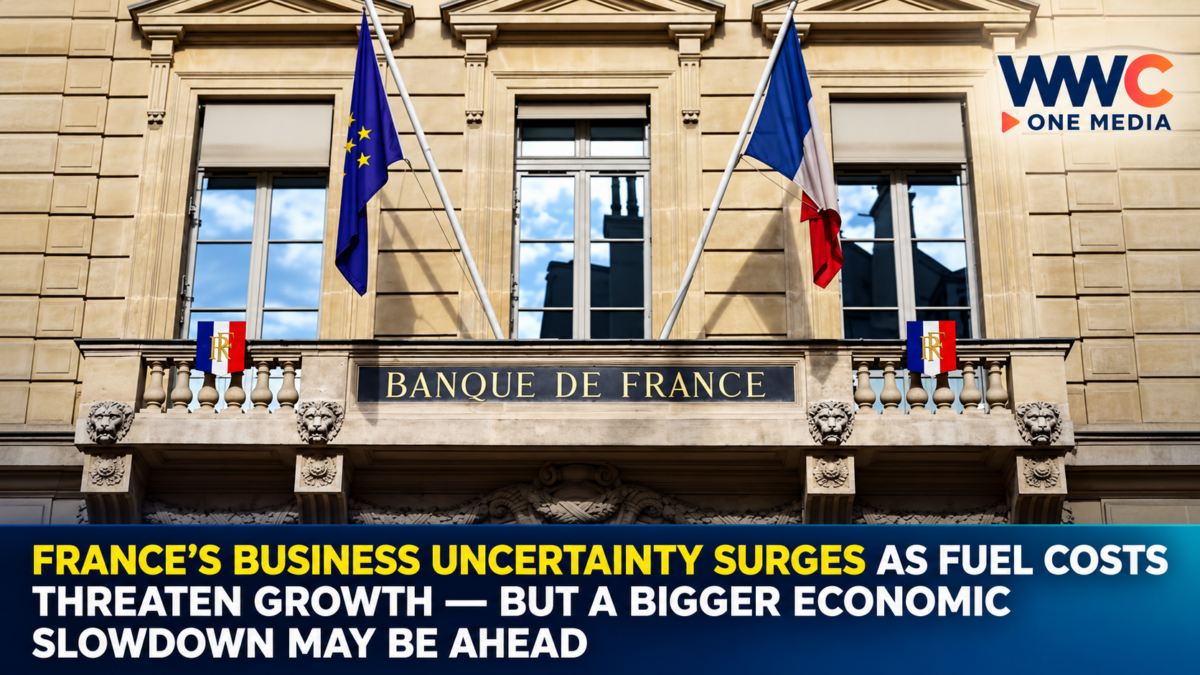
PARIS, France — October 14, 2026 — France’s economic outlook is facing renewed pressure after the country’s central bank reported a sharp increase in business uncertainty, with rising fuel prices, weakening household purchasing power and hesitation over new investment threatening an already fragile recovery.
The Bank of France’s latest monthly business survey, published October 12, found that uncertainty rose significantly in September, ending a downward trend that had continued since March.
The findings were based on responses from approximately 8,500 companies and establishments surveyed between September 27 and October 5.
Business executives reported growing concerns about energy costs, the general economic environment and consumers becoming more cautious with their spending.
Some companies said projects were being postponed, while others reported later orders and greater difficulty managing rising expenses.
The warning came as the central bank estimated that France’s economy expanded by just 0.1% during the third quarter of 2026.
Yet the results were not universally negative.
Manufacturing and business services continued expanding, while aerospace and electrical equipment benefited from strong demand.
The emerging problem is that growth remains too weak and uneven to provide much protection against additional shocks.
But while French companies are increasingly worried about energy costs and economic uncertainty, the bigger question is whether these pressures could push Europe’s second-largest economy into a prolonged slowdown — and leave policymakers with fewer options to revive growth.
Bank of France Reports Sharp Jump in Business Uncertainty
The central bank’s uncertainty indicator rose sharply during September.
The increase reversed a generally declining trend that began after uncertainty peaked in March.
The indicator is based on analysis of written comments provided by company executives participating in the monthly survey.
It is not simply a traditional consumer-confidence poll or a measure showing that a particular percentage of all French businesses have lost confidence.
Rather, the Bank of France examines the language executives use to describe challenges affecting their operations.
In September, references to fuel prices increased substantially.
Businesses also discussed uncertainty surrounding economic conditions and the purchasing power of households.
The central bank noted that hesitation was translating into practical decisions.
Companies were delaying some projects, customers were placing orders later and consumers were becoming more careful with spending.
These responses suggest that uncertainty could begin influencing real economic activity.
France’s Economy Barely Grows in Third Quarter
The Bank of France estimated quarterly economic growth of only 0.1%.
That would leave France close to stagnation.
The figure was developed using its business survey together with other economic indicators.
France’s national statistics agency, INSEE, is scheduled to release its preliminary third-quarter GDP estimate on October 30.
Until then, the central bank figure should be described as an estimate rather than a final GDP result.
A 0.1% expansion is positive growth.
It does not confirm that France is in recession.
However, it signals how limited the economy’s momentum has become.
If firms reduce investment and households continue postponing purchases, even a relatively small additional shock could weaken the outlook.
Key Figures From the Bank of France Survey
| Indicator | September 2026 finding |
|---|---|
| Businesses and establishments surveyed | Approximately 8,500 |
| Estimated third-quarter GDP growth | +0.1% |
| Industrial capacity utilization | 76.8% |
| Industrial firms with supply difficulties | 11% |
| Construction firms with supply difficulties | 5% |
| Firms reporting recruitment difficulties | 18% |
| Industrial firms that raised prices | 13% |
| Market-service firms that raised prices | 11% |
The figures reveal an economy facing cost pressures but still showing pockets of resilience.
Rising Fuel Prices Squeeze Companies and Consumers
Fuel prices were among the most prominent concerns in the survey.
Higher transportation and energy costs affect businesses across a wide range of industries.
Manufacturers pay more to transport raw materials and finished products.
Construction firms face higher expenses for machinery, deliveries and building materials.
Retailers and restaurants can also suffer when households spend more on essential expenses and have less money available for discretionary purchases.
The Bank of France found that some firms were unable to fully pass rising input costs on to their customers.
That puts pressure on profit margins.
When businesses cannot recover higher costs through selling prices, they may need to reduce expenses, delay hiring or reconsider investment plans.
The concern is particularly serious for companies operating in highly competitive markets.
Higher operating costs may continue even when demand is weak.
France’s Manufacturing Sector Is Growing — But Not Fast Enough
Industrial activity increased in September, although the expansion was weaker than companies had anticipated.
Production improved in aerospace, food processing, metallurgy and automobiles.
However, weakness continued in industries such as wood, paper, printing, rubber, plastics and glass.
Industrial capacity utilization increased to 76.8% from 76.4% in August.
That modest improvement shows factories were using slightly more of their available capacity.
Yet the sector remains uneven.
Some manufacturers have strong order books.
Others face persistent demand weakness or shortages of important components.
The central bank expects industrial production to accelerate in October, although the outlook differs significantly by industry.
Aerospace and AI Infrastructure Provide Economic Bright Spots
Aerospace remains one of France’s stronger manufacturing sectors.
The industry continues to benefit from significant demand, including orders connected to aviation and defense.
However, supply-chain disruptions remain an obstacle.
About 20% of aerospace firms reported supply difficulties, including problems involving engines and specialized equipment.
Demand for electrical equipment is also being supported by data centers, electrification and digital infrastructure.
Investment in artificial intelligence can increase requirements for electrical systems, computing-related equipment and associated industrial components.
That demand provides opportunities for some French manufacturers.
However, the central bank reported that electrical equipment production weakened in September after a strong August, partly because of supply constraints.
A rebound is anticipated in October.
These developments show that strong demand and supply limitations can exist simultaneously.
Restaurants and Transport Businesses Face Weak Demand
The service sector expanded in September, supported by business services and tourism-related activity.
Hotels benefited from visitor demand and the return of business travelers following the summer period.
Software publishing, engineering and professional services also performed relatively well.
However, restaurants and transportation businesses experienced declining activity.
The Bank of France linked transportation weakness partly to high fuel prices and subdued demand.
Restaurants continued to face weak household consumption.
These patterns suggest that consumers are prioritizing essential spending while reducing some discretionary expenses.
Businesses that depend on frequent purchases by households may be especially vulnerable if purchasing power remains under pressure.
Corporate Cash Flow Weakens
Another concerning finding involves business cash positions.
The Bank of France reported a slight deterioration in manufacturing and a more pronounced decline in market services.
Some firms face higher input costs without being able to increase prices enough to maintain margins.
Others are experiencing longer customer payment periods.
Professional services businesses, including legal, accounting and engineering firms, reported pressure associated with delayed payments.
Cash flow matters because companies need sufficient liquidity to meet wages, rent, supplier bills and other operating expenses.
A business can have a healthy order book and still struggle if payments arrive too slowly.
Prolonged cash-flow pressure may force firms to postpone investments or reduce operating expenses.
Construction Remains a Weak Point
Construction activity increased only slightly in September.
Part of the improvement reflected the resumption of projects delayed by summer heatwaves.
However, the underlying demand environment remained weak.
The Bank of France reported particularly thin order books for single-family housing construction.
Renovation and finishing work also faced slower activity.
Higher materials and transportation costs were placing pressure on margins.
The sector is expected to remain broadly stable in October.
That outlook provides little evidence of a strong construction recovery.
The weakness matters because construction supports employment, housing supply and demand for numerous manufactured products.
Businesses Are Raising Prices Despite Weak Demand
The survey identified renewed pressure on industrial input costs.
Energy, fuel, metals and packaging materials became more expensive for some manufacturers.
However, selling prices increased more slowly than costs.
In September, 13% of industrial firms reported raising prices, compared with a historical average of about 10% for that month.
In market services, 11% raised prices, compared with a usual September average of around 8%.
The contrast illustrates why inflation can remain difficult to manage.
Companies may need higher prices to protect margins, but customers may already be struggling with affordability.
If businesses cannot increase prices, profitability suffers.
If they do, households may reduce spending further.
Hiring Difficulties Have Not Disappeared
Despite weak economic growth, some companies continue struggling to recruit workers.
The survey found that 18% of businesses reported recruitment difficulties.
The share was 16% in manufacturing and approximately 18% in services.
Construction continued to face particular hiring challenges.
Specialized industries, including aerospace, also reported shortages of qualified personnel.
This suggests that France’s labor-market challenges are not solely about the number of available jobs.
They also involve matching workers’ skills and locations to employers’ needs.
Weak overall economic growth can therefore coexist with shortages in specific professions.
Political and Fiscal Uncertainty Adds Another Challenge
France’s business uncertainty is emerging against a difficult political and fiscal backdrop.
The country faces continuing debates over government spending, budget deficits and public debt.
Political disagreements can make it harder for companies to anticipate future taxation, public investment and economic policy.
Independent reporting has highlighted concerns that political gridlock and fiscal uncertainty are weighing on business investment.
The Wall Street Journal described a negative feedback loop involving weak growth, diminished confidence and public-finance challenges.
However, the Bank of France survey emphasized fuel prices and the broader economic environment as prominent immediate concerns.
The sharp increase in its uncertainty indicator should not be attributed exclusively to domestic politics.
Could France’s Weak Economy Become a Bigger European Problem?
France is one of the euro area’s largest economies.
Weak French growth can affect regional demand, corporate investment and trade.
French businesses operate internationally in aerospace, luxury goods, banking, energy, transportation and industrial manufacturing.
A sustained slowdown could influence suppliers and commercial partners beyond France.
The European Central Bank must also consider developments in major member economies when evaluating monetary policy.
But the ECB faces competing risks.
Lower interest rates may support economic activity, while persistent energy inflation could argue for continued caution.
The French survey therefore adds another layer of complexity to the European monetary outlook.
It does not, by itself, signal a confirmed ECB policy change.
Why Asian Markets and the Philippines Should Pay Attention
France’s economic conditions can matter to businesses throughout Asia through trade, investment, tourism and international supply chains.
French companies maintain commercial operations and supplier relationships across the region.
If consumer spending or investment weakens significantly, some Asian exporters may face reduced demand.
Conversely, continued French investment in aerospace, defense, electrical equipment and data centers could support selected suppliers.
For the Philippines, the more immediate shared concern is global energy prices.
Expensive oil and transport fuel can affect both French businesses and Philippine consumers, although the economic consequences differ.
The Bank of France survey does not establish any direct decline in Philippine employment or trade caused by France’s uncertainty increase.
Any such effect would require separate economic evidence.
What Happens Next?
The economic outlook will become clearer as additional data arrive.
October 30: INSEE is scheduled to publish France’s preliminary third-quarter GDP figures.
Next Bank of France survey: Business comments will show whether uncertainty continues rising or begins to ease.
Energy markets: Fuel-price developments will remain important for operating costs and household purchasing power.
Industrial production: Strong aerospace and electrical equipment demand could support activity if supply constraints improve.
Consumer spending: Restaurant, retail and other discretionary sectors will provide evidence of whether households are becoming more cautious.
Fiscal policy: France’s budget decisions will influence confidence, investment and government borrowing conditions.
The Bigger Question: Can France Avoid a Prolonged Period of Stagnation?
France’s latest business survey presents a mixed economic picture.
Manufacturing output is still increasing.
Services are supporting growth.
Aerospace and electrical equipment benefit from strong demand.
But a sharp rise in uncertainty is changing how businesses and consumers behave.
Fuel costs are squeezing margins.
Households are postponing purchases.
Some companies are delaying projects.
Construction remains subdued, and business cash flow is becoming more difficult to manage.
The Bank of France’s estimated 0.1% quarterly GDP growth leaves the economy vulnerable to new shocks.
Restoring confidence will require more than a temporary decline in uncertainty.
Businesses need clearer economic conditions, manageable costs and sufficient demand to justify expanding production and investment.
France’s economy is still growing, but barely. And while business leaders are increasingly worried about fuel prices and weak demand, the bigger test is whether the country can rebuild confidence before caution turns into declining investment, weaker employment and a much deeper economic slowdown.