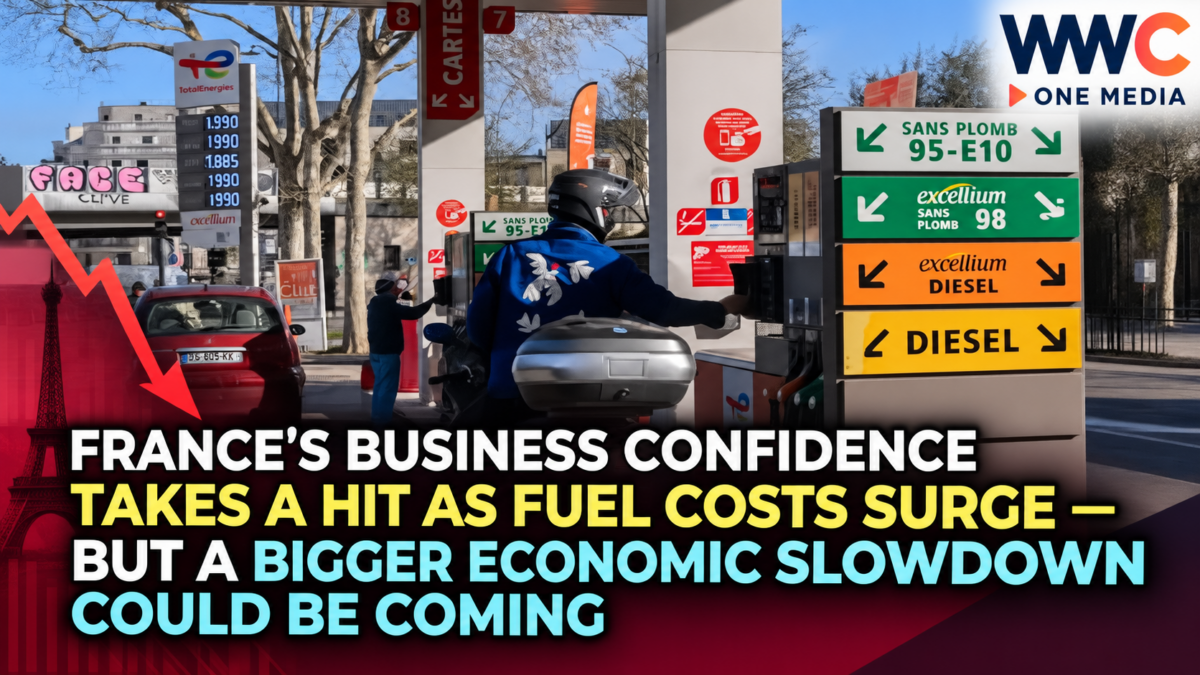
PARIS, France — October 14, 2026 — France’s business community is growing increasingly nervous as soaring fuel costs, weakening consumer spending and political uncertainty threaten to derail an already fragile economic recovery.
A new Bank of France survey published on October 12 revealed a sharp increase in business uncertainty during September, reversing months of gradual improvement and raising questions about whether Europe’s second-largest economy can withstand another prolonged period of financial pressure.
The central bank surveyed approximately 8,500 businesses and establishments between September 27 and October 5.
Its findings showed that executives are becoming more concerned about energy prices, household purchasing power and the general economic environment.
Some businesses reported delaying investment projects, while others said customers were postponing orders or becoming increasingly cautious with their spending.
The warning came alongside the central bank’s estimate that French gross domestic product expanded by just 0.1% in the third quarter of 2026.
Although manufacturing and market services continued growing in September, the recovery remains uneven, with construction activity weak and financial pressures building across several industries.
The findings arrive at a sensitive moment for France, which is also struggling with political divisions, fiscal pressures and elevated government borrowing costs.
But while the immediate concern is rising uncertainty among French business leaders, the bigger question is whether high energy prices and weakening confidence could push France from sluggish growth into a more serious economic downturn.
Bank of France Survey Reveals Sharp Increase in Business Uncertainty
The Bank of France’s latest monthly business survey identified a significant reversal in corporate sentiment.
The central bank reported that its uncertainty indicator rose sharply in September after generally declining from a peak reached in March.
The indicator is derived from textual analysis of comments provided by business leaders during the survey.
It seeks to capture the extent to which companies express concern about economic conditions and their future operations.
Unlike a simple questionnaire asking whether confidence has improved or deteriorated, the measure analyzes the issues businesses raise when describing their situation.
Fuel prices emerged as a prominent concern.
Executives also increasingly referred to the general economic environment, delayed projects and subdued household demand.
The results suggest that uncertainty is beginning to influence business decisions rather than remaining a theoretical concern.
However, the survey does not show that all French companies are reducing production or canceling investments.
Business activity continues to grow in some sectors.
The more important warning is that the recovery is fragile and vulnerable to additional shocks.
French Economy Estimated to Grow Just 0.1% in Third Quarter
The Bank of France estimated that the economy expanded by approximately 0.1% in the third quarter of 2026.
That follows a period of very weak growth.
The forecast is based on the monthly business survey, official production indicators, other economic surveys and higher-frequency information.
The estimate is not yet the final official GDP result.
France’s national statistics agency, INSEE, is scheduled to publish its preliminary third-quarter GDP figures on October 30.
Reuters reported that the central bank’s outlook was consistent with sluggish activity supported primarily by services, while manufacturing and construction remained weaker.
A quarterly expansion of 0.1% indicates that the economy is still growing, but only marginally.
Such limited growth gives households, businesses and the government little room to absorb new economic shocks.
A deterioration in energy prices, demand or financing conditions could weaken the outlook further.
However, positive GDP growth does not itself establish that the country is in recession.
Key Findings From the October 12 Business Survey
The official Bank of France report identifies several areas of strength and weakness.
| Economic indicator | September 2026 finding |
|---|---|
| Business uncertainty | Sharp increase |
| Third-quarter GDP growth | Estimated +0.1% |
| Industrial capacity utilization | 76.8%, up from 76.4% |
| Industrial firms reporting supply difficulties | 11% |
| Construction firms reporting supply difficulties | 5% |
| Businesses reporting recruitment difficulties | 18% |
| Aerospace supply difficulties | Around 20% |
| October industrial production outlook | Further growth expected |
These are survey findings and short-term estimates rather than a complete set of final national economic statistics.
The data paint a mixed picture.
Some companies continue receiving substantial orders and increasing output.
Others face weaker consumer demand, mounting operating expenses and deteriorating cash flow.
The divergence is important because it suggests that France’s economic problems are not affecting every sector equally.
Fuel Prices Become a Major Threat to French Companies
Higher fuel costs have become one of the most frequently cited concerns among survey respondents.
Energy and transportation expenses influence operations across the economy.
Manufacturers pay more to transport raw materials and finished goods.
Construction companies face higher costs for machinery, logistics and building supplies.
Restaurants and retailers may experience reduced customer spending as households devote more of their budgets to essential expenses.
Transportation businesses are particularly exposed because fuel represents a major operating cost.
The Bank of France specifically identified high fuel prices and weak demand as factors behind reduced activity in transport services.
The problem is not simply that companies must pay more for energy.
Many firms are struggling to pass those costs on to customers.
When expenses rise faster than selling prices, profit margins come under pressure.
This can eventually affect hiring, investment and business expansion.
Middle East Conflict Adds to France’s Inflation Risks
The increase in energy costs comes against the backdrop of continuing conflict in the Middle East.
Disruptions to oil production and shipping have contributed to elevated international energy prices.
Because energy markets operate globally, developments in the Persian Gulf can affect fuel costs in Europe.
French companies are particularly sensitive to increases in diesel and transportation expenses.
Higher oil prices can also influence the cost of chemicals, plastics, packaging and other industrial inputs.
However, the effects vary according to individual companies’ contracts, energy consumption and ability to adjust prices.
The Bank of France survey establishes that fuel costs are a growing concern.
It does not quantify precisely how much of the increase in business uncertainty is attributable to any single geopolitical event.
Other factors, including domestic demand and fiscal policy, are also important.
Manufacturing Continues Growing, but More Slowly Than Expected
French industrial production increased in September.
However, the improvement was weaker than businesses had anticipated.
This distinction matters because a positive monthly change can still be disappointing when companies had expected a stronger rebound.
The industrial sector remains divided.
Some manufacturers are benefiting from demand for aerospace equipment, defense-related products and electrical infrastructure.
Other industries continue facing weak orders and increasing costs.
According to the Bank of France, industrial capacity utilization rose to 76.8% from 76.4% in August.
That indicates a modest increase in the use of available production capacity.
However, utilization remains uneven across different industries.
The overall figures do not support the conclusion that French manufacturing has entered a broad-based boom.
Aerospace Industry Remains a Bright Spot
Aerospace has been one of the strongest parts of the French manufacturing economy.
The Bank of France reported continued robust activity in September.
Demand for aircraft and related equipment has supported production schedules.
However, manufacturers are also experiencing pressure from supply-chain constraints.
The survey found that supply difficulties affected approximately one in five businesses in the aerospace sector.
Problems involving engines and specialized equipment have complicated efforts to increase production.
This illustrates an important economic tension.
Strong demand does not always translate immediately into higher output.
Companies may have enough orders but lack the materials, components or production capacity needed to complete them.
Such constraints can also increase costs.
For France, aerospace remains a source of economic resilience, but further expansion depends on resolving supply bottlenecks.
Data Centers and AI Investment Support Electrical Equipment Demand
The survey also identified strong demand in electrical equipment and related industries.
Investment in data centers is one factor supporting these activities.
Modern artificial intelligence systems require substantial computing capacity and electrical infrastructure.
Building data centers creates demand for power equipment, cooling systems, specialized electronics and network components.
The Bank of France noted that orders remain particularly strong in electrical equipment.
However, the industry’s performance is not uniformly positive.
Production declined in September after stronger activity in August, partly because of supply difficulties.
Businesses expect a rebound in October.
The broader takeaway is that AI-related infrastructure investment is helping support selected French industries even as consumer-facing sectors struggle.
That does not mean AI investment is sufficient to offset every weakness in the national economy.
Restaurants and Transportation Businesses Face Weak Demand
France’s service sector expanded in September, but the improvement was uneven.
Business-oriented services performed relatively well.
Hotels benefited from tourism and the return of corporate travel after the summer.
Software publishing, engineering and certain professional services also saw growth.
Restaurants, however, continued to experience weak demand.
The Bank of France reported that consumers remained cautious about discretionary spending.
Transportation services also contracted amid high fuel prices and subdued activity.
These differences highlight the importance of household purchasing power.
Consumers facing higher essential expenses may reduce spending on dining, entertainment and other nonessential purchases.
A prolonged reduction in discretionary demand could weaken businesses that depend on frequent customer spending.
Corporate Cash Flow Deteriorates Despite Continued Activity
Another troubling development involves company liquidity.
The Bank of France reported that cash positions deteriorated slightly in manufacturing and more noticeably in market services.
Rising costs are one reason.
But delayed customer payments are also creating problems.
Some professional services firms reported longer payment times, affecting their ability to manage operating expenses.
For smaller businesses, cash-flow pressure can become particularly serious.
A profitable company may still face difficulties if customers delay paying invoices while wages, rent and other obligations remain due.
Cash shortages can force businesses to postpone hiring or investment.
In extreme cases, prolonged financial stress can threaten survival.
However, the survey does not establish that bankruptcies are rising uniformly across all French sectors.
It indicates that financial conditions are becoming more difficult for a number of businesses.
Construction Industry Remains Under Pressure
France’s construction sector continues to face weak demand.
Activity increased only slightly in September.
Part of the improvement came from work resuming after projects were delayed during summer heatwaves.
That temporary rebound should not be confused with a lasting recovery in construction demand.
The Bank of France reported that order books remain weak, particularly for single-family homes.
Higher materials and transportation costs are also affecting profitability.
The sector’s outlook for October is largely flat.
Companies are expecting limited growth, with some activities weakening after the temporary September recovery.
Construction matters because it supports employment, housing supply and demand for materials.
Persistent weakness can therefore affect several other parts of the economy.
Recruitment Problems Persist Even With Slow Growth
France’s weak economic growth has not eliminated all labor shortages.
According to the Bank of France, 18% of surveyed businesses reported recruitment difficulties.
The share increased slightly from August.
In services, 18% of firms experienced hiring challenges.
The figure was 16% in manufacturing.
Construction recorded the highest share, at approximately 22%.
Some specialized sectors, particularly aerospace, continued to experience difficulty finding workers with appropriate skills.
The figures show that labor-market conditions can differ sharply across industries.
An economy may experience weak overall growth while certain employers still struggle to recruit.
The problem may reflect mismatches between available workers and the skills or locations required by businesses.
Political Uncertainty Deepens Economic Anxiety
The business survey comes during a difficult political period.
France has experienced recurring disputes over government budgets, fiscal policy and parliamentary support.
Prime Minister Sébastien Lecornu’s government has faced pressure to reduce the deficit while preserving economic activity.
Investors are also watching France’s borrowing costs and the country’s ability to address rising public debt.
Reuters reported on October 7 that Bank of France Governor Emmanuel Moulin believed France did not currently need intervention from the European Central Bank to address its financial conditions.
He instead emphasized the importance of an effective domestic budget strategy.
Political uncertainty can discourage investment when businesses cannot predict future taxes, spending policies or regulatory conditions.
However, the October Bank of France survey identified fuel prices as a particularly prominent immediate concern.
It would therefore be misleading to attribute the entire rise in uncertainty solely to French political instability.
Government Debt Raises Concerns About France’s Financial Flexibility
France’s public finances remain another source of concern.
The country faces a high debt burden and pressure to narrow its budget deficit.
An October Wall Street Journal analysis described how political gridlock, fiscal instability and weaker investment were reinforcing each other.
Rising government borrowing costs can increase the expense of refinancing debt.
That may limit the government’s ability to respond to future economic disruptions.
It can also complicate negotiations over public spending and taxation.
However, high sovereign debt does not automatically mean a country is on the verge of default.
France remains a major advanced economy with deep financial markets.
The central issue is whether policymakers can restore confidence and improve fiscal sustainability without unnecessarily weakening growth.
Could France Enter a Recession?
The latest survey has intensified concern about France’s economic outlook.
But a recession is not yet established by the reported figures.
The Bank of France estimates positive, if very weak, quarterly growth.
Some industries are still expanding.
Services continue to provide support, and aerospace and electrical equipment have substantial demand.
However, the risks are significant.
Rising fuel costs could reduce consumer spending.
Political uncertainty may delay investment.
Weak construction activity can affect employment and housing supply.
Higher financing costs could also limit business expansion.
If these pressures persist or intensify, economic growth could weaken further.
The official third-quarter GDP release scheduled for October 30 will provide an important opportunity to assess whether the central bank’s preliminary estimate was accurate.
What the European Central Bank May Be Watching
France is a member of the euro area, meaning its monetary policy is determined by the European Central Bank.
The ECB must consider economic conditions across all euro-area countries rather than respond exclusively to French developments.
Weak French growth could support arguments for less restrictive monetary policy.
However, elevated energy prices and inflation pressures across Europe could complicate that approach.
Lower interest rates may help borrowing and investment but could also increase demand when inflation remains too high.
Conversely, higher rates may support inflation control while creating additional pressure on borrowers.
The ECB therefore faces a difficult balancing act.
France’s business uncertainty is one indicator among many that policymakers must assess.
The latest survey does not establish that the ECB has decided to change interest rates in response.
What the Warning Means for European Financial Markets
Weak French business confidence can influence investors’ expectations about corporate profits and the country’s economic outlook.
Businesses facing higher costs and weaker demand may experience pressure on earnings.
Companies in fuel-intensive industries may be particularly exposed.
Meanwhile, concerns about public debt can influence French government bond yields.
However, financial markets do not always move in the same direction as business surveys.
Reuters reported that European stock markets gained on October 12, supported partly by banking shares, despite continued energy-related concerns.
Investors also consider company-specific results, sector trends and international developments.
The latest Bank of France survey is therefore an important economic warning but not proof of an immediate stock-market collapse.
Could France’s Weakness Affect Asia?
France is an important European economy with commercial links across Asia.
French companies operate in aerospace, luxury goods, transportation, energy, technology and financial services.
A prolonged slowdown could influence demand for imported products, investment and corporate expansion.
For Asian manufacturers, France’s strong aerospace and electrical equipment orders may present opportunities.
But weakness in consumer spending could challenge companies supplying retail and discretionary products.
The effects would differ by country and industry.
The survey does not establish that Asian exports to France have already fallen because of the September increase in uncertainty.
Any such conclusion would require separate trade data.
Why the Philippines Should Watch France’s Economic Outlook
Developments in France may matter to Philippine businesses through international trade, tourism, investment and the broader European economy.
French multinational companies participate in industries with supply chains extending across Asia.
Changes in investment or production decisions can influence suppliers and commercial partners.
Filipino businesses exporting to Europe may also be affected if weaker consumer demand spreads through the region.
At the same time, the energy-price pressures identified in the Bank of France survey are relevant to the Philippines because both economies are exposed to international oil markets.
However, their economic structures and policy responses differ substantially.
There is no evidence from this survey alone that France’s rising uncertainty has caused a specific change in Philippine GDP, employment or investment.
What to Watch Next
The coming weeks will help establish whether the rise in uncertainty is temporary or becoming a more persistent economic problem.
October 30 — France’s preliminary third-quarter GDP release
INSEE will publish initial estimates of the economy’s actual performance.
October business surveys
The next Bank of France survey will show whether uncertainty continues increasing.
Fuel and energy prices
Further changes could influence transportation costs, manufacturing expenses and household purchasing power.
2027 budget negotiations
The government’s fiscal decisions will affect business confidence and financial-market perceptions.
European Central Bank policy
Interest-rate decisions will help determine financing conditions across the euro area.
Corporate investment and cash flow
Companies’ willingness to invest will provide evidence of whether uncertainty is slowing the economy.
The Bigger Question: Can France Escape Its Low-Growth Trap?
France’s latest business survey delivers a warning at a critical moment.
Economic activity has not collapsed.
Manufacturing continues to grow, services remain resilient in some areas, and demand for aerospace and electrical equipment is supporting parts of the industrial economy.
But rising uncertainty threatens to weaken those gains.
High fuel prices are pressuring companies and households.
Weak consumer spending is hurting restaurants and transportation businesses.
Construction demand remains fragile.
And financial concerns are being reinforced by political disputes and uncertainty over the government’s budget.
The Bank of France expects the economy to have grown by only 0.1% during the third quarter.
Such limited expansion leaves little room for further setbacks.
The immediate challenge is restoring confidence.
The longer-term challenge is improving growth while containing inflation and stabilizing public finances.
France’s business leaders are becoming more anxious just as the economy struggles to maintain momentum. But the bigger test is still ahead: If fuel prices remain high, households keep cutting spending and political uncertainty persists, could Europe’s second-largest economy slip from weak growth into a more damaging economic downturn?