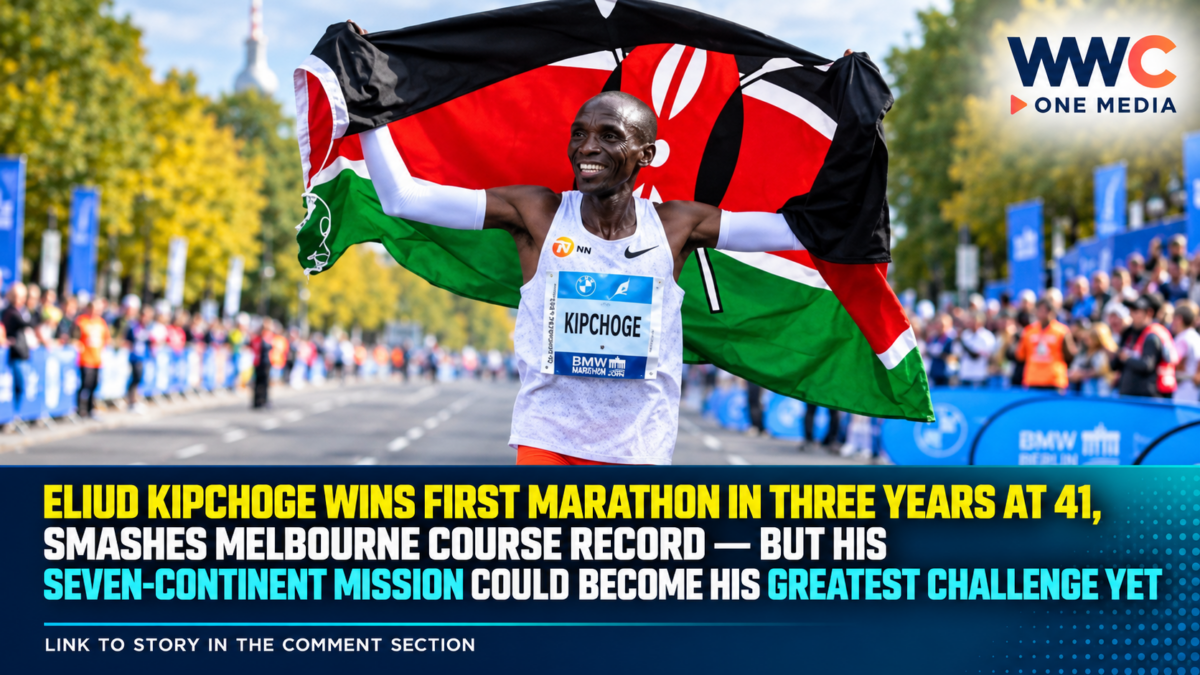
MELBOURNE, AUSTRALIA — Kenyan marathon legend Eliud Kipchoge has delivered a stunning comeback at 41, winning the Melbourne Marathon in a course-record 2 hours, 9 minutes and 10 seconds to end a three-year victory drought. The two-time Olympic champion broke away from the field in the final 10 kilometers and crossed the finish line inside the iconic Melbourne Cricket Ground, claiming his 17th career marathon victory. But the triumph is part of something even more ambitious: a mission to complete marathons on all seven continents in two years, testing how far one of the greatest distance runners in history can push his extraordinary career.
Eliud Kipchoge has reminded the world why he remains one of marathon running’s most celebrated figures.
On Sunday, October 11, the 41-year-old Kenyan secured his first victory over the marathon distance since the 2023 Berlin Marathon, winning in Melbourne with a performance that also broke the event’s course record.
He finished the 42.195-kilometer race in 2:09:10, beating the previous course best by two seconds.
Australia’s Thomas Do Canto finished second in 2:10:35, while fellow Australian Reece Edwards claimed third in 2:14:33.
According to Reuters and Channel NewsAsia, the victory was Kipchoge’s 17th over the marathon distance.
For an athlete whose career has already included two Olympic gold medals, a former world record and historic achievements in endurance running, the Melbourne victory added another remarkable chapter.
The significance extends beyond the result.
Kipchoge is now pursuing a seven-continent marathon tour designed to take his running legacy beyond the traditional elite racing circuit.
His win in Australia demonstrates that although he is no longer producing the world-record performances of his peak years, he still possesses the experience, endurance and competitive ability to win major races.
Kipchoge Ends Three-Year Marathon Victory Drought
Kipchoge’s last marathon victory before Melbourne came at the Berlin Marathon in September 2023.
That triumph was followed by a period in which results became less consistent than during his extraordinary run of dominance.
For much of the previous decade, the Kenyan had been almost unbeatable at the marathon distance.
He won major city races, captured consecutive Olympic titles and established himself as a defining figure in modern endurance sport.
But as he moved into his 40s, questions emerged about how long he would continue competing at the highest level.
The Melbourne result provided a powerful response.
Although his winning time was slower than his former world-record pace, he controlled the race well enough to defeat the leading competitors and establish a new event benchmark.
The victory also ended a gap of more than three years between marathon wins.
For Kipchoge, the result was both a competitive achievement and a reminder of the value of persistence.
A Decisive Breakaway in the Final 10 Kilometers
Kipchoge’s victory was built on race management and a decisive move late in the event.
Australian Associated Press reported that he broke away from his competitors during the final 10 kilometers.
Rather than relying on an explosive early pace, the veteran runner demonstrated patience before establishing a decisive advantage.
He finished 1 minute and 25 seconds ahead of runner-up Thomas Do Canto.
The performance illustrated the experience that has helped Kipchoge dominate marathon racing for much of his career.
Distance running rewards more than speed.
Athletes must manage energy consumption, hydration, pacing, terrain and the physical demands of competing for more than two hours.
Kipchoge’s ability to move clear in the closing stages demonstrated that his tactical judgment remains formidable.
The result was especially meaningful because Melbourne was his debut at the event.
Kipchoge Breaks Course Record by Just Two Seconds
Kipchoge crossed the finish line in 2:09:10.
The previous Melbourne Marathon record was 2:09:12, set by Kenya’s Timothy Kiplagat Ronoh in 2022.
The two-second improvement was narrow, but it was enough to establish a new record in the event’s official results.
This should be distinguished from a world record.
Kipchoge did not break the world marathon record in Melbourne.
His former world record of 2:01:09, set in Berlin in 2022, remains considerably faster than Sunday’s result.
The Melbourne performance was a race-record achievement specific to the event.
It nevertheless represented a notable accomplishment for a runner competing at age 41.
The record also came during the first edition of the Melbourne Marathon using a revised, faster course layout.
Course changes can affect historical comparisons, making it important to distinguish an event record from a directly comparable performance under identical race conditions.
He Could Have Run Faster but Chose to Celebrate With Fans
One of the most memorable moments came as Kipchoge approached the finish.
According to Associated Press and Australian Associated Press, the Kenyan slowed briefly to acknowledge spectators inside the Melbourne Cricket Ground.
He waved to cheering fans while completing the final section of the course.
The gesture suggested that the occasion mattered beyond the finishing time.
Despite the record-breaking performance, Kipchoge appeared relaxed as he celebrated with the crowd.
He spent additional time interacting with supporters after the race.
His willingness to engage with spectators reflected the broader purpose of his current running programme.
Rather than focusing exclusively on winning the world’s most prestigious races, Kipchoge is using his appearances to connect with running communities across different continents.
The interaction offered a fitting conclusion to his Melbourne debut.
Melbourne Cricket Ground Hosts Historic Finish
The race concluded inside the Melbourne Cricket Ground, one of Australia’s most recognizable sporting venues.
The Melbourne Marathon’s finish inside the stadium gives runners an opportunity to complete their race in front of spectators in a setting associated with major Australian sporting events.
For Kipchoge, the stadium finish created a memorable scene.
After running more than 42 kilometers through Melbourne, he entered the arena with the race effectively decided.
The final section allowed the two-time Olympic champion to acknowledge supporters and celebrate his return to winning form.
The 2026 Nike Melbourne Marathon Festival was also a significant mass-participation event.
Organizers expected approximately 66,000 participants across its different races over two days, including about 20,000 in the full marathon.
Those figures refer to the wider running festival and expected participation, not to the number of elite athletes in the men’s marathon race.
The combination of recreational runners, experienced competitors and one of the sport’s greatest champions helped make the weekend a major event for Australian athletics.
Thomas Do Canto and Reece Edwards Complete Men’s Podium
Kipchoge was not the only runner to deliver a strong performance.
Australia’s Thomas Do Canto finished runner-up in 2:10:35.
His result placed him 1 minute and 25 seconds behind Kipchoge.
Reece Edwards, also representing Australia, finished third in 2:14:33.
The two Australians completed the podium behind the Kenyan champion.
The official event results confirm the finishing order and times.
Do Canto’s performance was particularly notable because he finished ahead of the other Australian competitors in a race featuring one of the most accomplished marathon runners in history.
For Australia’s distance-running community, the event provided an opportunity for domestic athletes to compete alongside an internationally recognized champion.
However, finishing second to Kipchoge does not automatically establish a national record or Olympic qualification.
Such achievements would require separate confirmation under the applicable athletics rules.
Camille French Wins Women’s Melbourne Marathon
The women’s marathon also produced an international winner.
New Zealand’s Camille French claimed victory in 2:28:25.
Australia’s Sinead Diver finished second in 2:28:49, just 24 seconds behind French.
Ireland’s Nichola Sheridan placed third in 2:29:13.
The close times among the top finishers reflected a competitive women’s race.
French’s victory added another important result to the international field.
While Kipchoge attracted much of the global attention, the women’s competition formed an equally important part of the Melbourne Marathon programme.
The leading results were confirmed in CNA’s Reuters report.
The event showcased endurance talent from Kenya, Australia, New Zealand and Ireland across the men’s and women’s competitions.
A Seven-Continent Marathon Tour Becomes Kipchoge’s New Mission
Perhaps the most significant part of Kipchoge’s current career is his decision to pursue a new type of challenge.
The Kenyan has launched a global running initiative commonly described as his World Tour.
His goal is to run a marathon on each of the world’s seven continents over approximately two years.
The mission is intended to connect him with running communities and support causes he believes in.
Rather than limiting his appearances to the traditional World Marathon Majors, Kipchoge is looking to participate in races across a wider range of locations.
The project began with the Cape Town Marathon in South Africa in May 2026.
Melbourne is another stage of the continental campaign.
The objective includes reaching Antarctica, making the undertaking particularly ambitious.
However, the complete seven-continent mission has not yet been accomplished.
The Melbourne victory should be described as progress toward the goal, not the completion of the entire tour.
Why Running Across Seven Continents Is So Difficult
Completing marathons on all seven continents presents challenges that extend beyond normal training.
Each destination may involve different climates, terrain, travel demands and logistical conditions.
Runners must adapt to variations in temperature, humidity, altitude, road conditions and recovery opportunities.
International travel can also affect sleep, training schedules and physical preparation.
Antarctica presents an especially unusual environment because of its extreme temperatures, isolation and logistical complexity.
For a 41-year-old elite athlete, managing recovery between marathons is another important consideration.
Marathon racing places substantial demands on the body, and experienced runners often structure their schedules carefully.
Kipchoge’s goal is therefore different from simply entering one major marathon.
It requires long-term planning and consistency across several physically demanding events.
His ability to remain healthy and competitive throughout the project will be closely watched.
Cape Town Marked an Emotional Beginning
Kipchoge launched the continental mission at the Cape Town Marathon in May 2026.
The event had special significance because it marked his first marathon race in Africa.
Despite being one of Kenya’s most famous athletes, much of his elite marathon career had been spent competing in major races outside his home continent.
The Cape Town appearance allowed him to bring his international profile to a major African running event.
He finished second there before moving on to further stops on his global tour.
The Melbourne victory therefore continued a journey that combines elite competition with engagement across different running communities.
The project represents a shift in how Kipchoge is defining success during the later stages of his career.
Winning remains important, but so does the opportunity to connect with people in different parts of the world.
Two Olympic Gold Medals Define an Extraordinary Legacy
Long before Melbourne, Kipchoge had secured his place among the greatest marathon runners in history.
He won Olympic marathon gold at Rio de Janeiro in 2016.
He successfully defended his title at the Tokyo Olympics, held in 2021.
Those victories made him one of the rare athletes to win consecutive Olympic marathon titles.
He also won major races in cities including London, Berlin, Chicago and Tokyo.
At his peak, Kipchoge combined exceptional pacing ability with remarkable consistency.
In 2022, he lowered the official men’s world marathon record to 2:01:09 in Berlin.
That performance remained the world record until fellow Kenyan Kelvin Kiptum ran 2:00:35 at the Chicago Marathon in 2023.
Kipchoge’s broader significance is not based on a single race.
It comes from years of sustained excellence across the marathon’s most prestigious stages.
The First Man to Run a Marathon Distance in Under Two Hours
Kipchoge also became internationally famous for breaking the two-hour barrier over the marathon distance.
In October 2019, he completed 42.195 kilometers in 1:59:40 during the INEOS 1:59 Challenge in Vienna.
The achievement demonstrated an extraordinary level of physical performance.
However, it was not recognized as an official marathon world record because the event used specially arranged conditions, including pacing and other support not permitted in standard record-eligible competition.
The distinction remains important.
Kipchoge is the first person documented to cover the marathon distance in under two hours in the controlled event, but that performance is separate from official marathon world records.
His Melbourne victory adds another chapter to the same career, although under very different competitive circumstances.
Is Kipchoge Making a Comeback at 41?
The Melbourne result will inevitably revive discussion about whether Kipchoge can return to the highest level of elite marathon competition.
His three-year victory drought had raised questions about his future.
The new course record suggests that he still has significant competitive ability.
But the performance should be interpreted carefully.
A winning time of 2:09:10 is excellent in the context of the Melbourne race and its competition.
It does not establish that Kipchoge has returned to the world-record pace he achieved earlier in his career.
The standard among the fastest marathon runners remains exceptionally high.
For Kipchoge, success may now involve balancing competitive victories with the goals of his seven-continent tour.
His Melbourne performance shows he can still win.
Whether he can challenge the world’s fastest runners again at the very top level remains an open question.
What Kipchoge’s Victory Means for Runners Across Asia
Kipchoge’s career has inspired recreational and professional runners around the world, including across Southeast Asia.
Countries such as the Philippines, Singapore, Malaysia, Thailand and Indonesia have expanding communities of marathon and recreational runners.
Major road-running events have become important opportunities for fitness, tourism and community participation.
Kipchoge’s success offers an example of how disciplined training, pacing and consistency can support long-term athletic achievement.
However, recreational runners should not attempt to copy an elite marathoner’s training volume or racing schedule without considering their own experience and physical condition.
The physical demands of marathon racing require appropriate preparation and recovery.
The wider appeal of Kipchoge’s current mission lies in bringing attention to running communities beyond the sport’s most established elite events.
His appearances can help inspire participation while highlighting the different cultures and landscapes connected through distance running.
The Bigger Picture: Kipchoge’s Greatest Race May Now Be Against Time
Eliud Kipchoge has already achieved more than most endurance athletes could hope to accomplish.
He owns two Olympic marathon gold medals, has held the official world record and became the first person to cover the marathon distance in under two hours under specially arranged conditions.
Yet at 41, he is still finding reasons to compete.
His Melbourne Marathon victory ended a three-year wait for another win and established a new event record.
It also showed the experience and competitive spirit that have defined his career.
But the seven-continent mission represents a different ambition.
It is not focused exclusively on faster times or major championship medals.
Instead, it combines endurance, international travel, community engagement and the challenge of remaining active at an elite level later in life.
Kipchoge has proved that he can still win a marathon at 41, claiming his 17th career victory in Melbourne.
But the bigger test lies ahead as he continues his mission to run across all seven continents — a challenge that could redefine the final chapter of one of athletics’ greatest careers.
For the Kenyan legend, Melbourne may be remembered as more than the place where he ended a three-year winning drought. It could be the moment that confirmed his extraordinary running story is far from finished.