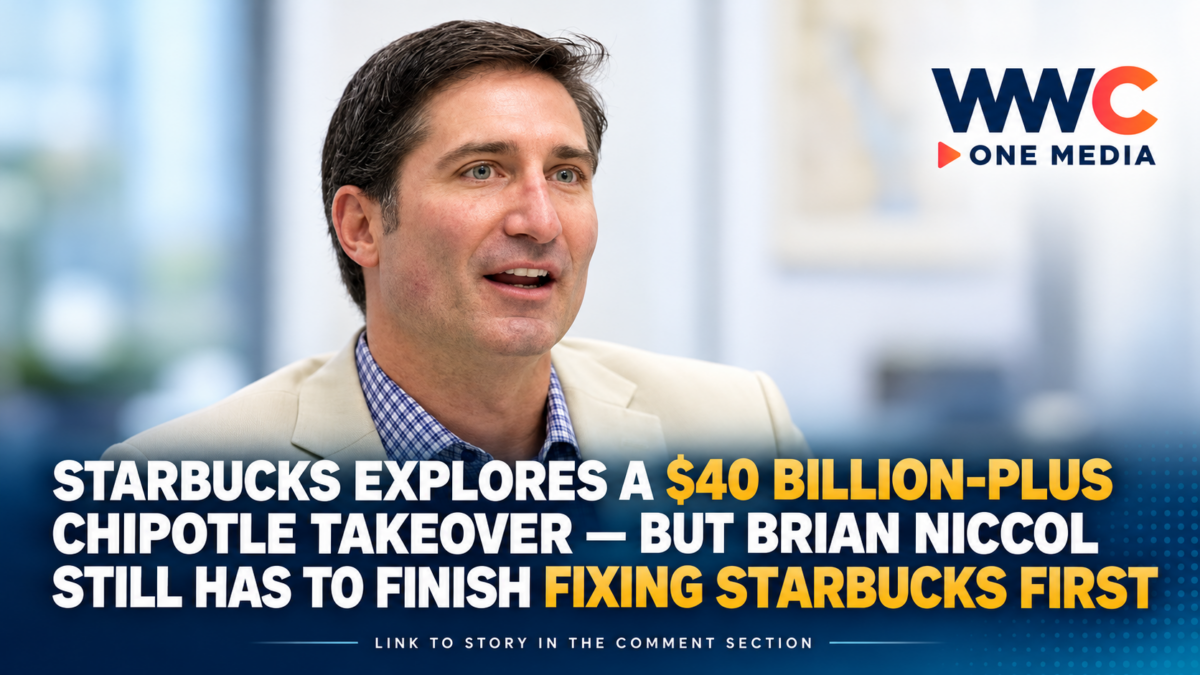
SEATTLE — Starbucks is reportedly exploring one of the most audacious restaurant acquisitions in history: a potential takeover of Chipotle Mexican Grill, the burrito chain once run by Starbucks CEO Brian Niccol.
If the deal ever happens, it would reunite Niccol with the company he led from:
2018 to 2024.
It would also combine two of the most recognizable restaurant brands in the United States.
One sells:
coffee
breakfast
and
snacks.
The other sells:
burritos
bowls
and
fast-casual meals.
On the surface, the businesses look very different.
But the strategic logic may be more interesting than it first appears.
Starbucks has:
tens of thousands of stores worldwide.
Chipotle has:
thousands of restaurants
and a much smaller international footprint.
Starbucks has enormous:
real-estate experience
digital loyalty infrastructure
and
global licensed partners.
Chipotle has one of the most successful fast-casual restaurant concepts ever built.
Put them together and Starbucks could become something much bigger than a coffee company.
But there is a major problem.
Starbucks is still trying to fix itself.
And buying Chipotle could become either:
Brian Niccol’s biggest strategic masterstroke
or
an enormously expensive distraction.
FIRST, THERE IS NO CONFIRMED DEAL
This is the most important factual point.
Starbucks has not announced an agreement to buy Chipotle.
Chipotle has not said it has accepted an offer.
There is no disclosed transaction price.
There is no signed merger agreement.
And there is no confirmed financing package.
The Financial Times reported that Starbucks has worked with advisers on a potential takeover proposal.
But the current status of those discussions is unclear.
That means investors should treat this as:
a reported exploration
not
a completed acquisition.
STARBUCKS IS NOT CONFIRMING THE REPORT
Starbucks responded carefully.
The company said it does not comment on:
rumors and speculation.
Instead, it emphasized that management remains:
“laser-focused”
on executing its:
Back to Starbucks
strategy.
That language matters.
Starbucks is effectively telling investors:
Do not assume this deal is happening.
At least not yet.
THE STOCK MARKET STILL TOOK THE POSSIBILITY SERIOUSLY
Chipotle shares surged roughly:
6%
after the report.
At one point, the stock rose even more.
Starbucks shares initially fell sharply before recovering much of the decline.
That pattern makes sense.
Chipotle shareholders would potentially receive a:
takeover premium.
Starbucks shareholders, meanwhile, would have to worry about:
purchase price
debt
integration risk
and
execution.
That is why targets often rise while acquirers fall when takeover rumors emerge.
THIS COULD BECOME THE BIGGEST RESTAURANT DEAL EVER
Chipotle is worth roughly:
$40 billion-plus.
Any buyer would normally have to pay:
a premium
above the current market value.
That means the transaction could easily reach:
$45 billion
$50 billion
or potentially more.
That would dwarf many previous restaurant-industry acquisitions.
For comparison, Burger King’s purchase of:
Tim Hortons
in 2014 was worth roughly:
$11 billion.
A Starbucks-Chipotle deal could be several times larger.
STARBUCKS ITSELF IS WORTH AROUND $100 BILLION
This is not a small bolt-on acquisition.
Chipotle would represent a huge purchase relative to Starbucks.
Starbucks would likely need some combination of:
cash
new debt
and
stock issuance.
That raises the cost substantially.
Starbucks already carries significant debt.
Analysts have estimated net debt at roughly:
$9 billion-plus.
Taking on tens of billions more could materially change the company’s balance sheet.
BRIAN NICCOL IS THE OBVIOUS LINK
The entire idea makes much more sense when one name enters the conversation:
Brian Niccol.
Niccol became Chipotle CEO in:
2018.
He inherited a company still recovering from devastating:
food-safety scandals.
Over the next six years, Chipotle rebuilt its brand.
Digital sales expanded.
Drive-through pickup lanes known as:
Chipotlanes
spread across the country.
Revenue grew.
Store economics improved.
The stock soared.
Niccol became one of the most highly regarded restaurant executives in America.
Then Starbucks hired him.
NICCOL LEFT CHIPOTLE FOR STARBUCKS IN 2024
Starbucks recruited Niccol to lead its own turnaround.
The coffee chain was struggling with:
long wait times
slowing traffic
complex menus
and
customer dissatisfaction.
Niccol launched:
Back to Starbucks.
The strategy focused on restoring the company’s original coffeehouse identity.
More employees.
Faster service.
Simpler operations.
More comfortable stores.
And a renewed emphasis on:
human connection.
THE TURNAROUND IS STARTING TO SHOW RESULTS
Starbucks’ latest quarter showed meaningful improvement.
Global comparable-store sales increased:
7.9%.
Comparable transactions rose:
4.2%.
U.S. comparable sales increased:
7.9%.
That suggests customers are returning.
North American comparable sales rose:
8.1%.
That is important because restaurant turnarounds ultimately depend on:
traffic.
Price increases can temporarily boost revenue.
But sustainable growth needs more people walking through the door.
Starbucks finally appears to be getting some of them back.
STARBUCKS NOW HAS MORE THAN 41,000 STORES
At the end of its fiscal third quarter, Starbucks had:
41,304 stores globally.
That is one of the largest restaurant networks in the world.
Roughly:
16,933
were in the United States.
The company therefore has enormous experience with:
site selection
real estate
store construction
and
international franchising.
Those capabilities could be very valuable to Chipotle.
CHIPOTLE IS MUCH SMALLER INTERNATIONALLY
Chipotle has nearly:
4,000 U.S. restaurants
and a relatively small overseas footprint.
That creates one of the clearest possible strategic benefits.
Starbucks could help Chipotle expand faster outside North America.
Starbucks already has licensed partners and operating experience across:
Europe
Asia
Latin America
and
the Middle East.
Chipotle has only recently begun expanding more aggressively abroad.
That is where a deal could make the most sense.
CHIPOTLE JUST ENTERED MEXICO
Chipotle opened its first restaurant in:
Nuevo León, Mexico
in July.
That move was symbolically important.
The brand built its identity around:
Mexican-inspired food
yet historically had almost no presence in Mexico itself.
Entering the country represents part of a larger international push.
CHIPOTLE ALSO EXPANDED INTO SAUDI ARABIA
The company opened its first restaurant in:
Riyadh
in August.
That expansion used a local operating partner.
It demonstrates that Chipotle is increasingly comfortable with:
partnership-based international growth.
That is exactly the model Starbucks knows extremely well.
STARBUCKS COULD ACCELERATE THAT PROCESS
Imagine Starbucks using its international infrastructure to help Chipotle enter:
Japan
South Korea
Southeast Asia
or
more European markets.
Starbucks already knows:
local landlords
regulators
suppliers
and
franchise partners.
Chipotle would not have to build those relationships from scratch.
That could potentially save years.
THIS MAY BE THE STRONGEST ARGUMENT FOR THE DEAL
Analysts have struggled to find obvious cost synergies between:
coffee
and
burritos.
The supply chains are different.
The kitchens are different.
The customer occasions are different.
But international expansion is one area where the strategic logic is clearer.
Starbucks could provide Chipotle with a global platform.
Chipotle could provide Starbucks shareholders with exposure to a second high-growth restaurant brand.
That is more compelling than trying to combine coffee beans and avocados.
THE CUSTOMER DAYPARTS ALSO COMPLEMENT EACH OTHER
Starbucks is strongest in:
morning
and
afternoon.
Chipotle is strongest around:
lunch
and
dinner.
A combined restaurant group would therefore capture consumer spending across much more of the day.
That could make marketing and loyalty programs more valuable.
One household might buy:
Starbucks at 8 a.m.
and
Chipotle at 7 p.m.
The company would participate in both transactions.
CROSS-BRAND LOYALTY COULD BE POWERFUL
Starbucks Rewards is one of the most successful restaurant loyalty programs in the world.
Chipotle also has a large digital customer base.
A combined ecosystem could potentially create:
shared rewards
promotions
and
customer data.
Imagine earning points at Starbucks and redeeming them at Chipotle.
Or receiving personalized promotions across both brands.
That could increase customer frequency.
But it would also require careful technology integration.
SHARED REAL ESTATE COULD OFFER SAVINGS
Starbucks and Chipotle often occupy similar types of locations:
shopping centers
urban corridors
and
drive-through developments.
A combined company could potentially negotiate leases more aggressively.
It might also identify locations where both brands could operate within the same development.
Analysts estimate there could be some savings in:
corporate overhead
technology
and
real estate.
One estimate suggested roughly:
$300 million annually
could potentially be removed from overlapping corporate expenses.
That is useful.
But it is not enough by itself to justify a $40 billion-plus acquisition.
THE SUPPLY-CHAIN SYNERGIES ARE MUCH WEAKER
Starbucks buys enormous quantities of:
coffee
milk
cups
and
bakery products.
Chipotle buys:
beef
chicken
rice
beans
avocados
and
produce.
There is not much overlap.
That reduces one of the classic benefits of restaurant consolidation.
Two burger chains can often combine purchasing power.
A coffee chain and a burrito chain have fewer opportunities.
That makes the strategic case more dependent on growth rather than cost cutting.
CHIPOTLE IS STILL GROWING
Chipotle’s latest reported quarter produced:
$3.3 billion
in revenue.
That was up:
9.3% year over year.
Comparable restaurant sales increased:
2.2%.
Transactions rose:
1.0%.
The company opened:
100 company-owned restaurants
during the quarter.
Those numbers show that Chipotle is not a distressed asset.
It is still growing.
That makes it expensive.
BUT CHIPOTLE’S MARGINS HAVE BEEN SQUEEZED
Restaurant-level operating margin fell to:
25.2%
from:
27.4%
a year earlier.
Overall operating margin declined to:
15.7%
from:
18.2%.
Why?
Higher costs.
Chipotle reported pressure from:
beef
freight
labor
and
produce usage.
This is one reason the share price has struggled.
The company is still growing.
But growth has become more expensive.
CHIPOTLE’S STOCK HAS FALLEN SHARPLY SINCE NICCOL LEFT
Since Niccol departed for Starbucks, Chipotle shares have lost roughly:
40%
from their earlier levels.
That decline makes a takeover more plausible.
A company that once looked prohibitively expensive suddenly looks less expensive.
But “cheaper” does not mean cheap.
At roughly $40 billion, Chipotle remains one of the most valuable restaurant companies in the world.
STARBUCKS’ STOCK HAS MOVED THE OTHER WAY
Starbucks shares have improved under Niccol.
Investors have given him credit for signs that:
traffic
and
customer experience
are improving.
That creates an interesting valuation dynamic.
Niccol left Chipotle.
Chipotle’s valuation fell.
He joined Starbucks.
Starbucks’ outlook improved.
Now the company he runs may be considering buying the company he left.
That is an extraordinary corporate loop.
BUT STARBUCKS HAS ITS OWN MARGIN PROBLEM
Starbucks’ non-GAAP operating margin was:
14.4%
in its latest quarter.
The company is spending heavily on:
labor
store improvements
and
restructuring.
Those investments are designed to rebuild the business.
But they cost money.
A giant acquisition would add another layer of complexity.
That is why some analysts immediately questioned the timing.
ONE ANALYST CALLED THE IDEA “JUMPING THE SHARK”
The skepticism is straightforward.
Starbucks finally appears to be stabilizing.
Why introduce a $40 billion-plus acquisition now?
Restaurant mergers can distract management.
Integration requires:
systems
legal teams
finance staff
and
executive attention.
Niccol already has one massive turnaround on his desk.
Buying Chipotle would give him a second major challenge.
WALL STREET IS DIVIDED
Some analysts see strategic logic.
Others see:
very little.
TD Cowen described a transaction as a:
low-probability outcome.
RBC questioned whether the cost savings would justify the acquisition price.
William Blair argued there are limited obvious revenue synergies beyond:
loyalty
and
cross-brand promotion.
That skepticism matters.
The market will demand a very clear explanation if Starbucks actually makes an offer.
THE BIGGEST RISK IS FINANCING
A takeover premium could push the purchase price toward:
$50 billion or more.
Starbucks cannot simply write a check that large.
It would need financing.
That could mean:
more debt.
Debt is expensive in today’s market.
Interest rates remain high.
Adding tens of billions in borrowing could reduce:
earnings
and
financial flexibility.
It could also threaten Starbucks’ credit rating.
STOCK FINANCING HAS ITS OWN PROBLEM
Starbucks could issue shares instead.
That would preserve cash.
But existing shareholders would be diluted.
Investors would own a smaller percentage of the combined company.
And if Starbucks shares fall because investors dislike the deal, stock financing becomes even more expensive.
That is why mega-deals often require a delicate combination of:
cash
debt
and
equity.
A DEAL WOULD ALSO FACE REGULATORY REVIEW
Starbucks and Chipotle do not compete head-to-head in the same way two coffee chains would.
That could reduce antitrust risk.
But a $40 billion-plus acquisition involving two enormous restaurant brands would still attract scrutiny.
Regulators could examine:
labor markets
supplier relationships
commercial real estate
and
consumer competition.
The transaction would likely require extensive review.
LABOR COULD BECOME AN ISSUE
Starbucks has spent years dealing with:
unionization efforts.
Chipotle has a large hourly workforce of its own.
Combining two massive restaurant employers could create new labor questions.
Worker organizations would likely scrutinize:
wages
benefits
scheduling
and
store closures.
That could become part of the political debate around the transaction.
BRAND SEPARATION WOULD BE ESSENTIAL
No serious analyst expects Starbucks to start selling:
pumpkin-spice burritos.
The brands would almost certainly remain operationally separate.
That is important.
Starbucks has a distinct identity built around:
coffeehouse culture.
Chipotle is built around:
customizable fast-casual meals.
Trying to merge the brands themselves would risk damaging both.
The more realistic model would be a parent company overseeing two independent chains.
RESTAURANT CONGLOMERATES ALREADY EXIST
Restaurant Brands International owns:
Burger King
Tim Hortons
Popeyes
and
Firehouse Subs.
Yum Brands owns:
KFC
Taco Bell
and
Pizza Hut.
Inspire Brands owns:
Arby’s
Dunkin’
Buffalo Wild Wings
and others.
The concept therefore is not unusual.
What would be unusual is the scale.
Starbucks and Chipotle are both enormous standalone brands.
THIS COULD TURN STARBUCKS INTO A RESTAURANT HOLDING COMPANY
If Starbucks bought Chipotle, investors might stop viewing it simply as:
a coffee company.
It could become the foundation of a broader:
restaurant conglomerate.
That could eventually open the door to additional acquisitions.
The company could allocate capital across multiple consumer brands.
But that would represent a major strategic transformation.
Starbucks has spent decades focused primarily on one core identity.
NICCOL HAS EXPERIENCE RUNNING MULTIPLE BRANDS
Before Chipotle, Niccol spent years at:
Yum Brands.
He led:
Taco Bell
and worked within a multi-brand restaurant organization.
That experience may partly explain why he would consider a portfolio approach.
He understands both:
single-brand turnarounds
and
restaurant conglomerates.
That makes the takeover theory more credible.
BUT CHIPOTLE’S CULTURE IS PART OF ITS VALUE
Chipotle’s success came partly from its distinctive operating philosophy.
It emphasizes:
fresh preparation
limited menus
and
restaurant-level execution.
A large parent company could potentially damage that culture if it imposes too much bureaucracy.
Starbucks would need to avoid the classic acquisition mistake:
Buying a successful brand and then changing the things that made it successful.
INTERNATIONAL EXPANSION COULD BE THE REAL PRIZE
Chipotle has long argued that it can eventually operate:
thousands more restaurants.
The U.S. still offers growth.
But the international opportunity is enormous.
Starbucks has already built the infrastructure needed to operate globally.
That could accelerate Chipotle’s expansion into markets where:
fast casual dining
and
Mexican-inspired food
are gaining popularity.
This is probably the strongest long-term strategic case for a deal.
STARBUCKS COULD ALSO DIVERSIFY AWAY FROM COFFEE
Coffee is an enormous global category.
But Starbucks remains exposed to:
coffee prices
morning traffic
and
beverage trends.
Chipotle would add exposure to:
lunch
dinner
and
meal spending.
That diversification could make the combined company less dependent on one consumer occasion.
It could also reduce sensitivity to coffee commodity prices.
CHIPOTLE WOULD GAIN A GLOBAL DISTRIBUTION MACHINE
For Chipotle, the advantage is obvious.
Instead of slowly entering one international market at a time, it could potentially use:
Starbucks’ real-estate network
franchise relationships
technology
and
brand infrastructure.
That could change Chipotle from primarily a U.S. growth story into a:
global restaurant growth story.
Investors may ultimately decide that opportunity is worth paying for.
BUT THIS IS STILL BRIAN NICCOL BETTING ON BRIAN NICCOL
There is also an uncomfortable governance question.
The central strategic argument depends heavily on one executive.
Niccol knows Chipotle better than almost anyone.
He knows its:
operations
culture
management team
and
growth opportunities.
That is an advantage.
But it also creates the risk of overconfidence.
CEOs sometimes buy businesses they know well because they believe they can create value.
Sometimes they are right.
Sometimes familiarity makes them underestimate the difficulty.
STARBUCKS SHAREHOLDERS WOULD BE BETTING ON EXECUTION TWICE
Niccol still has to complete the Starbucks turnaround.
He needs to sustain:
traffic growth
margin recovery
service improvements
and
store modernization.
Then, if the acquisition happens, he would also need to:
integrate Chipotle
and
accelerate its growth.
Investors would essentially be betting that one executive can execute two major strategic projects simultaneously.
That is a demanding assumption.
CHIPOTLE SHAREHOLDERS MAY DEMAND A HIGH PREMIUM
Chipotle investors know the company still has long-term growth potential.
The board therefore would have little reason to accept a modest premium.
A serious buyer may need to offer:
20%
30%
or more
above the unaffected market price.
That could quickly push the acquisition cost toward:
$50 billion-plus.
The higher the premium, the harder the financial math becomes for Starbucks.
AND CHIPOTLE MAY NOT WANT TO SELL AT ALL
A takeover report does not mean Chipotle wants a buyer.
The company has recently:
improved transactions
raised comparable-sales guidance
and
continued opening restaurants.
Management could argue the share-price decline is temporary.
If Chipotle believes the stock is undervalued, selling now could mean giving away future upside.
That makes any negotiation difficult.
CHIPOTLE HAS EVEN BEEN REPURCHASING ITS OWN STOCK
During the second quarter, Chipotle spent roughly:
$630.7 million
repurchasing shares.
It had another:
$1.7 billion
of authorized buybacks remaining at quarter-end.
That is usually a sign management believes its stock offers value.
It also strengthens the argument that the company does not need to sell itself.
THE NEXT MAJOR DATE IS OCTOBER 28
Chipotle is scheduled to report:
third-quarter results on October 28.
Those numbers could materially change the takeover narrative.
Investors will focus on:
traffic
same-store sales
margins
and
2027 guidance.
If results are strong, Chipotle’s valuation could rise.
That would make an acquisition more expensive.
If results disappoint, pressure for a strategic transaction could increase.
STARBUCKS WILL ALSO SOON GIVE 2027 GUIDANCE
Starbucks has said it will provide:
fiscal 2027 guidance
with its next earnings update.
That may be even more important than the takeover rumor.
Investors want to know whether:
Back to Starbucks
can deliver sustainable:
sales growth
and
margin expansion.
If management suddenly announces a giant acquisition before proving the turnaround, investors could react negatively.
THE BIGGER STORY: STARBUCKS MAY BE THINKING BEYOND COFFEE
The most interesting part of this story is not whether Starbucks actually buys Chipotle.
It is what the possibility says about the company’s ambitions.
Starbucks built one of the world’s most powerful restaurant brands by dominating:
coffee.
But Brian Niccol has spent much of his career thinking in broader restaurant terms.
He helped rebuild:
Taco Bell.
He transformed:
Chipotle.
Now he is rebuilding:
Starbucks.
A Chipotle acquisition could signal that Starbucks eventually wants to become something closer to:
a global restaurant platform.
The strategic appeal is real.
Starbucks has:
41,000-plus stores
global real-estate expertise
and
one of the world’s strongest restaurant loyalty programs.
Chipotle has:
fast unit growth
strong restaurant economics
and
enormous international whitespace.
Together, they could create a restaurant group with extraordinary consumer reach.
But the risks are just as large.
Chipotle could cost:
$50 billion or more.
Starbucks still has billions tied up in its own turnaround.
Debt is expensive.
Margins are still recovering.
And many analysts see limited direct operating synergies.
That means Niccol would have to prove that buying Chipotle creates more value than simply allowing both companies to continue growing independently.
Starbucks may be considering bringing Brian Niccol back together with Chipotle — but the real question is whether one of America’s most successful restaurant CEOs can rebuild one giant while simultaneously buying another.