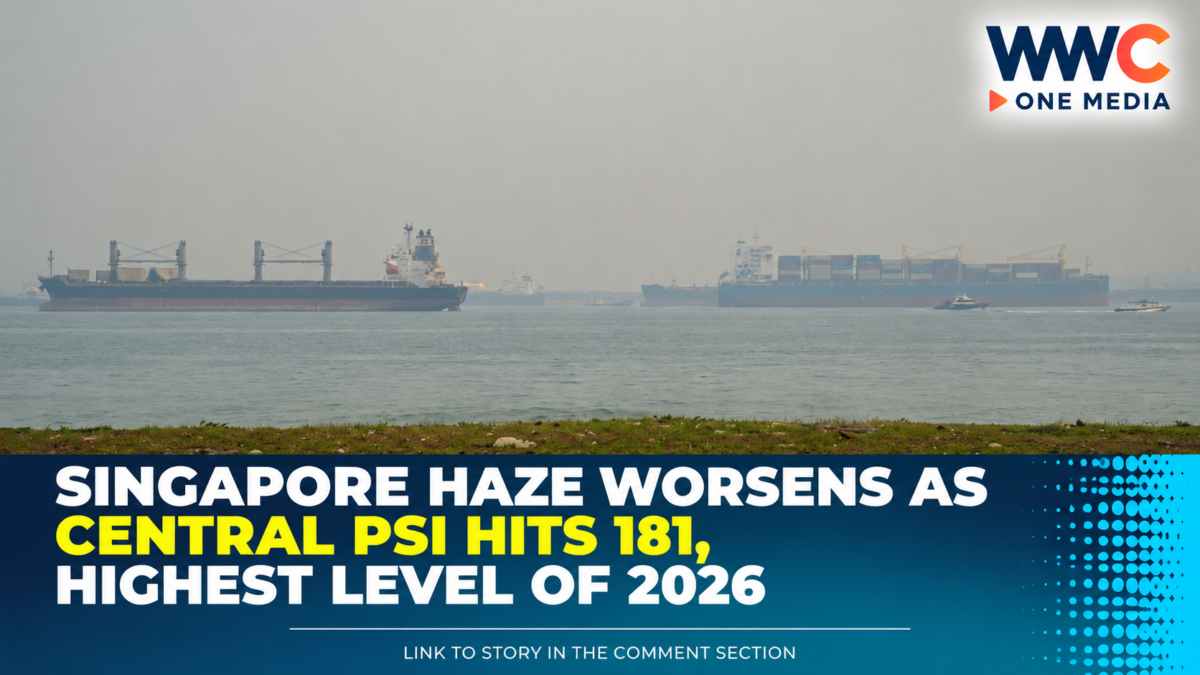
SINGAPORE — Haze conditions across Singapore worsened on Friday (Oct. 9), with the 24-hour Pollutant Standards Index (PSI) in the central region reaching 181 at noon, the highest reading recorded so far in 2026.
The increase came as smoke from forest and land fires in Indonesia continued drifting towards Singapore, raising health concerns during a busy weekend that includes the Formula One Singapore Grand Prix.
According to the National Environment Agency (NEA), all five regions recorded unhealthy air quality, with the central area registering the highest PSI, followed by the west at 170 and the south at 160. The east and north recorded readings of 147 and 123 respectively at noon.
The readings underscore the continuing impact of transboundary haze as Singapore prepares for large crowds at outdoor events and residents are advised to take precautions against prolonged exposure to polluted air.
Central Singapore approaches very unhealthy range
The 24-hour PSI measures air quality using a rolling average of six pollutants. Readings between 101 and 200 are classified as unhealthy, while levels from 201 to 300 are considered very unhealthy.
At 181, central Singapore was approaching the threshold for the very unhealthy category, although it had not crossed it as of noon on Friday.
The central region’s reading was also higher than the previous 2026 peak reported earlier in the haze season, reflecting the severity of the latest deterioration.
The NEA’s readings showed that pollution remained widespread rather than confined to a single part of the island. The west and south also recorded high PSI levels, while the north had the lowest reading among the five regions but remained within the unhealthy range.
Residents should note that the 24-hour PSI and one-hour PM2.5 readings measure different aspects of air pollution. The PSI reflects overall air quality over the preceding 24 hours, while PM2.5 provides a more immediate indication of fine-particle pollution, which is particularly relevant during haze episodes.
Smoke from Sumatra and Kalimantan drifts towards Singapore
The NEA said moderate to dense smoke plumes from southern and central Sumatra, as well as West Kalimantan, had been observed drifting towards Singapore.
Data from the Asean Specialised Meteorological Centre showed 314 hotspots in Sumatra and 162 in Kalimantan on Oct. 8, indicating substantial fire activity in the neighbouring Indonesian regions.
With prevailing winds blowing mainly from the south or southeast, smoke from these areas may continue to affect Singapore.
The agency forecast that the 24-hour PSI could remain between the high end of the moderate range and the middle of the unhealthy range. Dry conditions in parts of Sumatra and Kalimantan may also allow fire activity and haze to persist.
The situation remains dependent on changing wind patterns, rainfall and the intensity of fires across the region. Showers in parts of Sumatra and Borneo could help improve local conditions, but they may not immediately clear haze already drifting towards Singapore.
Residents urged to limit strenuous outdoor activity
Health advisories become particularly important when air pollution remains elevated for extended periods.
When the 24-hour PSI is in the unhealthy range, members of the public are advised to reduce prolonged or strenuous outdoor physical activity. People who are more vulnerable to air pollution — including older adults, pregnant women, children and individuals with chronic heart or lung conditions — should take additional care.
The NEA also advises residents to check the latest one-hour PM2.5 readings before deciding whether to exercise or participate in outdoor activities.
When the one-hour PM2.5 reading enters the high band, healthy individuals should avoid strenuous outdoor activity for the next hour. Vulnerable people should avoid outdoor activity during that period.
People who experience breathing difficulties, persistent coughing or other concerning symptoms should seek appropriate medical advice.
Employers have also been urged to reduce the duration of prolonged or strenuous outdoor work for healthy workers. For vulnerable employees, employers should minimise such exposure and provide suitable protective equipment based on the conditions at the worksite.
Schools and workplaces monitor the situation
Schools and preschools have measures in place to protect students during haze episodes, including adjusting outdoor activities and using air purifiers where available.
The Ministry of Education has said school closures would be considered if the air-quality forecast for the following day reaches the hazardous range, when the PSI exceeds 300. Any closure would be announced alongside the daily haze situation update, with schools notifying parents directly.
For now, the readings remain below the hazardous threshold, but the unhealthy conditions mean schools, employers and families should continue monitoring official updates.
Residents planning outdoor exercise, children’s activities or work that involves physical exertion should make decisions based on the latest local readings rather than relying only on how visible the haze appears.
Haze raises concerns ahead of the Singapore Grand Prix
The deteriorating air quality comes as Singapore hosts the Formula One Grand Prix weekend from Oct. 9 to 11, bringing large numbers of spectators to outdoor events around Marina Bay.
The race itself is expected to proceed as planned, but organisers and authorities are monitoring the haze and preparing contingency measures should conditions worsen.
The Federation Internationale de l’Automobile (FIA) said on Thursday that haze could lead to restrictions on entertainment and other outdoor activities if air quality deteriorates. The governing body said the race was not expected to be affected at that point, while relevant agencies continued monitoring conditions.
The Singapore Tourism Board said it was tracking pollution levels and would provide updates and make medical assistance and N95 masks accessible at the circuit if needed. Officials have also noted that rain expected over the weekend could help improve the haze, although prevailing winds may continue bringing smoke towards Singapore.
The haze is a concern for spectators, event workers and performers who may spend long periods outdoors. Any decision to modify activities will depend on actual air quality, visibility, public-health considerations and operational requirements.
Haze could persist as dry weather continues
Singapore’s latest air-quality readings reflect a wider regional haze episode linked to fires in Indonesia.
The NEA has warned that dry conditions in fire-prone parts of southern ASEAN could sustain hotspot activity, while winds may continue transporting smoke towards Singapore and neighbouring Malaysia.
Although rain may provide temporary relief in some areas, the overall outlook remains uncertain. The duration and severity of the haze will depend on weather conditions and whether fires across Sumatra and Kalimantan can be brought under control.
For residents, the immediate priority is to follow official health advisories, monitor one-hour PM2.5 readings and limit strenuous outdoor activity when pollution levels are high.
With the central PSI reaching 181 on Friday, Singapore’s air quality has entered one of its most concerning periods of the year. The coming days will determine whether rainfall brings relief or whether the haze continues to affect daily life and outdoor events across the island.