NEW YORK — Wall Street is being pulled apart by two very different but increasingly connected risks: an Iran war keeping gasoline above $4 a gallon and an artificial-intelligence boom that suddenly has investors questioning whether revenue is growing fast enough to justify hundreds of billions of dollars in spending.
On one side is:
oil.
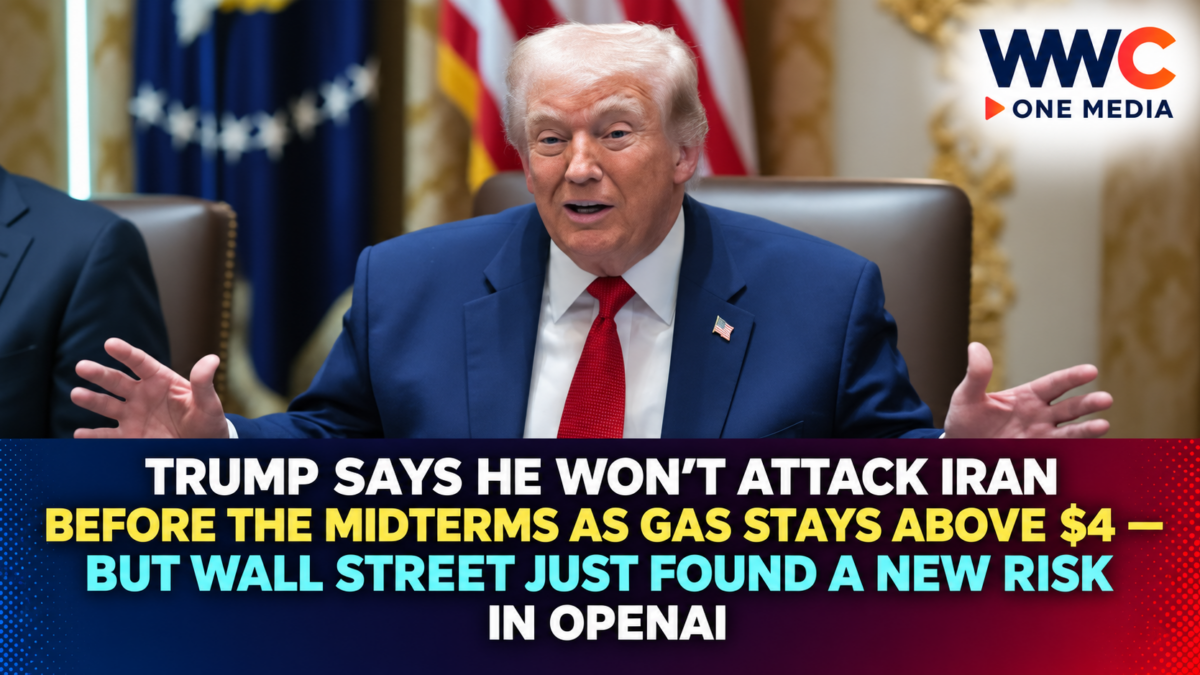
President Donald Trump says the United States will not attack Iran before the November 3 midterm elections and says talks with Tehran are:
“productive.”
That temporarily cooled crude prices.
But U.S. gasoline remains around:
$4.36 per gallon.
That is roughly:
40% higher than a year ago.
And it is the highest national average ever recorded for this time of year.
On the other side is:
artificial intelligence.
OpenAI has told investors its annualized revenue is closer to:
$50 billion
rather than the roughly:
$70 billion
figure many investors believed.
That discrepancy immediately hit:
Nvidia
Broadcom
AMD
Micron
Oracle
and other companies tied to the AI infrastructure boom.
The market suddenly has two uncomfortable questions.
Can Trump bring energy prices down before voters go to the polls?
And can AI companies generate enough revenue to justify the extraordinary amount of money being spent on:
Chips
Data centers
Cloud capacity
and
Electricity?
GASOLINE IS STILL ABOVE $4
American drivers are still paying historically high prices at the pump.
AAA reported the national average for regular gasoline at approximately:
$4.36 per gallon
on October 8.
One week earlier it was:
$4.41.
One month earlier:
$4.15.
A year earlier:
$3.12.
That means gasoline is now more than:
$1.20 per gallon
more expensive than a year ago.
And this is the first October in AAA records when the U.S. national average has remained above:
$4 per gallon.
That makes fuel prices an increasingly important political issue heading into the midterm elections.
TRUMP NEEDS CHEAPER GAS BEFORE NOVEMBER 3
High gasoline prices are particularly dangerous politically because voters see them:
every day.
They do not need an economist to explain inflation.
They see the number on the gas station sign.
Trump has spent months arguing his administration would bring:
energy abundance
and
lower prices.
Instead, the Iran conflict has repeatedly pushed oil back above:
$100 per barrel.
That has created an awkward economic problem.
Trump wants to maintain military pressure on Iran.
But every escalation risks making gasoline more expensive for American voters.
TRUMP NOW SAYS THERE WILL BE NO ATTACK BEFORE THE MIDTERMS
Trump attempted to calm markets by saying the United States would not attack Iran before:
November 3.
He also said Washington was having:
productive discussions
with Tehran.
Oil prices responded immediately.
Brent crude fell back toward:
$103 per barrel
on October 9.
West Texas Intermediate dropped toward:
$90.
That shows how politically sensitive the oil market has become.
A single presidential comment can move global energy prices within minutes.
BUT THE IRAN WAR IS ALREADY EIGHT MONTHS OLD
The underlying problem has not disappeared.
The conflict has disrupted:
Oil exports
Tanker routes
and
Refined-fuel supply.
The Strait of Hormuz remains the central risk.
Before the war, shipments through Hormuz represented roughly:
20% of global oil and fuel flows.
That makes the waterway one of the most important energy chokepoints in the world.
Any major disruption can quickly affect:
Crude
Gasoline
Diesel
Jet fuel
and ultimately
consumer inflation.
IRAN IS CONSIDERING A PROPOSAL TO REOPEN HORMUZ
Iranian officials have said Tehran is reviewing a U.S. response to a proposal that could reopen the Strait of Hormuz within:
seven days.
If that happens, energy markets could receive major relief.
More tankers could move through the Gulf.
Fuel supplies could normalize.
Risk premiums could decline.
And gasoline prices could finally begin falling more significantly.
But negotiations remain uncertain.
Markets have already been disappointed by previous attempts at de-escalation.
THAT IS WHY CHEAP GAS KEEPS FEELING LIKE “GODOT”
CNBC compared the wait for lower gasoline prices to:
Samuel Beckett’s “Waiting for Godot.”
The comparison is effective because motorists have repeatedly been told relief is coming.
Oil falls.
Gasoline starts dropping.
Then another attack occurs.
Another tanker is hit.
Another refinery shuts.
Another military escalation follows.
And fuel prices climb again.
The result is a cycle of:
hope
followed by
another supply shock.
KALSHI TRADERS ARE NOT CONVINCED GAS WILL FALL BELOW $4
Prediction-market traders remain skeptical.
Contracts on Kalshi have implied a high probability that gasoline will still be above:
$4 per gallon
around Election Day.
Prediction markets are not forecasts guaranteed to be correct.
They simply represent the price at which traders are willing to take financial positions.
But the skepticism illustrates how little confidence exists that fuel prices will normalize quickly.
THE GULF OF MEXICO IS MAKING THE PROBLEM WORSE
Iran is not the only supply risk.
Hurricane Isaias has forced producers in the Gulf of Mexico to shut approximately:
1.3 million barrels per day
of oil production.
That represents roughly:
62.9%
of current Gulf output.
The storm therefore removed a large amount of U.S. crude supply at exactly the wrong time.
Even if Middle East tensions ease temporarily, hurricane disruptions can keep crude markets tight.
OIL JUMPED 4% BEFORE TRUMP’S COMMENTS
On October 8, Brent crude surged more than:
4%.
The rally came after renewed:
Tanker attacks
and
Gulf production disruptions.
Brent settled near:
$104.28 per barrel.
WTI climbed above:
$91.
That immediately revived concerns about:
Inflation
and
Interest rates.
Energy remains one of the fastest ways geopolitical conflict can reach ordinary households.
HIGH OIL PRICES CAN KEEP THE FED TIGHT
This is where the energy story connects directly to Wall Street.
Higher oil prices increase costs for:
Transportation
Manufacturing
Food distribution
and
Air travel.
Companies eventually pass some of those costs to consumers.
That makes inflation harder to control.
The Federal Reserve may therefore be less willing to lower interest rates.
In fact, markets still see the possibility of another Fed hike later this year if inflation remains elevated.
That hurts:
Stocks
Housing
Corporate borrowing
and
Consumers.
AND THEN OPENAI GAVE TECH INVESTORS A SECOND PROBLEM
While energy traders worried about Iran, technology investors were hit by another shock.
A Financial Times report said OpenAI’s annualized revenue at the end of September was around:
$50 billion.
That was approximately:
$20 billion lower
than the:
$70 billion
figure previously circulating.
The headline was enough to trigger a sharp selloff across AI-related stocks.
But the situation is more complicated than:
“OpenAI missed revenue by $20 billion.”
THE $20 BILLION GAP IS PARTLY AN ACCOUNTING ISSUE
Reuters reported that OpenAI’s own revenue number excludes certain:
cloud-partner revenue.
That differs from the way analysts had attempted to compare OpenAI with:
Anthropic.
Anthropic reportedly includes revenue generated through cloud partners such as:
Amazon Web Services
and
Google Cloud
in some of its annualized figures.
To make the two businesses easier to compare, investors had been using adjusted estimates for OpenAI.
That contributed to the higher:
$70 billion
figure.
So the lower number does not necessarily mean OpenAI suddenly lost $20 billion of business.
It means investors were comparing two companies using different revenue definitions.
OPENAI IS STILL GROWING AT AN EXTRAORDINARY RATE
The revenue number still shows spectacular growth.
OpenAI reportedly entered 2026 with an annualized revenue run rate around:
$20 billion.
By September, that was near:
$50 billion.
That is an increase of roughly:
150%
in less than a year.
By ordinary corporate standards, that is extraordinary.
But ordinary standards no longer apply.
OpenAI has become one of the central demand drivers behind a global AI infrastructure buildout worth:
hundreds of billions of dollars.
That means investors expect extraordinary growth.
OPENAI’S REVENUE MATTERS TO NVIDIA
Nvidia does not own OpenAI.
But OpenAI is an enormous consumer of:
AI computing.
The company needs massive clusters of GPUs to:
Train models
Run ChatGPT
and
Serve enterprise customers.
If OpenAI grows rapidly, demand for AI chips grows.
If OpenAI’s economics disappoint, investors start asking whether infrastructure spending will eventually slow.
That is why Nvidia shares dropped approximately:
2.9%
after the revenue report.
THE ENTIRE CHIP COMPLEX SOLD OFF
Nvidia was not alone.
AMD fell around:
3.9%.
Broadcom dropped approximately:
4.3%.
Micron fell around:
4.8%.
Intel declined more than:
5%.
Oracle also fell sharply.
These companies do very different things.
But the market connected them through one theme:
AI capital spending.
If AI companies generate less revenue than expected, the massive infrastructure cycle looks slightly less secure.
MICROSOFT HAS BILLIONS TIED TO OPENAI TOO
Microsoft remains one of OpenAI’s most strategically important partners.
It invested billions of dollars into the company and supplies large amounts of:
Azure cloud infrastructure.
Microsoft’s own financial filings show how important the relationship became.
At one point, OpenAI represented approximately:
45%
of Microsoft’s commercial remaining performance obligations.
That proportion later fell as Microsoft signed major contracts with other customers.
But OpenAI remains a strategically important source of long-term Azure demand.
MICROSOFT IS TRYING TO REDUCE ITS DEPENDENCE
This is one reason Microsoft has broadened its AI relationships.
It has invested in and partnered with:
Anthropic
and
Other AI developers.
It is also building its own AI models.
The company increasingly wants Azure to become the infrastructure layer for:
many competing AI companies
rather than depending too heavily on one.
That is strategically similar to TSMC manufacturing chips for multiple competing semiconductor designers.
Microsoft wants to win regardless of which AI model becomes dominant.
MICROSOFT’S CLOUD BUSINESS IS ALREADY ENORMOUS
For fiscal Q4 2026, Microsoft reported:
$90 billion
in quarterly revenue.
Microsoft Cloud generated:
$59.3 billion.
Full-year cloud revenue surpassed:
$214 billion.
That gives Microsoft enormous financial capacity to keep investing.
But AI infrastructure is expensive.
Microsoft’s free cash flow has been pressured by elevated:
Capital expenditures
and
Data-center investment.
That makes return on AI spending increasingly important.
NVIDIA FACES THE SAME QUESTION
Nvidia’s own financial performance remains extraordinary.
Demand for:
Blackwell
and future:
Rubin
systems remains extremely strong.
But Nvidia’s biggest customers are spending staggering amounts of money.
Eventually, those customers need to generate:
revenue
and
profits
from the infrastructure.
The AI boom cannot rely indefinitely on one company buying chips from another company that buys cloud capacity from another company.
At some point, end users need to pay enough money to support the entire chain.
THIS IS WHY OPENAI’S REVENUE NUMBER HIT THE MARKET SO HARD
OpenAI sits close to the end of that chain.
Consumers pay for:
ChatGPT subscriptions.
Businesses pay for:
API usage
and
Enterprise tools.
Those revenues help justify the enormous infrastructure behind the service.
If OpenAI produces:
$50 billion
instead of:
$70 billion,
investors naturally question whether projected infrastructure spending is running ahead of monetization.
Even if the accounting difference explains much of the gap, the psychological effect is significant.
AI INFRASTRUCTURE SPENDING IS BECOMING ENORMOUS
The major technology companies are collectively committing:
hundreds of billions of dollars
toward:
Data centers
Power
Networking
GPUs
and
Custom chips.
OpenAI itself has discussed infrastructure commitments on an extraordinary scale.
Anthropic is pursuing massive computing arrangements.
Oracle is financing huge data-center projects.
CoreWeave and other neocloud operators are expanding aggressively.
Investors are starting to ask the obvious question:
Who ultimately pays for all of this?
BORROWING COSTS MAKE THE QUESTION EVEN MORE IMPORTANT
The 10-year Treasury yield remains near:
24-year highs.
The 30-year Treasury recently touched around:
5.6%.
That means capital is expensive.
Building an AI data center with debt becomes much more costly at:
5% to 6% rates
than at:
2% rates.
The same is true for power projects and semiconductor fabs.
High borrowing costs therefore raise the required return on AI investment.
AI STOCKS ARE NO LONGER GETTING A FREE PASS
For several years, the market rewarded almost any company with credible exposure to:
AI.
That phase is changing.
Investors increasingly want:
Revenue
Margins
Cash flow
and
Return on invested capital.
This explains why Thursday’s OpenAI report produced such a broad selloff.
The market is no longer asking only:
“How fast is AI growing?”
It is asking:
“How profitable is that growth?”
OPENAI MAY STILL SEEK AN ENORMOUS VALUATION
OpenAI is expected to pursue additional financing.
Reports have discussed valuations reaching into:
the trillion-dollar range.
At that scale, investors need enormous future revenue.
A business worth:
$1 trillion
cannot justify its price with ordinary software economics.
It needs to become one of the largest technology platforms in the world.
That makes transparency around revenue increasingly important.
PUBLIC MARKETS WOULD DEMAND MUCH MORE DISCLOSURE
OpenAI remains privately held.
That means financial information is far less transparent than it would be for:
Microsoft
Nvidia
or
Google.
If OpenAI eventually goes public, investors would receive audited financial statements.
They would be able to analyze:
Revenue
Costs
Cash burn
Margins
and
Capital commitments.
For now, estimates and annualized run rates remain important proxies.
That creates confusion.
ANTHROPIC IS ALSO GROWING EXTREMELY FAST
OpenAI is not the only frontier AI company generating huge revenues.
Anthropic has reportedly reached an annualized revenue run rate above:
$65 billion.
Some forecasts put the company near:
$100 billion
by year-end.
But again, accounting definitions matter.
Anthropic’s revenue treatment may include cloud-partner business differently from OpenAI’s.
Investors therefore need to compare:
like with like.
Headline run-rate figures alone can be misleading.
THE BIGGER AI QUESTION IS WHETHER THERE WILL BE MULTIPLE WINNERS
If OpenAI, Anthropic and other model providers all generate tens of billions of dollars of revenue, the infrastructure boom becomes easier to justify.
There is enough demand for:
Nvidia
AMD
Broadcom
Microsoft
Amazon
and others.
But if only one or two frontier companies ultimately dominate, infrastructure providers may face a much more concentrated customer base.
That increases risk.
OIL AND AI MAY LOOK UNRELATED — BUT THEY COLLIDE THROUGH INFLATION AND INTEREST RATES
This is what makes the current market unusually complicated.
Higher oil prices increase inflation.
Higher inflation keeps interest rates elevated.
Higher interest rates increase the cost of financing AI infrastructure.
That means a tanker attack in the Strait of Hormuz can indirectly hurt:
Nvidia
Microsoft
or
OpenAI’s financing plans.
The connection may seem distant.
But financial markets connect everything through:
the cost of capital.
THE NASDAQ IS PARTICULARLY VULNERABLE TO THAT COMBINATION
Technology stocks depend heavily on future growth.
When interest rates rise, the value investors assign to future profits falls.
At the same time, oil-driven inflation can pressure corporate costs.
That is why the combination of:
$100 oil
and
questions about AI revenue
was particularly toxic for technology shares.
On October 8:
The Nasdaq fell 1.25%.
The:
S&P 500 dropped 0.47%.
The:
Dow managed a small 0.10% gain.
Energy stocks outperformed.
Technology stocks did not.
NVIDIA’S DROP DOES NOT MEAN AI DEMAND HAS COLLAPSED
This distinction is important.
There is no evidence that Nvidia suddenly lost major orders because OpenAI’s revenue figure was lower.
TSMC just reported extraordinary growth.
AI data-center projects continue expanding.
Cloud companies are still investing heavily.
Nvidia’s product demand remains strong.
Thursday’s move was primarily a:
valuation and confidence reaction.
Investors are questioning how long the current spending pace can last.
That is different from demand collapsing today.
OIL’S DROP DOES NOT MEAN THE WAR RISK IS GONE EITHER
The same logic applies to energy.
Brent falling from around:
$104
to approximately:
$103
does not mean the Iran crisis is over.
Trump’s comments reduced the immediate probability of a U.S. strike.
But tanker attacks remain a threat.
Hormuz is not fully normalized.
Sanctions remain in place.
And the U.S. continues military and economic pressure.
The oil market remains vulnerable to another headline.
AMERICAN HOUSEHOLDS FEEL THE ENERGY SIDE MORE DIRECTLY
AI valuations matter enormously to investors.
But gasoline matters more directly to most households.
At:
$4.36 per gallon,
a 15-gallon fill-up costs roughly:
$65.40.
At last year’s $3.12 price, the same tank would have cost about:
$46.80.
That is an extra:
nearly $19 per fill-up.
For families driving frequently, the difference accumulates quickly.
That pressure can reduce spending elsewhere.
HIGH GAS PRICES CAN HIT RETAIL, RESTAURANTS AND TRAVEL
When consumers spend more on fuel, they may spend less on:
Dining
Shopping
Entertainment
and
Travel.
That makes gasoline prices relevant to much more than energy companies.
Retailers monitor fuel costs because they affect:
Consumer budgets
and
Shipping expenses.
Airlines monitor jet fuel.
Delivery companies monitor diesel.
Energy inflation spreads through the economy.
DIESEL IS AN EVEN BIGGER PROBLEM FOR BUSINESS
U.S. diesel prices have surged dramatically during the Middle East conflict.
Diesel powers:
Trucks
Farm equipment
Construction machinery
and
Industrial transport.
When diesel rises, transportation companies pass costs along the supply chain.
That can eventually affect:
Food
Retail goods
and
Construction costs.
The Trump administration has already taken steps to expand access to tax-exempt red-dyed diesel in an attempt to provide relief.
ENERGY COULD BECOME THE MIDTERM ELECTION’S BIG ECONOMIC ISSUE
Inflation has remained politically important.
But energy prices are particularly visible.
Trump can point to:
Job growth
Stock-market gains
or
AI investment.
But if motorists see:
$4.50 gasoline
every day, that can shape perceptions of the economy more powerfully than abstract statistics.
That puts additional pressure on Washington to avoid further escalation with Iran.
AI COULD BECOME THE MARKET’S BIG EARNINGS ISSUE
Meanwhile, investors are entering earnings season with a different concern.
They want technology companies to explain:
How much AI revenue they are actually generating.
How much infrastructure spending is required?
What are the margins?
How quickly is capacity being monetized?
And when does free cash flow improve?
Those questions are becoming harder to avoid.
MICROSOFT’S NEXT RESULTS WILL BE CLOSELY WATCHED
Microsoft’s Azure growth remains one of the best indicators of enterprise AI demand.
Investors will watch:
Azure growth
Copilot adoption
OpenAI-related bookings
and
Capital expenditures.
If Azure continues accelerating, that would support the broader AI thesis.
If growth slows while spending remains high, concerns will intensify.
NVIDIA’S NEXT GUIDANCE MAY MATTER EVEN MORE
Nvidia will face the same scrutiny.
Investors already know the company can sell enormous amounts of hardware.
The next questions are:
How long are customer commitments?
How quickly is Rubin ramping?
Are hyperscalers extending orders into 2028?
Are margins holding?
And are customers financing purchases with increasingly aggressive debt structures?
The answers will determine whether Thursday’s selloff was an opportunity or a warning.
THE BIGGER STORY: WALL STREET IS NOW TESTING WHETHER TWO BOOMS CAN SURVIVE EACH OTHER
The U.S. economy is currently experiencing two enormous forces.
One is geopolitical.
The Iran conflict has pushed oil and gasoline prices dramatically higher.
The other is technological.
AI has triggered one of the largest infrastructure investment cycles in modern corporate history.
But those forces increasingly collide.
Higher energy costs push inflation higher.
Higher inflation keeps interest rates elevated.
Higher rates make AI infrastructure more expensive to finance.
And investors then demand stronger revenue growth from companies like:
OpenAI
to justify that spending.
That is why today’s market story is much bigger than:
Trump
or
Nvidia
or
gas prices.
It is about whether the U.S. can simultaneously absorb:
$100 oil
5%-plus bond yields
and
hundreds of billions of dollars of AI spending
without breaking either consumer demand or investor confidence.
Trump says he will not attack Iran before the midterms.
That buys energy markets time.
OpenAI says its annualized revenue is near:
$50 billion.
That still represents extraordinary growth.
But neither issue is resolved.
Gasoline remains above:
$4.
The Strait of Hormuz remains vulnerable.
And AI infrastructure spending continues to grow far faster than the transparency around the revenue supporting it.
Wall Street may have survived another volatile week — but the next major market shock could come from either a tanker in the Persian Gulf or a spreadsheet inside an AI startup.