A mysterious death at a Russian plague-research institute has put Siberia under an uncomfortable global spotlight.
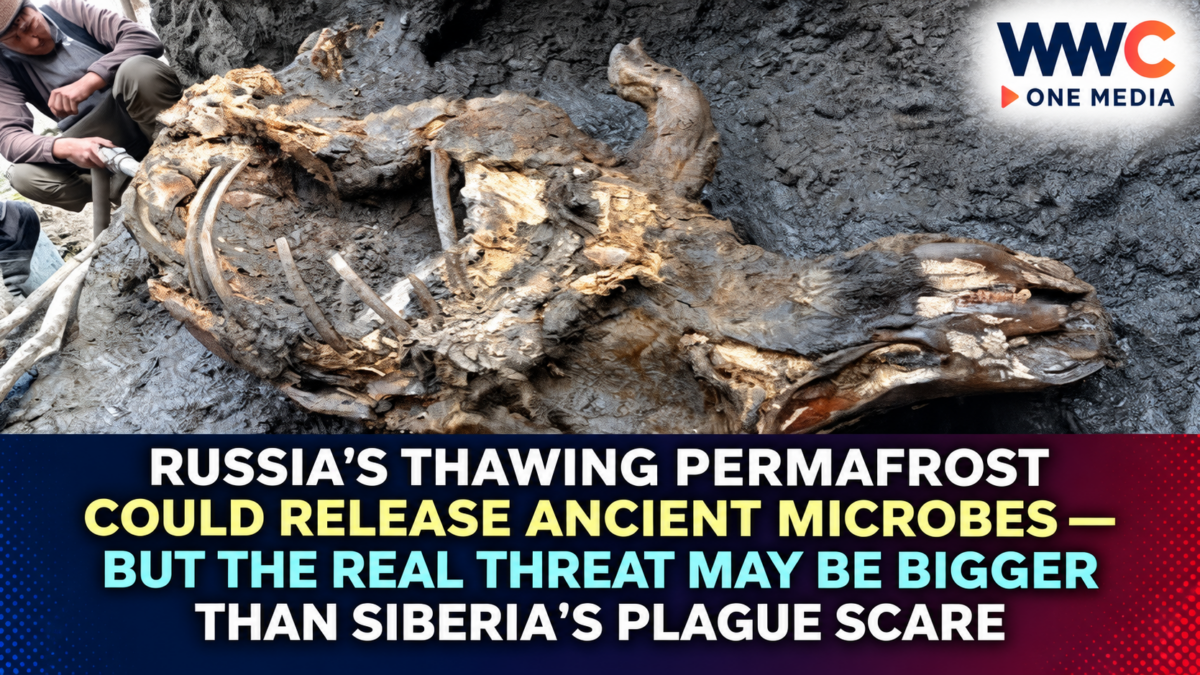
But while health authorities investigate what killed a 28-year-old laboratory worker in Irkutsk, scientists have been warning about a potentially much larger long-term risk buried beneath Russia’s frozen north: ancient microbes preserved for thousands — and in some cases tens of thousands — of years in permafrost.
The concern is not that a prehistoric pandemic is about to erupt tomorrow.
There is currently no evidence that an ancient human virus released from thawing Russian permafrost is spreading among people.
But researchers have demonstrated that some viruses can remain infectious after being frozen for extraordinary periods, while the Arctic is warming far faster than the planet as a whole.
That combination is turning what once sounded like science fiction into a legitimate area of scientific and public-health research.
And the most important lesson may be that the threat is not simply “plague.”
SIBERIA’S PLAGUE SCARE REMAINS UNRESOLVED
The immediate alarm began after Darya Shipilova, a 28-year-old employee of the Irkutsk Anti-Plague Research Institute of Siberia and the Far East, died on October 2 from pneumonia of undetermined origin.
Reports and speculation quickly raised fears that she might have contracted pneumonic plague while working at the institute.
Russian authorities have not confirmed that.
According to Reuters, approximately 200 people who had contact with Shipilova were initially placed under medical observation. Russian officials subsequently said nearly 5,000 samples had been tested without detecting plague or another dangerous pathogen among her contacts.
Russia’s health authorities say the situation is under control and that monitoring of contacts has been completed.
However, the precise cause of Shipilova’s death has not been publicly established.
The World Health Organization has asked Moscow for additional information about what tests were conducted and which pathogens were examined.
That distinction matters.
At this point, it would be inaccurate to describe the incident as a confirmed Russian plague outbreak.
There are no confirmed plague cases linked to the incident, according to the information supplied by Russia to the WHO.
PLAGUE ITSELF IS DEADLY — BUT TREATABLE
Plague is caused by the bacterium Yersinia pestis.
It remains present in animal populations in several parts of the world, although modern human infections are relatively uncommon.
Pneumonic plague is particularly dangerous because it infects the lungs and can spread between people through respiratory particles.
The World Health Organization says untreated pneumonic plague can become fatal extremely quickly, but modern antibiotics are effective when treatment begins early.
That makes plague frightening, but it also makes it a pathogen modern medicine understands reasonably well.
Researchers know what causes it.
They know how it spreads.
They know how to test for it.
And they have antibiotics capable of treating it.
The greater uncertainty surrounding permafrost is that scientists do not know everything that remains frozen inside it.
SCIENTISTS HAVE ALREADY REVIVED A 48,500-YEAR-OLD VIRUS
One of the most dramatic demonstrations came from researchers studying ancient Siberian permafrost.
In research published in the journal Viruses, scientists revived several ancient viruses recovered from frozen material.
The oldest sample produced a virus estimated to have remained frozen for more than 48,500 years.
After thawing, it was still capable of infecting its host.
That finding sounds terrifying.
But there is an essential fact often lost in sensational coverage.
The revived viruses used in these experiments infected Acanthamoeba, a group of single-celled organisms.
They were not shown to infect humans.
Researchers deliberately use amoeba-infecting viruses partly because that reduces the biological risk involved in studying ancient viral viability.
Scientists have also recovered evidence of extraordinarily diverse viral communities from permafrost.
A Nature Communications study analyzing ancient frozen soil found a wide variety of giant viruses, including genetic material from previously unknown viral lineages.
The scientific significance is nevertheless substantial.
If viruses capable of infecting amoebas can retain infectivity after tens of thousands of years in frozen ground, researchers cannot simply assume that every other virus becomes harmless after long periods underground.
That is a reason for surveillance and research.
It is not proof that a prehistoric human pandemic is waiting beneath Siberia.
A 2026 STUDY FOUND THOUSANDS OF LARGELY UNKNOWN VIRUSES
More recent research has made the microbial world inside thawing permafrost look even more complex.
A Nature Communications study published in 2026 identified 9,963 viral populations along a permafrost-thaw gradient.
Researchers reported that 99.9% were novel compared with viruses catalogued from other soils.
The study also found that viral diversity and biological activity changed as permafrost thawed.
Again, that does not mean 9,963 new diseases are waiting to infect humans.
Most environmental viruses never infect people.
Many infect bacteria, archaea or other microorganisms.
The research is important because it demonstrates how little scientists still know about the microscopic ecosystems preserved in frozen ground.
And as that ground thaws, those ecosystems are changing.
THE ARCTIC IS WARMING NEARLY FOUR TIMES FASTER THAN THE PLANET
The reason this matters now is climate change.
A major analysis published in Communications Earth & Environment found that the Arctic warmed nearly four times faster than the global average between 1979 and 2021.
Researchers calculated an Arctic warming rate of approximately 0.73 degrees Celsius per decade during the period, compared with around 0.19 degrees globally.
Permafrost is soil or sediment that remains frozen for at least two consecutive years.
Some Arctic permafrost has remained frozen far longer — preserving animal remains, plants, microorganisms and ancient genetic material.
As temperatures rise, deeper layers can thaw.
That creates well-known climate risks because previously frozen carbon can be converted by microbes into carbon dioxide and methane.
But thawing also exposes biological material that has been isolated from modern ecosystems for extraordinary periods.
The question is what happens when that material encounters today’s environment.
SIBERIA HAS ALREADY SEEN A DEADLY DISEASE RETURN AFTER A THAW
Scientists do not need a hypothetical ancient virus to demonstrate that thawing frozen ground can create infectious-disease risks.
Russia experienced a disturbing example in 2016.
An anthrax outbreak struck the Yamalo-Nenets region of Siberia following unusually warm weather.
A 12-year-old boy died and more than 2,300 reindeer were killed.
Scientists and authorities linked the outbreak to anthrax spores released as previously frozen ground thawed, potentially exposing infected animal remains that had been preserved for decades.
Anthrax is particularly well suited to long-term environmental survival because the bacterium Bacillus anthracis can produce extremely durable spores.
The 2016 outbreak therefore does not prove that every ancient disease can return from permafrost.
But it proves the broader mechanism is not purely theoretical.
A pathogen can remain preserved.
Environmental conditions can change.
And people or animals can eventually encounter it again.
ANTIBIOTIC RESISTANCE IS ALSO BURIED IN THE ICE
Another surprising discovery involves antibiotic resistance.
Researchers have found resistance genes in bacteria recovered from ancient permafrost — including resistance mechanisms that existed thousands of years before modern doctors began prescribing antibiotics.
One study of ancient Arctic permafrost identified genes providing resistance against several classes of antibiotics, including aminoglycosides, beta-lactams and tetracyclines. Researchers studying Siberian permafrost have likewise cultured ancient bacteria carrying multiple resistance genes.
This does not mean thawing permafrost will automatically release a superbug resistant to every modern medicine.
Antibiotic resistance is an ancient natural phenomenon. Microorganisms have competed with one another chemically for vastly longer than humans have manufactured antibiotics.
But the discoveries reveal another layer of biological uncertainty inside frozen ecosystems.
The issue is not simply whether an ancient organism survives.
Scientists also need to understand what biological traits it carries and whether those traits could interact with modern microbes.