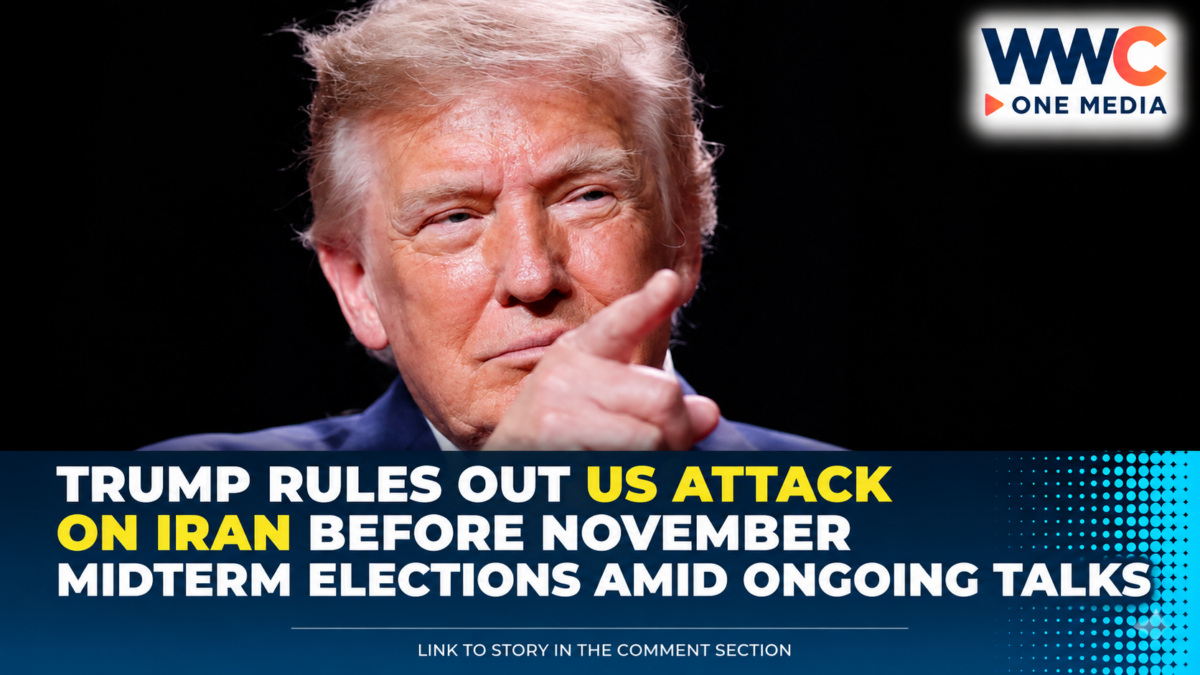
WASHINGTON — US President Donald Trump has said the United States will not launch another attack on Iran before the November 3 midterm elections, citing what he described as productive discussions with Tehran as tensions continue to threaten regional security and global energy supplies.
In a post on his Truth Social platform on Thursday, Oct. 8, Trump said Washington was engaged in discussions with the Iranian government and would maintain its blockade of Iranian ports.
“We will not be attacking Iran at any time prior to the Midterm Elections to be held in the United States on November 3rd,” Trump wrote.
He did not provide details about the discussions or explain what conditions would need to be met for a broader agreement with Iran.
The announcement came as oil prices rose amid renewed concerns about a possible escalation in the conflict. Reports that the White House had asked the Pentagon to prepare additional military options had fuelled speculation that US strikes could resume before the elections. (Reuters; CNA)
Trump says discussions with Tehran are productive
Trump described the discussions with Iran as productive but offered few details about their scope, participants or progress.
His statement signalled a pause in the prospect of further US attacks before the midterm elections, although it did not amount to a comprehensive peace agreement or an announcement that the conflict had ended.
The president also reiterated his position that Iran must not acquire a nuclear weapon. Washington has continued to press Tehran over its nuclear programme, while Iran has rejected key US demands and denied seeking to develop nuclear weapons.
The nuclear issue remains one of the central obstacles to a diplomatic settlement. Differences over uranium enrichment, Iran’s nuclear stockpile and the future of economic sanctions have complicated previous efforts to reach an agreement.
Trump’s announcement also left unresolved the question of what would happen after the November elections. He did not outline a detailed plan for ending the conflict or specify whether military action could resume if negotiations failed.
US blockade of Iranian ports remains in force
Despite ruling out attacks before the elections, Trump said the US blockade of Iranian ports would remain in full force.
The blockade has become a central element of Washington’s pressure campaign against Tehran, restricting Iran’s ability to export oil and adding to the economic strain facing the country.
The wider conflict has also disrupted shipping through the Strait of Hormuz, a strategically important waterway through which a substantial share of the world’s oil and fuel supplies normally passes.
Disruptions in the strait have raised concerns among energy traders, governments and businesses that depend on reliable oil shipments. The uncertainty has contributed to volatility in international crude prices, with the cost of energy becoming an increasingly important concern for consumers.
Trump has argued that the United States is in a strong position against Iran economically and militarily. However, continued tensions over shipping and the absence of a comprehensive agreement mean that risks to regional stability remain.
Reports of possible strikes fuel market concerns
Trump’s announcement followed reports that the White House had asked the Pentagon to develop options for additional strikes against Iranian targets.
The Atlantic reported on Wednesday that military options were being prepared, while The New York Times published a similar report on Thursday.
Those reports contributed to speculation that Washington might escalate its military campaign before the elections, adding to concerns about the possibility of further disruption to energy supplies.
Trump’s public statement appeared to address that uncertainty by ruling out attacks during the period leading up to the vote. However, the reports about military planning and the president’s announcement did not establish what options remain under consideration for the period after the elections.
The situation remains fluid, with diplomatic contacts continuing alongside military and economic pressure.
Rising fuel prices add to political pressure
The conflict has also become a domestic political issue in the United States, where higher fuel prices have added to concerns about the cost of living.
Polling cited by Reuters and other news organisations has indicated dissatisfaction among many Americans over the administration’s handling of the conflict and its economic consequences.
Although Trump is not personally on the ballot on November 3, the midterm elections will determine control of Congress for the remainder of his current term. Republicans are seeking to retain their majorities, while Democrats are campaigning on issues including household costs and the administration’s policies.
The outcome will influence the legislative environment in which Trump pursues his remaining domestic and foreign-policy priorities.
Trump has publicly connected the conflict with the election period, arguing that Iran may be attempting to prolong the confrontation for political reasons. Such claims are the president’s interpretation of Tehran’s intentions and have not been independently established.
The prospect of additional military action before voters head to the polls could also affect perceptions of the administration’s management of the conflict, particularly if it leads to further increases in fuel prices or additional disruption to international trade.
Iran conflict continues to affect regional security
The announcement came as security concerns remained elevated across the Middle East.
The conflict has affected maritime traffic and raised concerns about possible attacks on oil infrastructure and commercial vessels. Recent reports of tanker incidents near the Gulf have added to worries about the safety of key shipping routes.
The situation has also been complicated by hostilities involving Iran-aligned armed groups in the region, including Yemen’s Houthi movement, which has escalated attacks on Saudi Arabia.
These developments have heightened concerns that the conflict could expand beyond direct confrontation between Washington and Tehran, potentially affecting neighbouring countries and international energy markets.
For governments and businesses, the main uncertainty is whether diplomatic engagement can produce a durable reduction in hostilities or whether the region will continue to experience periodic escalations.
What happens after November 3 remains unclear
Trump’s statement provides a specific commitment about US military action before the midterm elections, but it does not resolve the broader dispute between Washington and Tehran.
The two countries still face substantial differences over Iran’s nuclear programme, economic sanctions, maritime security and the future of the conflict.
There was no immediate announcement of a final agreement, a confirmed timetable for negotiations or a comprehensive plan to restore normal conditions across affected shipping routes.
For now, the US administration says discussions are progressing, while maintaining economic pressure on Iran and leaving its longer-term strategy unclear.
The weeks ahead will be important in determining whether the diplomatic contacts can produce concrete progress. Until then, uncertainty over the conflict is likely to remain a concern for regional governments, international markets and Americans preparing to vote in the November midterm elections.
The key question is whether the pause in the prospect of US attacks can create space for a lasting diplomatic settlement — or whether tensions will rise again once the election period has passed.