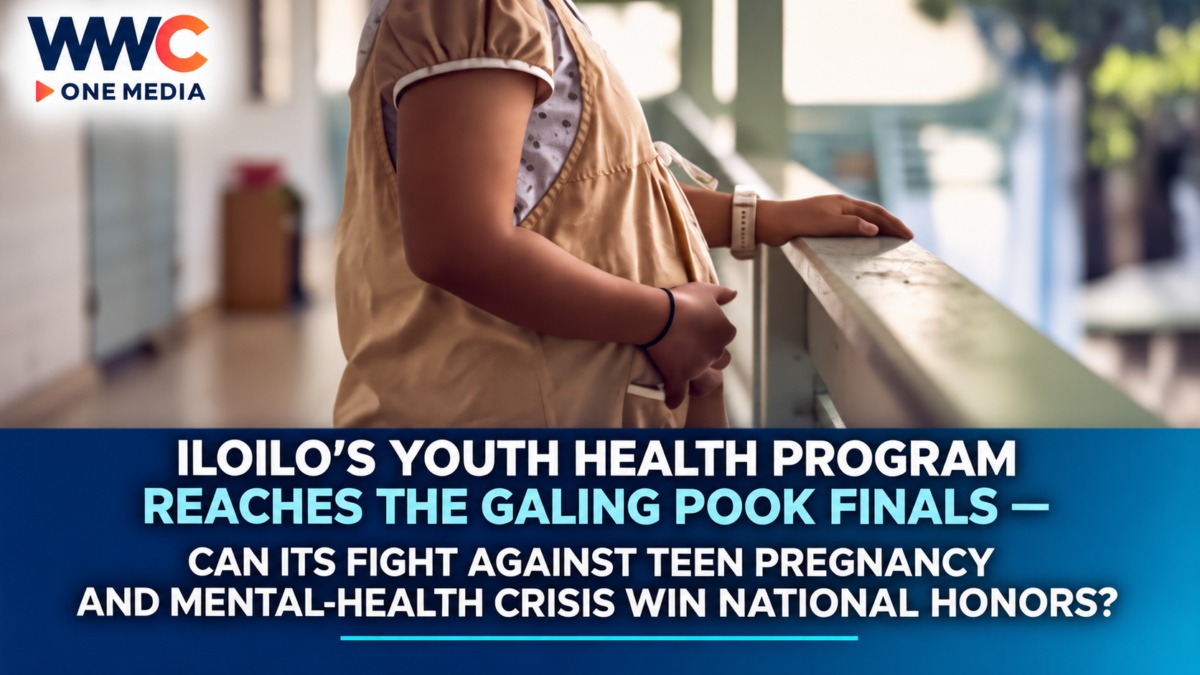
ILOILO — A province-wide program tackling some of the Philippines’ most difficult youth-health problems has made it to the finals of the 2026 Galing Pook Awards, putting Iloilo’s approach to teenage pregnancy, mental health and adolescent development on the national stage.
The program, Tib-ong Kabataan: Total Adolescent and Youth Health Development for MoRProGRes Iloilo, successfully passed the national validation process and was selected as one of this year’s finalists.
The Iloilo Provincial Health Office received confirmation of the selection from the Galing Pook Awards Committee on October 2, according to IPHO chief Dr. Maria Socorro Colmenares-Quiñon.
But Iloilo has not won yet.
The province’s final presentation before the national selection committee is scheduled for October 20 in Pasay City.
And that final stage could determine whether Tib-ong Kabataan joins the province’s previous Galing Pook-winning initiatives.
From teen pregnancy to mental health, Iloilo is attacking the problem as one system
What makes Tib-ong Kabataan different is that it does not treat adolescent health as a single-issue campaign.
Instead, the program brings together health services, schools, local government offices, youth leaders and community partners.
Its five major strategies include:
- Training and capacity-building for health workers and adolescents
- Certification of adolescent-friendly health facilities
- Establishment of Teen Centers and Family and Youth Development Centers
- Integrated adolescent health services in schools and communities
- Stronger partnerships and institutionalization of youth-health programs across the province
The philosophy is simple but significant:
Don’t wait for a young person to reach a hospital with a serious problem. Bring information, prevention, counseling and health services closer to where young people actually live and study.
Why the program is gaining attention now
Iloilo’s bid comes as youth mental health and teenage pregnancy remain major public-health concerns nationally.
The Department of Health’s adolescent-health framework identifies sexual and reproductive health, mental health, violence prevention and other adolescent risks as core areas requiring accessible, youth-friendly services.
The national government has also intensified efforts to prevent teenage pregnancy through sex education and adolescent-friendly health services. The Presidential Communications Office said the government has been strengthening these interventions alongside DSWD programs supporting adolescent mothers.
Iloilo is therefore attempting something increasingly important in public health:
turning national policy into a locally coordinated system.
Iloilo says the numbers are moving in the right direction
At a September 2026 forum on Universal Health Care, Gov. Arthur Defensor Jr. presented provincial data showing a 7% reduction in adolescent births from 2022 to 2025.
The province also reported a 38% decline in suicide deaths among people aged 3 to 30 over the same period.
Those figures are potentially significant.
But they need to be interpreted carefully.
The provincial data show that the indicators moved in a favorable direction during the period when Iloilo expanded youth-health and psychosocial interventions. They do not establish that Tib-ong Kabataan alone caused those declines, because multiple health, social and economic factors can influence teenage pregnancy and suicide rates.
That distinction is critical when assessing whether a public program is actually replicable elsewhere.
The program is already reaching schools
Tib-ong Kabataan is not confined to provincial government offices.
Iloilo has been taking adolescent-health activities directly into schools and communities.
Recent activities have included discussions on mental health, anti-bullying, smoking and vaping prevention, alongside medical and dental consultations and HIV screening.
That reflects the program’s broader philosophy of combining prevention with actual services.
Instead of telling teenagers where to seek help, the province is attempting to put those services closer to them.
Teen Centers are becoming the physical backbone
One of the most visible pieces of Iloilo’s youth strategy is its network of Teen Center 2.0 facilities.
As of 2026, the provincial government said it had constructed 21 Teen Center 2.0 facilities, with 11 already fully operational.
The province plans to build five more during the year and ultimately establish teen centers across its public secondary-school network.
The centers are intended to become hubs for much more than recreation.
They can support:
Psychosocial services.
Mental-health support.
Career guidance.
Counseling.
Youth development.
Health education.
Social-media awareness.
That makes the physical infrastructure part of a larger prevention strategy.
Nearly 300 school leaders were brought into the system
The province recently convened roughly 300 school heads, principals and administrators during its 2026 Teen Center Summit.
The objective was to strengthen the operation of the centers and help educators recognize their role in adolescent well-being.
That matters because a youth-health program can only work if schools become part of the referral and support network.
Teachers and school administrators are often among the first adults to notice changes in a student’s behavior, attendance or emotional state.
The challenge is turning that awareness into a system where students can safely obtain professional help.
Mental health is becoming a bigger part of Iloilo’s health system
The province’s youth strategy is also connected to a broader push to integrate mental-health care into primary healthcare.
In September, Defensor said Iloilo was working to accredit rural health units so they could provide the PhilHealth outpatient mental-health benefit package.
The governor also highlighted PRIME — Program for Resilience of Iloilo in Mind and Emotion, a psychosocial-support initiative launched in 2020.
Earlier this year, the province also launched a 24/7 PRIME Helpline providing psychosocial support, crisis intervention and referral services through social workers and psychometricians.
That creates an important distinction.
Tib-ong Kabataan is not operating in isolation.
It sits within a wider network of youth health, mental-health and psychosocial programs.
Iloilo’s youth problem is not just about pregnancy
The need for this approach is underscored by recent Western Visayas data.
A policy brief from the Commission on Population and Development Region 6 reported that 27% of young people aged 15 to 24 in the region experienced moderate to high psychological distress, based on the Western Visayas sample of the 2021 Young Adult Fertility and Sexuality Study.
The report also found substantially higher levels of distress among some vulnerable groups and linked elevated psychological distress with experiences including abuse and cyberbullying.
That puts the Galing Pook bid into a broader regional context.
Iloilo is not simply responding to teenage pregnancy.
It is trying to build a system around the whole adolescent experience.
The program has also evolved from a reactive model
According to Iloilo Provincial Administrator Raul Banias, the province’s approach has shifted from what he described as a more reactive, hospital-centered model toward a proactive, data-driven, whole-of-province system.
That transformation is central to the Galing Pook case.
The award is not simply looking for a program that sounds good.
Galing Pook’s validation process examines factors including implementation, results, community participation, innovation, sustainability, resilience, efficiency and potential for replication.
That means Iloilo’s biggest challenge is not merely proving that Tib-ong Kabataan exists.
It has to demonstrate that the model works, can be sustained and can potentially be replicated elsewhere.
Iloilo has already won a Galing Pook award
The province is no stranger to the competition.
In 2023, Iloilo won a Galing Pook Award for its “Zero to Limpyo Iloilo: Movement for a Province-Wide Zero Open Defecation” program.
Three years later, the province is back in the national competition with a very different challenge.
This time, the focus is the health and development of young people.
That makes the 2026 bid another test of whether Iloilo can turn province-wide governance into programs that produce measurable results.
The program was one of more than 300 entries
Tib-ong Kabataan’s progression is also significant because it was initially selected among 33 finalists from more than 300 entries nationwide before advancing through the validation process.
That means the program has already cleared multiple stages of national scrutiny.
But the final presentation will be the decisive step.
Iloilo has another lesson in this story: prevention needs partnerships
Tib-ong Kabataan involves far more than the provincial health office.
The initiative brings together provincial departments, health workers, DepEd-Iloilo, Sangguniang Kabataan leaders, local government units and other partners.
Other recent youth-health activities have also involved universities, civic groups and private-sector partners.
That is particularly important for teenage pregnancy and mental health because neither problem can be solved by doctors alone.
A teenager struggling with depression may need a counselor, teacher, parent, social worker and health professional.
A teenager at risk of early pregnancy may need accurate information, reproductive-health services, family support and an environment where asking for help does not result in stigma.
The system has to work together.
Iloilo is also competing against the clock
The province’s final presentation is scheduled for October 20.
That means the next stage is no longer about simply demonstrating that the program is innovative.
Iloilo will have to make the case that its model delivers meaningful results and deserves national recognition.
And that is where the reported declines in adolescent births and suicide deaths become important—but also where the province’s evidence will face its toughest scrutiny.
The question for evaluators will ultimately be:
Can Iloilo prove that its approach is not only ambitious, but measurable, sustainable and replicable?
The bigger lesson for Philippine local governments
The most important part of Tib-ong Kabataan may ultimately have little to do with the award.
The program represents a broader shift in how local governments can approach adolescent health.
Instead of waiting for national agencies to solve problems from Manila, local governments can build integrated systems around their own communities.
That can mean:
- Bringing services into schools
- Creating youth-friendly facilities
- Training local health workers
- Building referral networks
- Giving young people safe spaces
- Using local data to identify problems
- Connecting health services with education and social protection
The Department of Social Welfare and Development’s ProtecTEEN program provides another national example of this integrated approach, combining sexual and reproductive-health services with education, livelihood and psychosocial support for adolescent mothers. Iloilo is among its pilot areas in Region VI.
The convergence of these programs points toward a larger national trend:
Teenage pregnancy and youth mental health are increasingly being treated as interconnected development issues rather than isolated medical problems.
The bottom line
Iloilo’s Tib-ong Kabataan has reached the finals of the 2026 Galing Pook Awards after passing national validation, putting the province’s youth-health strategy under the country’s spotlight.
Its model combines adolescent-friendly health services, Teen Centers, school and community outreach, mental-health interventions, capacity-building and partnerships.
The province also reports a 7% decline in adolescent births from 2022 to 2025 and a 38% reduction in suicide deaths among people aged 3 to 30 during the same period—promising indicators, though they should not be interpreted as proof that one program alone caused those changes.
Now comes the decisive moment.
On October 20, Iloilo will make its final presentation before the Galing Pook national selection committee in Pasay City.
The question isn’t whether Iloilo has built an ambitious youth-health program. It clearly has. The question is whether its results are strong enough to turn that innovation into another national Galing Pook win.
And if Tib-ong Kabataan succeeds, its biggest prize may not be the trophy.
It could be a blueprint other Philippine provinces use to fight teenage pregnancy, mental-health struggles and the wider health crisis facing young Filipinos.