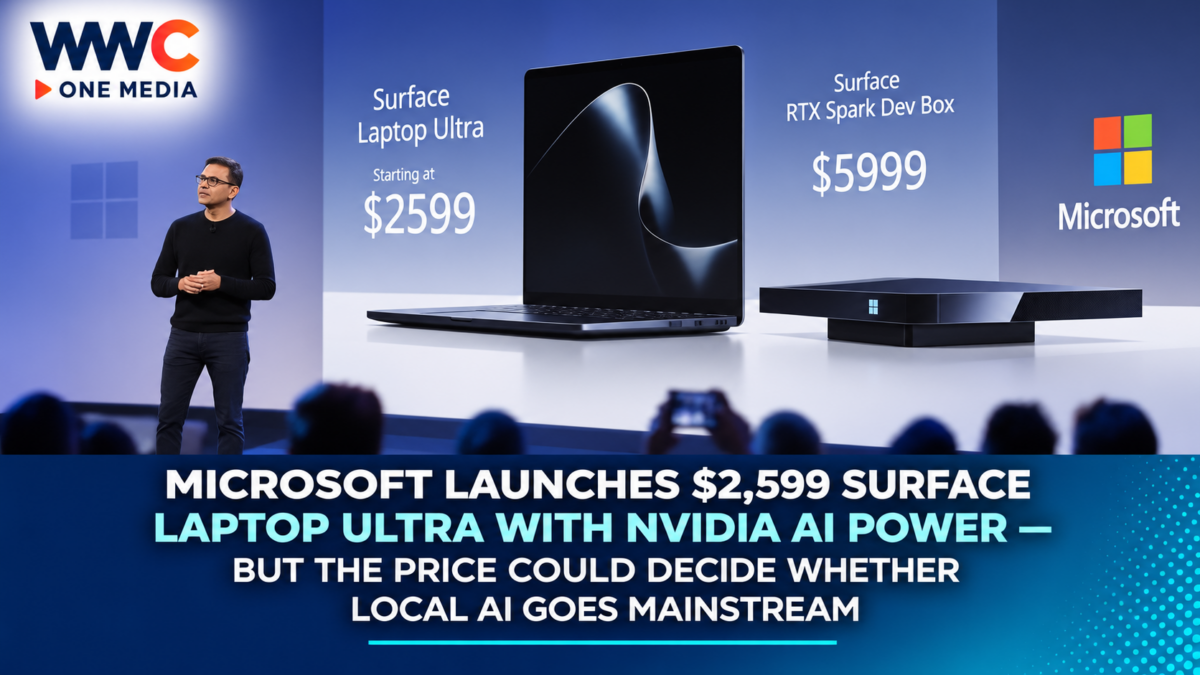
SAN FRANCISCO — Microsoft has opened preorders for its most powerful Surface laptop ever, putting a $2,599 starting price on a machine designed to bring high-end artificial-intelligence workloads out of cloud data centers and directly onto a personal computer.
The new Surface Laptop Ultra will begin shipping on October 16, 2026, powered by Nvidia’s new RTX Spark platform and aimed squarely at developers, creators and AI professionals rather than ordinary laptop buyers.
The entry-level model starts at $2,599 with an 18-core processor, 24GB of unified memory and 512GB of storage. Higher-end configurations rise to $5,899, with a 20-core processor, 128GB of unified memory and 1TB of storage.
Microsoft says the machine can deliver up to 1 petaflop of AI performance and run AI models larger than 120 billion parameters locally, depending on configuration.
That makes the Laptop Ultra much more than another premium Windows notebook.
It is part of a larger strategic bet by Microsoft and Nvidia that some of the AI work currently performed in expensive cloud data centers can move onto high-powered PCs, reducing latency, improving privacy and cutting cloud-computing costs.
But the strategy has an obvious problem.
The hardware required to run serious AI workloads locally is still expensive enough that the first wave may remain limited largely to businesses, developers and wealthy power users.
Microsoft Is Calling It the Most Powerful Surface Laptop Ever
Microsoft says the Surface Laptop Ultra was designed from the beginning around Nvidia’s RTX Spark architecture.
The platform combines an Nvidia Blackwell RTX GPU with up to 6,144 cores, a Grace CPU with as many as 20 cores and up to 128GB of unified memory.
That memory architecture is especially important for AI.
Large models often require enormous amounts of memory, and conventional laptops can struggle to run them locally.
Microsoft says the Ultra can support models exceeding 120 billion parameters while delivering up to one petaflop of AI performance.
That puts the device in a very different category from mainstream Copilot+ PCs.
It is closer to a portable AI workstation.
The Real Target Is Professional AI Work
Microsoft is not pretending that the Laptop Ultra is a mass-market machine.
Its own launch materials repeatedly emphasize:
developers;
AI builders;
creative professionals;
designers;
and technical users.
These customers may run large local language models, coding assistants, image-generation systems, 3D applications and other workloads that currently depend heavily on cloud infrastructure.
The idea is that users can keep more sensitive or expensive tasks on the device itself while sending only the most complex work to cloud services.
That hybrid model could become increasingly important as companies try to control rapidly rising AI-inference costs.
Microsoft Wants AI to Run Both Locally and in the Cloud
Reuters reported that Microsoft is redesigning Windows around a hybrid AI model.
Copilot will continue sending the hardest tasks to cloud infrastructure, but it can increasingly delegate other work to models running directly on a PC when privacy, speed or cost matter more.
This is a strategically important shift.
The first generation of generative AI relied heavily on remote data centers.
Users typed a request.
The request traveled to a cloud server.
The model processed it.
Then the response came back.
Microsoft now wants Windows machines themselves to handle a larger share of those tasks.
If successful, that could reduce pressure on Azure data centers while giving customers more control over where their data is processed.
Nvidia Gains Access to Another Massive Market
The Surface Laptop Ultra is also important for Nvidia.
The company already dominates high-end AI chips used in data centers.
But the personal-computer market remains much more heavily influenced by Intel, AMD and Apple.
RTX Spark gives Nvidia a way to push deeper into premium Windows PCs.
Reuters noted that success could help Nvidia challenge Intel and AMD in one of the last major computing categories where it has not traditionally dominated the processor itself.
The partnership therefore benefits both companies.
Microsoft gets access to Nvidia’s AI hardware ecosystem.
Nvidia gets a flagship Windows platform.
Microsoft Is Taking Direct Aim at Apple
The competitive target is obvious.
The Surface Laptop Ultra is designed to challenge the MacBook Pro at the premium end of the laptop market.
The base Ultra starts at $2,599, compared with Apple’s entry-level MacBook Pro at $1,999, according to Reuters.
However, Microsoft’s base configuration includes 24GB of memory versus 16GB on Apple’s entry-level machine.
At the top end, Microsoft’s $5,899 Ultra with 128GB of memory competes more closely with highly configured MacBook Pro models.
Reuters noted that an Apple MacBook Pro with 128GB of memory, a 40-core graphics configuration and 2TB of storage costs around $6,700, although the machines are not directly comparable.
That gives Microsoft an argument that the Ultra is expensive because it belongs in the same professional workstation category as top-end Macs.
Microsoft Is Offering MacBook Owners Up to $1,000 to Switch
Microsoft is making that rivalry unusually explicit.
The company is offering customers up to $1,000 cash back when they trade in an eligible MacBook Pro for a Surface Laptop Ultra.
Microsoft even framed the promotion around the idea of “breaking up” with a MacBook.
That kind of marketing signals how seriously Microsoft sees Apple as the benchmark for this device.
Surface historically played an important role as a showcase for Windows hardware.
With Laptop Ultra, Microsoft appears to be using Surface more aggressively as a direct premium competitor rather than merely a reference design.
The Display Is Another Major Selling Point
The Ultra features a 15-inch PixelSense Ultra touchscreen.
Microsoft says it is the brightest display the company has ever put into a Surface Laptop and claims peak HDR brightness up to 25% higher than the MacBook Pro M5.
The company is positioning the screen specifically for creators who need strong color accuracy and brightness for editing video, reviewing designs or working with visual data.
The laptop also includes a touchpad that is 30% larger than previous Surface models and supports advanced haptic feedback.
Those upgrades reinforce Microsoft’s effort to compete on premium industrial design rather than performance alone.
The Surface Ultra Brings Back Serious Port Selection
Microsoft is also giving the machine a much more extensive selection of ports than many thin premium laptops.
The Ultra includes:
three USB-C ports;
HDMI;
USB-A;
a full-size SD card reader;
and a 3.5mm headphone jack.
Microsoft says the laptop can drive up to three 4K displays.
This may sound like a small detail, but it matters to professional users who often complain about needing adapters or docks for premium laptops.
Magnetic USB-C Is One of the Most Interesting Design Changes
Microsoft has also introduced a new feature called Magnetic Connect.
The included charging cable magnetically attaches to one of the USB-C ports and disconnects if pulled, functioning conceptually like Apple’s MagSafe system while still using USB-C as the physical connection.
The port remains usable for data and video when it is not charging.
Microsoft describes it as the first built-in magnetic USB-C charging solution on a laptop.
That could prove useful if the company eventually brings the system to less expensive Surface models.
The Storage Is User-Removable
Another unusual feature is removable storage.
Microsoft says users can replace, upgrade or secure their own SSD rather than being locked permanently into the original storage configuration.
That could appeal to enterprise customers and developers who care about repairability or data security.
It also differentiates the Surface from some premium laptops that increasingly solder or tightly integrate components.
The Device Is Thin—but Not Ultralight
Despite its workstation-class ambitions, Microsoft kept the chassis below 18 millimeters thick and around 4.5 pounds.
The company says it developed a new thermal design offering up to 2.5 times more thermal capacity than its existing Surface Laptop line.
That matters because powerful processors can lose performance when laptops become too hot.
Sustained AI or rendering workloads generate far more heat than everyday web browsing.
The thermal design will therefore be one of the most important factors reviewers will test once final retail units arrive.
Gaming Is Part of the Pitch Too
Microsoft and Nvidia are also highlighting gaming.
The RTX Spark architecture supports features including ray tracing, DLSS and Nvidia Reflex in compatible games.
At the launch event, Microsoft demonstrated Gears of War: E-Day running at 60 frames per second and said hundreds of AAA and independent games would be available at launch.
Call of Duty support for RTX Spark is expected in 2027.
This matters because RTX Spark uses an Arm-based architecture.
Windows on Arm has historically faced software and gaming compatibility limitations.
Microsoft is clearly trying to show that those limitations are shrinking.
But “Hundreds of Games” Is Not the Same as Universal Compatibility
This is where buyers should remain cautious.
Microsoft’s demonstrations show substantial progress.
But the entire Windows game catalog is enormous.
Some titles may still depend on software, drivers or anti-cheat systems that do not work perfectly on Arm.
The same concern can apply to specialized professional software.
For developers and creators considering a $2,599-to-$5,899 machine, compatibility will matter as much as benchmark performance.
A workstation is only useful if the software required for a workflow actually runs reliably.
Local AI Could Save Companies Money
The strongest business argument for the Ultra is not necessarily speed.
It is cost.
Cloud AI workloads are expensive because organizations pay for tokens, processing and infrastructure every time models run remotely.
Microsoft argues that local AI can reduce that expense.
A developer could test models locally.
A company could keep sensitive documents on-device.
Some coding tasks could run without consuming cloud tokens.
More difficult tasks could still move to Azure or another cloud platform when necessary.
Microsoft describes this combination as “hybrid intelligence.”
If companies use enough AI, paying $2,599 or more upfront for powerful hardware could potentially reduce recurring cloud costs.
Privacy Is the Other Big Local-AI Argument
Cost is only one advantage.
Privacy may become even more important.
Certain businesses cannot freely send confidential information to remote models.
Financial institutions, governments, healthcare providers and software companies may want more processing to happen inside controlled devices.
Microsoft is also introducing security technology called Microsoft Execution Containers, or MXC, intended to isolate AI agents and restrict which files or data they can access.
Anthropic, OpenAI and Nvidia are among companies expected to use these security tools.
Microsoft’s pitch is that Windows should become the safest environment for increasingly autonomous AI agents.
AI Agents Raise a Bigger Security Problem
AI agents are more powerful than conventional chatbots because they can take actions.
They can search files.
Modify documents.
Run software.
Write code.
Potentially send messages or perform tasks on behalf of users.
That creates obvious security risks if an agent receives too much access.
Microsoft’s new containment architecture is designed to prevent agents from accessing data or performing actions they have not been authorized to use.
This could become as important as the Laptop Ultra hardware itself.
If AI agents become a routine part of computing, operating systems will need a new permissions and security model.
The $2,599 Starting Price Is the Biggest Obstacle
For all of Microsoft’s technology claims, the launch may ultimately be judged by one number:
$2,599.
That is far above the price most consumers pay for a laptop.
And the most capable configuration costs $5,899.
Reuters quoted Moor Insights & Strategy analyst Anshel Sag arguing that the hardware may now be expensive enough that local AI is realistic primarily for users and organizations with substantial budgets.
That is the central contradiction.
Microsoft wants AI to move from centralized cloud infrastructure into personal computers.
But the machines capable of running truly large models locally remain premium products.
Memory Prices Are Part of the Problem
One reason for the high pricing is the global memory market.
AI demand has driven dramatic increases in memory-chip demand, particularly for large-capacity systems.
Reuters noted that Nvidia raised the price of its DGX Spark AI desktop by roughly 75% since launch, to around $6,950, amid higher memory costs.
The Surface Laptop Ultra requires as much as 128GB of unified memory.
That kind of capacity is inherently expensive.
If memory prices remain elevated, affordable high-end local AI could remain difficult to achieve.
Microsoft Is Not Alone
The Surface Laptop Ultra is only one member of a broader RTX Spark ecosystem.
Asus, Dell, Lenovo, HP and MSI are also releasing RTX Spark-powered systems beginning October 16.
That matters because Microsoft does not need Surface itself to dominate sales for the strategy to succeed.
Surface often functions as a showcase for what Windows hardware partners can build.
If other manufacturers offer lower prices or specialized configurations, RTX Spark could spread much more widely than Microsoft’s own laptop line.
The Surface Ultra Is a Flagship, Not a Volume Product
That is perhaps the best way to interpret the device.
Microsoft is not trying to replace the ordinary $800 or $1,200 laptop.
It is showing what a high-end AI Windows PC can look like.
The Ultra demonstrates:
large unified memory;
local frontier-scale models;
agentic workflows;
high-end creative performance;
gaming;
and hybrid cloud integration.
Over time, parts of that capability could move downmarket.
That pattern is common in technology.
Features first appear in expensive flagship products and become cheaper later.
Microsoft’s Real Bet Is on a New PC Upgrade Cycle
For years, the PC industry struggled to create compelling reasons for consumers and businesses to upgrade.
Faster processors alone were often not enough.
AI may provide a new reason.
If new software increasingly requires powerful local acceleration, older PCs could become less capable.
That could trigger another corporate upgrade cycle.
Microsoft clearly hopes that AI agents, local models and hybrid computing become important enough that businesses replace PCs sooner than they otherwise would.
The Surface Laptop Ultra is designed to demonstrate the upper end of that vision.
The Bigger Question Is Whether Users Actually Need This Much Local AI
The technical achievement is impressive.
But there is still an unanswered demand question.
Most consumers do not need to run 120-billion-parameter AI models on their laptops.
Many are perfectly satisfied using cloud-based AI through a browser.
Even professional users may decide that renting cloud compute is more economical than buying a $5,899 workstation.
Microsoft therefore needs more than powerful hardware.
It needs compelling applications that make local AI genuinely useful.
If those applications arrive, the Laptop Ultra could look like an early version of a new computing category.
If they do not, it risks becoming an expensive demonstration of technology that most people still prefer to access through the cloud.
Microsoft Is Betting the Future of Windows Is Hybrid
The Surface Laptop Ultra is ultimately a hardware expression of Microsoft’s broader AI strategy.
The company does not believe everything should run in the cloud.
It also does not believe everything should run locally.
Instead, it wants Windows to decide where each task belongs.
Simple or privacy-sensitive work can remain on the computer.
More demanding workloads can use Azure.
AI agents can move between both environments.
That could make the PC far more important in the AI era than many people expected.
The Biggest Test Comes After October 16
Microsoft has now answered the two biggest launch questions:
price and availability.
Preorders are open.
Shipping begins October 16.
The next questions are harder.
How fast is the device under sustained workloads?
How broad is software compatibility?
How good is battery life under heavy AI usage?
How much benefit does 128GB of unified memory provide?
And most importantly, will enough professionals pay $2,599 to $5,899 for local AI?
Microsoft and Nvidia believe high-end PCs can become personal AI workstations powerful enough to take meaningful workloads away from the cloud.
The Surface Laptop Ultra proves that the hardware is increasingly capable.
But the bigger question is whether local AI can become affordable enough to escape the professional niche—or whether the future Microsoft is building will remain limited to users who can afford a laptop priced like a workstation.