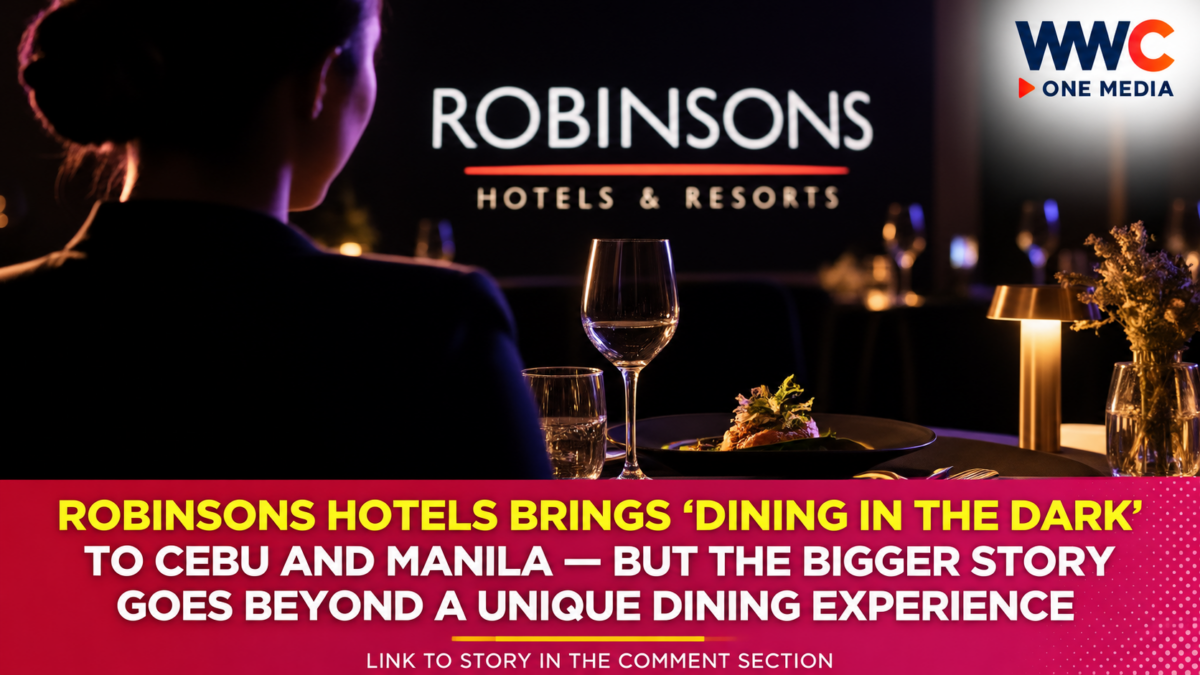
MANILA, PHILIPPINES — Robinsons Hotels and Resorts is turning off the lights at two of its flagship hotels, inviting guests to eat an entire mystery meal in complete darkness while visually impaired Filipinos take the lead.
The hospitality arm of Robinsons Land Corporation is offering Dining in the Dark at Dusit Thani Mactan Cebu and The Westin Manila, combining experiential dining with an inclusion program that creates hospitality opportunities for people with visual impairments.
Guests are served a mystery menu without seeing the food in front of them.
With visual cues removed, diners are encouraged to rely more heavily on taste, smell, touch and hearing as they try to identify the ingredients, textures and flavors of each course.
But the strongest part of the concept may not be what is on the plate.
RHR partnered with Resources for the Blind to recruit and train visually impaired guides who help guests move through an environment in which sighted diners suddenly become dependent on other senses—and on the people who navigate that reality every day.
That role reversal turns what could have been a novelty restaurant concept into a broader hospitality experiment involving inclusion, employment and empathy.
Guests Dine Without Seeing Their Food
The experience removes one of the strongest influences on how people judge food: appearance.
In a conventional restaurant, diners immediately see the color, presentation and portion size of a dish.
Dining in the Dark strips those visual signals away.
Instead, guests are asked to focus on aroma, temperature, texture and flavor.
RHR says the format also creates a different challenge for its culinary teams because chefs cannot rely on presentation to shape guests’ expectations.
The food must stand on taste, balance and sensory contrast alone.
The Westin Manila is offering a specially curated three-course mystery menu, while Dusit Thani Mactan Cebu offers the experience both as a standalone dining option and as part of a hotel stay package.
Visually Impaired Guides Become the Experts
The biggest reversal happens once guests enter the darkened dining area.
People who normally depend heavily on sight are suddenly placed in an unfamiliar environment.
The visually impaired guides, by contrast, are accustomed to navigating without visual information.
They become the experts.
They help guests find their seats, understand the dining environment and move through the experience comfortably.
RHR Senior Vice President and Business Unit General Manager Barun Jolly said the company was attracted not only to the sensory aspect of Dining in the Dark but also to its ability to create genuine human connection.
The company says its guides came from different professional backgrounds and were not necessarily hospitality workers before joining the program.
They underwent training developed by hotel food-and-beverage teams together with Dining in the Dark specialists.
RHR Partners With Resources for the Blind
The inclusion element is supported by Resources for the Blind, an organization that has previously participated in similar dining concepts in the Philippines.
RHR worked with the group to recruit visually impaired participants and prepare them for guest-facing hospitality roles.
The partnership matters because employment barriers remain a significant issue for people with disabilities.
Rather than positioning the guides merely as beneficiaries, the Dining in the Dark format puts them in leadership roles during the experience.
Guests rely on them.
They manage the unfamiliar environment.
And they become central to the service itself.
That changes the power dynamic.
Instead of asking sighted diners simply to imagine disability, the format places visually impaired workers in positions of competence and authority.
Dining in the Dark Is Not Entirely New to the Philippines
RHR’s rollout is not the first time Filipinos have encountered the concept.
In 2016, Noche – Dine in the Dark Manila offered meals in total darkness with visually impaired staff in partnership with Resources for the Blind.
Cebu has also experimented with similar sensory dining events.
The Philippine Star reported on a darkness-themed dining experience in Cebu as early as 2017.
That means the current RHR program should not be described as inventing the concept for the Philippines.
What is new is the deployment of the format across two major hotel properties under Robinsons Hotels and Resorts.
The Cebu operation also appears to have begun before October.
Dusit Thani Mactan Cebu announced that its Dine in the Dark experience opened on September 7, 2026.
The Cebu Experience Is Already Operating
Guest reviews published in September confirm that the Dusit Thani Mactan Cebu program was already active before the latest RHR-wide announcement.
Recent diners described being guided through the meal by visually impaired staff and emphasized the difference between eating in darkness and a conventional restaurant setting.
These reviews are subjective experiences rather than independent evidence of commercial success.
But they support the timeline showing that the Cebu offering was already operating in September.
That distinction matters for accurate reporting.
RHR’s October announcement represents the wider promotion and expansion of the concept, not necessarily the first operational day in Cebu.
Dusit Thani Mactan Is Also Selling a Stay-and-Dine Package
The Cebu property is using the concept as more than a restaurant attraction.
Dusit Thani Mactan Cebu currently lists a “Stay in Luxury, Dine in Complete Darkness” hotel package, with rates starting from ₱16,000 before applicable charges.
That approach reflects a broader hospitality trend.
Hotels are increasingly selling experiences rather than rooms alone.
A resort stay can now be bundled with immersive dining, wellness activities, entertainment or destination experiences.
For hotel operators, these packages can increase guest spending while differentiating properties in a competitive market.
For guests, the attraction is less about simply booking accommodation and more about gaining a memorable experience they cannot easily replicate elsewhere.
Experiential Dining Has Become a Bigger Hospitality Strategy
Dining in the Dark fits into a growing category of experiential hospitality.
Restaurants and hotels increasingly compete through interactive or immersive concepts rather than relying entirely on traditional menus and décor.
These experiences can become particularly valuable in the social-media era because guests increasingly seek activities that feel unusual, memorable or shareable.
Ironically, Dining in the Dark removes one of the central tools of modern dining culture: food photography.
Guests cannot see the dish.
They cannot judge it visually.
And the experience works precisely because people are temporarily separated from screens and visual distractions.
That may give the format a different appeal from other highly visual immersive dining concepts.
Robinsons Hotels Is Expanding Its Hospitality Portfolio
The program also arrives as Robinsons Hotels and Resorts continues expanding its national footprint.
RHR describes itself as the hospitality arm of Robinsons Land and currently operates 10 brands across 30 properties in 20 cities and municipalities nationwide.
Its portfolio covers multiple market segments, including upscale international hotels, full-service properties and value-oriented accommodations.
The Westin Manila and Dusit Thani Mactan Cebu sit at the premium end of that portfolio.
That makes them logical locations for an experiential dining concept that depends on premium service, carefully managed environments and trained staff.
The offering could also serve as a test of whether similar experience-driven programs could work across other RHR properties.
The Westin Manila Gives the Concept a Metro Manila Audience
Bringing Dining in the Dark to The Westin Manila gives RHR access to a different customer base.
The Manila market includes business travelers, local diners, corporate groups and residents seeking premium restaurant experiences.
A three-course mystery dinner offers the hotel a way to stand out in a crowded dining market.
The concept can also appeal to groups because much of the entertainment comes from shared uncertainty.
Diners cannot see each other’s reactions.
They must describe tastes, textures and guesses verbally.
That can make the meal more conversational than a conventional restaurant experience.
The format therefore has potential beyond individual diners.
It could appeal to team-building groups, celebrations and corporate events, although specific packages would need to be confirmed by the hotel.
The Culinary Challenge Is Different in Total Darkness
Chefs ordinarily rely heavily on visual presentation.
Plating influences what diners expect even before they taste a dish.
A brightly colored sauce, carefully arranged garnish or visible ingredient can shape perception.
In darkness, those cues disappear.
That forces chefs to think differently.
Textures need to be distinguishable.
Aromas become more noticeable.
Temperature differences can become more important.
The order of flavors can also shape the experience more strongly.
This is part of why the meal is served as a mystery menu.
Not knowing what is on the plate encourages diners to think more carefully about what they are tasting.
The Concept Can Be Meaningful—But Hotels Need to Avoid Tokenism
The inclusion element is potentially powerful, but it also carries responsibility.
Programs involving people with disabilities can become superficial if workers are presented merely as part of an attraction.
The stronger approach is to treat visually impaired guides as trained hospitality professionals with meaningful roles, compensation and opportunities for advancement.
RHR’s public statements emphasize that its guides are central to the experience rather than decorative participants.
Jolly said the recruits brought determination, experience and a willingness to learn, and described them as the heart of the program.
That framing is important.
The long-term test will be whether these opportunities lead to sustainable hospitality employment rather than remaining limited to short-term experiential events.
The Program Challenges Assumptions About Disability
One of the more interesting aspects of Dining in the Dark is how quickly conventional assumptions can reverse.
In normal circumstances, sighted individuals often assume that they are the ones providing assistance to people with visual impairments.
Inside the darkened dining room, the opposite happens.
The guide is confident.
The guest is uncertain.
The guide knows how to move.
The guest has to listen.
That reversal can communicate something that conventional diversity training often struggles to achieve.
It demonstrates capability rather than merely discussing it.
Guests experience dependence directly while visually impaired workers demonstrate competence in real time.
That may be why the concept has endured internationally.
But the Experience Is Still a Commercial Hospitality Product
The social-impact story should not obscure another reality.
Dining in the Dark is also a commercial product.
Hotels are using it to attract guests, create buzz and differentiate their food-and-beverage offerings.
Those commercial and social objectives do not necessarily conflict.
A program can generate revenue while also expanding employment opportunities.
In fact, commercially viable inclusion programs may be more sustainable because companies have an incentive to continue them.
The important question is whether the social benefits remain meaningful as the experience grows.
RHR Is Betting Guests Want More Than Good Food
Traditional hotels competed heavily on location, rooms and restaurants.
Increasingly, those basics are not enough.
Guests can compare dozens of properties online within minutes.
That makes distinctive experiences more valuable.
RHR is effectively betting that a memorable dining story can become part of the reason someone chooses a hotel.
For Dusit Thani Mactan Cebu, the experience can complement a resort stay.
For The Westin Manila, it can attract diners who may not otherwise book a room.
In both cases, the dining concept functions as a hospitality differentiator.
Could the Concept Expand to Other RHR Hotels?
RHR has not announced a nationwide rollout.
For now, the experience is associated with Dusit Thani Mactan Cebu and The Westin Manila.
Any broader expansion would depend on demand, operational results and the ability to recruit and train guides.
Complete-darkness dining also requires careful safety procedures.
Guests need orientation.
Staff need to manage movement.
Food allergies and dietary restrictions must be addressed in advance because diners cannot visually identify ingredients.
These operational details make the format more complex than a conventional restaurant service.
That complexity could limit how quickly the concept expands.
The Bigger Opportunity Is Inclusive Hospitality
The strongest long-term impact may not come from how many mystery dinners are sold.
It may come from whether hospitality companies begin seeing disability inclusion differently.
People with visual impairments can work in guest service, training, customer relations and other hospitality functions when environments and processes are designed appropriately.
Dining in the Dark demonstrates one specific model.
But the broader principle is much larger.
Companies can rethink jobs around people’s abilities rather than assumptions about their limitations.
If that mindset spreads beyond a single dining concept, the social impact could become more significant than the event itself.
Dining in the Dark Is Designed to Change More Than Taste
RHR is selling a three-course meal in darkness.
But the real product is perspective.
Guests lose the visual information they normally depend on.
Chefs lose plating as one of their main tools.
Visually impaired guides become the people with the greatest situational confidence.
And hotels gain an opportunity to combine commercial hospitality with an inclusion program.
Robinsons Hotels and Resorts is betting that guests will remember not only what they tasted, but how the experience changed the way they viewed the people guiding them.
The bigger question is whether Dining in the Dark remains a memorable hospitality novelty—or becomes a model for creating more meaningful employment opportunities for visually impaired Filipinos across the industry.