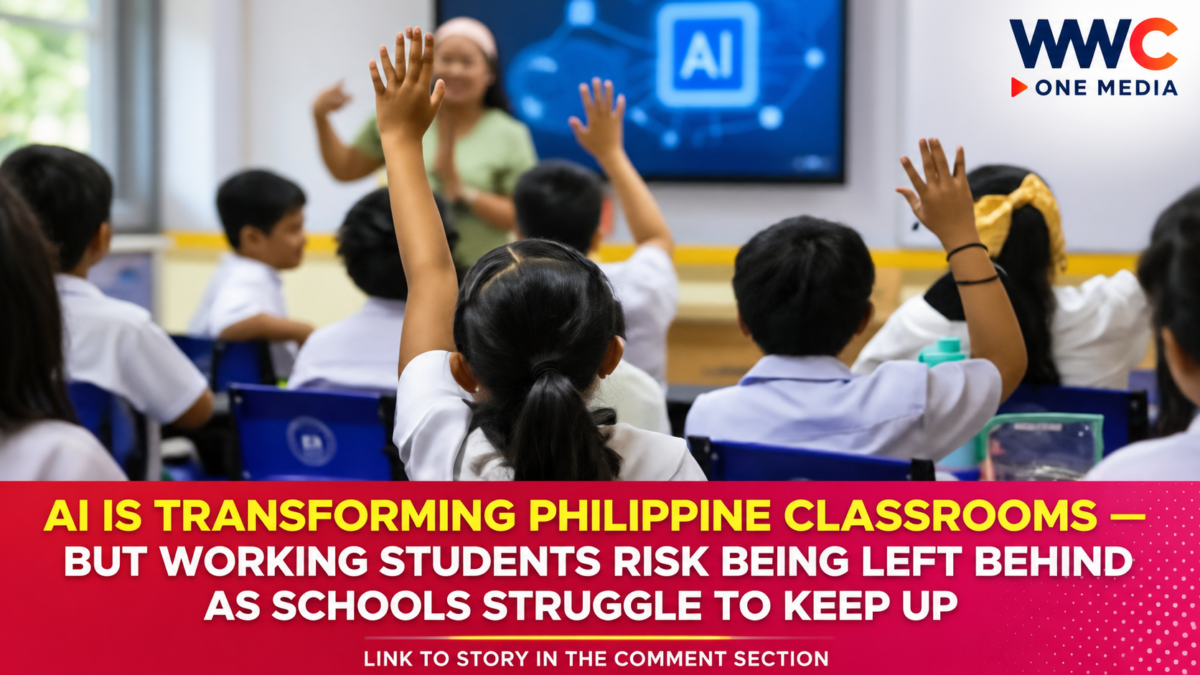
MANILA, Philippines — The artificial intelligence revolution is sweeping through Philippine colleges and training institutions, promising smarter classrooms, personalized education and new career opportunities. But behind the technological excitement, a growing concern is emerging: working students, part-time learners and those studying remotely may be among the biggest losers if schools fail to close the widening AI support gap.
A new study commissioned by education technology company Instructure and conducted with Philippine research firm The Fourth Wall found that while educational institutions are increasingly integrating AI into their operations, many remain unprepared to ensure that all students benefit equally.
The research surveyed 207 education practitioners from higher education and technical-vocational institutions across Metro Manila, Metro Cebu and Metro Davao.
Its findings suggest that the next major education divide may no longer be simply about who owns a computer or has internet access. It could increasingly involve who receives the training, guidance and institutional support needed to use AI effectively.
For thousands of Filipinos juggling school requirements, jobs and family obligations, that difference could become increasingly important as employers place greater value on digital skills
Educators Give AI Support for Working Students a Troubling Score
Confidence in equal AI support
2.66/5
Educators’ average rating
Education practitioners surveyed
207
Across three metro areas
One of the study’s most concerning findings was educators’ low confidence that remote, part-time and working students would receive support comparable to that available to other learners.
Respondents gave that confidence a rating of just 2.66 out of 5.
The study also identified two major barriers to continuing education:
- 67% cited work and livelihood responsibilities.
- 65% identified financial constraints.
These results highlight a difficult reality for students already balancing multiple responsibilities.
A full-time learner may have more opportunities to attend AI workshops, receive faculty assistance and experiment with digital learning tools. A working student attending evening classes or relying on asynchronous lessons may face greater difficulty accessing the same support.
The findings do not establish that working students are already falling behind in measured academic performance. Instead, they reveal educators’ concerns that unequal support could create new disadvantages as AI adoption accelerates.
Half of Institutions Already Offer AI Skills Programs — But Readiness Remains Uneven
AI adoption is no longer limited to classroom experiments.
According to the Instructure study, surveyed institutions reported the following adoption levels:
Reported AI adoption among surveyed institutions
0%15%30%45%60%AI literacy programsStaff-facing AI sys…AI in course delive…AI tutoring assista…
Source: Instructure–The Fourth Wall study, as reported by InsiderPH. Percentages refer to surveyed institutions.
However, implementing technology does not necessarily mean schools are prepared to use it effectively.
Educators rated confidence in faculty and staff AI training at 2.87 out of 5, while institutional tracking of whether educational resources are being distributed fairly received an even lower 2.74.
Darren Read, Instructure’s managing director for Asia-Pacific, warned that adopting AI without clear institutional direction could create a new divide between students who receive adequate guidance and those left to navigate the technology independently.
The findings point to a crucial distinction: providing access to AI tools is only the first step. Ensuring that students understand how to use them responsibly, critically and effectively is an entirely different challenge.
UNESCO Warns AI Could Deepen Global Education Inequality
The Philippine findings reflect broader concerns raised by UNESCO about the potential consequences of rapidly expanding artificial intelligence in education.
In its 2025 report AI and Education: Protecting the Rights of Learners, UNESCO warned that new digital technologies could reinforce existing inequalities unless governments and schools establish safeguards for equal access, privacy and learner protection.
The organization estimated that approximately 2.6 billion people worldwide remained without internet access in 2024.
UNESCO also highlighted uneven school connectivity, with global internet access available in only around 40% of primary schools, 50% of lower-secondary schools and 65% of upper-secondary schools.
These global figures are not specific to Philippine universities, but they reinforce the importance of addressing the digital divide before AI-dependent education becomes more widespread.
For developing economies, the challenge is particularly significant: technological innovation can expand opportunities, but its benefits may remain concentrated among learners who already possess adequate resources.
CHED Introduces New AI Rules Covering 5.8 Million College Students
The warning comes at a critical moment for Philippine higher education.
In September 2026, the Commission on Higher Education (CHED) introduced Memorandum Order No. 21, establishing a national framework for responsible AI use in colleges and universities.
According to the Philippine Information Agency and Philippine News Agency, the policy is intended to guide:
- 2,366 higher education institutions
- 188,261 faculty members
- More than 5.8 million students
The guidelines permit AI use in teaching, research and academic administration while requiring safeguards for data privacy, academic integrity and student welfare.
Importantly, human oversight must remain part of high-impact decisions involving grades, admissions, scholarships and student progression.
The framework also allows schools to adapt AI policies to their own circumstances rather than imposing identical systems across all institutions.
However, policy adoption alone cannot guarantee equitable access. Universities must still address differences in devices, internet connectivity, faculty capability and student schedules.
AI Skills Are Becoming More Important in the Philippine Job Market
The issue extends beyond the classroom.
In an August 2026 report, The Philippine Star highlighted warnings from AI expert Kai-Fu Lee that artificial intelligence could disrupt not only business process outsourcing but also a wider range of digital and knowledge-based occupations.
The report emphasized the growing importance of retraining and adapting workforce skills as automation advances.
For working students, this creates a difficult challenge.
They are pursuing education to improve their employment prospects while simultaneously facing pressure to learn technologies that could transform the jobs they currently hold.
Those who receive structured AI training may gain useful skills for an evolving labor market. Students without comparable access could face additional barriers.
But the study does not establish a direct relationship between a student’s current AI access and future earnings or employment outcomes.
Schools Face a Critical Test: Who Actually Benefits From AI?
The Instructure findings suggest that Philippine schools may need to move beyond simply encouraging students and teachers to experiment with AI applications.
More meaningful measures could include affordable access to digital tools, flexible training for employed learners, stronger teacher development, transparent rules for classroom AI use and monitoring of whether disadvantaged students are actually benefiting.
Such measures would be particularly relevant for institutions serving students who attend evening classes, pursue technical-vocational qualifications or rely on remote instruction.
The challenge is not necessarily to slow technological progress, but to ensure that adoption does not outpace students’ capacity to participate.
UNESCO’s recommendations reinforce the importance of keeping human needs, educational quality and equal opportunities at the center of AI policy.
The urgency is evident. Philippine schools are adopting AI while the government moves to establish responsible-use standards and employers increasingly reassess the skills needed in the workplace.
The central question is whether the benefits of this transformation will reach students who already face the greatest barriers to completing their education.
A New Digital Divide Could Shape the Future of Filipino Education
The latest research highlights a critical challenge for the Philippine education system.
Artificial intelligence has the potential to help students learn more efficiently, access personalized instruction and develop skills demanded by employers.
Yet these benefits are not automatic.
Without adequate institutional support, the same technology could deepen existing differences between students with financial resources, flexible schedules and reliable connectivity, and those who lack these advantages.
There is also an important limitation to the findings: the 207 respondents represent selected education practitioners, not a nationally representative sample of Philippine institutions or students.
The study therefore offers an early warning about institutional readiness rather than proof of a nationwide educational crisis.
Nevertheless, its central message is clear.
The future of Philippine education will not be determined solely by how quickly schools embrace artificial intelligence. It will also depend on whether working students and other underserved learners have a fair opportunity to benefit.
And as AI becomes more deeply embedded in education and employment, that challenge may become increasingly difficult to ignore.