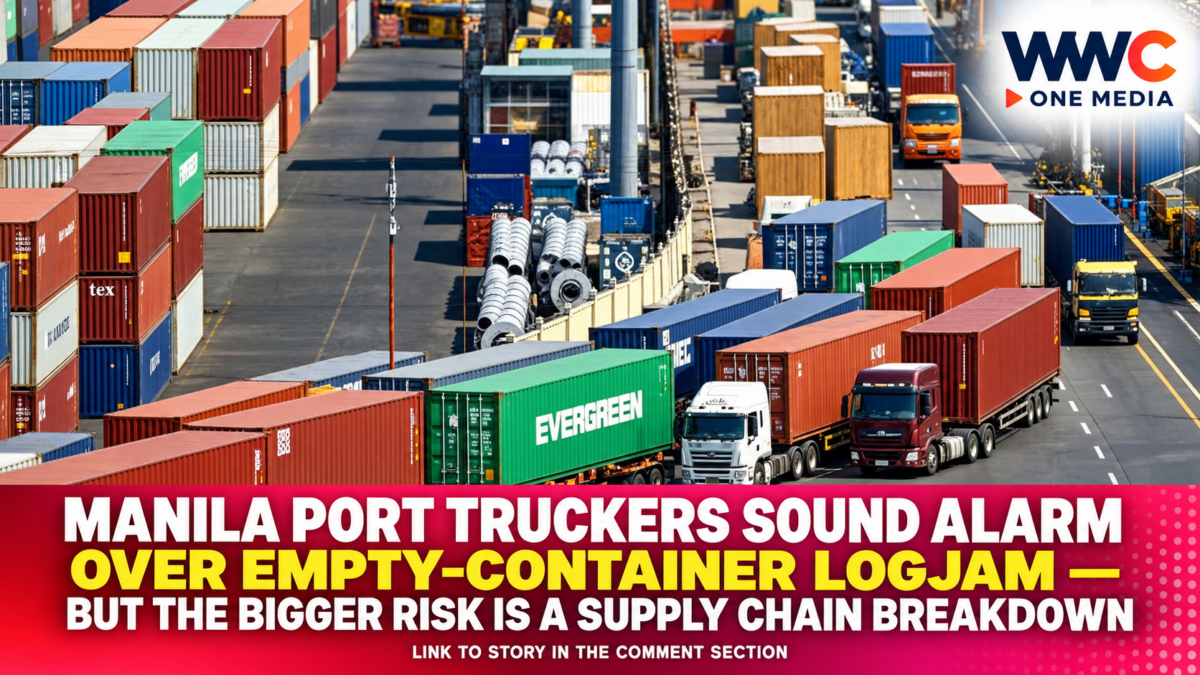
MANILA, Philippines — Manila port truckers are demanding urgent action from foreign shipping lines over a worsening pileup of empty containers, warning that trucks are being trapped for days or even weeks and that the bottleneck could soon hit imports, deliveries and businesses across the country.
The Port Truckers Customs Brokers Multipurpose Cooperative and allied logistics groups said shipping lines must provide enough depot space for empty-container returns or move excess equipment out of the Philippines altogether.
Truckers say the problem has become so severe that some vehicles cannot return to normal cargo operations because they remain stuck carrying empty containers that shipping lines are unable—or unwilling—to accept.
For an economy heavily dependent on imported raw materials, food, consumer goods and industrial supplies moving through Manila’s ports, the consequences could spread well beyond the trucking sector.
Truckers say empty containers are tying up their fleets
Industry representatives say some truckers are waiting two weeks to as long as one month just to secure a return slot for empty containers.
Reynaldo Soliman, chairperson of the Port Truckers Customs Brokers Multipurpose Cooperative and a convenor of the Customs Brokers, Port Truckers and Alliance, said around 1,000 empty containers were awaiting official return based on an estimate attributed to the Bureau of Customs.
According to InsiderPH, truckers claim the situation has contributed to an 85% to 90% slowdown in Manila port trucking operations.
The practical problem is simple.
A truck carrying an empty shipping container cannot immediately be deployed to pick up another loaded container until that box is returned.
When depots have no available slots, the truck—and the capital invested in it—effectively sits idle.
That reduces the number of trucks available to move imported cargo out of ports and exports into terminals.
Some operators say the situation is worse than during the pandemic
The Confederation of Truckers Association of the Philippines, or CTAP, has separately raised similar concerns.
CTAP President Mary Zapata said truckers often do not know when their next trip will be because shipping lines lack sufficient space to receive returned containers.
She described the current state of the industry as, in her assessment, worse than during the pandemic, citing not only empty-container congestion but also high fuel costs, shipping-line practices, truck bans, a shortage of drivers and various destination charges.
CTAP and allied organizations began a three-day trucking holiday on October 6, while customs brokers and other groups had already called for a voluntary “rest day” beginning October 5.
The actions are intended to pressure government agencies, port operators and international shipping lines to enter direct negotiations and produce concrete solutions.
This is not just a one-day protest
Industry groups say the disruption is broader than a conventional transport strike.
Organizers have asked participating customs brokers and logistics operators to withhold or suspend activities such as gate-pass processing, bookings and truck manifests.
PortCalls Asia reported that the October 5 action followed a September 23 forum at which truckers and customs brokers had already warned about worsening congestion involving empty containers.
A separate coalition involving CTAP, the Aduana Business Club, Inland Haulers and Truckers Association and Port Allied Logistics Group identified six major concerns:
- problems returning empty containers;
- destination and ancillary charges imposed by foreign shipping lines;
- a shortage of truck-trailer drivers;
- insurance requirements;
- truck bans and pass-through fees; and
- congestion and problems involving the terminal appointment system.
The empty-container issue, however, has emerged as the most immediate flash point because it directly removes trucks from productive service.
The costs can escalate quickly
Truckers say delays in returning containers are not just operational headaches.
They can also create substantial charges.
According to the industry group cited by InsiderPH, detention fees can reach roughly ₱1,000 to ₱3,000 per container per day, depending on container size, while temporary safekeeping may cost more than ₱5,000 daily.
Soliman also alleged that some parties were asking for ₱15,000 or more to obtain return slots and called on the Department of Trade and Industry to investigate.
Those allegations would require independent investigation to determine responsibility and whether any improper charging has occurred.
But the wider concern is undisputed: when trucks and containers remain idle, logistics costs rise.
Those costs can eventually be passed on to importers, manufacturers, retailers and ultimately consumers.
Government admits there is a problem
The Bureau of Customs has acknowledged that empty-container congestion and limited depot capacity are creating real operational difficulties.
In an October 5 statement, the BOC said it was aware of problems affecting truckers, customs brokers, importers and exporters and had been coordinating with industry stakeholders.
At the same time, the bureau appealed for calm and warned that disruptions to port activity could further worsen cargo movement and supply-chain conditions.
The BOC encouraged industry players to use Customs Industry Consultative and Advisory Councils and other stakeholder meetings to reach workable solutions while keeping ports operating.
That response shows the government is attempting to avoid a situation in which a protest over congestion creates even more congestion.
The empty-container problem has been building for months
The issue is not entirely new.
As early as February 2026, the Bureau of Customs had already ordered shipping lines to deal with overstaying empty containers at Philippine ports.
The BOC cited records showing that some empty containers had remained inside port facilities beyond the legally allowed 90-day dwell period.
Customs Commissioner Ariel Nepomuceno formally asked the Association of International Shipping Lines to coordinate with members and accelerate the removal or re-exportation of those containers.
The agency said removing them would free up terminal space at both Manila South Harbor and the Manila International Container Terminal.
That earlier action makes the current dispute more significant.
It suggests the October crisis is not simply the result of a sudden spike in volume but part of a persistent problem involving empty-container management.
Manila ports handle millions of containers every year
The stakes are large because Manila’s two principal international container terminals handle a massive share of the country’s trade.
Philippine Ports Authority data showed that in 2024, the Manila International Container Terminal handled about 2.95 million twenty-foot equivalent units, or TEUs, while Manila South Harbor processed around 1.29 million TEUs.
Together, the terminals handled well over 4 million TEUs in a single year.
That means even moderate disruptions to truck circulation can affect thousands of containers and businesses that depend on predictable cargo movement.
The Philippines’ geography also makes efficient ports particularly important because many goods subsequently need to be moved by road or transferred to other islands.
The real bottleneck may be outside the port gates
One important distinction is that a shortage of empty-container return slots is not necessarily the same as congestion inside the main cargo terminals themselves.
The terminals can be operating within manageable yard utilization levels while truckers are still unable to return empties to designated shipping-line depots.
That distinction matters because it affects who should solve the problem.
Truckers are placing much of the responsibility on international shipping lines, arguing that carriers must provide adequate depot capacity and alternative return sites when their preferred locations are full.
Port authorities, meanwhile, are responsible for ensuring that terminal operations remain fluid.
The Bureau of Customs has authority over importation, container admission and enforcement of dwell rules.
Local governments affect truck bans and road access.
The dispute therefore cuts across several agencies and private-sector operators—which is one reason it has been difficult to resolve.
Empty containers have long been a congestion problem
Philippine port authorities have previously acknowledged that empty containers can consume substantial yard space.
Earlier PPA materials noted that empty boxes once accounted for more than 20% of terminal yard utilization, with average dwell times nearly three times the allowed period.
The agency previously proposed monitoring reforms intended to speed up empty-container returns and reduce logistics costs.
The recurring nature of the problem suggests that Manila’s container system still lacks a consistently efficient mechanism for matching shipping-line capacity with truckers trying to return equipment.
Why businesses should pay attention now
The timing could be particularly sensitive.
The Philippines is approaching the final quarter of the year, when imports, retail inventories, manufacturing inputs and consumer deliveries typically rise ahead of the Christmas shopping season.
A prolonged reduction in truck availability could make it harder for importers to remove cargo quickly from ports.
That creates a chain reaction:
containers stay in terminals longer;
terminal space becomes tighter;
storage and detention costs increase;
trucks make fewer trips;
and importers face longer lead times.
The costs can eventually affect everything from manufacturing inputs to supermarket inventories.
Shipping lines also need a chance to respond
Truckers have leveled serious criticism against foreign shipping lines, but responsibility for congestion cannot automatically be assigned to one group without full operational data.
Shipping lines must manage vessel schedules, equipment positioning and container imbalances across multiple countries.
Global trade flows frequently create situations in which large numbers of empties accumulate in import-heavy markets while exporters elsewhere need additional equipment.
The key question is whether carriers serving Manila have provided adequate return facilities and whether current depot arrangements are sufficient for the volume of containers they are bringing into the country.
That is the issue government regulators now need to establish clearly.
The dispute is becoming an economic problem
For now, the truckers’ message is increasingly urgent.
They are asking shipping lines to accept their empty containers faster, expand depot capacity and remove surplus boxes from the Philippines.
The Bureau of Customs, meanwhile, is calling for dialogue instead of prolonged work stoppages.
Both sides have good reason to seek a fast solution.
Because every truck sitting idle with an empty container is one less truck available to move food, raw materials, factory supplies and consumer goods.
And if the backlog persists, the biggest cost may not be paid by the shipping lines or the truckers.
It may eventually be passed on to Philippine businesses—and Filipino consumers.