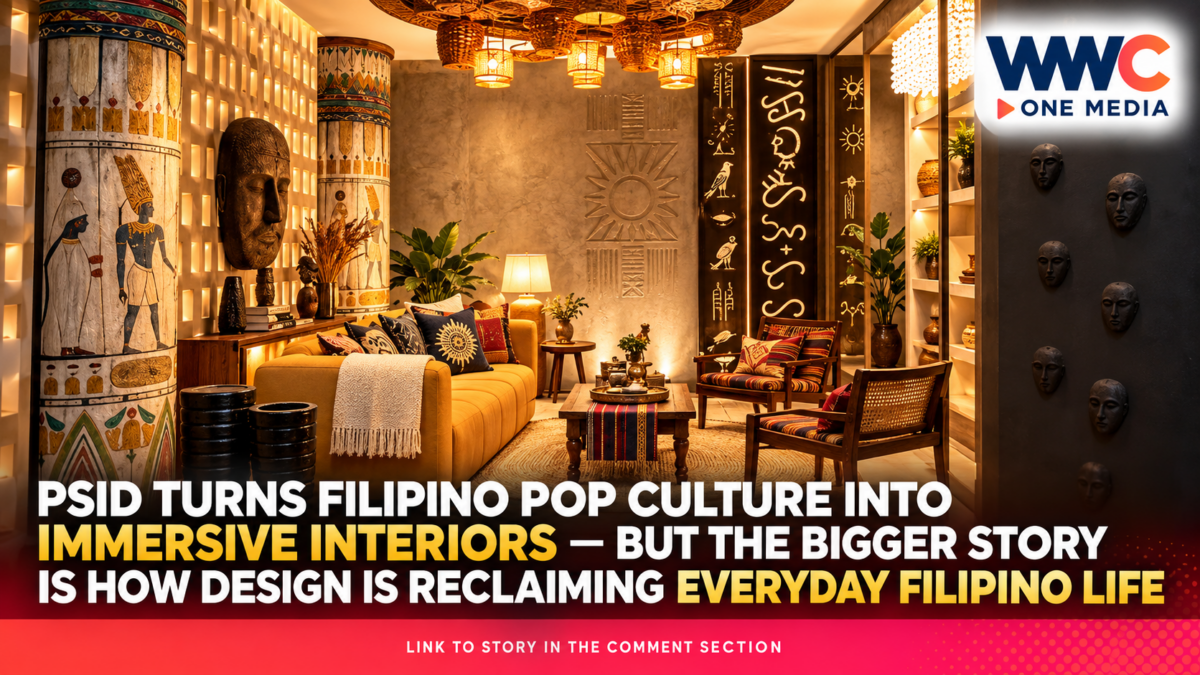
MANILA, Philippines — Sungka, cassette tapes, MRT rides, coffee culture and even the “bebot era” are being transformed into full-scale interior spaces as the Philippine School of Interior Design turns Filipino pop culture into the centerpiece of its latest graduation showcase.
The Philippine School of Interior Design, or PSID, is staging “What the Pop!”, a month-long exhibition that takes everyday Filipino memories from different generations and reimagines them as contemporary interior environments.
Running throughout October at the third floor of V-Mall in Greenhills, San Juan City, the exhibit features eight immersive installations created by PSID’s graduating batch.
But beneath the nostalgia is a much bigger idea.
The designers are showing that Filipino interior design does not always have to look to foreign trends, luxury aesthetics or imported cultural references for inspiration.
Sometimes, the most powerful design language can come from the things Filipinos grew up with.
From sungka and piko to Bauhaus design
One of the most distinctive installations is Toyang, which blends traditional Filipino childhood games with Bauhaus-inspired geometry.
The exhibit incorporates references to games such as sungka, piko, trumpo and sipa, placing familiar Filipino childhood experiences inside a contemporary design framework.
That combination may seem unusual.
Bauhaus design is known for functional forms, geometry and a strong connection between art and everyday life.
Traditional Filipino games, meanwhile, are associated with streets, schoolyards, homes and childhood memories.
Putting the two together turns nostalgia into something more than decoration.
It becomes a design concept.
A Filipino home from another era
Another installation, TeleBisyon, looks back to Filipino domestic life from roughly the 1940s through the 1960s.
The space recreates elements of a Filipino mid-century modern home using details such as capiz windows, solihiya, banig and vintage household appliances.
The concept shows how everyday materials traditionally associated with Filipino homes can still fit within contemporary interior design.
Capiz, woven surfaces and native textures have long appeared in Philippine architecture and furniture.
But instead of treating them as museum pieces, the exhibit places them inside a lived-in environment—suggesting that heritage elements can continue evolving rather than simply being preserved.
The 1970s get both music and protest
Not every installation is designed purely around warm nostalgia.
Istambay takes a darker approach to the 1970s.
The concept uses a Brutalist-inspired bar lounge built around industrial textures, weathered iron and protest-inspired artwork.
Its design evokes the social tension and resistance associated with the period, according to the exhibit description.
That makes it one of the more politically charged installations in the showcase.
Rather than presenting history only through memorabilia, the space uses interior design to communicate atmosphere—heaviness, unrest and tension.
Another 1970s-inspired installation, Tunog Kalye, takes a different route.
Instead of political history, it focuses on music.
The designers created a vintage listening environment featuring references to radios, cassette tapes, speakers and album art, drawing attention to the way music shaped Filipino identity before streaming platforms and smartphones took over.
Millennials get romance, fashion and the “bebot era”
The exhibit then moves into more recent memory.
Karisma draws from the bold visual culture associated with the Filipino “bebot era,” translating it into a colorful walk-in closet and vanity area.
The style reflects a period when pop music, fashion, glossy magazines, celebrity culture and increasingly globalized influences began reshaping young Filipino identity.
Another millennial-centered installation, Tealik, takes inspiration from 1990s Filipino romantic movies.
Its intimate bedroom uses soft colors, layered surfaces and tactile upholstery to capture the emotional atmosphere associated with Filipino love stories from that period.
The idea shows how popular entertainment can influence not only fashion or music but also how people imagine personal spaces.
Gen Z turns the MRT into entertainment
Perhaps one of the most recognizably contemporary concepts is Aliwan Ave.
The designers transform the everyday experience of riding the MRT into a gaming and entertainment sanctuary.
Linear lighting and transportation-inspired details reference the visual language of the rail system while turning commuting—a routine often associated with crowding and stress—into a stylized interior environment.
The concept reflects an important shift in how younger designers are approaching inspiration.
Instead of looking only at historic landmarks or traditional motifs, they are treating ordinary urban life as part of Filipino culture.
That means train rides, gaming, smartphones, convenience culture and city routines can become legitimate design references.
Coffee culture becomes part of Filipino domestic life
The final Gen Z-focused installation, SIMULA, imagines the home of a newly married couple.
At the center of the residential dining space is a coffee bar, reflecting the increasingly visible role coffee culture plays in the routines and social lives of younger Filipinos.
Coffee shops have become more than places to buy drinks.
For many young professionals and students, they function as workspaces, meeting points, study areas and lifestyle destinations.
Bringing that culture into a residential setting reflects how commercial and domestic spaces are increasingly influencing one another.
PSID has been pushing Filipino culture deeper into design
“What the Pop!” is not an isolated experiment for PSID.
The school has a long-running tradition of using graduation exhibits to allow students to turn cultural themes into full-scale design concepts.
Its 2025 “Designs of Christmas Exhibit”, for example, featured 12 installations interpreting Christmas through styles ranging from Brutalism and Art Deco to distinctly Filipino themes.
One exhibit, Simoy ng Pasko, used limestone, terrazzo, rattan and capiz to create a dining lanai inspired by Simbang Gabi.
PSID’s official student-design portfolio also documents previous projects involving museum concepts, residential interiors, furniture styling and other collaborative environments.
That makes “What the Pop!” part of a continuing shift in Philippine design education toward experiential storytelling rather than interiors being treated purely as decoration.
Filipino design is entering a bigger regional conversation
The exhibit is also arriving at a moment when the Philippine design sector is trying to define a stronger identity internationally.
The Design Center of the Philippines is staging the 15th edition of Design Week Philippines from October 10 to 18, 2026, bringing together designers, communities and creative industries through exhibitions, workshops and events nationwide.
The official program emphasizes collaboration, cultural identity, sustainability and the idea that design should respond to shared social challenges.
The Design Center is also involved in Manila FAME 2026, scheduled for October 15 to 17 at the World Trade Center Metro Manila, one of the country’s major platforms for furniture, home, fashion and lifestyle design.
Meanwhile, the Philippine Institute of Interior Designers has also been pushing the discussion toward a more defined Filipino design identity.
At the 2026 Manila Interior Design Summit, organizers framed the challenge in regional terms, arguing that neighboring Southeast Asian countries have become increasingly clear about how their design traditions are presented internationally while the Philippines still has room to claim a stronger position.
That makes student exhibits like “What the Pop!” more relevant than they may first appear.
Pop culture is becoming serious design material
Pop culture has traditionally been treated as temporary.
Songs disappear from the charts.
Fashion trends change.
Movies leave cinemas.
Games fall out of fashion.
Technology becomes obsolete.
But interior design can freeze those experiences long enough for people to reconsider what they meant.
A cassette tape can become a symbol of how one generation experienced music.
A capiz window can represent the Filipino home.
An MRT carriage can represent urban life.
A coffee bar can say something about how another generation socializes and works.
The significance of “What the Pop!” lies in treating all of those things as culturally worthy.
There is also a commercial lesson
That approach increasingly matters outside schools and exhibitions.
Retailers, restaurants, hotels and consumer brands now routinely use interiors as part of storytelling.
Consumers do not simply enter stores to buy products; they photograph spaces, share them on social media and associate visual environments with brands.
Recent Philippine campaigns are also increasingly combining pop culture, design and immersive experiences.
Jollibee and Stratworks, for example, recently won marketing awards for an experiential campaign built around Filipino pride and cultural memorabilia, showing how immersive environments are becoming part of mainstream brand communication.
That creates opportunities for young interior designers who can combine function with cultural storytelling.
The bigger question is what “Filipino design” should look like
For decades, defining Filipino design often meant using recognizable indigenous materials or traditional motifs.
Those elements remain important.
But “What the Pop!” proposes a broader definition.
Filipino identity can also mean playing piko outside a childhood home.
Listening to music on cassette.
Watching local romance movies.
Riding the MRT.
Playing video games.
Meeting friends over coffee.
Those experiences may not appear in traditional heritage textbooks, but collectively they form part of how generations of Filipinos understand themselves.
That is why the exhibit’s biggest contribution may not be any single room.
It is the idea that ordinary Filipino life itself can become a legitimate source of serious design.
And as Philippine designers search for a clearer identity in an increasingly competitive regional creative economy, the most distinctive inspiration may already be surrounding them.
The challenge is not finding something Filipino enough to design around—it is learning to recognize the culture hidden in everyday life.