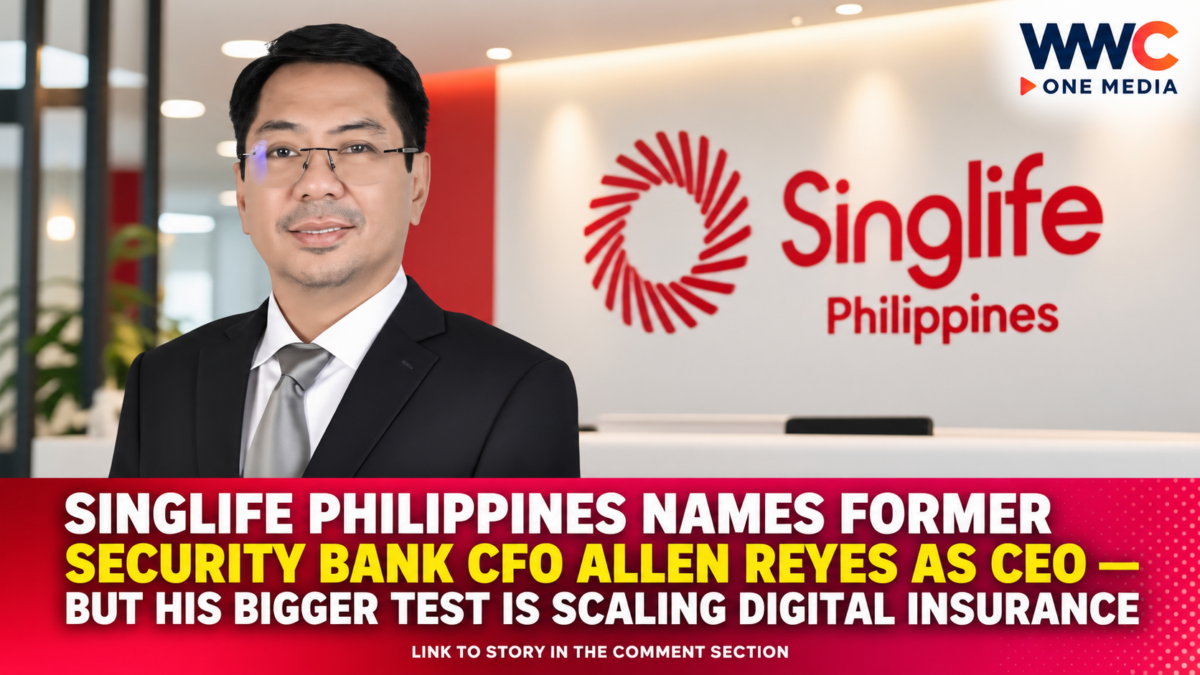
MANILA, Philippines — Singlife Philippines has named former Security Bank chief financial officer Allen Reyes as its new chief executive officer, handing the veteran finance executive the task of accelerating the digital insurer’s next phase of growth as competition for Filipino insurance customers intensifies.
Reyes succeeds Lester Cruz, who is leaving the company after roughly two years at the helm.
Singlife thanked Cruz for his leadership and contributions but did not disclose the reason for his departure or details of his next move.
The leadership change comes at a significant moment for Singlife Philippines.
The insurer grew both new business and its customer base by 23% in 2025, while policy purchases through its own mobile app nearly tripled from the previous year.
That gives Reyes something valuable to inherit: momentum.
But it also gives him a difficult assignment.
Can Singlife turn rapid digital adoption into a larger, profitable and durable insurance business in a country where protection remains relatively shallow compared with the size of the economy?
From Security Bank CFO to digital-insurance CEO
Reyes brings nearly three decades of experience across banking, insurance and global shared-services operations.
Before joining Singlife Philippines, he served as chief financial officer of Security Bank Corp.
He also held senior finance roles at multinational companies including Diageo, Sony Global Services and Deutsche Bank.
According to Singlife, Reyes will lead the company as it expands further into digital insurance and strategic partnerships.
His official company profile says his mandate includes scaling the business and strengthening Singlife’s position in the Philippine digital-insurance market.
Reyes is a graduate of the University of Santo Tomas and completed the Leading Sustainable Corporations Programme at the University of Oxford.
The appointment comes after a strong 2025
Singlife enters the leadership transition from a stronger operating position than it had several years ago.
The company reported that its total new business grew 23% in 2025, while its customer base also increased by 23%.
More importantly for a digital-first insurer, policies purchased through its app rose by nearly three times year on year.
Singlife’s own website now says it is trusted by more than one million Filipinos, reflecting the scale it has built through direct digital distribution and partnerships.
Its digital strategy revolves around allowing customers to purchase and manage protection without traditional branch visits or paper-heavy application processes.
Products available through the Singlife ecosystem include life, accident, income-loss, funeral-cost and critical-illness protection, as well as investment-linked offerings.
The Philippine insurance market itself is growing
Reyes is taking control as the wider Philippine insurance industry expands.
Insurance Commission data showed total premiums across life, non-life and mutual benefit associations reached ₱502.64 billion in 2025, up 14.1% from ₱440.53 billion a year earlier.
The life sector accounted for more than 80% of total premiums.
The same data showed the industry paid out roughly ₱121.88 billion in life insurance benefits and ₱34.05 billion in non-life claims during 2025.
That suggests Filipinos are spending more on protection and insurers are handling a larger volume of financial obligations.
But the industry’s economic footprint is still relatively modest.
Insurance penetration remained below 2% of GDP during much of 2025.
The Insurance Commission reported penetration of 1.85% as of the third quarter of 2025, up from 1.74% a year earlier.
Importantly, this figure measures insurance premiums relative to gross domestic product.
It should not be interpreted as the percentage of Filipinos who have insurance.
That distinction is crucial because some industry promotional material has previously described low penetration as if it directly represented the share of insured individuals.
Digital distribution is becoming Singlife’s biggest weapon
Singlife’s competitive advantage is not a nationwide branch network.
It is distribution through platforms Filipinos already use.
The company has spent years integrating insurance products into major financial apps, effectively bringing protection into the same digital environments where consumers send money, pay bills and manage savings.
One of its earliest large-scale partnerships was with GCash.
Singlife says one of its initial GCash products insured more than 10,000 people in less than two months after launch.
That partnership has continued to expand.
In September 2026, Singlife launched additional life and disability coverage through GCash, with premiums starting at around ₱65 per month.
BusinessMirror reported that the expanded partnership potentially places Singlife products in front of GCash’s roughly 90-million-user ecosystem.
That kind of reach is difficult for a traditional insurance agency network to replicate quickly.
Maya gives Singlife another major digital channel
GCash is not Singlife’s only distribution partner.
The company also partnered with Maya to offer life insurance and investment products through the Maya Insurance marketplace.
Singlife was positioned as Maya’s first digital insurance provider when the collaboration launched.
It has also worked with Asia United Bank’s HelloMoney and Hello Pag-IBIG platforms to broaden access to insurance products through additional digital channels.
Together, those partnerships point to Singlife’s central strategy:
meet customers where they already manage money instead of waiting for them to seek out an insurance company.
That reduces friction in a product category that many consumers historically considered complicated or inconvenient.
Singlife itself has changed ownership
Reyes is also taking over after an important corporate restructuring.
Singlife Philippines is now fully owned by Singapore Life Holdings Pte. Ltd., a move the company says strengthens group alignment and helps accelerate its digital-first strategy.
At the global level, Singapore Life Holdings itself became a wholly owned subsidiary of Japan’s Sumitomo Life Insurance Company in March 2024.
Sumitomo Life is one of Japan’s major insurers and has substantial assets and experience across Asian financial markets.
That means Singlife Philippines now sits within a much larger regional insurance group—giving it greater potential access to capital, technology and insurance expertise.
Singlife has already received fresh capital
The Philippine business has also received direct investment from its parent.
In 2024, Singlife Philippines secured ₱600 million in funding from Singapore Life Holdings to support growth, innovation and further digital development.
That funding came as the parent group was increasing its commitment to the Philippine insurance market.
For Reyes, the challenge will be determining how aggressively to deploy that backing.
Digital insurers can acquire customers quickly, but sustainable growth requires more than app downloads.
Policies must be renewed.
Premiums must grow.
Claims must be managed efficiently.
Customers must trust the company enough to purchase larger and longer-term protection products.
Singlife earned nearly ₱497 million in premium income in 2025
Insurance Commission figures cited by BusinessMirror show Singlife Philippines recorded around ₱496.8 million in premium income in 2025, up slightly from ₱491.8 million the previous year.
The company had approximately ₱2.17 billion in total assets and ₱1.55 billion in invested assets.
Those numbers show Singlife has developed meaningful scale—but remains much smaller than the Philippines’ long-established life-insurance giants.
That makes digital distribution critical.
Instead of competing head-to-head by building thousands of agents or branches, Singlife is attempting to scale through apps and embedded insurance partnerships.
The next battle is moving beyond low-cost policies
Digital insurance often begins with inexpensive products.
Low premiums help introduce consumers to insurance without demanding a major financial commitment.
Singlife’s GCash offerings, for example, include policies with premiums starting at only tens of pesos per month.
That strategy is useful for customer acquisition.
But the bigger commercial opportunity lies in moving customers toward broader and more valuable protection over time.
A consumer who first purchases low-cost accident insurance could eventually require income protection, critical illness insurance, life insurance or investment-linked products.
The question for Reyes will be whether Singlife can successfully make that transition.
A company can issue millions of small digital policies while still struggling to build deeper relationships with customers.
Trust remains the biggest hurdle
Technology solves one problem in insurance: accessibility.
It does not automatically solve trust.
Insurance products involve long-term promises.
Consumers are paying money today for benefits that may only be needed years later—or after a serious illness, accident or death.
That means customers need confidence that:
the insurer will still be financially strong;
claims will be paid fairly;
policy terms are understandable;
personal information is secure;
and customer service will be available when needed.
Singlife itself has emphasized that digital insurance should not become impersonal.
Its previous leadership argued that technology needs to be combined with a human element to build lasting customer trust.
That challenge does not disappear under a new CEO.
Reyes brings financial discipline at a crucial time
This may be where Reyes’ CFO background becomes particularly important.
Digital financial companies frequently focus heavily on growth metrics such as customer acquisition, app usage and transaction volume.
But insurers face an additional set of responsibilities.
They must manage capital.
They must invest premiums prudently.
They must price risk correctly.
They must remain solvent enough to meet future policyholder obligations.
And they must balance growth against profitability.
A former bank CFO therefore arrives with experience that could become increasingly valuable as Singlife matures from a fast-growing digital challenger into a larger financial institution.
The real test begins after the leadership change
Allen Reyes is inheriting a company with several things working in its favor.
Singlife Philippines has a growing customer base.
App-based policy purchases are increasing rapidly.
Its parent company has strengthened ownership and financial support.
It already has relationships with some of the Philippines’ largest digital-finance platforms.
And the country’s overall insurance market continues to expand.
But none of those factors guarantees long-term leadership.
Traditional insurers are also investing heavily in digital distribution.
Banks continue expanding bancassurance.
E-wallets increasingly host multiple insurance providers.
And Filipino customers can compare protection products more easily than ever.
That makes Singlife’s next phase more difficult than simply putting insurance inside another app.
Under Allen Reyes, the bigger challenge will be proving that a digital insurer can turn millions of convenient transactions into long-term financial protection—and turn rapid customer growth into a sustainable insurance business.