MANILA, Philippines — Global Dominion Financing Inc. and the Bayan Family of Foundations are joining forces to bring financial and business education closer to Filipino entrepreneurs, betting that access to money alone will not be enough to help the country’s millions of micro, small and medium enterprises survive and grow.
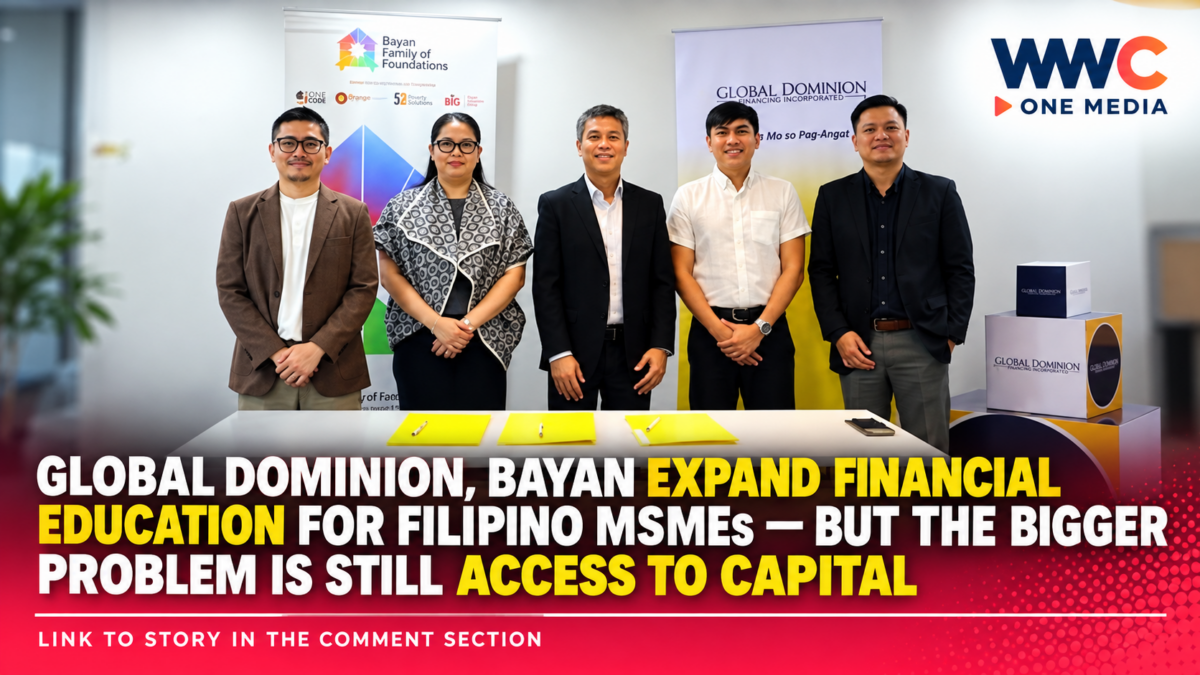
The two organizations signed a partnership on September 22, 2026, aimed at strengthening Global Dominion’s Ka-partner Academy, an education platform serving borrowers, business partners and the wider MSME community.
Under the agreement, the Bayan Family of Foundations, or BFF, will contribute its experience in entrepreneurship training, curriculum development and community capacity-building, while Global Dominion will use its financing network and borrower base to broaden the program’s reach.
The partnership will also expand the academy’s use of social-media content and other formats designed to make financial education easier to access for entrepreneurs who may not be reached by traditional classroom programs.
But behind the initiative is a much larger Philippine economic problem.
Filipino MSMEs dominate business — but not bank lending
Micro, small and medium enterprises account for more than 99% of Philippine business establishments and employ more than 60% of the workforce, according to the Bangko Sentral ng Pilipinas.
That makes them one of the most important engines of employment, local commerce and household income in the country.
Yet their access to formal financing remains disproportionately small.
BSP data reported by BusinessWorld showed Philippine bank lending to MSMEs reached ₱574.8 billion at the end of 2025, up 5.2% from a year earlier.
Despite that increase, MSME loans represented only 4.73% of the banking industry’s ₱12.14-trillion loan portfolio, after applicable exclusions.
More recent BSP figures cited at a September 2026 financing forum put MSME lending at more than ₱580 billion, or roughly 6% of total business lending.
That remains a striking mismatch for a sector representing virtually the entire Philippine business population.
The problem therefore is not simply teaching entrepreneurs how to manage money.
It is making sure viable small businesses can actually obtain financing on terms they can use.
Financial education is becoming part of the lending strategy
Global Dominion President and CEO Samuel Cariño said the partnership reflects the idea that a financial institution should do more than release loans.
“We finance businesses, while BFF builds entrepreneurs. The Ka-partner Academy is where our missions converge,” Cariño said in announcing the program.
Cariño took over as Global Dominion president and CEO effective June 1, 2026, succeeding Patricia Poco-Palacios, who moved into a broader leadership role within the Asialink Group.
For lenders, stronger financial education can serve more than a social purpose.
Entrepreneurs who understand cash flow, debt obligations, pricing, budgeting and business risks may be better positioned to use borrowed capital productively and avoid repayment problems.
That is particularly relevant in the Philippine MSME market, where many owners operate with limited formal financial training and often rely heavily on personal savings.
A 2024 survey cited by BSP officials found that 88% of MSMEs wanted to expand, yet many remained dependent on their own funds or hesitant to borrow.
Bayan brings entrepreneurship training into the partnership
The Bayan Family of Foundations operates through several organizations with different development roles.
Bayan Academy focuses on education, training and curriculum development; Bayan Innovation Group handles research and strategic planning; Bayan SEARCH focuses on community development; while Bayan EDGE works on impact investing and resource mobilization.
BFF President and CEO Carlo Sagun said financial education needs to be delivered through multiple formats rather than through a single traditional approach.
The goal, he said, is not merely to distribute information but to help create meaningful changes in businesses and in entrepreneurs’ lives.
That philosophy is increasingly aligned with government policy.
The BSP itself conducts an annual Economic and Financial Learning Program for MSMEs, with its 2026 sessions focusing on smarter financial decisions, digital financial tools, business resilience and protection against emerging risks.
Financial literacy in the Philippines is improving — but gaps remain
The broader financial-literacy picture has shown progress.
The BSP’s 2025 Consumer Finance and Inclusion Survey found that 74% of Filipinos correctly answered at least half of its financial-literacy questions, up from 69% in 2021.
Formal borrowing also gained ground over informal lending.
About 16% of Filipino adults borrowed from formal providers in 2025 compared with 10% who used informal lenders, reversing the pattern recorded in 2021.
That is encouraging for regulated financing companies.
However, only 50% of adults individually owned a formal financial account in 2025, showing that significant portions of the population remain only partially connected to the formal financial system.
That combination — growing financial literacy but uneven access — explains why lenders are increasingly pairing education with financing.
Global Dominion is pushing deeper into MSME lending
The Bayan partnership is only one part of Global Dominion’s broader MSME strategy.
Earlier this year, the company said it was looking to offer larger and longer-term financing products while increasing its focus on borrowers underserved by traditional banks.
Global Dominion and other members of the Asialink Group also raised ₱4 billion through social corporate notes arranged by Security Bank Capital and guaranteed by the Credit Guarantee and Investment Facility.
The proceeds were designated to expand MSME lending portfolios.
Global Dominion has also partnered with Go Negosyo on mentorship and income-generation programs for Filipino entrepreneurs, indicating that the Bayan agreement forms part of a wider strategy to combine lending with business development.
The company said this year that artificial intelligence-assisted systems had already helped its teams disburse more than ₱200 million in loans faster, while retaining human involvement in credit decisions.
It reported ₱4.4 billion in total revenue and ₱874.7 million in net income for 2025, according to a company-authored article published by Philstar.
Its branch network has also expanded rapidly
Global Dominion has significantly increased its nationwide physical footprint.
Company disclosures earlier in 2026 said its network had reached 196 branches, up from more than 140, with expansion into areas including Cavite, Davao Oriental and Isabela.
The latest InsiderPH report describes the company as operating more than 170 branches and employing nearly 2,000 people.
The different figures appear to reflect different company reporting periods or definitions of active locations, so the safest conclusion is that Global Dominion now operates a large national branch network extending across Luzon, Visayas and Mindanao.
Its products include real-estate financing, vehicle financing, doctors’ loans and secured business financing.
But education cannot solve the financing gap by itself
This is where the partnership faces its biggest test.
Business training can improve budgeting, planning, borrowing decisions and financial discipline.
It cannot by itself solve high borrowing costs, insufficient collateral, weak credit histories or lending requirements that prevent many small businesses from obtaining capital.
That distinction matters.
An entrepreneur may understand exactly how much financing is needed to expand a store, add equipment or hire workers and still be unable to qualify for an affordable loan.
That is why BSP officials have increasingly argued that the question is not simply whether financing exists, but whether the financing available actually works for MSMEs.
The real opportunity: combining knowledge with capital
The Global Dominion-Bayan partnership reflects an important evolution in Philippine financial inclusion.
For years, the discussion centered heavily on getting more money into the hands of small entrepreneurs.
Now the focus is broadening toward what happens after the loan is released.
Does the entrepreneur understand cash flow?
Can the business distinguish revenue from profit?
Is borrowed money being used for productive expansion rather than plugging recurring losses?
Can the owner manage debt if demand suddenly falls?
Those questions ultimately determine whether financing creates sustainable growth or merely temporary liquidity.
That makes Ka-partner Academy potentially valuable.
But the program’s true impact will not be measured by the number of social-media posts, seminars or entrepreneurs who view its educational material.
It will be measured by whether businesses that receive both knowledge and financing become stronger, more resilient and more capable of expanding.
Because for Philippine MSMEs, financial literacy may help entrepreneurs make smarter decisions — but without affordable and accessible capital, knowledge alone cannot finance the next store, machine, employee or expansion.